vision boards
Vision Board vs Mood Board: Add Future-Self Audio
Vision board vs mood board, explained softly: what each one is for, when to use it, and why future-self audio makes the image practice stick.
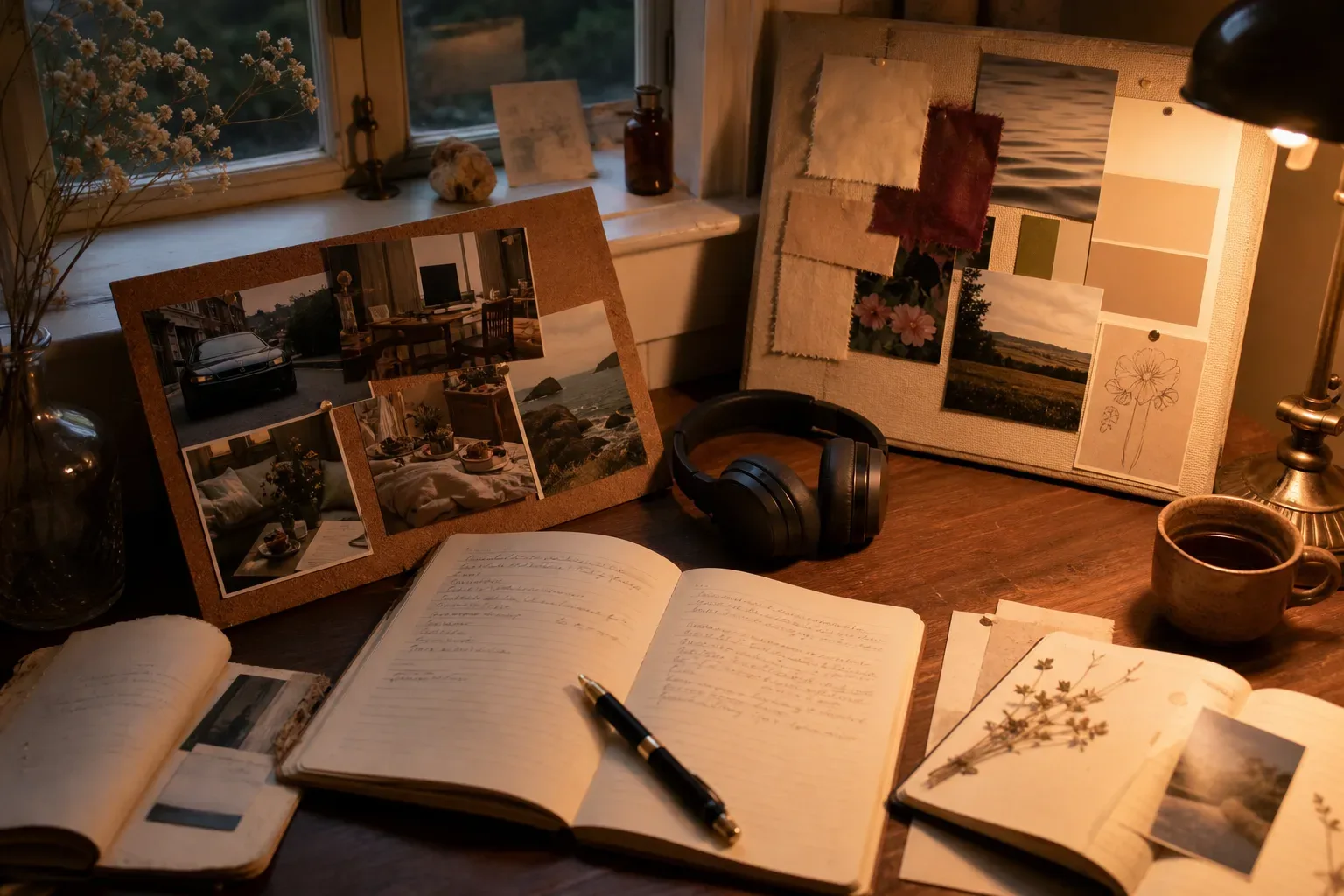
A corkboard leans against the wall. A few images are pinned crooked. The difference is simple: a vision board shows what you intend to make real, while a mood board shows the feeling and visual world around it. Future-self audio gives both a daily voice, so the practice doesn’t stay flat.
What is a vision board, and what is a mood board?
A vision board names a desired future, while a mood board studies the feeling, style, and atmosphere around an idea.
A vision board is usually concrete. You might place a photo of a writing desk, a passport, a calmer kitchen, a studio, a healthy morning, or a sentence that names a new way of living. It points forward. It says, quietly: this is where I’m practicing my attention. In goal-setting research, specificity matters. Edwin Locke and Gary Latham’s goal-setting theory, built across more than 400 studies, found that specific and challenging goals tend to improve performance more than vague aims.
A mood board is softer. It may not know the destination yet. It collects texture. Linen, low light, a blue room, a handwritten note, a certain kind of silence. Designers use mood boards to create visual direction before a product, room, or brand is finished. A 2017 design education paper in The Design Journal described mood boards as tools for shared reference and early decision-making, not final proof.
Here is the cleanest comparison:
| Practice | Core question | Best for | Output |
|---|---|---|---|
| Vision board | What am I intending to make real? | Clear desires and life direction | Images, words, symbols of a future self |
| Mood board | What does it feel like? | Early clarity, taste, tone, identity | Colors, textures, references, atmosphere |
| Future-self audio | Who am I rehearsing being? | Daily repetition and felt identity | A short recording you listen to each day |
A vision board says, “there.” A mood board says, “like this.” Audio says, “already.”
The distinction helps because many people ask the wrong tool to do the whole job. A mood board can’t force a decision before you’re ready. A vision board can feel brittle if the images don’t feel true. In a 2023 Pew Research Center report, 62% of U.S. adults said they try to make at least some major life decisions based on personal values. That sounds simple. It isn’t. A board can help, but only if it knows its role.
Which one helps more with manifestation?
A vision board helps more when your desire is clear, and a mood board helps more when you’re still listening for what feels true.
If you’re practicing manifestation, the board is not magic paper. It is a repeated cue. It trains attention. It gives the mind one small place to return. Research on mental imagery has been careful here: imagining outcomes alone can soothe you, but it doesn’t always move behavior. Gabriele Oettingen’s work on mental contrasting, tested across decades, suggests that pairing a desired future with present obstacles is more effective than fantasy alone.
So the question is not, “Which board is stronger?” The better question is, “Which board tells the truth about where I am?” If you can name the life you want, make a vision board. If you can only sense the quality of it, make a mood board first. A quiet image can be honest before a full sentence is ready.
A board works best when it leads to action, even a small one. Peter Gollwitzer’s research on implementation intentions, often summarized as “if-then” planning, found that specific cues increase follow-through across many studies. If I see the board at 8:30 p.m., then I write for 10 minutes. If I hear the audio after brushing my teeth, then I choose tomorrow’s first task.
There is a gentle trap here. Some boards become decoration for a self you never meet. Beautiful, but distant. The more useful board is sometimes plain. Three images. Two words. One daily cue. The image is not the practice. The return is the practice.
For most people, the strongest answer is not vision board vs mood board. It is vision board plus mood board when needed, then audio every day. The visible and the heard belong together.
Why does future-self audio change the practice?
Future-self audio changes the practice because it gives your desired identity a daily voice, not just a visual reference.
The AYA Method is a daily audio manifestation practice. Each day you listen to a short personalized recording — your Dream-Self Moment — narrated from the version of you who has already manifested the life you intend. Listening is the practice. Repetition is the work. The audio is the method.
That matters because the mind does not respond only to images. It responds to language, timing, repetition, memory, and tone. Dr. Andrew Huberman has often described behavior change as a matter of repeated neural firing and state-dependent practice, not a single insight. In a more formal behavioral frame, Lally and colleagues found in a 2009 European Journal of Social Psychology study that habit formation took a median of 66 days, with wide variation from 18 to 254 days.
A board can become invisible after a week. You stop seeing it. The eyes adapt. Audio interrupts that drift because it enters through time. You press play. You listen for 2 or 3 minutes. You hear yourself described as someone who already moves differently. Not as a wish. As a rehearsal.
This is where the future-self frame matters. Neville Goddard wrote often about living “in the end,” meaning the inner assumption of the wish fulfilled. Joe Dispenza speaks in a different language about rehearsing a new self until the body learns the signal. You don’t have to accept every claim to see the practical center: repeated inner rehearsal changes what you notice, choose, and tolerate.
The board is the altar. The audio is the appointment.
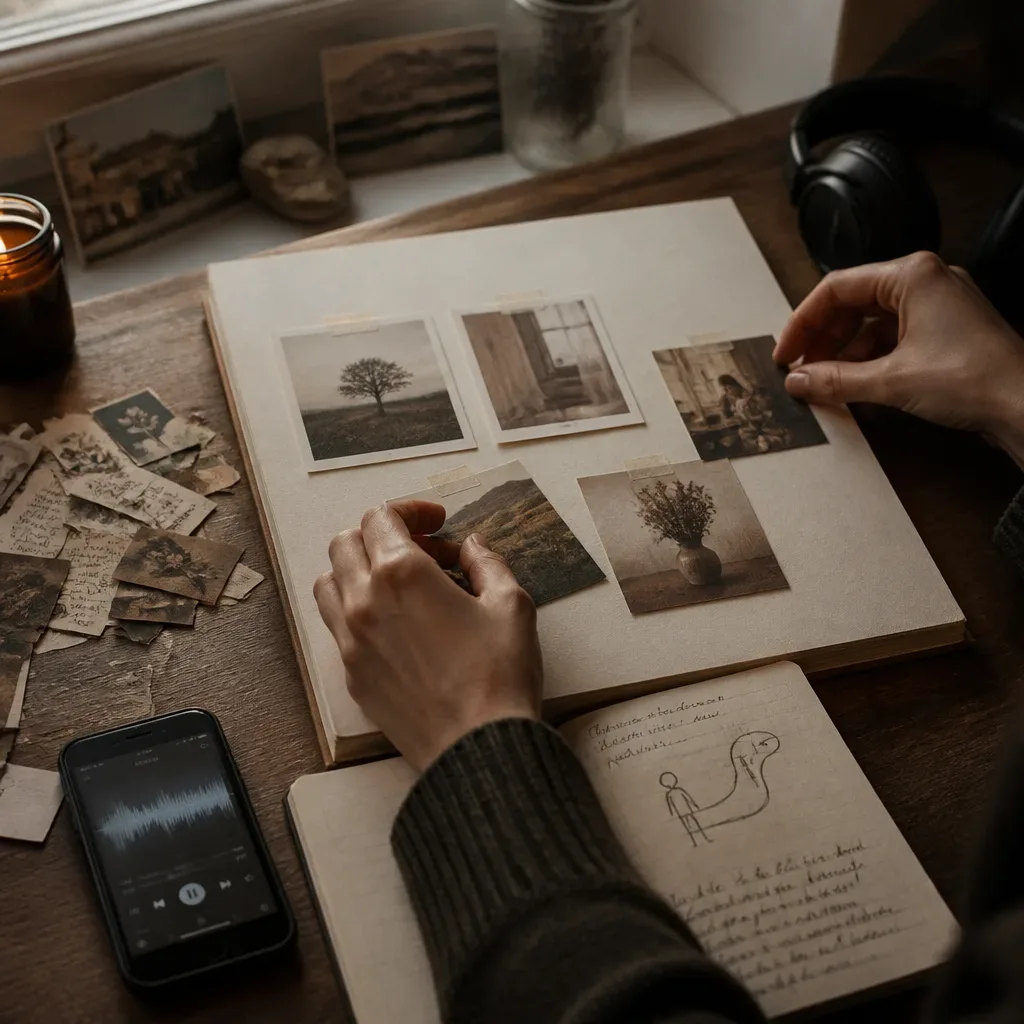
How should you build the board without making it clutter?
Build the board with fewer pieces than you want, then attach each piece to one lived behavior.
Start small because attention is finite. Miller’s famous 1956 paper proposed that working memory holds about 7 items, plus or minus 2, though later research often places the number closer to 4. Either way, a board with 48 images asks too much from a tired mind. You don’t need more symbols. You need symbols you can remember.
Use this simple order:
- Name the season. Choose a time frame, such as 30, 60, or 90 days.
- Choose one life area. Home, body, work, love, money, art, or spiritual practice.
- Collect 15 images. Don’t judge yet. Save what keeps calling you back.
- Cut to 5 images. Keep only the ones that feel true after 24 hours.
- Add 3 phrases. Use plain language. No performance. No borrowed glamour.
- Attach 1 daily cue. Decide when you’ll look, listen, or act.
- Review after 14 days. Remove what feels performative. Keep what still feels alive.
The 14-day review matters. In product design, a first version is rarely sacred. You test what people actually use. Rituals deserve the same honesty. If the board makes you feel behind, revise it. If the mood board keeps giving you a calm yes, let it speak longer.
You can also separate the boards. Put the mood board in a private place, where it can be unfinished. Put the vision board where it can function as a cue. A 2021 review in Behavioral Sciences noted that environmental cues play a meaningful role in habit loops. The shelf, phone lock screen, mirror, or notebook cover can all become the place where the future self is remembered.
Clarity is not the same as pressure. A true board feels like recognition, not a test.
What belongs on a future-self board?
A future-self board should include evidence of how you live, not only images of what you own.
This is where many boards go thin. They show objects, but not identity. A car, a room, a city, a body. Those may be true. But without the daily life around them, they can become symbols without roots. A stronger board includes scenes of behavior: the notebook open, the shoes by the door, the glass of water, the calm bank account review, the message sent with honesty.
Try adding these layers:
- Place: where your future self wakes, works, rests, or creates.
- Time: the hour of day that carries the new rhythm.
- Body: posture, breath, clothing, movement, sleep.
- Words: one sentence your future self would say without strain.
- Proof: a small sign that the change is real in ordinary life.
- Support: the person, practice, or room that helps you return.
This pairs well with affirmations, if you keep them grounded. An affirmation is not there to shout over doubt. It is there to give the mind a clean sentence to repeat. Studies on self-affirmation, including work by Claude Steele and later health-behavior research, suggest that value-based reflection can reduce defensiveness and support follow-through in some contexts.
But in Aya, the daily affirmation is a complement. The listening practice comes first. If you use an affirmation with your board, let it come from the audio, not from a phrase that sounds impressive online. One true sentence is better than 20 polished ones.
A good future-self board does not flatter you. It recognizes you early.
Where do timing, astrology, and daily cues fit?
Timing helps when it gives the practice a repeatable container, not when it becomes another reason to wait.
Some people like to make boards at the new moon, on a birthday, after a move, or at the start of a month. That can be useful. A date becomes a threshold. Research on the “fresh start effect” by Hengchen Dai, Katherine Milkman, and Jason Riis found that temporal landmarks, such as Mondays, birthdays, and new years, can increase goal-related behavior because they create a mental separation from the past self.
If you work with astrology and manifestation, keep it simple. Use timing as a soft frame. A new moon can be a night to choose images. A full moon can be a night to remove what no longer feels true. A Mercury retrograde period can be a review, not a panic. The sky can be a calendar. It does not have to become a command.
Daily cues are less romantic, but they are often more reliable. BJ Fogg’s behavior design work at Stanford emphasizes tiny behaviors attached to existing routines. After coffee, press play. After closing the laptop, look at the board. After washing your face, choose one action for tomorrow. The cue should be so ordinary that you don’t need a new personality to keep it.
You can also use the AYA Method with your board in a very plain way: look at one image, listen to your Dream-Self Moment, then write one sentence about the action that belongs to today. That can take under 5 minutes. The board stays visible. The audio stays central. The day gets one next step.
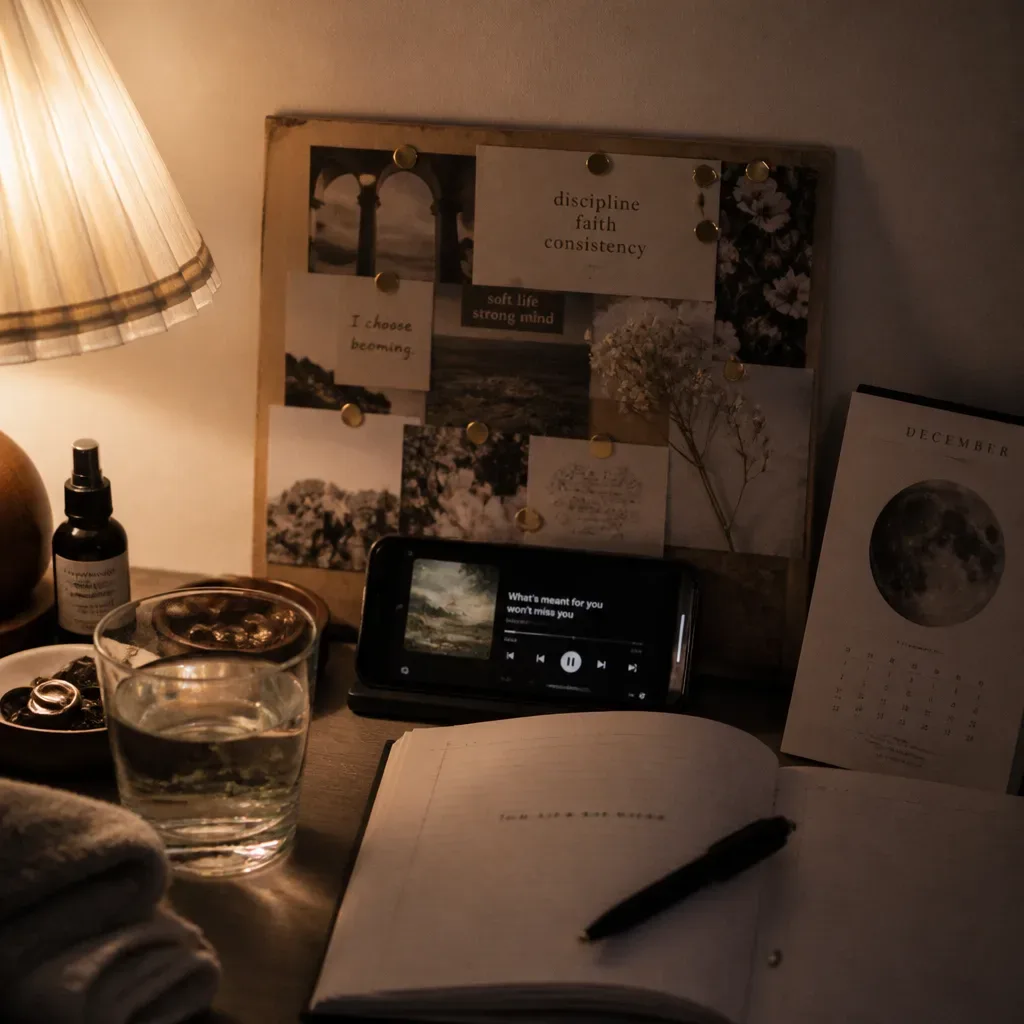
Which should you choose this week?
Choose a mood board if you’re sensing, choose a vision board if you’re naming, and choose future-self audio if you want the practice to meet you daily.
Here is a quiet decision guide:
| If this is true | Choose | Why |
|---|---|---|
| You don’t know what you want yet | Mood board | It lets desire arrive through texture and pattern |
| You know the life area, but not the details | Mood board for 7 days, then vision board | It gives the mind time to sort the signal |
| You can name the outcome clearly | Vision board | It turns intention into a visible cue |
| You keep forgetting the board exists | Future-self audio | It gives the practice a daily return |
| You feel pressured by perfect images | Smaller board | It protects honesty |
For a simple week, do this:
- On day 1, gather images for 20 minutes.
- On day 2, remove half.
- On day 3, choose the 5 that still feel true.
- On day 4, write one future-self sentence.
- On days 5 to 7, listen daily and take one small action.
That is enough structure. The American Psychological Association has reported for years that stress affects follow-through, sleep, and decision-making. A practice that requires an hour will often lose to a hard day. A practice that takes 3 minutes has a better chance of staying yours.
If you want more context before making your board, read the broader manifestation guide. If your board leans heavily on language, keep the affirmations guide close. If timing matters to you, use astrology and manifestation as a soft reference, not a rulebook. And when you’re ready to make the image speak, return to the AYA Method.
The board waits quietly until you come back.