the place
The table — on the small physical place where the diary practice actually happens
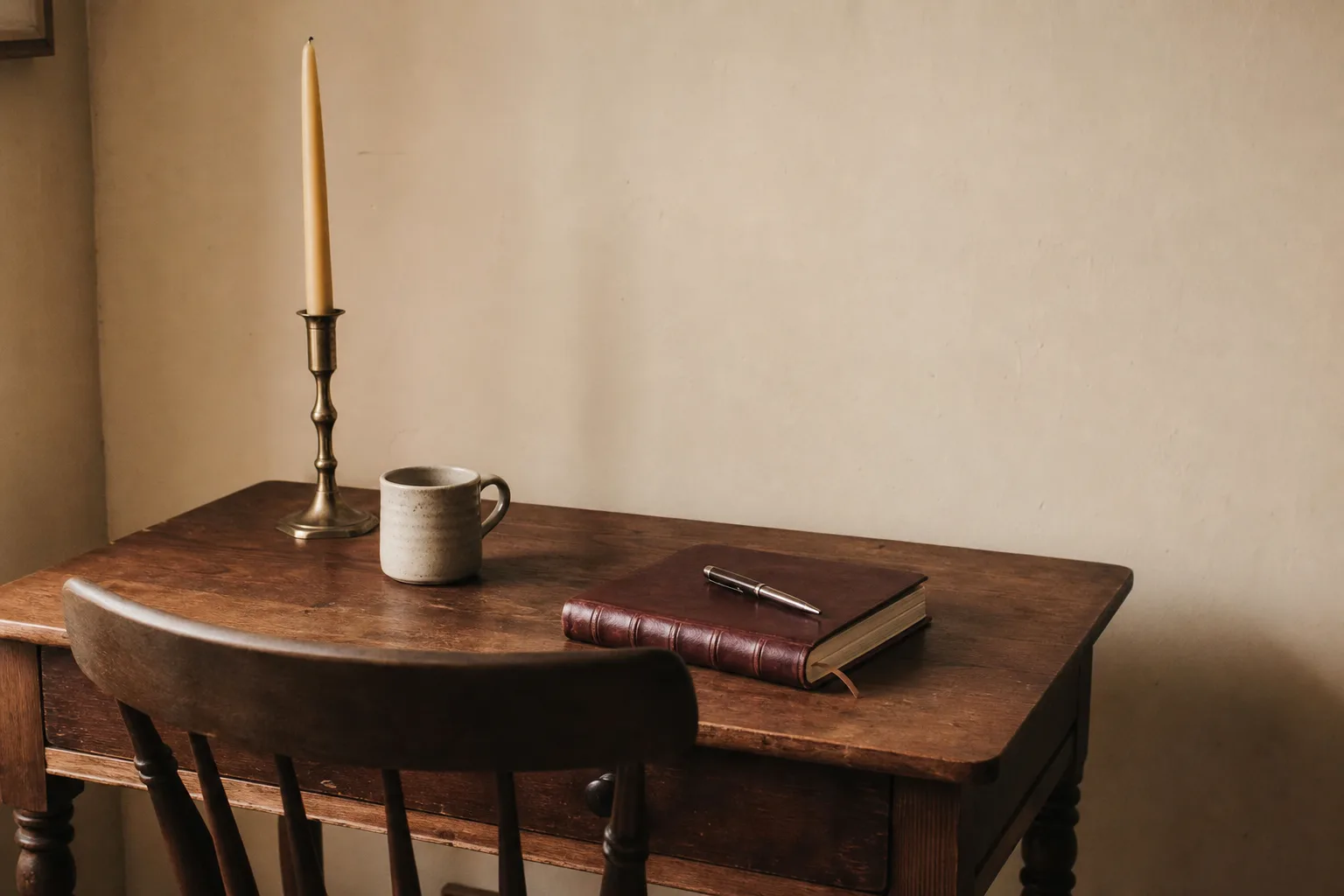
My table is wood, slightly too small for a laptop, with a window to the left and a candle to the right. The notebook lives on it. The pen lives on it. I sit at it every morning before anything else. The practice is what I do here. The reason it works is because it has a here.
Why the place matters
Most manifestation advice ignores the physical world. It says “set an intention” or “visualize the outcome” without ever mentioning the chair, the room, the time of day. This is a small dishonesty that grows. The practices that survive are the ones that have a place.
The mechanism is unromantic: the human nervous system is a context-learning machine. Repeat a behavior in a specific place, and the place starts to do half the work. Sit down, and the body settles. Open the notebook, and the mind quiets. None of this is mystical. It’s classical conditioning. Pavlov’s dog learned to salivate at the bell because the bell predicted food. Your body learns to settle at the table because the table predicts the practice.
What makes a good table
Three things matter, and they are unfussy:
- It is the same one every day. Same surface, same chair, same orientation. Don’t rotate.
- It has natural light, ideally from one side. Mornings are easier when the light tells the time.
- The journal lives on it. Not in a drawer. Not in a bag. On it. The friction of retrieval is what makes most people quit.
Things that don’t matter: how nice the table is. How big the room is. Whether you have a dedicated space or one corner of a shared kitchen. We have written from rented kitchens, sublet apartments, hotel desks, and the back room of a friend’s bookshop. The practice traveled. The table did not.
My table, as a specific example
Mine is a wooden side table, slightly too small for a laptop, in front of a window that gets morning light. On it: a leather notebook, a fountain pen, a candle in a small brass holder, a ceramic cup, a sprig of dried lavender that should probably be replaced. Behind me: a chair I bought at a market in Lisbon for thirty euros. To my left: the window. To my right: the candle.
This is not a beautiful setup. It is mine. It is the same every day, which is what makes it work.
The quiet trick
Set the table the night before. Not metaphorically — literally. Open the journal to a fresh page. Place the pen on it. Pour the water into the cup. Light the candle in the morning, but lay the matchbook ready. The five minutes of preparation the night before saves the morning from the friction that kills most practices.
This is the difference between people who keep the practice and people who don’t. The keepers prepare the next morning’s table tonight.
And then the audio
The morning pages happen at the table. More on those. Then, still at the table, the Dream-Self Moment from the AYA Method. The pages clear the static. The audio gives you a voice to listen to once the static is gone. The order matters: write before you listen.
The table holds both. That’s its job.