vision boards
Vision Board Ideas for 9 Life Areas
Vision board ideas for love, money, health, work, and more, with future-self audio as the daily practice that keeps the images close.
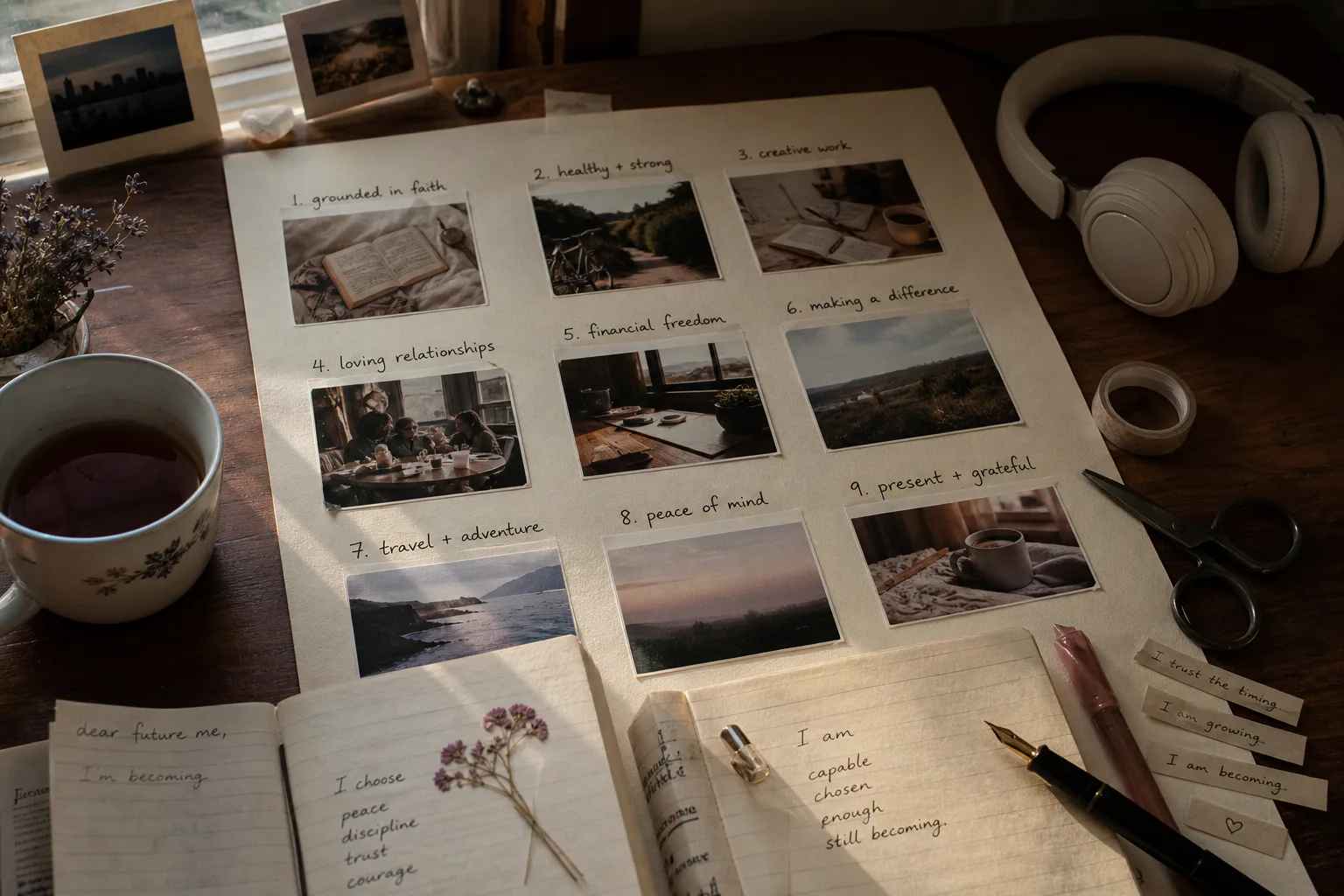
A few torn images sit beside your tea. The best vision board ideas begin with nine ordinary parts of life, then return to one voice: your future self. Use images for direction, words for truth, and daily audio for repetition, so the board becomes something you live with, not something you forget.
Why should vision board ideas begin with audio, not images?
Vision board ideas become steadier when you hear the future before you decorate it.
A board can be beautiful and still be vague. It can hold beaches, rings, apartments, clear skin, book covers, babies, bank balances, and rooms with very good light. But a board does not tell you who you are becoming while you move toward those things. Audio can. Sound enters the body differently. You do not have to stare. You can listen while your room is still.
The AYA Method is a daily audio manifestation practice. Each day you listen to a short personalized recording — your Dream-Self Moment — narrated from the version of you who has already manifested the life you intend. Listening is the practice. Repetition is the work. The audio is the method.
That matters because repetition is how a cue becomes familiar. In habit research, Wendy Wood has written that about 43% of daily actions are repeated in the same context, often with little active decision. A vision board placed on a wall can become part of the room. A short audio ritual keeps the meaning awake.
There is also a quieter reason. Many people make boards from wanting. Future-self audio asks from being. The difference is small, but you can feel it. One says, I hope I get there. The other says, I remember how I became her.
A board gives the future a shape. Audio gives it a voice.
What should you choose before you choose pictures?
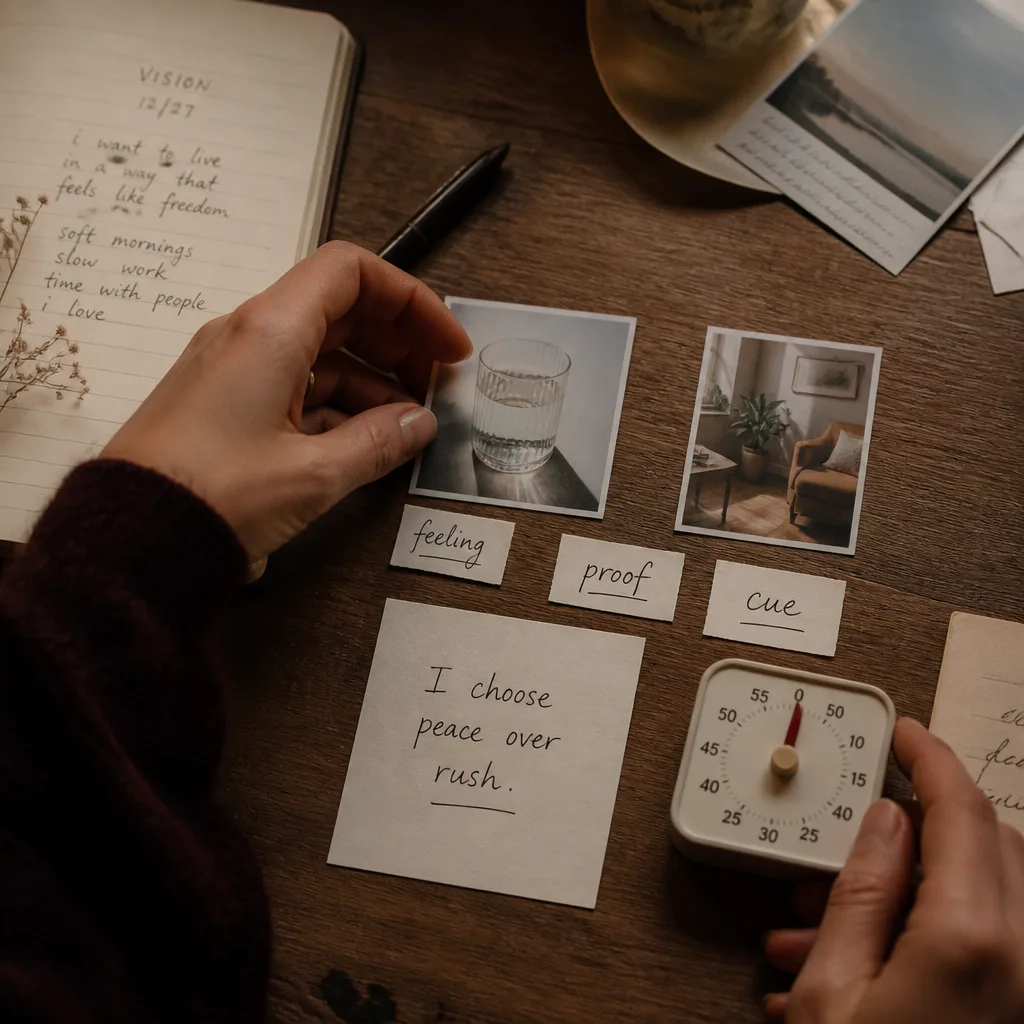
Choose the feeling, proof, and daily cue for each life area before you choose the image.
This is where most boards become too loud. You open a folder. You save 60 images in 12 minutes. Suddenly everything looks possible, but nothing feels yours. Before the images, name the life you are actually practicing. Specificity is kind to the nervous system. It lowers the noise.
In 1999, psychologist Peter Gollwitzer described implementation intentions as if-then plans that improve follow-through. The finding has been repeated across many behavior studies: when a person links a desired action to a clear cue, they are more likely to do it. Your board can use the same logic. If I see the kitchen image, then I drink water before coffee. If I see the invoice image, then I send one clean follow-up.
Use this quiet filter before saving anything:
- Feeling: What do I want this part of life to feel like in my body?
- Proof: What would show me, in real life, that this is becoming true?
- Cue: What small action could I repeat this week?
- Phrase: What would my future self say here?
- Limit: What image am I choosing because someone else would approve?
The board is not a wish list. It is a rehearsal space.
You can still use beauty. Beauty helps attention. But beauty without proof can turn into fog. A board works better when every image has a job. One image can remind you to sleep. One can remind you to send the email. One can remind you that love does not need to feel like panic.
Which 9 life areas belong on a future-self vision board?
The most useful vision board ideas cover nine life areas: body, mind, love, home, work, money, creativity, community, and inner life.
Nine is enough to feel whole without making the board chaotic. You are not trying to manage every desire. You are giving the self a map it can recognize. Research on goal setting often warns against overload; even the often-cited Dominican University study by Gail Matthews reported higher completion when goals were written, shared, and reviewed, but not multiplied without care. Fewer clear aims tend to travel farther.
Use the table as a starting point. Keep one image per area if your board is small. Use three if your board is digital and you can create sections.
| Life area | Image idea | Future-self line |
|---|---|---|
| Body | A glass of water, walking shoes, rested skin | I keep promises to my body in small ways. |
| Mind | A clear desk, an open book, a quiet phone | My attention has a home. |
| Love | Two cups, held hands, an honest message | I am safe in slow, clear love. |
| Home | Fresh sheets, a lamp, a clean sink | My home lets me exhale. |
| Work | A calendar block, studio table, sent proposal | I do work I can stand behind. |
| Money | A paid invoice, simple budget, savings note | I look at money without leaving myself. |
| Creativity | Paint, draft pages, a voice memo | I make before I judge. |
| Community | Dinner table, group walk, kind faces | I let good people know me. |
| Inner life | Candle, moon note, morning window | I return to myself every day. |
If you want a wider base, read the manifestation pillar alongside this board. It names the larger practice without asking you to make it complicated.
Your images should make you quieter, not more frantic. That is the test.
How do you make each life area feel specific enough to use?
Make each area specific by pairing one image with one sentence, one behavior, and one sign of progress.
A vague health image says fit. A useful health image says I walk for 20 minutes after lunch three times this week. A vague money image says rich. A useful money image says I check my account every Friday and send invoices within 24 hours. Numbers calm the fantasy. They give it a floor.
Mental imagery research helps here. In a 1998 study, Shelley Taylor and colleagues found that students who visualized the process of studying tended to do better than those who visualized only the desired grade. The image of the outcome can inspire, but the image of the next action teaches the body what to do.
Try this 9-part pass:
- Pick one life area.
- Write the future-self sentence in present tense.
- Choose one image that proves the sentence.
- Add one repeated action under 10 minutes.
- Name one visible sign you could notice within 30 days.
- Remove any image that creates comparison instead of recognition.
- Listen to your Dream-Self Moment before you place the image.
- Put the board where your attention already goes.
- Review it once a week, not all day long.
For love, the sign may be answering honestly instead of pleasing. For work, it may be one sent proposal. For home, it may be clearing the chair that always gathers clothes. These are not small because they are meaningless. They are small because they are repeatable.
A future self is built from evidence the present self can survive.
If you also use written phrases, the affirmations pillar can help you choose words that feel clean. The daily affirmation can sit beside the board. It supports the audio. It does not replace it.
Where do astrology, timing, and symbols fit without taking over?
Use astrology and symbols as gentle timing cues, not as permission slips.
A moon phase, birth chart note, or seasonal marker can help you choose when to refresh the board. Many people like making a board at a new moon or reviewing it at the start of a month. Pew Research Center reported in 2023 that 70% of U.S. adults describe themselves as spiritual in some way, even when they do not share one formal practice. Symbols matter because humans make meaning with pattern.
Still, the board should not make you wait to live. If a symbol helps you remember, keep it. If it makes you feel watched or late, remove it. Your future self is not hiding behind a date. She is in the next honest action.
You might use symbols like this:
- A moon image for monthly review.
- A key for home or access.
- A receipt for money clarity.
- A doorway for a new work chapter.
- A hand-written date for a 30-day practice.
- A small star map for wonder, not pressure.
If you like timing rituals, astrology and manifestation can give you a softer frame. Keep the center simple: listen, look, act. The audio holds the identity. The board holds the image. The day holds the proof.
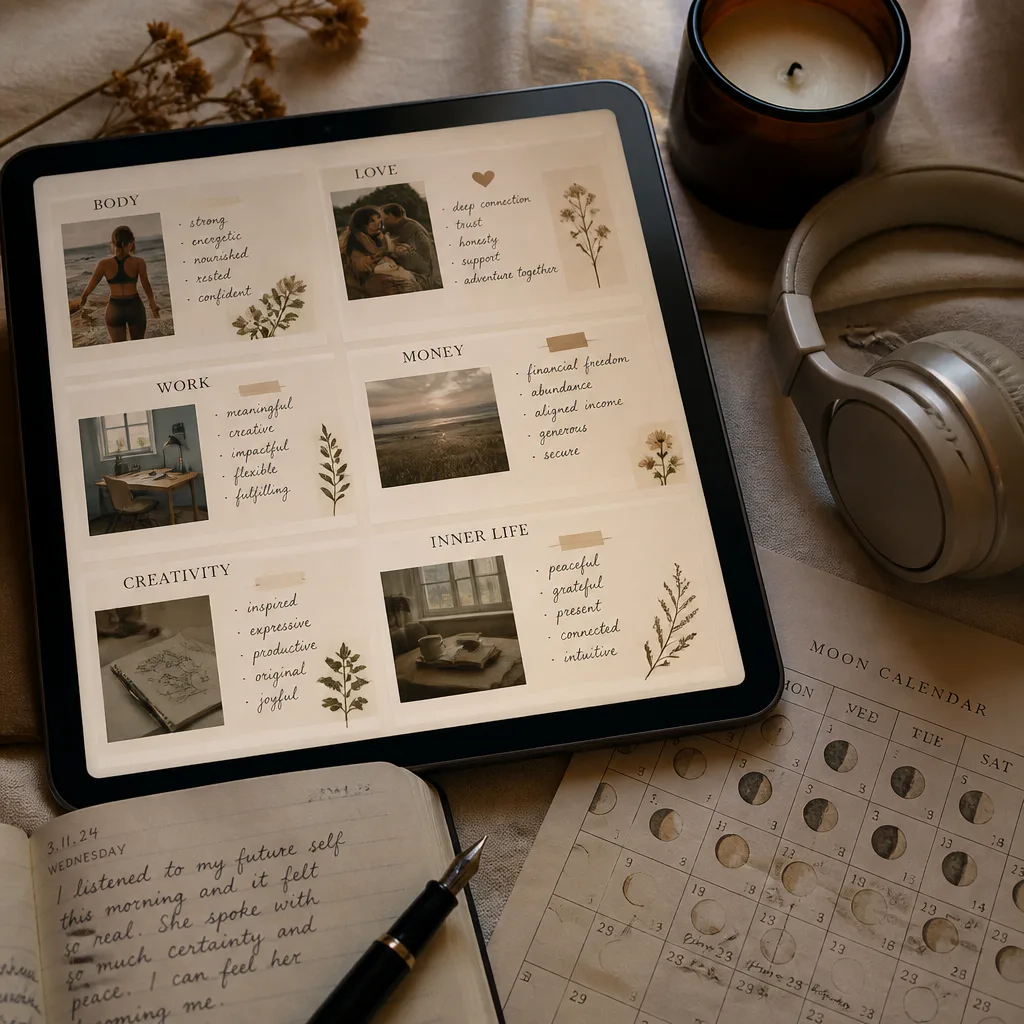
This is also where a Manifestation Board inside an app can help. It is portable. It can sit beside your Dream-Self Moment instead of becoming another forgotten file. But the board is still a complement. The audio is the method.
How do you use the board each day without making it another task?
Use the board for two minutes after audio, then choose one small action from one life area.
Do not make the board a second job. The mind resists rituals that arrive with too many rules. BJ Fogg, founder of the Behavior Design Lab at Stanford, has long taught that tiny behaviors work because they are easy to repeat. A two-minute board practice is more useful than a 45-minute review you avoid by Thursday.
Here is a simple daily rhythm:
- Listen to your Dream-Self Moment.
- Look at the board without scanning for lack.
- Let one image catch your eye.
- Ask: what is the smallest true action here?
- Do it, schedule it, or write the first line.
Some days the image will be the water glass. Some days it will be the invoice. Some days it will be the two cups, and the action is sending the honest text. The point is not to touch all nine areas every day. The point is to keep the whole life visible while choosing one door.
The board should bring you back to now. Not later. Not when you are better. Now.
For a fuller structure, keep the AYA Method page nearby and return to the Dream-Self Moment first. If you are still shaping your broader practice, the manifestation guide can help you separate desire from daily repetition.
What are 27 quiet vision board ideas you can use today?
Use these 27 vision board ideas as prompts, then edit until each one feels like yours.
You do not need all of them. Choose 9 to 12 if your board is physical. Choose up to 27 if your board is digital and organized by life area. A 2022 review in Frontiers in Psychology noted that visual mental imagery can influence emotion and motivation, especially when it feels vivid and personally relevant. Personal is the word to keep.
Body
- A water glass beside your bed.
- Shoes by the door for a 20-minute walk.
- A calendar with three sleep nights circled.
Mind
- A phone outside the bedroom.
- A single open notebook.
- A reading chair with morning light.
Love
- Two cups on a table.
- A message that says what you mean.
- A hand resting open, not reaching.
Home
- Fresh sheets.
- A clean sink before sleep.
- One warm lamp in a quiet corner.
Work
- A sent proposal.
- A studio desk before anyone arrives.
- A calendar block named deep work.
Money
- A paid invoice.
- A simple weekly money date.
- A savings note with a real number.
Creativity
- Three draft pages.
- A voice memo titled idea 01.
- Paint on fingers, not in a drawer.
Community
- A dinner table with enough chairs.
- A walk with one good friend.
- A birthday written down before it passes.
Inner life
- A candle after the room is clean.
- A moon note in your planner.
- Headphones waiting by the bed.
The best board is not the one someone else would pin. It is the one that makes your next honest action visible.
When the images are chosen, listen again. Let the future speak first.
The life you keep listening for can hear you now.