vision boards
Vision Board Examples That Become Future-Self Audio
Vision board examples become clearer when you turn images into future-self audio: specific scenes, daily cues, and words you can hear.
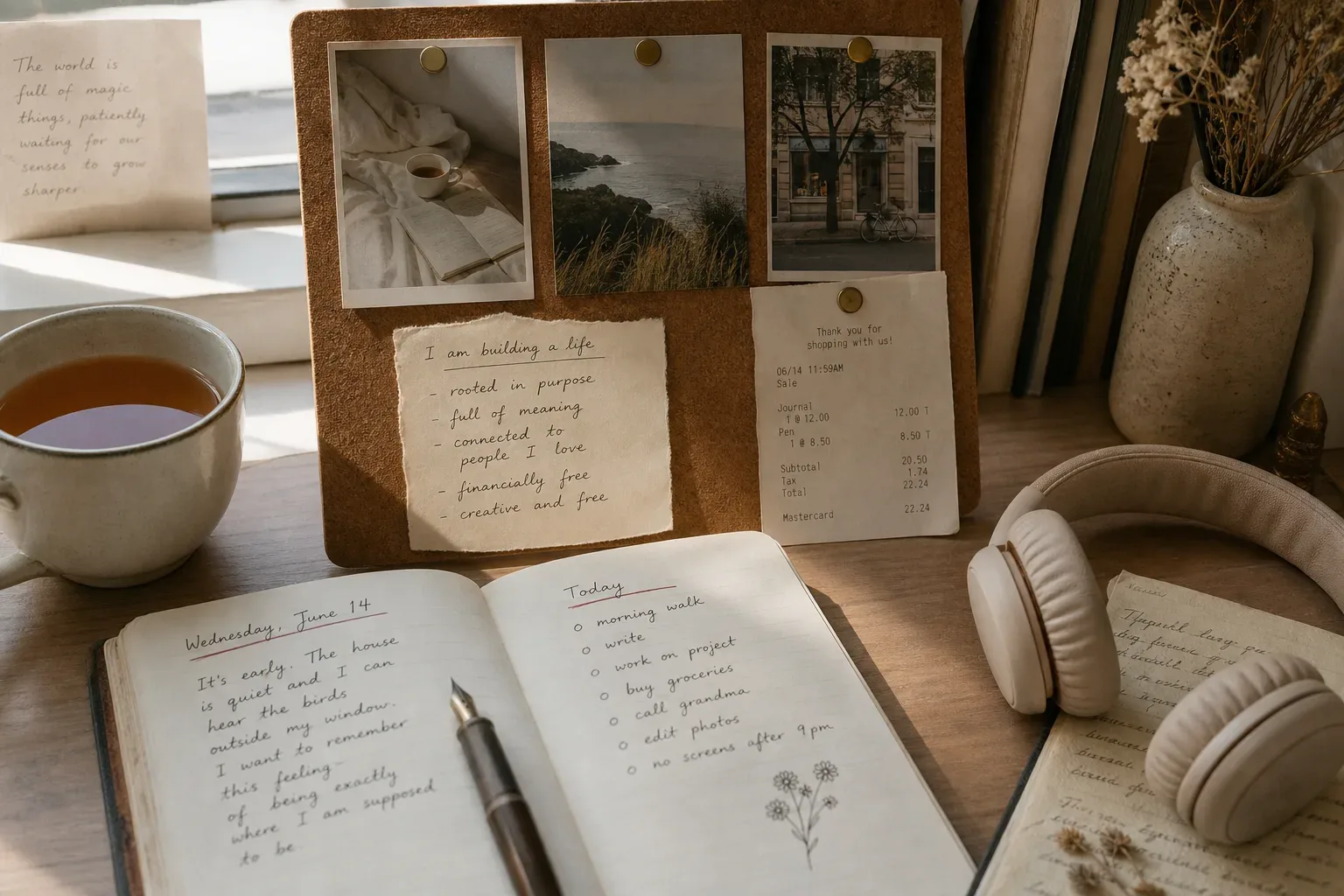
A board sits above the desk. Three photos. One receipt. One word circled twice. Vision board examples become future-self audio when you stop treating images as decoration and start reading them as evidence: each picture can become one sentence your future self says, with enough detail to feel true.
What makes vision board examples easier to turn into audio?
The best examples show a lived moment, not a vague wish.
A vision board is the part of the practice you can see. Audio is the part you can return to with your eyes closed. When those 2 parts speak to each other, the image stops being a flat symbol. It becomes a cue. In cognitive neuroscience, cues matter because repeated cues help shape automatic prediction; the brain is always asking what usually comes next.
This is why a photo of a calm kitchen can be more useful than a glossy quote about success. The kitchen gives your future self somewhere to stand. You can hear the kettle. You can see the light on the counter. You can say, I wake here, and I know what this morning is for. A 2002 review by Locke and Latham found that specific, difficult goals reliably improved performance across decades of studies, while vague goals did less.
The AYA Method is a daily audio manifestation practice. Each day you listen to a short personalized recording — your Dream-Self Moment — narrated from the version of you who has already manifested the life you intend. Listening is the practice. Repetition is the work. The audio is the method.
That definition matters here. The board doesn’t become the method. The board gives raw material to the method. Your daily affirmation and Manifestation Board can support the practice, but the repeated audio is the center.
A picture tells you what you want to remember. A voice tells you who is remembering.
Use this simple test:
| If the board shows | The audio can say | Keep it? |
|---|---|---|
| A specific room | I put my keys down here every evening | Yes |
| A random luxury photo | I am rich and happy | Rewrite |
| A calendar with 3 marked dates | I follow through on the dates I chose | Yes |
| A body image from someone else | I move with care and keep my appointments | Rewrite |
Which vision board examples translate best into a Dream-Self Moment?
The best examples are scenes you can enter in 30 to 60 seconds.
Think in categories, but write in moments. A career board is not only a new title. It might be the first email you send without shrinking. A home board is not only a sofa. It might be the sound of the door closing when you come back to a place that feels yours. A money board is not only a number. It might be a banking app screenshot with one debt gone.
Here are 7 vision board examples that usually translate cleanly into audio:
- The morning table. A cup, notebook, window, and 10 quiet minutes.
- The paid invoice. A real number, a date, and a saved receipt.
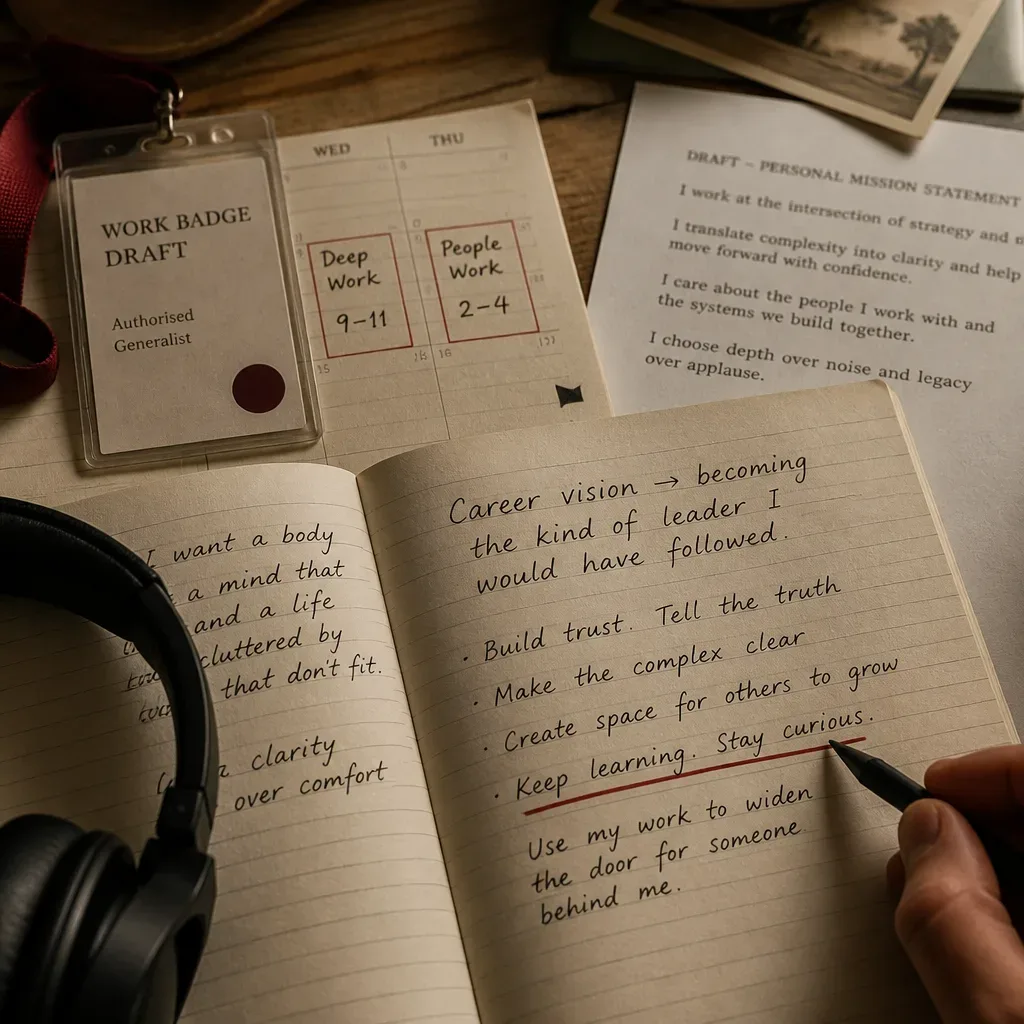
- The work badge. Your name, your role, your first calm commute.
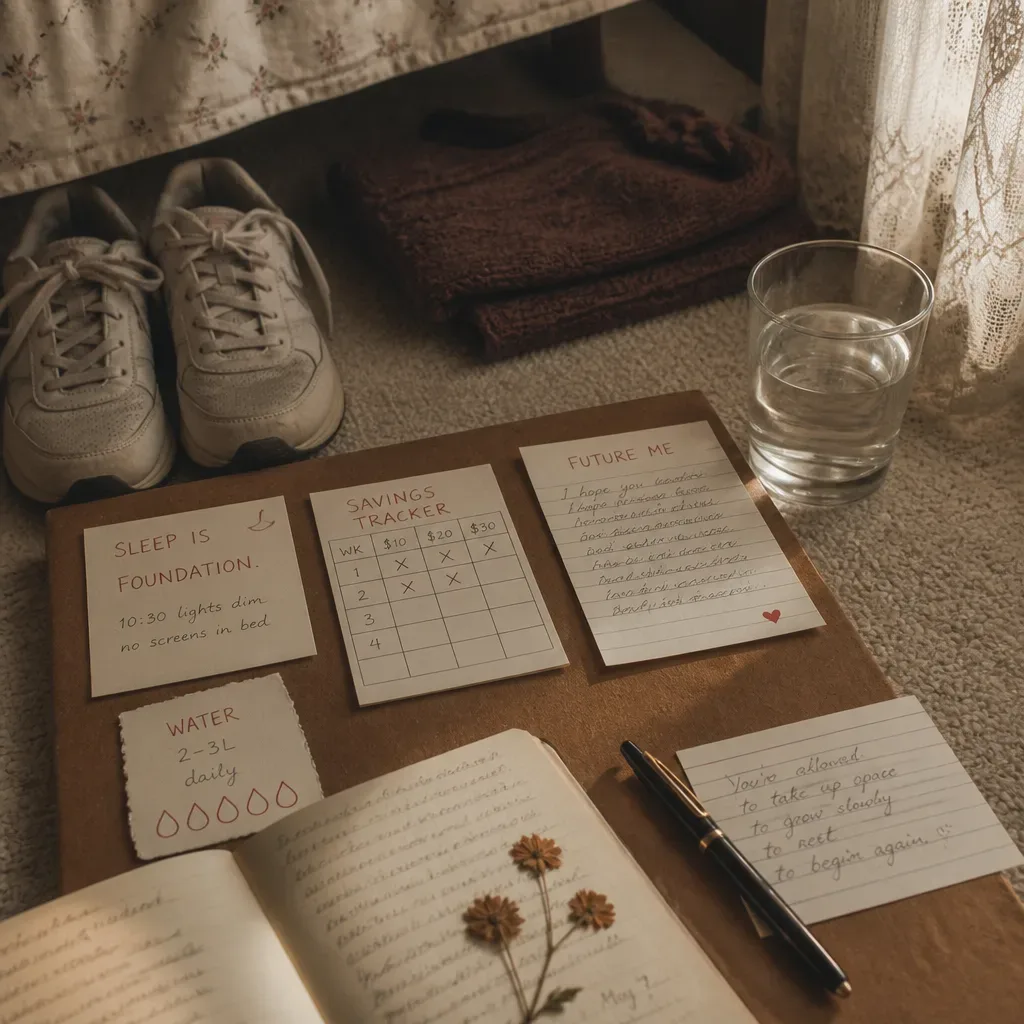
- The body-care corner. Shoes, water bottle, mat, and a realistic schedule.
- The clean bedroom. Clear floor, soft lamp, phone outside the bed.
- The conversation. A message sent clearly, without overexplaining.
- The creative proof. A draft, a file name, a small published piece.
The word small is not a weakness. In behavior research, small cues often do more than grand declarations because they create repeatable contact. Gollwitzer and Sheeran’s 2006 meta-analysis on implementation intentions reviewed 94 studies and found medium-to-large effects when people used if-then plans. If it is 7:30, I put on my shoes. If I open the laptop, I write the first 80 words.
For manifestation context, you can keep the board near the broader practice described in manifestation, but make the audio precise. Specificity protects you from fantasy that never touches Tuesday.
How does a career vision board become future-self audio?
A career board becomes audio when it names the day-to-day behavior of the person already doing the work.
Start with the image. Maybe it’s a work badge, a studio desk, a published article, a client invoice, or a calendar with 2 focus blocks. Then ask what your future self does before anyone praises you. Do you open the file at 9:00? Do you send the proposal? Do you ask the shorter question in the meeting? The audio should make that behavior feel familiar.
Mental contrasting research from Gabriele Oettingen is useful here. In studies from the 1990s onward, positive fantasies alone sometimes predicted lower effort when they replaced planning. The shift comes when you pair the desired future with the present obstacle. Not shame. Just truth. The Dream-Self Moment can hold both: I speak clearly in the meeting, and I no longer wait until I feel fully ready.
A career audio scene might sound like this:
- I sit down before the room gets loud.
- I open the document I used to avoid.
- I send the message in 5 sentences, not 15.
- I let the work be seen while it’s still breathing.
Kelley and colleagues reported in 2002 that self-referential processing engages medial prefrontal regions, meaning the brain treats personally relevant material differently from neutral information. That doesn’t make any sentence magic. It means the words I am the kind of person who sends the draft may be more sticky than generic motivation.
What does a home, love, or belonging board sound like?
It sounds like safety you can recognize in ordinary details.
A home board often gets crowded with beautiful rooms. Keep 1 or 2, then add proof of function: a hook for keys, a table for 2, a shelf that isn’t overloaded, a bed you actually sleep in. The audio should not try to convince you that life is perfect. It should teach your body the tone of enough.
A relationship board needs even more care. Use images that show how you behave, not only who arrives. A hand on a mug. A message answered honestly. Two calendars with time protected. A quiet no. A warmer yes. In a 2023 Pew Research Center report, 30% of U.S. adults said they had used a dating app, but usage alone says little about secure connection. Your board can ask a better question: how do I speak when I know I don’t have to perform?
Try this future-self audio frame:
- Name the setting: I am in my kitchen on Sunday morning.
- Name the behavior: I say what I mean the first time.
- Name the felt shift: My chest stays soft because I am not bargaining for care.
- Name the next action: I keep my afternoon free instead of chasing reassurance.
For supportive language, the affirmations practice can help you find one sentence that doesn’t feel false. Keep it plain. I am loved may feel too far away on a hard day. I let steady care be steady might be closer.
A true board does not flatter you. It recognizes you.
Can a health or body board stay gentle and still be specific?
Yes, if it focuses on care behaviors rather than body judgment.
A health board can include walking shoes, a prescription refill reminder, blood work dates, a water bottle, a bedtime alarm, or a photo of sunlight on the floor. It does not need comparison. It does not need punishment. If an image makes you abandon yourself, it does not belong on the board.
Dr. Andrew Huberman often talks about behavior through repeatable protocols, especially light, sleep, and movement cues. You don’t have to adopt anyone’s full protocol to use the principle. A 2021 review in Sleep Medicine Reviews linked consistent sleep timing with better sleep outcomes across multiple populations. The audio can say, I protect my bedtime because tomorrow begins tonight.
Here are body-care examples that become audio without harshness:
- I take the walk before I negotiate with my mood.
- I book the appointment when the reminder appears.
- I eat sitting down, not standing over the sink.
- I leave the phone outside the bed 5 nights a week.
- I train in a way I can repeat next month.
The number matters. Five nights a week is kinder to the nervous system than always. Research on habit formation by Lally and colleagues in 2009 found that automaticity took a median of 66 days, with wide variation from 18 to 254 days. Repetition is not a personality test. It’s just how cues become familiar.
If your board includes spiritual timing, keep agency intact. You can read about astrology and manifestation as a reflective layer, then still ask the practical question: what do I do when the alarm rings?
How do money and stability boards become believable audio?
They become believable when you turn numbers into daily evidence.
A money board can become vague very quickly. Use numbers. Use dates. Use ordinary proof. A screenshot template with $1,000 saved. A crossed-out debt line. A calendar note for tax prep. A photo of groceries paid without panic. Specific financial cues help the future feel less theatrical and more usable.
The Federal Reserve’s 2023 Survey of Household Economics and Decisionmaking reported that 63% of adults said they could cover a $400 emergency expense using cash or its equivalent. That number is not a moral score. It is context. If your nervous system learned to treat money as danger, your audio should not shout wealth at you. It should build steadiness.
Try one of these scenes:
| Board image | Future-self audio line |
|---|---|
| Emergency fund tracker | I add the next $25 before I spend from fear |
| Paid bill receipt | I open the bill the day it arrives |
| Simple grocery list | I buy what supports the week I am living |
| Tax folder | I keep proof where I can find it |
A good money sentence does not bypass behavior. It names it. I check my balance on Friday morning. I pay the minimum before the due date. I ask one clear pricing question. These lines may sound unglamorous. Good. Stability often enters quietly.
For a broader frame, the vision board guide can help you choose images, while the audio turns those images into repeated self-talk.
If the board cannot survive an ordinary weekday, it is not ready to guide you.
What should you cut before recording the audio?
Cut anything that makes you feel absent from your own future.
Before you record or write your Dream-Self Moment, look at every image and ask whether it gives you a sentence you can live with. Some images are pretty but mute. Some are borrowed. Some speak in pressure. You are allowed to remove them. Editing is part of devotion to the real.
Use this 5-part check before turning the board into future-self audio:
- Can I name the scene? If not, choose a more concrete image.
- Can I name one behavior? The future needs hands.
- Can I repeat the sentence daily? If it creates dread, soften it.
- Can I measure one sign of follow-through? Use a date, count, or visible proof.
- Can I hear this in my own voice? If it sounds like someone selling you a life, cut it.
Research on self-affirmation, including work reviewed in the Journal of Personality and Social Psychology, suggests that values-based statements can reduce defensiveness in some contexts. But the sentence has to touch something real. The daily affirmation in the app can support this, but it should serve the audio, not replace it.
One quiet format works well:
I am in [place]. I do [behavior]. I notice [sensory detail]. I no longer [old pattern]. I keep [small promise].
For example: I am at my desk before 9. I open the draft before messages. The room is still. I no longer wait to feel chosen. I keep the first hour for the work that is mine.
This is where vision board examples become more than a collage. They become a script for recognition. Not a demand. A return.
Listen until the future starts sounding like home.