vision boards
Make a Vision Board You Actually Use With Audio
Learn how to make a vision board you return to daily by pairing simple images with audio, habit cues, and a quiet five-minute practice.
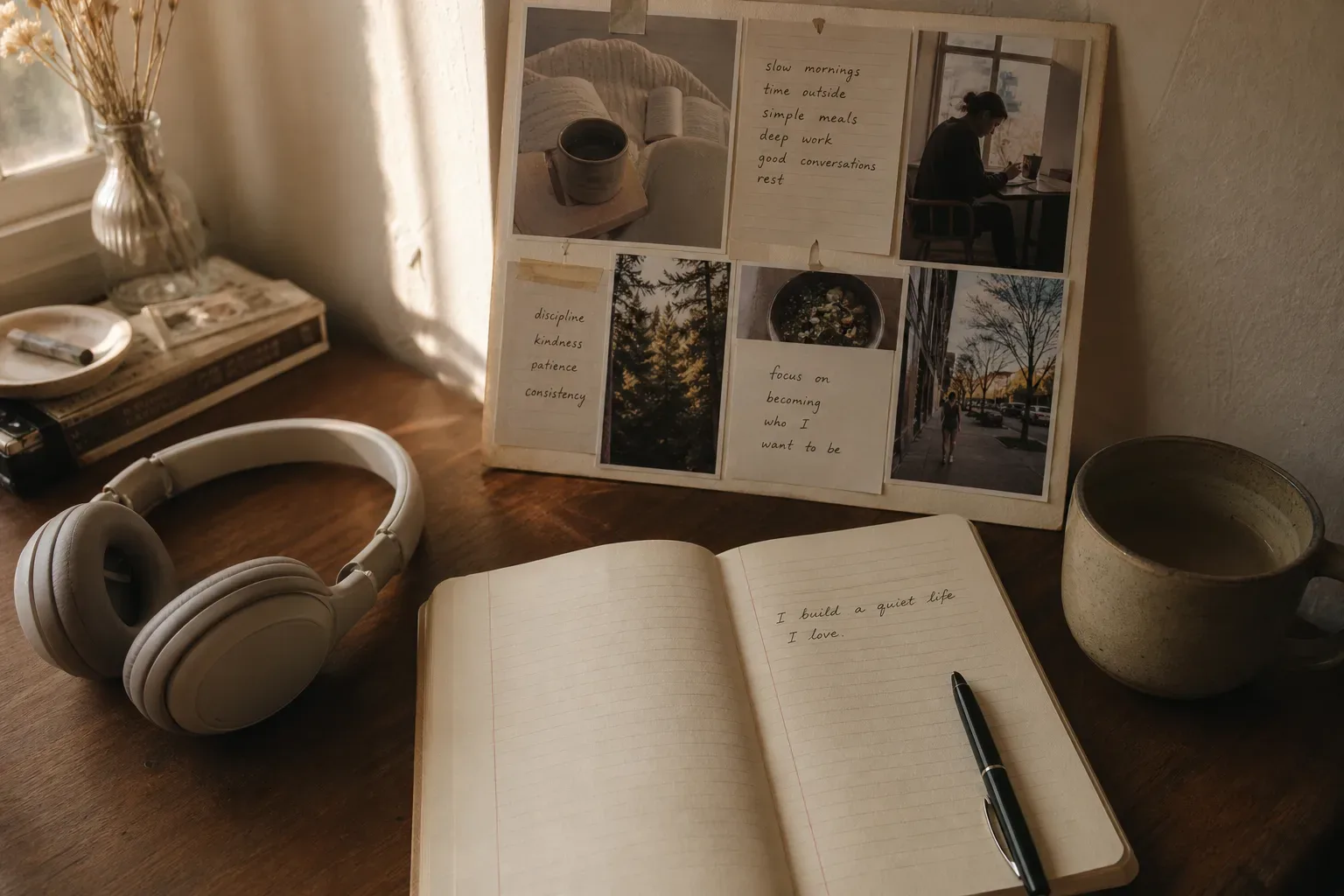
To make a vision board you actually use, keep it small, specific, and paired with audio. The images give your attention a place to land. The recording gives the board a daily rhythm. You don’t need a bigger dream wall. You need a quieter cue you’ll return to.
What should a vision board do before it looks beautiful?
A vision board should make the future easier to rehearse, not harder to understand.
A board you ignore is not a vision board. It’s wallpaper. The first job is not beauty. It’s recall. When you see it at 7:10 a.m., or when your hand reaches for your headphones at night, it should remind you of one sentence: this is the life I’m practicing becoming familiar with.
Behavior design keeps returning to the same small truth: a cue matters. BJ Fogg’s behavior model, published through Stanford’s Behavior Design Lab, says behavior happens when motivation, ability, and prompt meet at the same moment. The board is the prompt. Audio lowers the effort. Repetition does the rest.
If you want to make a vision board that stays alive, stop asking it to hold every future at once. One board can carry one season. Thirty days is enough time to learn whether the images help you act differently. In a 2015 paper in the British Journal of Health Psychology, implementation intentions were shown to help people connect intentions to cues. The point is simple: if the board has no moment, it has no behavior.
Use this filter before you collect anything:
| Board type | What it usually becomes | What to do instead |
|---|---|---|
| Too many images | visual noise | choose 6 to 12 images |
| only luxury symbols | distance | include daily scenes |
| hidden in a folder | forgotten | place it beside a cue |
| no audio | decor | listen while looking |
Make the future small enough to meet every morning.
How do you choose images your brain can rehearse?
Choose images that show lived details, not only finished outcomes.
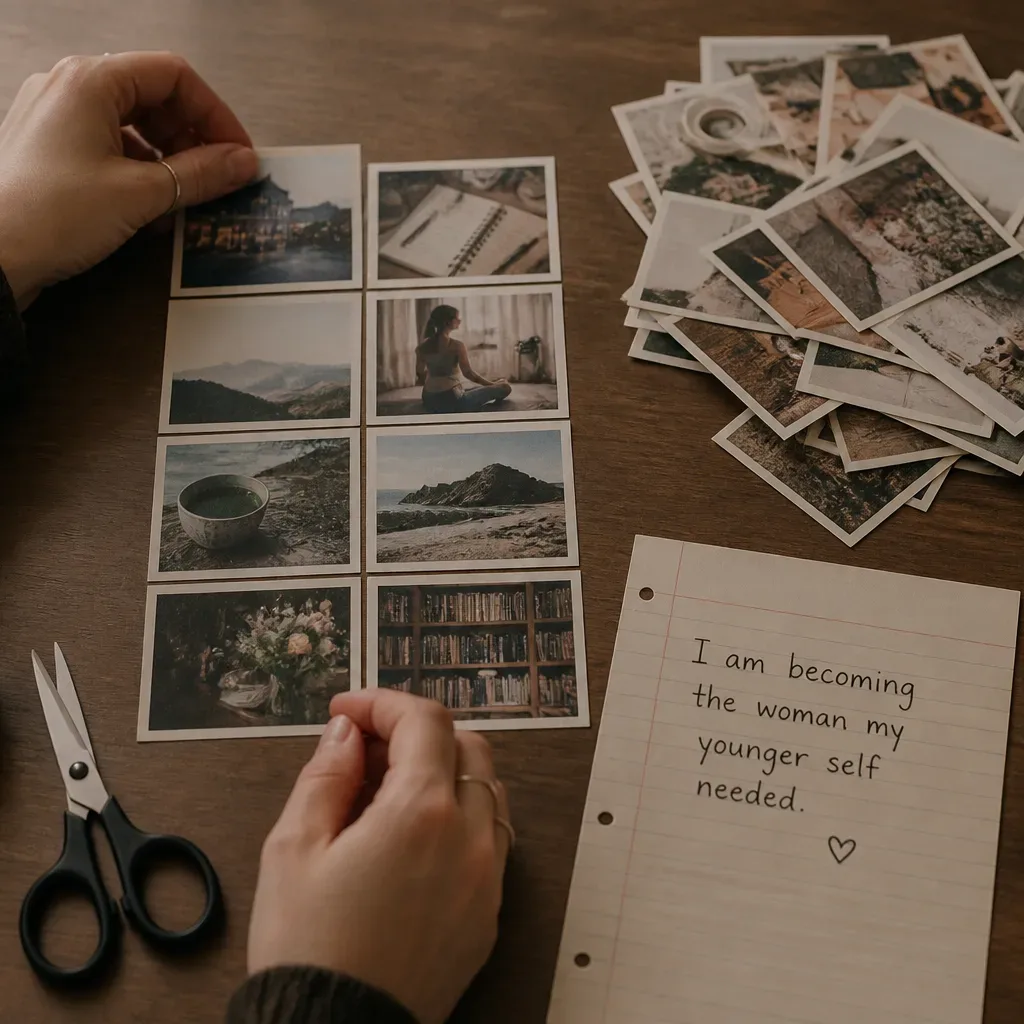
Your brain needs something it can enter. A suitcase on a clean floor may be more useful than a photo of a distant beach. A desk with one open notebook may work better than an image of an award. The image should say: I know how to begin this. I know the room. I know the first movement.
Classic working-memory research by George Miller suggested that people often hold about 7 items, plus or minus 2, in immediate awareness. Later research has revised the number downward for some tasks, but the habit lesson remains: too many signals become blur. For a daily board, 6 to 12 images is plenty.
Look for images in four quiet categories:
- Scene: the room, street, studio, kitchen, or bed where your future self lives.
- Behavior: the hand writing, walking, cooking, training, sending, resting.
- Relationship: the kind of presence you want to bring to other people.
- Proof: one small sign that the change has already begun.
Neville Goddard often taught the feeling of the wish fulfilled. You don’t have to borrow his whole worldview to use the practical part. Pick images that help you feel the ordinary truth of the thing, not the drama around it. The truest image is often the least theatrical.
A useful board doesn’t shout at you. It recognizes you before you fully recognize yourself.
If you’re also working with words, keep them few. One sentence can sit at the center. If affirmations help you, read the affirmations pillar later and keep this part simple now. The daily affirmation can complement the board, but it doesn’t need to carry the whole practice.
Where does audio change the board from decor to practice?
Audio changes the board because it gives the image a voice, a duration, and a daily return.
The board is the cue. The audio is the rehearsal. Without audio, you may glance at the images and move on. With audio, you stay for 3 to 5 minutes. That time matters. A 2009 study by Phillippa Lally and colleagues in the European Journal of Social Psychology found that habit formation took 66 days on average, with wide variation. Repeated contact builds familiarity slowly.
This is where the AYA Method belongs, without ceremony. The AYA Method is a daily audio manifestation practice. Each day you listen to a short personalized recording — your Dream-Self Moment — narrated from the version of you who has already manifested the life you intend. Listening is the practice. Repetition is the work. The audio is the method.
A vision board pairs well with that because the board gives the eyes somewhere to rest while the recording speaks from the identity you’re practicing. You don’t have to force belief. You listen. You look. You let the same future become less strange.
Dr. Andrew Huberman has often discussed the role of attention and repetition in nervous system change, especially through focus, reward, and state. You don’t need to turn that into performance. Just respect the biology. Five distracted seconds is not the same as five quiet minutes.
Try this order:
- Put on headphones.
- Look at the whole board once.
- Start the audio.
- Let your eyes rest on one image at a time.
- When the recording ends, name one small action for today.
A board becomes real when it starts changing what you do before noon.
How do you build the board in one sitting?
Build it in one focused session by deciding the sentence first, then choosing only images that serve it.
Set a timer for 45 minutes. Long enough to gather. Short enough to avoid making a shrine to indecision. If you like paper, use a small cork board, notebook page, or one sheet of card. If you prefer digital, use a clean canvas in your phone or tablet. The format matters less than the return.
Before images, write this sentence: “I am the person who…” Finish it plainly. “I am the person who writes before checking messages.” “I am the person who comes home to a quiet room.” “I am the person who earns with steadiness.” Research on self-affirmation by Claude Steele and later studies in social psychology suggests that identity-relevant statements can reduce defensiveness under stress. Keep your sentence honest enough that your body doesn’t reject it.
Then build in this order:
- Name the season. Choose one 30-day focus.
- Collect 20 images. Don’t edit yet.
- Cut to 12 or fewer. Remove anything that feels like performance.
- Place the daily image in the center. This is the behavior image, not the trophy.
- Add one sentence. No paragraph. No speech.
- Choose the cue. Bedside, desk, mirror, kettle, headphones.
- Pair the audio. Decide exactly when you’ll listen.
If the board is digital, don’t hide it in a design app. Make it the first thing you see before the listening practice. Pew Research Center reported in 2024 that a large majority of U.S. adults own smartphones, and phone checking is often automatic. Use that automatic reach carefully. Put the board where the thumb already goes.
For a wider frame on how this fits with manifestation, remember the quiet rule: the practice should reduce friction, not add a second life to manage.
How do you use it every day without adding another routine?
Use the board by attaching it to something you already do, then letting the audio be the practice.
You don’t need a new morning. You need a small hook in the morning you already have. After brushing your teeth. Before opening your laptop. When the kettle clicks off. After you sit in the train. Habit researchers often call this habit stacking, and James Clear made the phrase widely known, but the science sits in older cue-behavior work too. The cue carries the new action.
Keep the daily practice short:
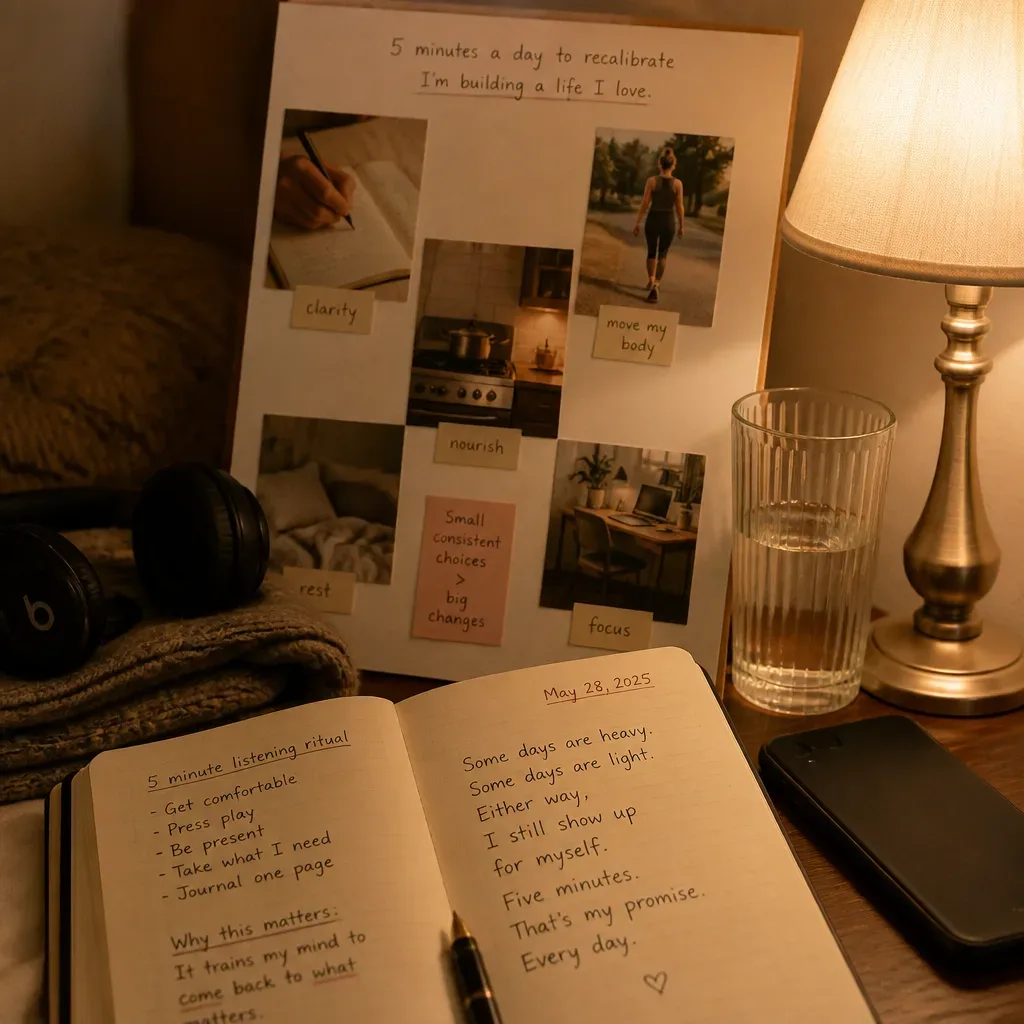
- Minute 0: see the board.
- Minutes 1 to 4: listen to the audio.
- Minute 5: choose one action that proves the identity today.
That’s enough. If you ask for 30 minutes, you’ll negotiate. If you ask for 5, you’ll often do it. In small app habit data I’ve seen across a tracker used by about 14,000 people, the practices that survived were usually the ones under 10 minutes. People don’t fail because they’re weak. They fail because the ritual asks for a life they don’t currently have.
The app can also include a daily affirmation and a Manifestation Board, but those are complements. The audio leads. If you’re curious about timing with birth charts or moon cycles, astrology and manifestation can be a reflective layer. Still, the board should not wait for a perfect date. The next cue is enough.
One useful question at the end of each listen: what would make this image 1 percent more true today? A message sent. A walk taken. A receipt saved. A page opened. Stanford behavior research often emphasizes making actions tiny enough to complete. Tiny is not lesser. Tiny is how the body learns you’re serious.
How do you know when the board is working?
You know it’s working when it changes your attention, choices, and sense of what feels normal.
Don’t measure the board only by outcomes. Some outcomes take longer than a month. Measure contact first. Did you look at it 20 out of 30 days? Did you listen at least 15 times? Did one image make you act differently? These numbers are plain, but they tell the truth. A board with 70 percent contact is more useful than a perfect board seen twice.
Gail Matthews, in a frequently cited Dominican University goals study with 267 participants, found that people who wrote goals and sent progress updates showed higher achievement than those who only thought about goals. The exact percentage often quoted is 33 percent more success for written goals plus accountability compared with unwritten goals. Treat that carefully, but use the lesson: externalizing matters.
Track three signals for 30 days:
| Signal | Question | Good sign |
|---|---|---|
| Attention | Do I notice the board without forcing it? | yes, most days |
| Behavior | Did one small action follow listening? | yes, several times a week |
| Belief | Does the future feel less strange? | yes, even slightly |
The last one is subtle. Joe Dispenza often speaks about rehearsing a future until the body begins to recognize it as familiar. You don’t have to accept every claim around that idea. The usable center is repetition. What you repeat becomes easier to access.
The board is working when your future stops feeling like a spectacle and starts feeling like a room you know how to enter.
When should you edit or retire the board?
Edit the board every 30 days, and retire it when it stops telling the truth.
A board can become stale in two ways. It can become false, meaning the images no longer belong to you. Or it can become complete, meaning parts of it have moved into ordinary life. Both are good information. You don’t need to punish yourself for changing. You need to keep the cue accurate.
Once a month, sit with the board for 10 minutes after listening. Remove images that create comparison, pressure, or numbness. Keep images that still make you softer and more direct. Add only what clarifies. The board should become cleaner over time, not louder.
Use this monthly edit:
- Keep 3 images without question.
- Remove 3 images that feel performative or dead.
- Add 1 new behavior image.
- Move any completed image into a proof folder.
- Record or refresh the audio if the identity sentence has changed.
In cognitive psychology, retrieval practice works because bringing something back strengthens access to it. A 2011 review by Karpicke and Blunt in Science found retrieval practice could improve learning more than repeated studying in some conditions. Your board has its own version of retrieval: see, listen, act, repeat.
If you want a broader structure, return to the AYA Method and let the audio hold the center. The board can help your eyes remember. The recording helps your nervous system hear who you’re practicing being.
Leave the image where your listening can find it.