affirmations
Self Worth Affirmations for Future-Self Audio
Self worth affirmations can steady the nervous system before and after future-self audio, helping the words feel believable, small, and real.

The headphones are still on the table. Before you press play, use one or two self worth affirmations to make the future-self audio easier to receive. The words should not inflate you. They should steady you. Then the audio can do its quiet work.
What are self worth affirmations really for?
Self worth affirmations are small statements that help you remember your value before proof arrives.
They are not slogans. They are not a way to pretend you never doubt yourself. They are closer to a hand on the shoulder. A sentence you can stay with for 10 seconds without leaving yourself.
Self-affirmation theory began with psychologist Claude Steele in 1988. The simple idea still holds: when people reflect on values that matter to them, they can meet threat with less defensiveness. In later research, David Creswell and colleagues found that self-affirmation reduced stress responses in a lab task, with cortisol patterns shifting in measurable ways. The words were not magic. They changed how the person related to pressure.
That distinction matters here. Self-worth is not a performance state. It is the ground under the performance. If an affirmation only helps when you feel impressive, it is not a self-worth affirmation. It is applause with better formatting.
Use this test: can the sentence still be true on a slow day, a messy day, a day when no one praises you? If yes, it belongs near your audio. If no, save it for another kind of practice.
A few examples that are quiet enough to be useful:
- I do not have to earn my place in my own life.
- I can be unfinished and still worthy of care.
- My worth is here before the outcome.
- I can receive good things without explaining why I deserve them.
- I can move slowly and still be moving.
The cleanest affirmations do not try to win an argument. They end it.
How do self worth affirmations support future-self audio?
They soften the part of you that resists hearing your own future as possible.
Future-self audio asks something tender of the mind. It asks you to listen to a version of you who already knows the new pattern. If your nervous system hears that as pressure, it may push back. This is normal. Hershfield’s work on future self-continuity has shown that people often relate to their future self almost like another person; in one 2011 study, stronger connection to a future self was linked with more patient financial choices.
This is where self worth affirmations help. They make the bridge shorter. Before the audio says, “I am living differently now,” the affirmation says, “I am allowed to listen.” That is enough. A door does not need to become a cathedral. It only needs to open.
The AYA Method is a daily audio manifestation practice. Each day you listen to a short personalized recording — your Dream-Self Moment — narrated from the version of you who has already manifested the life you intend. Listening is the practice. Repetition is the work. The audio is the method.
So the affirmation is not the main event. It is the candle you light before the room becomes quiet. The app also includes a daily affirmation and Manifestation Board, but those are complements. If you only have three minutes, listen to the Dream-Self Moment.
A simple pairing looks like this:
| Moment | What to say | Why it helps |
|---|---|---|
| Before audio | “I can listen without proving anything.” | Lowers inner debate |
| During audio | No extra words | Lets the recording lead |
| After audio | “One small act can come from worth.” | Brings the future self into the day |
In a 2016 Social Cognitive and Affective Neuroscience study, Cascio and colleagues found that self-affirmation activated brain regions linked with valuation and self-related processing. The finding is often overstated online. Keep it plain: words tied to real values can change attention.

Which self worth affirmations should you say before listening?
Before listening, choose affirmations that give you permission to receive the audio without needing to believe every word at once.
The before-listening moment is not the time for huge claims. Your mind may not be ready for “Everything I want is mine.” It may be ready for “I can hear this gently.” That smaller sentence may do more good because it creates less resistance.
Try these before pressing play:
- I can listen without forcing belief.
- I am allowed to hear a kinder version of myself.
- I do not have to argue with every good thing.
- I can let this audio meet me where I am.
- I am safe enough to practice a new thought.
- I can be skeptical and still be open.
- I do not need to feel ready to begin.
- I can receive these words slowly.
- The future me does not shame the current me.
- I can come home to myself one breath at a time.
There is research behind the softness. In psychological interventions, “believability” matters. Studies on implementation intentions, first developed by Peter Gollwitzer in the 1990s, show that specific, usable cues often work better than vague ambition. The same principle applies here. An affirmation paired with a clear moment is easier to repeat.
If you use the affirmations pillar as a wider reference, keep this one rule close: the line should feel like a place you can stand, not a costume you have to wear.
I like to ask one question before choosing the phrase: what would make my body stop bracing by 5 percent? Not 100 percent. Not forever. Five percent is enough for the first minute.
Self-worth grows well when the demand is small enough to repeat.
Which affirmations should you use after the audio ends?
After listening, choose affirmations that turn the future-self state into one ordinary action.
The minutes after audio matter because the mind is still close to the image, tone, and identity you just heard. You do not need to make a plan for your whole life. You need one clean next move. In behavior science, this is less glamorous and more reliable. BJ Fogg’s tiny habits model, published and taught widely at Stanford, centers on making actions small enough to happen after an existing prompt.
Here are self worth affirmations for that moment:
- I can act from worth before I feel certain.
- One honest choice is enough for now.
- I can answer the next moment with care.
- I do not need to punish myself into progress.
- I can choose the gentle action and still be serious.
- My future self begins in how I speak to myself now.
- I can take one step without making it my whole identity.
- I am allowed to be seen while I am still learning.
- I can keep one promise to myself today.
- The smallest true action counts.
The word “counts” is important. Many people dismiss small actions because they do not look impressive. But consistency often lives in the unimpressive. A 2009 European Journal of Social Psychology study by Phillippa Lally and colleagues found that habit formation took an average of 66 days, with wide variation from 18 to 254 days. Repetition is not decoration. It is the path the brain learns to expect.
For more context on how inner language sits inside a wider practice, read the manifestation pillar. Just keep the order straight. Listening leads. The affirmation helps you carry what you heard.
A good after-audio affirmation should make the day feel possible, not dramatic.
What if a self worth affirmation feels untrue?
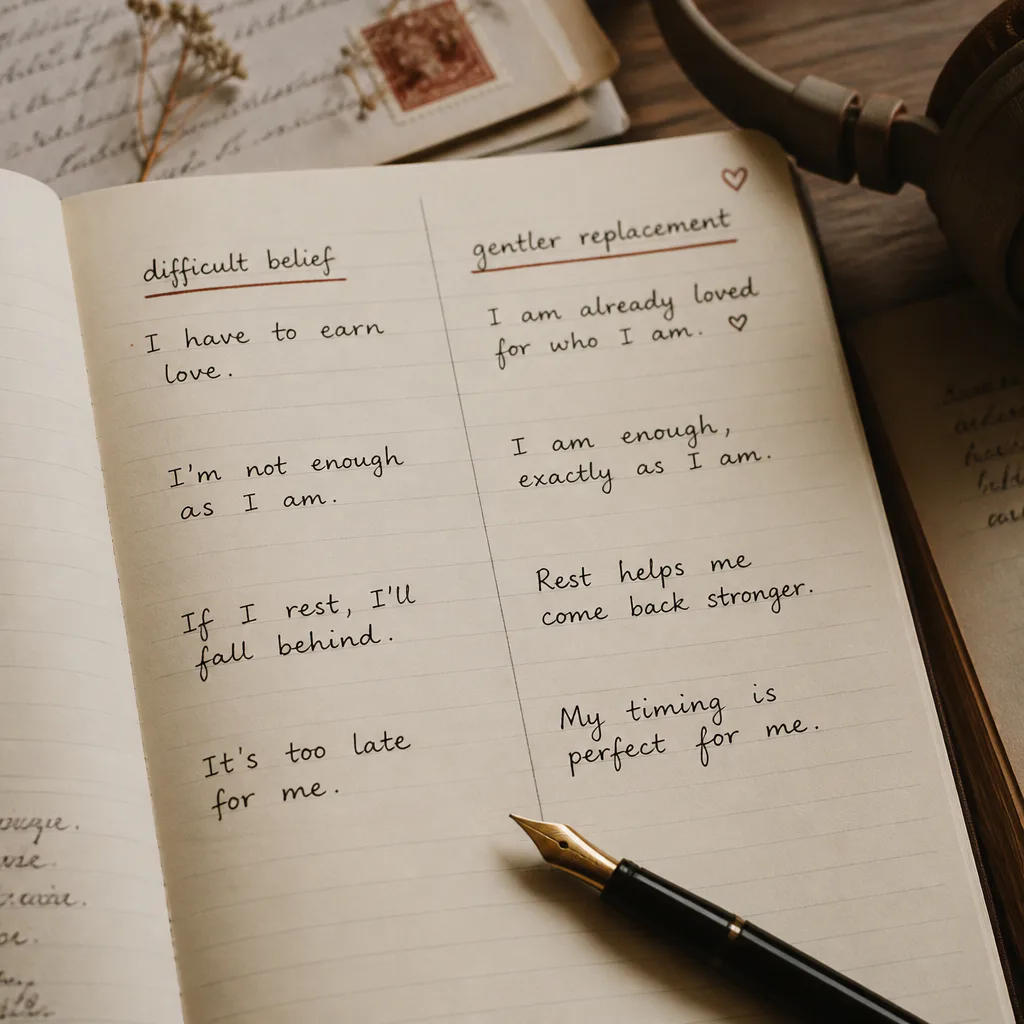
If an affirmation feels untrue, make it smaller until your body stops rejecting it.
This is not failure. It is information. The mind often protects old stories because they once helped you survive embarrassment, rejection, or uncertainty. Telling that mind “I am fully worthy of everything” may be too large at first. A bridge phrase can be more honest.
Use this ladder:
| If this feels false | Try this instead |
|---|---|
| I love myself completely. | I am willing to speak to myself with less harm today. |
| I deserve everything I want. | I can let one good thing reach me without pushing it away. |
| I am confident. | I can stay with myself while I feel unsure. |
| I always trust myself. | I can rebuild trust with one kept promise. |
| I am healed. | I can care for the part of me that still hurts. |
There is a reason this works. Cognitive dissonance theory, introduced by Leon Festinger in 1957, describes the discomfort that appears when beliefs and statements clash. If your affirmation is too far from your current belief, the clash can become the whole event. You spend the practice fighting the sentence instead of receiving it.
A bridge phrase does not lower the aim. It lowers the noise.
This is also why astrology, timing, and symbolic practices can be useful for some people when held lightly. If you work with timing, astrology and manifestation can help you name seasons of attention. Still, the sentence must land in your real life. No chart can do your listening for you.
You are not trying to hypnotize yourself into worth. You are practicing the conditions in which worth becomes easier to remember.
How can you choose the right affirmations for your future self?
Choose affirmations by matching them to the part of self-worth that feels hardest to receive.
Not all self-worth wounds sound the same. Some say, “I am too much.” Some say, “I am behind.” Some say, “If I rest, I will lose everything.” A useful affirmation speaks to the exact old sentence without attacking it.
Use this quick map:
- If you feel behind: “I can begin from here without insulting where I have been.”
- If you overgive: “I can care without disappearing.”
- If you fear being seen: “I can be visible in small, safe ways.”
- If you attach worth to work: “My output is not my identity.”
- If you compare constantly: “Another person’s timing does not erase mine.”
- If receiving feels unsafe: “I can let support arrive in amounts I can hold.”
The number matters less than the fit. In the CDC’s 2017 National Health Interview Survey, 14.2 percent of U.S. adults reported using meditation in the past year, up from 4.1 percent in 2012. Many people are trying quiet practices now. Fewer keep them. Fit is one reason. A practice that sounds beautiful but ignores your actual friction rarely survives Tuesday.
You can also connect your phrase to the Dream-Self Moment. Listen once. Notice the line that makes you soften or resist. Then write a self-worth affirmation that helps you stay near that line tomorrow.
For example:
- Audio says: “I let myself be supported.”
- Resistance says: “That is not safe.”
- Affirmation says: “I can receive support in small amounts.”
- Action says: “I answer the kind message instead of hiding.”
That is how the invisible becomes lived. Not through force. Through a sentence, a breath, and one chosen behavior.
How do you make self worth affirmations a daily practice without making them another task?
Make the practice short, attached to audio, and too simple to negotiate.
A daily practice fails when it asks for a new personality before breakfast. Keep it humble. If you already listen to future-self audio, place the affirmation directly beside it. One line before. One line after. That is all.
Here is a 3-minute structure:
- Sit somewhere you already sit.
- Say one before-listening affirmation once.
- Press play on your Dream-Self Moment.
- Let the audio be the practice.
- Say one after-listening affirmation once.
- Choose one small action that matches it.
This is intentionally plain. Dr. Andrew Huberman often describes behavior change through nervous system state, repetition, and reward timing. You do not need to turn that into a project. You only need a cue your body can recognize. Same chair. Same headphones. Same few words.
If you want more language options, return to the affirmations pillar and choose slowly. If you want the larger frame, keep the AYA Method close. If you want to understand how desire, identity, and action fit together, read the manifestation pillar when you have time.
The quiet rule is this: do not collect affirmations to avoid listening. The audio is the method. The affirmation is a handrail.
Here is a final short list to keep nearby:
- I am already worthy of kind attention.
- I can listen before I fully believe.
- I can keep one promise to myself.
- I do not need to earn rest.
- I can let the future me speak without shame.
- I can begin again without making a speech.
Say less. Return more.
The words can be small enough to stay.