affirmations
Affirmations Not Working? Hear Your Future Self First
Affirmations not working can mean your nervous system needs proof first. Try a future-self audio practice before repeating new words.

Your phone is face down. The room is still. If your affirmations are not working, the problem usually is not your desire. It is the order of the practice: your body is being asked to believe words before it has heard a believable version of you living them.
Why do affirmations feel fake when you say them?
Affirmations feel fake when the sentence asks for more belief than your nervous system can honestly offer.
This is why “I am completely confident” can make you feel smaller. Your mouth says yes. Your body says no. A 2009 study in Psychological Science by Joanne Wood and colleagues found that highly positive self-statements sometimes made people with low self-esteem feel worse, not better. The sentence created contrast. It showed them the gap.
That gap matters. It is not failure. It is feedback. If you say “I am rich” while your rent is late, your mind may begin building a legal case against the affirmation. It looks for evidence. It finds the unpaid bill, the old fear, the last time you were disappointed. Then the practice becomes a debate.
A sentence cannot carry a state it has never been allowed to enter. That is one reason affirmations work best when they are tied to memory, values, and identity rather than performance. Claude Steele’s self-affirmation theory, first published in 1988, did not say people should shout perfect statements at themselves. It pointed to the stabilizing effect of remembering what is already meaningful and true.
So when affirmations are not working, do not start by pushing harder. Start by listening for the point of refusal.
Look for signs like:
- a tight throat after the sentence
- a flat or sarcastic inner response
- sudden tiredness
- a need to repeat the line 50 times to feel anything
- a private sense that you are pretending
Your body is not blocking the practice. It is asking for a truer door.
What should you do before repeating another affirmation?
You should give your mind a scene it can enter before you ask it to speak a new belief.
That is where future-self audio helps. Instead of repeating a sentence in isolation, you listen to a short recording from the version of you who already lives the change. You hear details. The room. The choices. The calm after the thing became normal. In mental rehearsal research, imagery has been used for decades in sport psychology; a 1994 review by Driskell, Copper, and Moran found mental practice improved performance, with stronger effects when rehearsal was specific and repeated.
The AYA Method is a daily audio manifestation practice. Each day you listen to a short personalized recording — your Dream-Self Moment — narrated from the version of you who has already manifested the life you intend. Listening is the practice. Repetition is the work. The audio is the method. You can read the full frame here: the AYA Method.
Notice the order. You listen first. Then, if an affirmation appears, it has somewhere to live. The app also includes a daily affirmation and a Manifestation Board, but those are complements. The audio is the method because the voice gives your future a felt shape before your mind starts editing it.
A belief often changes after it has been rehearsed as ordinary. Not special. Not dramatic. Ordinary.
Try this small order for one session:
- Sit where you will not perform for anyone.
- Listen to a 3 to 7 minute future-self audio.
- Let one line from the audio stay with you.
- Say that line once out loud.
- Stop before you start forcing it.
This matters because habit formation depends on cues and repetition. A 2009 study by Phillippa Lally and colleagues in the European Journal of Social Psychology found habit automaticity took a median of 66 days, with wide variation. You do not need to feel complete belief on day one. You need a repeatable cue your system can return to.

How do you find the exact affirmation that is not landing?
You find it by testing the sentence against your body, not against your ambition.
Take the affirmation you have been using. Say it once. Not ten times. Once is enough. Then pause for 10 seconds and write the first honest response. If the line is “I am chosen,” the response may be “not by the people I want.” If the line is “Money comes easily,” the response may be “then why am I scared to open my account?” This is useful data.
Cognitive dissonance research, first named by Leon Festinger in 1957, describes the discomfort people feel when beliefs and reality clash. Affirmations can create that clash when they leap too far. The answer is not to abandon the desire. The answer is to reduce the lie-feeling.
Use this simple table.
| If the affirmation says | And your body says | Try this instead |
|---|---|---|
| I am wealthy | No, I am behind | I am learning to make steadier choices with money |
| I am loved by everyone | That is not true | I am becoming available for real love |
| I am fearless | I am scared right now | I can move with fear and still choose well |
| Everything works for me | Not lately | I can notice one thing that is working today |
The better line is not the smaller life. It is the safer bridge.
This is also where manifestation becomes less theatrical and more exact. You are not trying to decorate a fear. You are teaching your attention to recognize a new normal through repeated contact. Princeton Engineering Anomalies Research, often called PEAR, studied intention and random systems for nearly 28 years before closing in 2007. Its claims remain debated, but the wider lesson for practice is simpler: intention without repeatable method becomes hard to measure.
Give yourself something you can repeat without flinching.
How do you record or choose a future-self audio that works?
A useful future-self audio is specific, calm, present-tense, and short enough to use every day.
Do not build a speech. Build a scene. The mind understands scenes faster than slogans. If your desire is steady love, the scene might be you making tea on a Sunday with someone who is kind to you. If your desire is better work, the scene might be you closing your laptop at 5:42 p.m. because the day is complete. Specific numbers help. They tell the brain where to look.
Neuroscientist Dr. Andrew Huberman has often discussed the role of visualization, dopamine, and action, especially the way reward can support effort when tied to process. You do not need to turn that into a productivity sermon. You only need to make the future self concrete enough that your next choice can see it.
A good future-self audio includes:
- one ordinary location
- one sensory detail
- one identity sentence
- one choice you now make differently
- one sign that the desire has become normal
For example: “You are standing in your kitchen at 7:10. The light is low. You check your calendar and there is space between calls. You do not rush. You trust the work because the work has become steady.”
That lands differently from “I am successful.” It gives the affirmation a body.
If you use the AYA Method, your Dream-Self Moment does this for you inside a short personalized recording. You listen daily. Then you can use the daily affirmation as a small echo, not as the whole structure. The distinction is important. The affirmation names the state. The audio lets you visit it.
Keep it between 3 and 7 minutes. In a 2022 Pew Research Center report, 46 percent of U.S. adults said they use apps to track or manage health, fitness, or wellness in some form. The tools that last tend to be the ones that ask for less friction, not more devotion.
What is the 8-day reset when affirmations are not working?
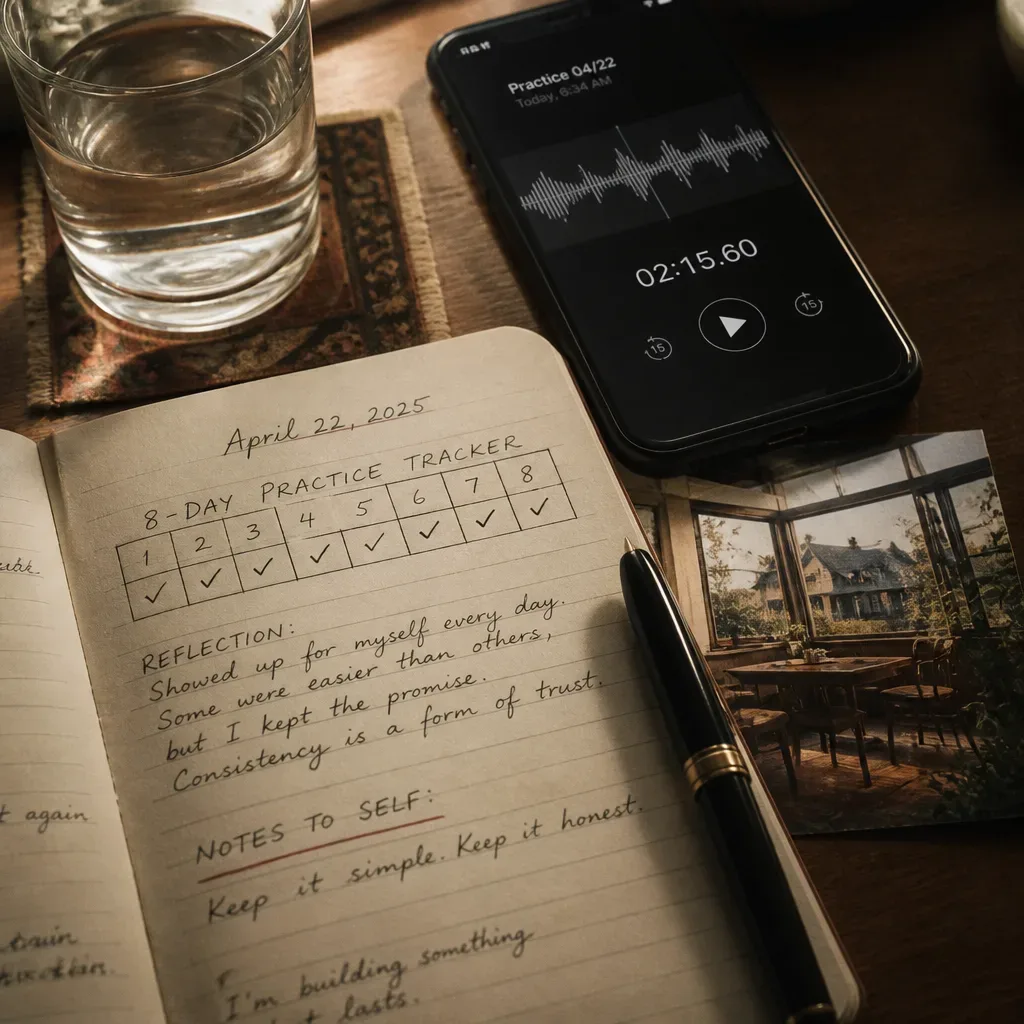
The 8-day reset is a short practice window where you listen first, speak less, and measure what becomes easier.
Eight days is long enough to interrupt the old performance loop. It is short enough that your mind does not turn the practice into a life sentence. Dax note, from reviewing wellness apps for years: if a tool cannot earn trust in the first week, most people quietly leave. Day eight is when I personally start to believe a practice might be useful.
Here is the reset.
- Day 1: Name the failed line. Write the affirmation that feels false. Do not judge it.
- Day 2: Find the body response. Say the line once. Mark where the no appears.
- Day 3: Choose the future scene. Pick one ordinary moment that implies the desire is real.
- Day 4: Listen first. Use your future-self audio before any written or spoken line.
- Day 5: Shrink the sentence. Make the affirmation believable by 5 percent.
- Day 6: Pair it with one action. Send the email. Drink the water. Open the account. Choose one.
- Day 7: Repeat without adding more. Same audio. Same line. No new script.
- Day 8: Review evidence. Look for softer self-talk, one cleaner choice, or less resistance.
A 2015 meta-analysis in Health Psychology Review found that self-affirmation interventions had small but reliable effects on health behavior outcomes, especially when they reduced defensiveness. Small effects matter in daily practice. A 2-degree turn is still a turn if you repeat it.
Your goal is not to feel suddenly remade. Your goal is to stop arguing with your own sentence.
This reset also pairs well with visual support, if you keep the order clear. The Manifestation Board can hold the image. The audio carries the practice. The affirmation follows as a small verbal trace.
How do you know if the new affirmation is working?
You know it is working when your choices become less dramatic and more consistent.
Do not only look for a mood. Moods move. Look for behavior. Did you send the message without rewriting it 12 times? Did you rest without bargaining? Did you notice the old thought and return sooner? These are not tiny things. They are evidence.
Behavioral scientists often separate intention from action because people can sincerely intend something and still not do it. In a widely cited 2006 review, Gollwitzer and Sheeran found implementation intentions, the “if-then” plans people attach to goals, had medium-to-large effects on goal attainment across studies. Your future-self audio can create the state. Your if-then plan can protect it.
Try this:
| Signal | What it may mean | What to do next |
|---|---|---|
| The sentence feels quieter | Less inner argument | Keep it unchanged for 7 more days |
| You take one clean action | Identity is becoming practical | Pair the line with that action |
| You feel grief | The old self is being seen | Slow down and choose a gentler line |
| You want to add 20 more affirmations | You may be chasing certainty | Return to one audio and one sentence |
A working affirmation does not always feel bright. Sometimes it feels plain. Plain is good. Plain means the sentence is no longer trying to impress you.
If you use astrology as part of reflection, keep it in the right place. Astrology and manifestation can help you name timing, themes, or personal symbolism. It should not replace the daily listening. Symbols can point. Practice is what you return to.
The sentence that works is the one you can live near.
What mistakes keep affirmations from becoming real?
The most common mistake is using affirmations as a performance instead of a practice.
You may be doing too much. Too many lines. Too much volume. Too many topics at once. A 2018 report from the American Psychological Association noted that chronic stress affects attention, sleep, and decision-making for many adults. When your system is already loaded, a long affirmation script can become another demand.
Keep it smaller than your ego wants.
Avoid these five mistakes:
- Repeating lines you secretly reject. Resistance is information.
- Changing the affirmation every day. Repetition needs a stable object.
- Using only future-tense language. “Someday” can keep the desire far away.
- Skipping the body. If your jaw tightens, listen.
- Treating the affirmation as the whole method. It is a complement, not the center.
Neville Goddard often taught the feeling of the wish fulfilled. Joe Dispenza often speaks about rehearsing a new state before the outer evidence arrives. You do not have to accept every claim from either teacher to use the practical thread: rehearse the identity before you demand the sentence.
This is why future-self audio belongs first when affirmations are not working. It lets you hear the state in motion. It makes the line less lonely.
For a simple next step, read the wider affirmations guide, then choose one line only. If you want the fuller practice, return to the AYA Method and let the Dream-Self Moment do the heavier lifting.
Softly is still a way through.