affirmations
Evening Affirmations After Dream-Self Audio
Evening affirmations can settle more deeply after a Dream-Self audio. Learn a quiet 12-minute practice for words that feel true at night.

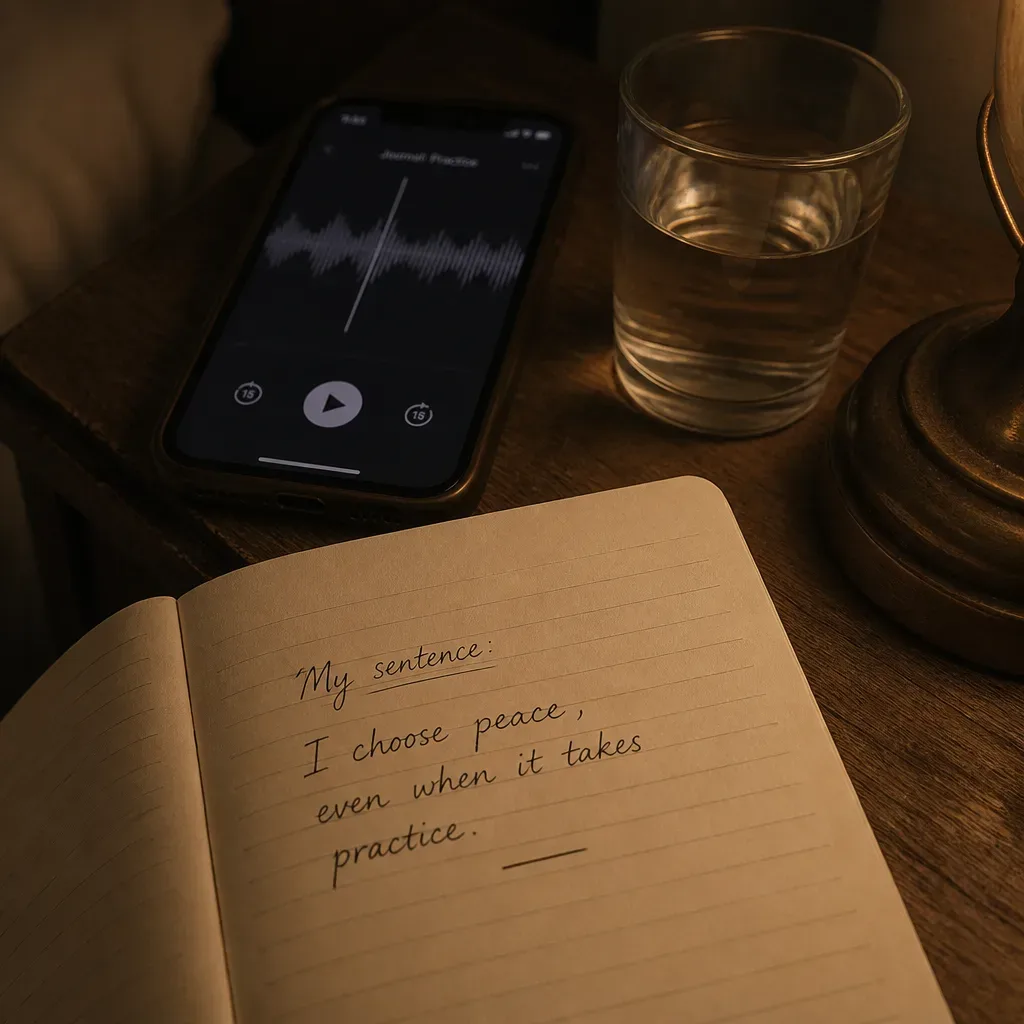
The lamp is low. Your phone is face down. Evening affirmations work best after a Dream-Self audio when they’re short, believable, and repeated slowly before sleep. Listen first. Then choose one sentence that echoes the future self you just heard, so the last thought of the day has somewhere kind to rest.
Why do evening affirmations land differently after audio?
They land differently because the audio gives your mind a felt context before the words ask to be believed.
A cold affirmation can feel like a sticker placed over an old bruise. You say, I trust myself, and another part of you says, not today. After a Dream-Self audio, the sentence has a room to live in. You have already heard a version of you speak from the life you intend. The affirmation isn’t trying to build the whole bridge. It’s one plank.
The AYA Method is a daily audio manifestation practice. Each day you listen to a short personalized recording — your Dream-Self Moment — narrated from the version of you who has already manifested the life you intend. Listening is the practice. Repetition is the work. The audio is the method.
This matters because the brain often receives spoken language differently from silent reading. A 2017 study in Memory found that words read aloud were remembered better than words read silently, a finding known as the production effect. The study isn’t about manifestation. Still, it points to something useful: sound, voice, and repetition can make language more available to memory.
Evening adds another layer. Sleep researchers have shown for decades that sleep supports memory consolidation. A 2013 review in Physiological Reviews describes sleep as active, not blank. The mind keeps sorting what you’ve practiced, feared, rehearsed, and felt. So the final cue matters. Not because it controls the night. Because it becomes part of what the night can work with.
A good affirmation doesn’t shout over doubt. It gives doubt a smaller job.
If you want a broader grounding in the practice, the affirmations pillar explains why wording, repetition, and state all matter. Here, the order is simple: audio first, affirmation second, sleep third. The sequence protects the softness of the evening.
What should you do before saying evening affirmations?
You should listen, lower the demand, and let the body know the day is ending.
The mistake is turning night into another performance review. You close your laptop and open a new scorecard: Did I manifest correctly? Did I say it enough times? Did I feel it? That kind of checking can wake the mind back up. The point is not to win the practice. The point is to return to one true sentence.
Give yourself a small setup. Two minutes is enough. The American Academy of Sleep Medicine often recommends consistent wind-down cues as part of sleep hygiene, and many clinical sleep resources suggest reducing stimulating input 30 to 60 minutes before bed. You don’t need a perfect evening. You need a repeatable signal.
Try this before the words:
- Put the phone on Do Not Disturb for 12 minutes.
- Sit or lie in the same place you usually sleep.
- Listen to your Dream-Self Moment without multitasking.
- Notice one sentence or image that stayed with you.
- Turn that into one evening affirmation.
If you use the AYA Method, don’t make the affirmation the main event. The audio is the method. The app also includes a daily affirmation and Manifestation Board, but those are complements. They work best when they support the listening rather than compete with it.
A 2009 study in the European Journal of Social Psychology found habit formation varied widely, with an average of 66 days for a behavior to become automatic. That number is often oversold, but the useful part is quieter: repetition needs to be small enough to survive ordinary life. Twelve minutes at night can survive more than a one-hour ritual.
How do you write affirmations that feel true at night?
You write them by making the sentence present, specific, and close enough for your system to accept.
At night, your defenses may be lower, but your honesty is often sharper. A sentence that sounds fine at noon can feel absurd at 11:38 p.m. This is not failure. It’s information. If an affirmation makes your body tighten, reduce the claim until it feels possible.
Use this simple filter:
| If the sentence says | Make it softer |
|---|---|
| I have everything I want | I can receive one next right thing |
| I never doubt myself | I can hear doubt and still choose |
| I am fully healed | I am allowed to rest while I mend |
| Money always finds me | I can make one clear money decision |
| I am fearless | I can be afraid and still be here |
Claude Steele’s self-affirmation theory, first developed in the 1980s, doesn’t say that repeating any sentence changes reality. It suggests that affirming core values can reduce defensiveness and help people stay open under threat. Later studies have been mixed across settings, which is worth saying. Still, the core lesson is useful: words work better when they touch what you actually value.
So don’t write like a billboard. Write like a witness.
Good evening affirmations often include:
- one present-tense verb
- one felt quality, such as steady, honest, safe, clear
- one small proof point from your real day
- no pressure to feel perfect
- no promise you secretly don’t believe
For example: I am becoming someone who answers my own life with care. Or: I can let tomorrow meet me after I sleep. Or: I know how to take one honest step.
Neville Goddard often wrote about entering the feeling of the wish fulfilled before sleep. You don’t have to take every claim literally to use the practical part. Night is suggestible because it’s quiet. A sentence repeated there should be clean. Not inflated. Not frantic. True enough.
The sentence that works is usually smaller than the sentence that impresses you.
If you’re new to the wider practice, manifestation is less useful as a fantasy and more useful as a daily way of training attention, identity, and action. The words at night should point you back to the person you’re practicing being.
Which evening affirmations work after a Dream-Self Moment?
The best ones echo the audio without copying it too literally.
Your Dream-Self Moment may include details: a room, a relationship, a body feeling, a calendar, a bank account, a morning, a quiet confidence. Don’t grab every detail. Choose the one that stayed. That is usually the doorway.
Here are evening affirmations you can adapt after listening:
- I can rest as the person I’m becoming.
- I don’t need to solve tomorrow before I sleep.
- My next honest step is enough for tonight.
- I know the sound of my own future self.
- I can let one true thing stay with me.
- My body is allowed to believe slowly.
- I return to what I already know is mine.
- I can be steady before I have proof.
- Tonight, I practice receiving my own voice.
- I don’t chase the life I intend. I rehearse belonging to it.
A note from the reviewer’s chair: the best wellness apps reduce friction. They don’t add twenty new obligations to your already loud day. Pew Research Center reported in 2024 that most U.S. adults own smartphones, and many check them frequently; the phone can become a slot machine at bedtime if the app asks too much. A short audio, then one sentence, is cleaner.
Joe Dispenza often speaks about mental rehearsal and emotion, while Dr. Andrew Huberman has popularized the role of repetition, attention, and state in learning. You don’t have to make either man your authority. The shared thread is practical: the brain changes through repeated signals, especially when attention is present. Three rushed affirmations while scrolling are weaker than one sentence heard fully.
If astrology is part of how you time your reflection, keep it secondary and grounded. Astrology and manifestation can offer a symbolic calendar, but it shouldn’t replace the nightly act of listening. The practice happens in your own room. With your own breath. With one sentence you can stand behind.
How long should the whole night practice take?
It should take about 12 minutes, because a short practice repeated nightly beats a long one you quit by Friday.
Here is the clean version:
| Minute | Practice | Why it helps |
|---|---|---|
| 0-1 | Put the room in night mode | Reduces decision noise |
| 1-7 | Listen to the Dream-Self Moment | Keeps audio as the method |
| 7-9 | Repeat one affirmation | Gives the mind a clear cue |
| 9-11 | Write one proof line | Links words to lived evidence |
| 11-12 | Stop | Lets sleep be sleep |
The stop matters. Many people make inner work too long because stopping feels like not doing enough. But behavioral design often favors tiny repeatable actions. BJ Fogg’s Tiny Habits model, developed at Stanford, focuses on making behaviors small and attaching them to existing prompts. Bedtime is already a prompt. You don’t need to invent a second life around it.
A 2022 review in Nature Reviews Psychology noted that habits are strongly shaped by context cues and repetition. Same chair. Same lamp. Same audio. Same small sentence. The ordinary sameness is not boring. It’s the point.
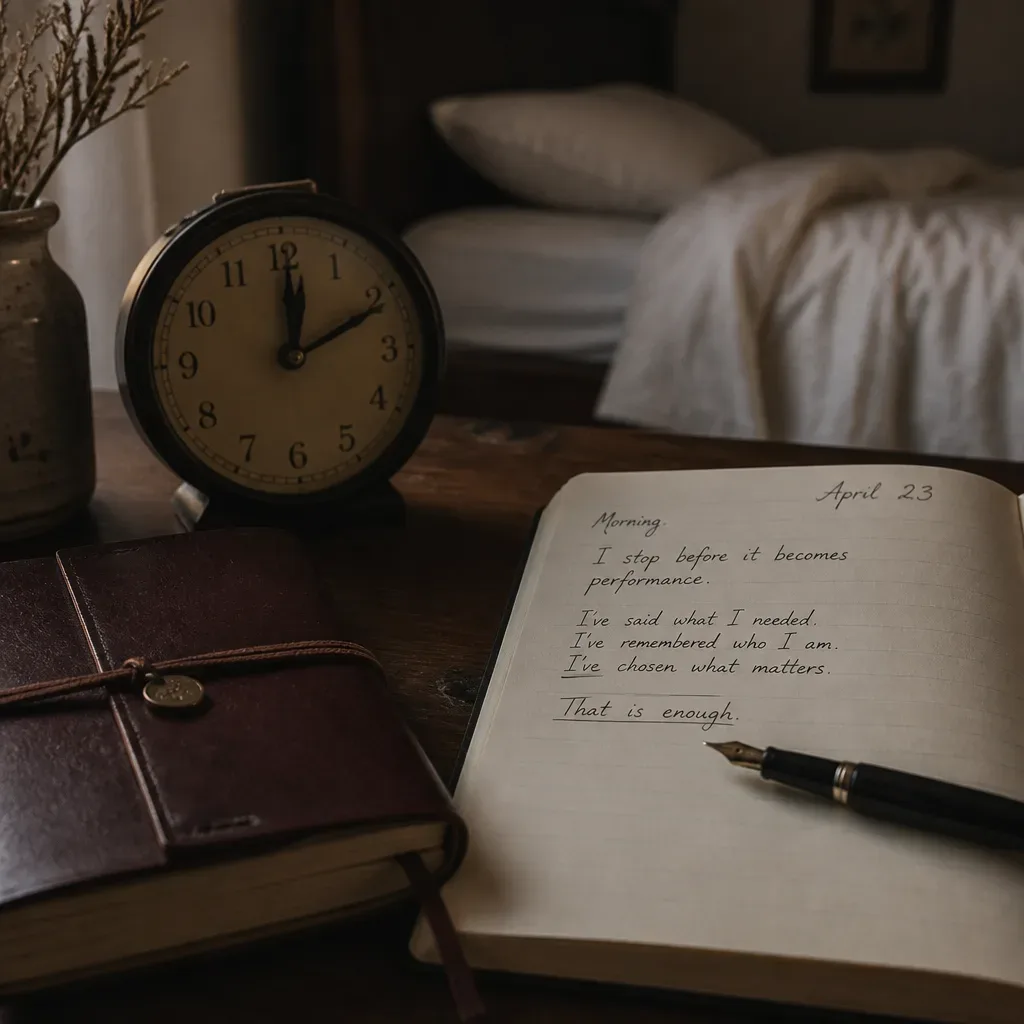
If you want to write the proof line, keep it plain. Not a gratitude list unless that comes naturally. Just one piece of evidence.
Examples:
- I answered the email I was avoiding.
- I didn’t restart the argument in my head for ten minutes.
- I chose water before wine.
- I asked for the price instead of guessing.
- I closed the laptop when I said I would.
Proof doesn’t have to be dramatic. It has to be noticed.
That one proof line keeps the affirmation from floating away. It tells the mind: this isn’t pretend. There was already a trace of it today.
What mistakes make evening affirmations feel hollow?
They feel hollow when they’re too big, too many, too late, or disconnected from the audio.
The first mistake is inflation. I am completely new by morning sounds dramatic. It also asks sleep to do the work of a whole life. A quieter sentence is stronger: I can wake and choose again. The second mistake is volume. Thirty affirmations can become noise. The third is checking. If you keep asking, do I believe it yet, you’re not practicing belief. You’re practicing surveillance.
The fourth mistake is using affirmations to avoid action. Manifestation is not a substitute for sending the message, setting the boundary, applying for the role, calling the doctor, or telling the truth. The Manifestation pillar is useful because it keeps desire connected to identity and repeated action. Words at night should make action clearer, not optional.
Clinical research on positive self-statements is more nuanced than social media admits. A 2009 paper in Psychological Science by Wood, Perunovic, and Lee found that positive self-statements could make some people with low self-esteem feel worse. That doesn’t mean affirmations are bad. It means scale matters. If the sentence is too far from your current self-image, the mind may reject it.
So edit down:
- From: I am always chosen.
- To: I can stop auditioning tonight.
- From: I never fail.
- To: I can learn without turning on myself.
- From: Everything is perfect.
- To: One part of me can unclench.
If you like a visual complement, the Manifestation Board can hold images or words from your Dream-Self Moment. But keep the order clear. Audio first. Then one sentence. Then rest.
How do you keep the practice going when you’re tired?
You keep it going by making the smallest version count.
Some nights you won’t want a method. You’ll want the room dark and the day over. Good. The practice should have a minimum viable version. In app terms, this is where most products fail: they assume your best self will show up every night. Real tools plan for your tired self.
Use the three-level version:
| Night type | What to do | Time |
|---|---|---|
| Full night | Audio, affirmation, proof line | 12 min |
| Tired night | Audio, one whispered sentence | 7 min |
| Barely-here night | One breath, one sentence | 60 sec |
The 60-second version isn’t failure. It’s continuity. Habit researchers often point to consistency over intensity. If you miss one night, don’t make the next night a punishment. A 2019 study in Health Psychology Review noted that lapses are common in behavior change; the return pattern matters more than the lapse itself.
Pair the practice with something you already do. After brushing teeth. After plugging in the phone. After turning off the larger light. The cue should be boring enough to repeat. Quiet enough to not ask for a new identity before bed.
One more note. If affirmations trigger distress, shame, or racing thoughts, pause and choose grounding instead. Name five things you see. Feel the sheet under your hand. Call someone safe if you need to. No manifestation practice should make you override your own nervous system.
For a simple next step, read the affirmations guide and then keep tonight very small. Listen. Choose one line. Let it be enough.
The room is still, and one true sentence stays.