affirmations
Money Affirmations That Feel Safer as Audio
Money affirmations can feel safer when heard as future-self audio, especially if money stress makes written statements feel false or tense.

A bill sits unopened on the table. Your phone is face down. Money affirmations can help, but only when they don’t make your body brace. Future-self audio can make them feel safer because you hear money change as memory, not demand. The voice matters. So does the pace.
Why do some money affirmations make your body tighten?
Some money affirmations feel unsafe because they ask you to believe a sentence your nervous system reads as a threat.
If you’ve lived through overdraft fees, unpaid invoices, family shame, or debt calls, money isn’t only math. It’s memory. The Federal Reserve’s 2023 Survey of Household Economics and Decisionmaking reported that 37% of adults would have trouble covering a $400 emergency expense using cash or its equivalent. For many people, “I’m wealthy now” doesn’t sound inspiring. It sounds like lying near an open wound.
This is where affirmations get misunderstood. The sentence isn’t meant to bully you into belief. It’s meant to give attention a new place to rest. Research on self-affirmation has shown measurable effects under stress. In a 2016 Social Cognitive and Affective Neuroscience study, Cascio and colleagues found that self-affirmation activated brain regions linked with valuation and self-processing. Still, the content has to feel reachable.
A safer money affirmation has three qualities:
- It doesn’t deny the present.
- It gives you one next self-image, not a fantasy life.
- It lets your body stay in the room.
A sentence can be technically positive and emotionally violent. “I’m rich and money comes easily” may sound clean on paper. But if your rent is late, your body may hear, “You’re failing because you don’t believe hard enough.” That isn’t practice. That’s pressure.
A softer version might be: “I can look at money and still stay with myself.” It’s not smaller. It’s truer. Truth is what makes repetition usable. You don’t need a louder affirmation. You need one your body can stay near.
For a fuller foundation on how statements shape attention, you can read the affirmations guide. It treats the words as a daily cue, not a performance.
Why can future-self audio feel safer than reading the same words?
Future-self audio can feel safer because it changes the affirmation from a claim you must prove into a memory you’re allowed to hear.
When you read “I’m safe with money,” you may inspect it. Is it true? Is it stupid? Who am I kidding? The mind becomes a courtroom. Audio can bypass some of that argument because tone arrives first. A 2021 Pew Research Center report found that 85% of U.S. adults owned a smartphone, which means short audio rituals can live inside an object many people already touch dozens of times a day.
In the AYA Method, this is the center of the practice: The AYA Method is a daily audio manifestation practice. Each day you listen to a short personalized recording — your Dream-Self Moment — narrated from the version of you who has already manifested the life you intend. Listening is the practice. Repetition is the work. The audio is the method.
That future-self frame matters. It doesn’t say, “Pretend nothing hurts.” It says, “Hear from the you who learned how to stay.” For money affirmations, that distinction is tender and practical. You’re not forcing a present-tense sentence across a gap. You’re listening to a version of you describe what became normal with time.
Here’s the difference in the body:
| Written money affirmation | Future-self audio version | Why it may feel safer |
|---|---|---|
| I’m rich. | I remember when money stopped feeling like danger. | It honors the old fear. |
| Money comes easily. | I’ve learned to receive without bracing. | It speaks to capacity. |
| I’m debt-free now. | I kept taking one honest step with what I owed. | It supports action. |
| I deserve more money. | I stopped shrinking when it was time to ask. | It names behavior. |
Voice gives an affirmation a handrail. A pause can make a sentence believable enough to touch.
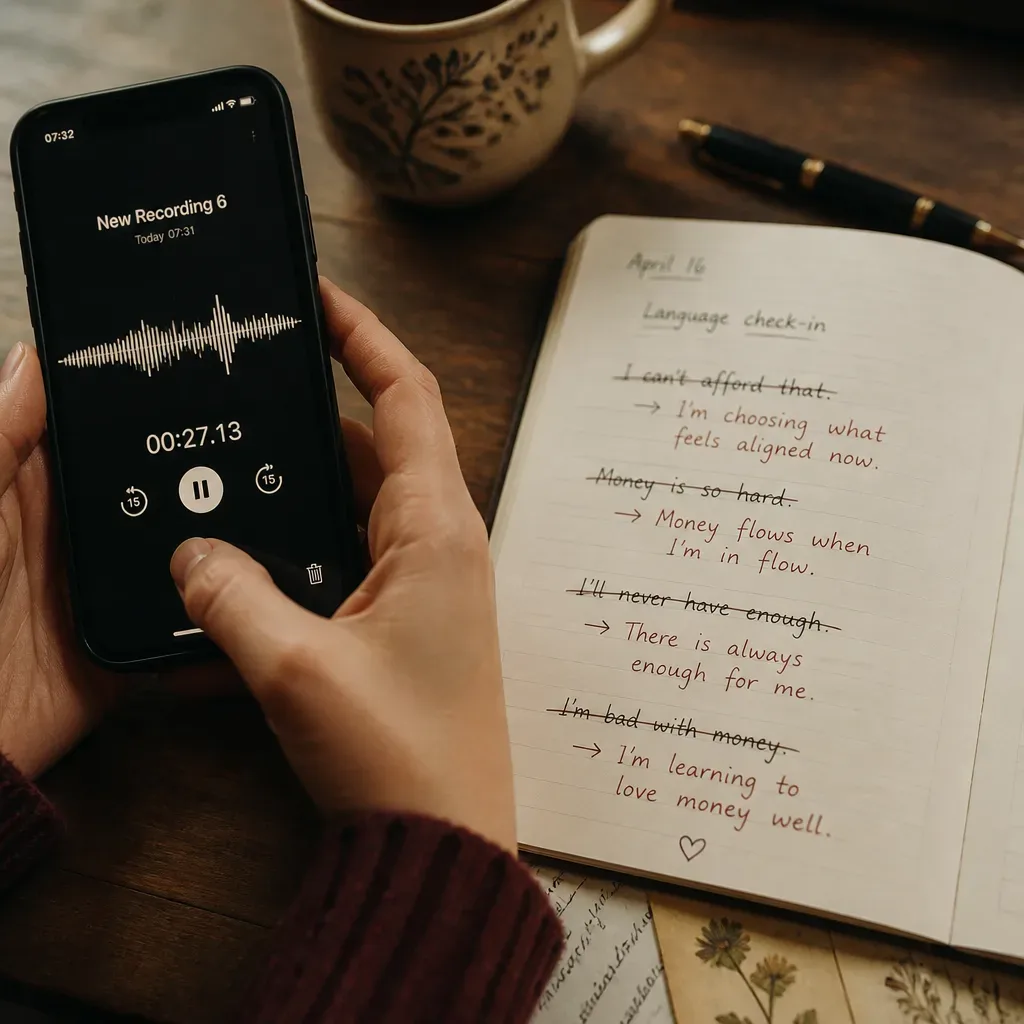
Which money affirmations are gentler when spoken by your future self?
The safest money affirmations are the ones that name steadiness before scale.
Try these as future-self lines, not declarations shouted at the present. Read them slowly. Then notice which one your shoulders can accept. The American Psychological Association has repeatedly named money as one of the most common sources of stress in its Stress in America reporting; that’s reason enough to use language with care.
- “I remember when I could finally look at my accounts without leaving myself.”
- “I learned to tell the truth about money in a quieter voice.”
- “I stopped making every number mean something about my worth.”
- “I became someone who opens the bill, breathes, and chooses one next step.”
- “I let support reach me without apologizing for needing it.”
- “I began asking for fair pay without making my needs small.”
- “I trusted slow repair more than sudden rescue.”
- “I noticed the small returns, and I let them count.”
- “I kept one promise to my future self each week.”
- “I became safe enough with money to make clear choices.”
The lines work because they don’t worship a number. They build a relationship. In clinical and behavioral research, implementation intentions have shown that specific “if-then” planning can increase follow-through. Peter Gollwitzer’s work on implementation intentions, cited widely since the late 1990s, points to this: behavior improves when the next action is concrete.
That’s why a sentence like “I open the banking app every Friday morning and breathe once before I judge myself” may serve you better than “Money loves me.” Specificity lowers the threat. It gives the mind a door.
You can pair any affirmation with a small cue:
- Before opening your banking app.
- After sending an invoice.
- While walking to work.
- Before a pricing conversation.
- After paying a bill.
One good money affirmation doesn’t make you fearless. It makes fear less likely to drive.
How do you write money affirmations that don’t feel false?
You write safer money affirmations by moving from proof to practice.
Start with the place that feels tense. Not the dream number. The moment. Is it checking a balance? Asking to be paid? Receiving a gift? Saying no to a purchase? A 2009 University College London study by Phillippa Lally and colleagues found that habit automaticity took 66 days on average, with a range from 18 to 254 days. Repetition needs patience. So do money beliefs.
Use this simple structure:
- Name the old pattern without shame.
- Name the new response in one sentence.
- Put it in future-self voice.
- Keep the line under 18 words if possible.
- Listen daily for at least 30 days before judging it.
Here’s an example. Old pattern: “I avoid my account because I’m scared.” New response: “I check, breathe, and choose one step.” Future-self audio: “I remember when checking my account became an act of staying with myself.”
The future-self version gives the behavior emotional meaning. It isn’t only “check the account.” It’s “I don’t abandon myself when numbers appear.” That’s a different identity.
You can also soften tense money affirmations with bridge words:
- “I’m learning…”
- “I’m becoming…”
- “I can begin…”
- “I’m allowed to…”
- “I remember when…”
Bridge words matter because the brain notices mismatch. If the sentence is too absolute, it can invite inner argument. Self-affirmation research doesn’t require you to use grand language. It asks you to reconnect with values and identity. In a 2013 PLOS ONE paper, Creswell and colleagues linked self-affirmation to lower stress responses in problem-solving tasks. The point is steadiness, not spectacle.
If you want the broader frame of manifestation without making money the whole story, the manifestation pillar gives a clear place to begin. Money is one room in the house. It isn’t the whole home.
What should a money affirmation audio sound like?
A money affirmation audio should sound like someone who isn’t trying to sell you certainty.
Pace is part of safety. A slow voice gives your body time to update. If every sentence arrives too quickly, your mind may treat it like instruction, not care. Audio researchers and clinicians often note that breath, rhythm, and tone can influence state; even in meditation studies, session lengths vary widely, but brief practices of 5 to 10 minutes are common in published trials.
For money, I’d keep the first audio short. Two to four minutes is enough. You’re not trying to flood the system. You’re trying to become familiar. Familiarity is underrated. A line heard calmly for 30 mornings can become more available during one difficult phone call.
A safer money affirmation audio might include:
- A first sentence that places you in the future.
- Two or three memories of what changed.
- One line about money behavior.
- One line about receiving.
- One quiet close.
For example:
“I remember when opening my accounts no longer meant disappearing. I learned to breathe before I judged myself. I became honest earlier. I asked cleaner questions. I let money become information again.”
That last sentence is worth keeping. Money becomes less frightening when it becomes information again.
You can also decide what not to include. Avoid numbers that your body rejects. Avoid luxury scenes that make you compare. Avoid language that makes wealth a moral score. The astrology and manifestation guide can be useful if you like timing rituals, but timing doesn’t replace listening. The audio is where the identity repeats.

How do you use money affirmations without avoiding real money tasks?
You use money affirmations well when they make real tasks easier to face, not easier to avoid.
This is the line. A sentence is supportive if it helps you open the email, check the account, make the call, send the invoice, or ask the question. It’s not supportive if it becomes a curtain. The Consumer Financial Protection Bureau has reported that financial well-being includes having control over day-to-day finances and the capacity to absorb a shock. That means practice has to touch behavior.
Pair the audio with one small action. Keep it almost too small. After listening, you might:
- Open one account.
- Rename one transaction.
- Send one invoice reminder.
- Move $5 to savings.
- Write one sentence about what you need to know.
The number matters less than the contact. You’re teaching your body that money can be approached in small doses. This is especially helpful if your old pattern is all-or-nothing repair. Six hours of panic budgeting once a month is not the same as five minutes of honest contact every morning.
There’s a design reason this works. Tiny rituals reduce friction. Stanford behavior researcher BJ Fogg has written for years about making habits small enough to do. A money affirmation paired with a small action becomes a loop: hear, feel, do, return. Not dramatic. Repeatable.
If you use the app, the daily affirmation and Manifestation Board can complement this, especially when you want a visible reminder. But they’re not the method. In Aya, listening stays central. The Dream-Self Moment is the daily return.
You can read more about how affirming language works in the affirmations pillar, especially if you’re sorting the difference between denial and devotion to a truer self.
When are money affirmations not enough?
Money affirmations are not enough when the problem requires protection, planning, legal help, debt support, or a change in income.
This matters. A softer sentence can help you stay present, but it can’t replace food, rent, fair pay, or expert advice. If you’re facing harassment from collectors, unsafe dependence, tax trouble, or high-interest debt, practical support belongs beside the practice. In the United States, nonprofit credit counseling agencies, legal aid groups, and government resources exist for this reason. In other countries, the names change, but the need is the same.
You’re allowed to use both. You can listen to a future-self audio in the morning and call a counselor at noon. You can repeat “I stay with myself when I ask for help” and then actually ask. The affirmation prepares the room. It doesn’t do every job in the room.
A good test is simple: after listening, do you feel a little more able to face one true thing? If yes, keep going. If you feel more detached from the facts, change the words. The practice should bring you closer to your life, not farther from it.
One sentence I return to as a designer is this: a ritual is only kind if it leaves you more able to live. That’s true for money affirmations too. They’re not proof that you’re spiritual enough, disciplined enough, or deserving enough. They’re a way of hearing the self you’re practicing becoming.
For the widest frame, keep the AYA Method close: listening is the practice, repetition is the work, and the audio is the method. If money has felt like noise for a long time, begin with one quiet recording. Let the future self speak in a way your present self can bear.
Leave the bill on the table for one breath, then come back to yourself.