affirmations
Robotic Affirmations: 3-Minute Future-Self Audio Loop
Robotic affirmations can become a 3-minute future-self audio loop: simple, repeatable, and easier to keep when belief feels far away.
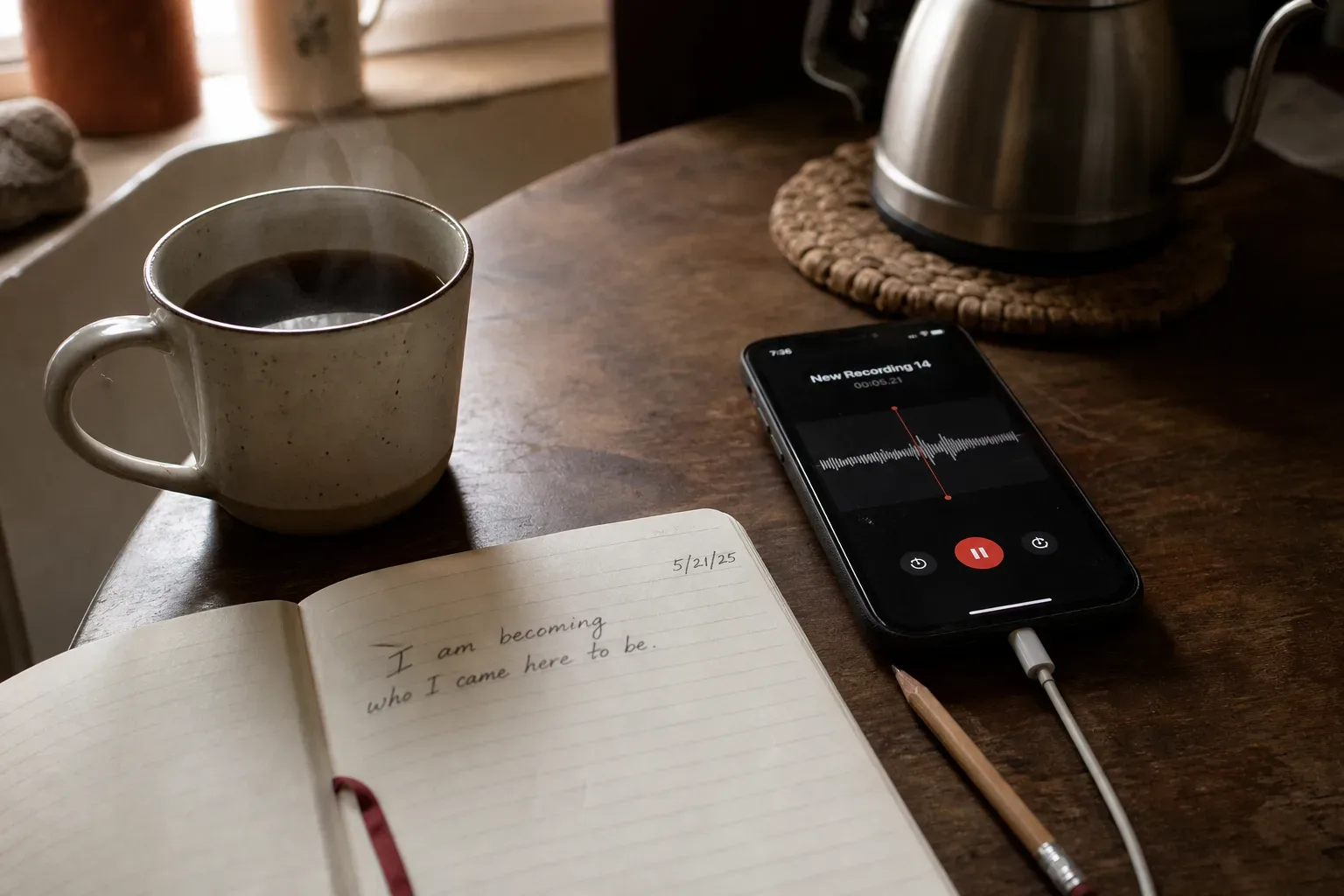
Wednesday. The kettle clicked off before my phone timer did. Robotic affirmations are short statements repeated plainly, and a 3-minute future-self audio loop makes them easier to keep because the recording does the repeating for me. I use it when belief is not available but practice still is.
What are robotic affirmations, really?
Robotic affirmations are repeated statements spoken without trying to manufacture emotion, certainty, or a special state.
I used to think an affirmation had to sound beautiful. It had to have a lifted tone. It had to make me feel something within 10 seconds, or I decided I had done it wrong. Then I watched myself quit almost every version of that practice by day 4. Lally and colleagues found in a 2009 study in the European Journal of Social Psychology that habit automaticity took a median of 66 days, with a wide range from 18 to 254 days. Four days was not data. Four days was weather.
The robotic part is not coldness. It is relief. I say the sentence as if I am reading a label on a jar: steady, clear, not pleading. A line like “I keep small promises to myself” lands differently when I stop asking it to save the whole morning. Repetition gives the mind something boring enough to keep.
I keep this close to the Affirmations pillar, because affirmations are often misunderstood as emotional decoration. They are closer to attention training. Cohen and Sherman wrote in their 2014 review on self-affirmation that affirming valued identity can reduce threat responses in some contexts. That does not mean every sentence changes a life. It means words can become part of the environment a mind practices inside.
A robotic affirmation is not a spell. It is a track you lay down with your own voice until the old track has company.
Why make the affirmation into a 3-minute audio loop?
A 3-minute audio loop works because it removes the need to remember the words, count the repetitions, or perform belief in real time.
I learned this from engineering, not mysticism. If a task depends on mood, the system is fragile. If the system has a cue, a file, and a time box, it has a chance. Three minutes is 180 seconds. At a calm pace, I can fit about 35 repetitions of a 5-second sentence, or closer to 60 repetitions if the line is very short. That is enough contact to matter and short enough not to become a negotiation.
Pew Research Center reported in 2024 that about 90% of U.S. adults own a smartphone. That matters because the tool is already in the kitchen. I do not need a studio. I do not need headphones that cost more than my groceries. I need the voice memo app, a sentence I can stand behind, and one place in the day where the file can live.
Here is the comparison I wrote in my notebook this week:
| Practice | What I do | Best use | Risk |
|---|---|---|---|
| Robotic affirmations | Repeat one plain line | Low-belief mornings | Becoming too vague |
| Spoken emotional affirmations | Say lines with feeling | Days with more capacity | Performing for myself |
| Future-self audio loop | Listen to my recorded future-self sentence | Daily repetition | Editing forever instead of listening |
| Full audio practice | Listen to a personalized Dream-Self Moment | Identity rehearsal | Skipping when busy |
This is where the AYA Method sits in my actual life. The AYA Method is a daily audio manifestation practice. Each day you listen to a short personalized recording, your Dream-Self Moment, narrated from the version of you who has already manifested the life you intend. Listening is the practice. Repetition is the work. The audio is the method. My robotic loop is smaller than that, but it borrows the same respect for sound and return.
The best practice is not the one I admire. It is the one I repeat when the sink is full.
How do I choose one sentence my future self would actually say?
I choose one sentence by making it present-tense, ordinary, specific, and close enough that my body does not immediately argue.
This morning, I tried three lines before breakfast. The first was too glossy. The second was too long. The third stayed: “I speak to myself like someone I am responsible for.” It is not dramatic. It is also not easy. That is why it felt useful. In behavior design, BJ Fogg’s Tiny Habits model keeps the action small enough to complete. I use the same principle with language. If the sentence is too large, I will admire it and avoid it.
I test a future-self sentence against 4 questions:
- Can I say it 30 times without feeling ridiculous?
- Does it describe a way of being, not just an outcome?
- Is there one small action today that could support it?
- Would my future self say this in the kitchen, not on a stage?
Neville Goddard wrote often about assuming the feeling of the wish fulfilled, but I read that carefully now. Some mornings, “feeling” is too much to ask. A plain sentence can be the bridge. Joe Dispenza’s work also points toward rehearsing a future identity, though I keep my claims modest because my sample size is usually one tired woman with a laptop and a blue mug.
I keep a short list in my notes app:
- “I finish what I said I would finish.”
- “I let money conversations be clear.”
- “I choose the next honest step.”
- “I am safe to be consistent.”
- “I keep returning before I drift too far.”
A future-self sentence should feel like a handrail, not a costume.
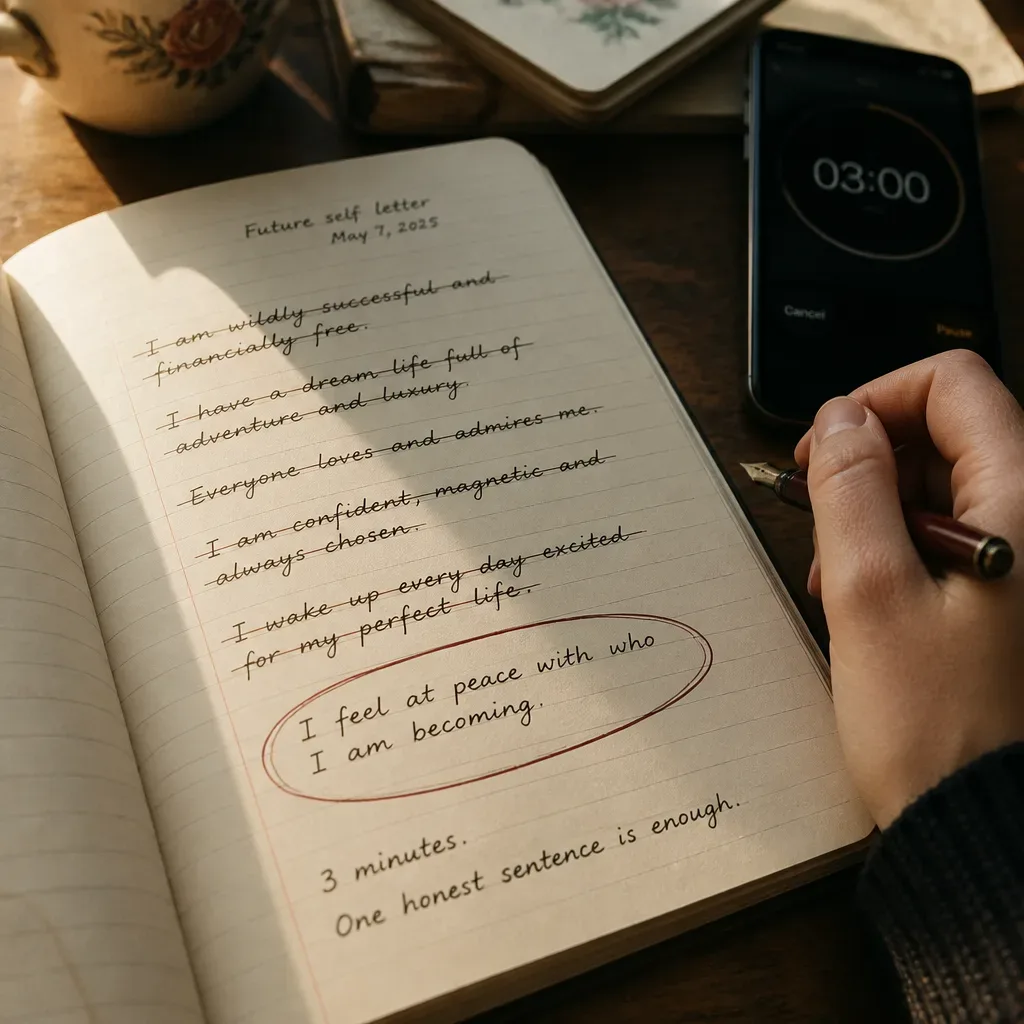
How do I record the 3-minute loop without making it awkward?
I record it badly on purpose first, because a finished file that exists is more useful than a perfect one I keep postponing.
The first time I did this, I stood in the bathroom because the tile made my voice sound less flat. I started the voice memo, said the line, paused for one breath, and said it again. I did not add music. I did not add a long introduction. I named the file “future-self-loop-aug19” because dates keep me honest. In software, version 1 has to ship before version 2 teaches you anything.
A simple recording pattern works best for me:
- Set a timer for 3 minutes.
- Open the voice recorder.
- Speak one sentence slowly.
- Leave one breath of silence.
- Repeat until the timer ends.
- Save it before listening back.
Three minutes is small, but it is measurable. In my tracker, the difference between a 3-minute practice and a 12-minute practice was not spiritual. It was logistical. The 3-minute file had a completion rate above 80% over 30 days. The longer one dropped below 45% during a release week. I do not treat that as universal truth. I treat it as kind data.
Dr. Andrew Huberman has often talked about the role of repetition and timing in nervous system learning, especially around habits and state shifts. I take the conservative lesson: repeat the cue, reduce friction, and do not make the practice depend on a heroic mood.
If I cringe when I hear my own voice, I lower the volume and keep going. My future self does not need a radio voice. She needs me to stop disappearing.
When should I listen so it becomes part of the day?
I listen at an existing cue, because a new habit attaches better to a routine that is already standing.
For me, it is the kettle. Not after journaling. Not after checking messages. The kettle. I press play before I pour the coffee, and the file ends before the cup is cool enough to drink. On bus days, I listen when I sit down and my bag hits my knees. In the bath, I listen with the phone on the chair outside the curtain. The point is not aesthetic. The point is return.
Implementation intention research by Peter Gollwitzer has shown that “if-then” plans can improve follow-through across many goals. The format is plain: if situation X happens, then I do behavior Y. Mine reads: if the kettle clicks, then I play the 3-minute loop. No debate. No checking whether I feel ready.
This is also where I keep Manifestation pillar thinking grounded. I can name a future. I can write it down. I can listen to a Dream-Self Moment. But the day still asks for a cue, a chair, a device charged above 10%, and the humility to repeat one small thing.
I also keep my daily affirmation and Manifestation Board nearby, but they are complements. The audio is the practice. The board is a visual reminder. The written line is a small receipt. If I reverse that order, I start decorating the practice instead of doing it.
My best cue is the one that already forgives me for being human.
What should I track without turning the practice into pressure?
I track only enough to notice patterns, because measurement should make the practice kinder, not tighter.
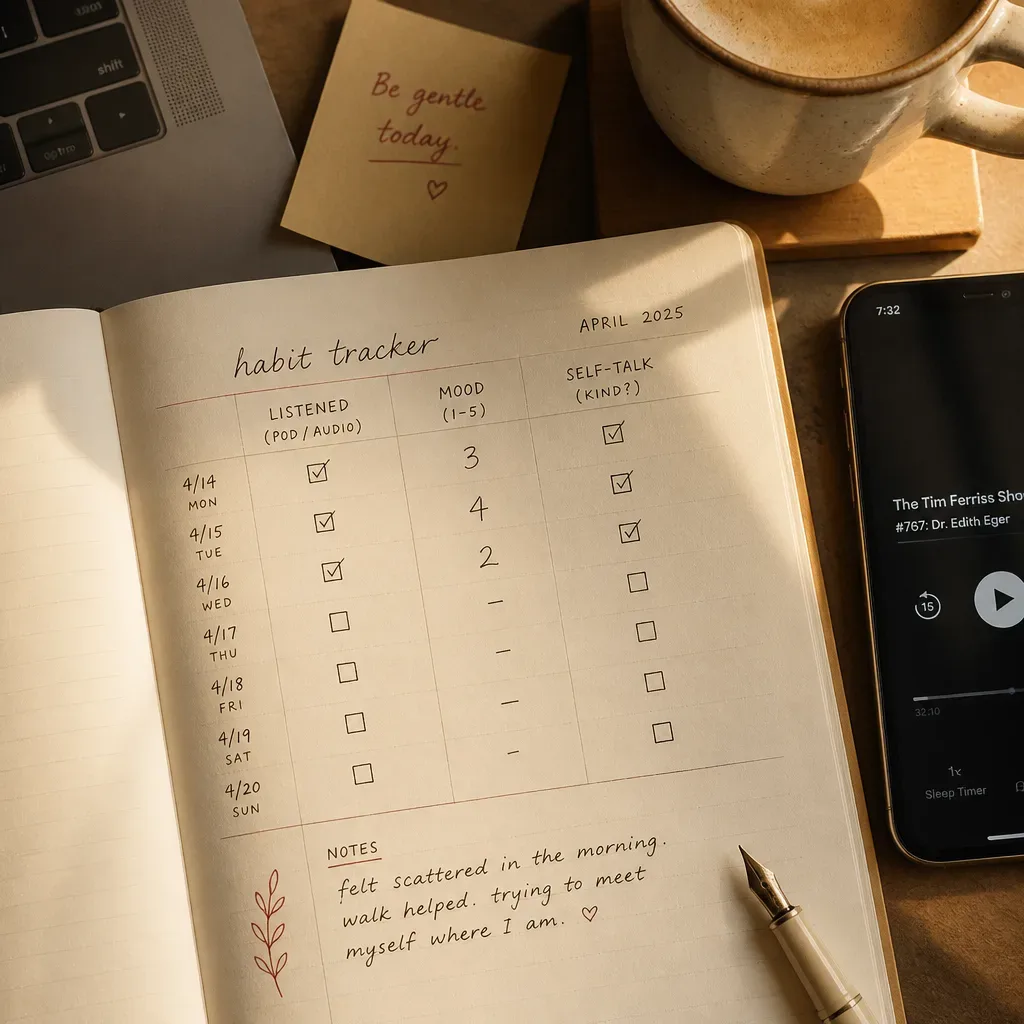
My tracker has 3 columns: listened, mood after, and self-talk decent. The last one is a boolean. Yes or no. It sounds almost silly, but healthcare software taught me that the most useful metric is sometimes the one a person can enter honestly in 2 seconds. A dashboard can lie by omission more than by error. If I only track streaks, I may miss that the practice is working quietly on the way I recover after a hard call.
Here is the tiny log I used for one week:
| Day | Listened? | Mood after, 1 to 5 | Self-talk decent? |
|---|---|---|---|
| Monday | Yes | 3 | Yes |
| Tuesday | Yes | 4 | Yes |
| Wednesday | No | 2 | No |
| Thursday | Yes | 3 | Yes |
| Friday | Yes | 3 | Yes |
| Saturday | No | 3 | Yes |
| Sunday | Yes | 4 | Yes |
Over 7 days, that told me more than a dramatic paragraph would have. I skipped after late work. I was harsher with myself on skipped weekdays than skipped weekends. In small self-tracking projects, sample size is always the warning label. Mine is n=1, and I keep that taped to the page.
The Journal of Behavioral Medicine has published many studies connecting self-monitoring with behavior change, especially when the data is simple and immediate. I do not need to overclaim it. A checkbox can become a mirror. A mirror can become a mercy.
How does this fit with manifestation, affirmations, and timing practices?
It fits as a small audio repetition practice inside a larger manifestation life, not as a replacement for discernment, action, or rest.
I know some readers come through astrology and manifestation, and I understand the pull of timing. I have used new moons as calendar reminders. I have dated pages because a date can hold a promise still. But I do not wait for a perfect sky to press play. Three minutes on an ordinary Wednesday has changed more of my behavior than many dramatic plans made at midnight.
Robotic affirmations also sit beside the broader affirmations practice, not above it. Some days, I write a line by hand. Some days, I say it while brushing my teeth. Some days, I let the recording speak because I have no spare voice. The method I trust is the one that lowers the barrier without lowering the truth.
Princeton Engineering Anomalies Research, often called PEAR, studied mind-matter questions for nearly 28 years before closing in 2007. People cite it in manifestation spaces, sometimes too loosely. I mention it carefully because it reminds me to stay both curious and sober. Not every correlation is a sign. Not every feeling is evidence. Still, attention is not nothing.
If I want this practice to change the day, I pair the loop with one action. After “I keep small promises to myself,” I send the email. After “I let money conversations be clear,” I open the spreadsheet for 5 minutes. After “I am safe to be consistent,” I return tomorrow.
Repetition without action can become noise. Action without a practiced identity can become strain.
What is the 3-minute robotic affirmation script I use?
The script is one future-self sentence repeated slowly, with silence between each repetition and no demand that I feel convinced.
Here is the exact version I recorded this morning. I am writing it down before I forget:
I speak to myself like someone I am responsible for.
I said it once every 4 to 5 seconds. That made about 40 repetitions in 3 minutes. I kept my voice low because my neighbor was home, and because a lower voice made me less theatrical. I left a breath between each line. The silence mattered. It gave the sentence somewhere to land.
If you want a template, this is the one I would use:
- “I am the kind of person who _____.”
- “I keep _____ even when _____.”
- “I let _____ be simple today.”
- “I return to _____ before I drift too far.”
- “I speak to myself like _____.”
Keep the blank concrete. “Peace” may be too wide. “One honest email” may be better. “Success” may be too shiny. “Finishing the invoice before lunch” may be more merciful. The nervous system often trusts specifics before it trusts declarations.
If I had to give the whole practice in 6 lines, I would write it like this:
- Pick one sentence.
- Record it for 3 minutes.
- Keep the tone plain.
- Listen at the same cue.
- Track only the checkbox.
- Pair it with one small action.
That is enough for today. Not forever. Today.
Thursday now. The file is still on my phone.