audio manifestation
Manifestation Podcast vs Future-Self Audio
A clear manifestation podcast comparison with personalized future-self audio, including when each helps, what to listen for, and what to skip.

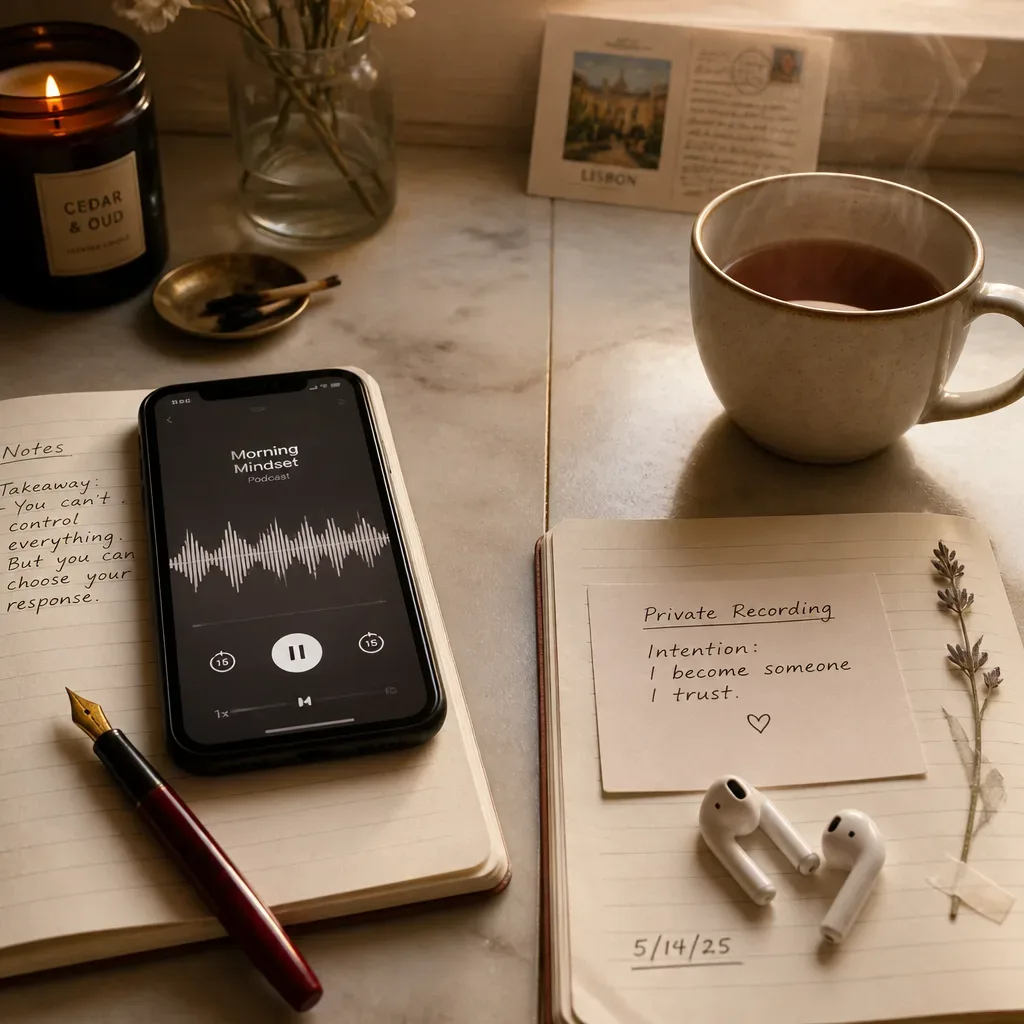
Your headphones are on the desk. One option is a manifestation podcast: useful for ideas, stories, and mood. The other is personalized future-self audio: better for repeated identity rehearsal. If you want learning, choose the podcast. If you want a daily practice, choose the audio made for you.
What is a manifestation podcast actually good for?
A manifestation podcast is best for learning the language of manifestation, not for replacing a daily practice.
A good episode can give you a frame. It can name a pattern you’ve felt but not said. It can bring in teachers like Neville Goddard, who wrote about “living in the end” in the 1940s, or Joe Dispenza, whose talks mix meditation, biology, and personal change. That kind of listening has a place. It’s like reading the side of the map before you walk.
Podcasts also fit the way people already listen. Edison Research’s 2024 Infinite Dial report found that 47% of Americans age 12 and older had listened to a podcast in the last month. That matters because friction matters. If you already listen while washing dishes or riding a train, a manifestation podcast can slip into a day without asking for much.
But scale is the catch. Most podcasts speak to thousands of people at once. The host can say “your dream life,” but they don’t know whether you’re trying to leave a job, write a book, steady your nervous system, or stop checking one person’s name on your phone. Wide audio can comfort you. It can’t always find you.
A podcast teaches you what to think about. Personalized audio lets you rehearse what you’re becoming.
That’s why I treat podcasts as education, not the center. If you’re new, start with one or two episodes and compare them with a grounded overview like the manifestation pillar. Look for plain language, not certainty theater. Look for examples, not promises. A useful manifestation podcast leaves you clearer after 30 minutes, not dependent on the next episode.
What does personalized future-self audio do differently?
Personalized future-self audio turns manifestation from general listening into specific repetition.
The AYA Method is a daily audio manifestation practice. Each day you listen to a short personalized recording — your Dream-Self Moment — narrated from the version of you who has already manifested the life you intend. Listening is the practice. Repetition is the work. The audio is the method.
That definition is doing more than branding. It tells you what the tool is for. Not passive comfort. Not another folder of advice. A short recording says, in your terms, what you’re practicing seeing as normal. If the desired life includes calmer mornings, cleaner decisions, or a more honest relationship with money, the audio speaks from inside that version of you.
There’s a reason repetition matters. A 2009 paper in the European Journal of Social Psychology by Phillippa Lally and colleagues found that habit automaticity took a median of 66 days to form, with wide variation from 18 to 254 days. The exact number isn’t the point. The point is that repetition makes a pathway less exotic.
The difference is also emotional precision. A podcast might say, “believe you’re worthy.” Personalized audio might say, “You answer the email before noon. You don’t apologize for asking the fee. You sleep without replaying the call.” One is a concept. The other is a room you can stand in.
Here’s the quiet test: if the audio could be sent to 50,000 strangers without changing a word, it isn’t personalized enough.

Which one works better for changing behavior?
Personalized future-self audio usually has the better structure for behavior change because it is shorter, repeatable, and tied to one identity cue.
This doesn’t mean every custom audio will work. Bad audio is bad audio, even when it uses your name. But the format has an advantage. Behavior change research keeps returning to cues, repetition, and identity. James Clear popularized the phrase “identity-based habits,” but the research spine is older: implementation intention studies by Peter Gollwitzer in the 1990s found that “if-then” planning can increase follow-through by linking a cue to an action.
A manifestation podcast rarely gives you that cue. It gives you an idea. Sometimes a very good one. But an hour later, the idea is competing with Slack, dinner, weather, and the small ache behind your eyes. Personalized future-self audio can be placed in the same slot every day. After brushing teeth. Before the first message. In the car before walking into work.
| Need | Manifestation podcast | Personalized future-self audio |
|---|---|---|
| Learn concepts | Strong | Light |
| Repeat daily | Harder if episodes are long | Easier if 3–7 minutes |
| Feel personally addressed | Usually low | High when well written |
| Build a cue | Possible | Natural |
| Replace overthinking | Sometimes | Better, if kept simple |
Dr. Andrew Huberman often describes neuroplasticity as requiring focused attention and repeated practice, especially when paired with adequate rest. Strip away the lab language and the lesson is plain: the brain learns what you return to. The return is not decorative. It’s the work.
This is where a daily audio practice earns its keep. Not because it’s mystical enough. Because it’s small enough to repeat. The voice that changes a habit is often the one you hear every day.
When should you choose a manifestation podcast instead?
Choose a manifestation podcast when you need context, comparison, or company more than you need a script.
There are seasons when you don’t know what you believe yet. You’re sorting through the difference between intention and fantasy. You’re trying to understand why affirmations sometimes feel fake. A smart podcast can help you hear several views before you decide what’s yours. Pew Research Center reported in 2023 that 49% of U.S. adults had listened to a podcast in the past year, and many said they use podcasts to learn. That learning role is real.
A podcast is also better when you want interviews. Hearing someone talk through a practice can show you the rough edges. I’ve trusted certain app founders more after listening to them answer plain questions for 40 minutes. I’ve trusted others less. Time reveals marketing shortcuts.
Use a manifestation podcast if you want:
- a broad introduction before choosing a practice
- interviews with teachers, therapists, founders, or long-time practitioners
- company on a walk or commute
- language for what you’re already sensing
- a low-pressure way to compare ideas
Just don’t confuse input with practice. Reading five menus doesn’t make dinner. Listening to five episodes doesn’t mean your inner script changed. If an episode gives you one sentence that feels true, write it down. If it gives you 17 open tabs in your head, close the app.
For a more structured view of the words you repeat to yourself, the affirmations pillar is worth keeping nearby. Affirmations can support the work. In Aya, the daily affirmation is a complement to the audio, not the main event.
When should you choose personalized future-self audio instead?
Choose personalized future-self audio when you already know the direction and need to hear it until it feels ordinary.
This is the place where less content helps. A podcast asks, “What else can I learn?” Personalized future-self audio asks, “What am I willing to repeat?” That question is less glamorous. It’s also more honest. Most change doesn’t fail because you lacked one more theory. It fails because the new self-image never became familiar enough to act from.
Mental rehearsal has a long research trail. Sports psychology has studied imagery for decades, and meta-analyses have generally found that mental practice can improve performance when paired with physical practice. The effect sizes vary by task, and it isn’t magic. Still, the principle is useful: the mind rehearses patterns before the body makes them visible.
A future-self recording makes that rehearsal intimate. It speaks as the version of you who has already crossed the line. Not “you should be confident,” but “you choose the clean answer now.” Not “money comes easily,” but “you look at the number, breathe, and make the call you said you’d make.” The phrasing matters because vague language gives the mind nowhere to land.
Here’s a simple way to choose:
- If you’re collecting ideas, listen to a podcast.
- If you’re choosing one intention, write it down.
- If you’re ready to repeat it daily, use personalized audio.
- If you’re tempted to keep researching, notice that as a delay.
- If the practice takes more than 10 minutes, make it smaller.
Manifestation gets less vague when it becomes a calendar event.
How do belief, skepticism, and science fit here?
Belief helps, but the useful question is whether the practice changes what you notice, choose, and repeat.
I’m an app reviewer, not a priest. I don’t need every tool to prove the whole cosmos is listening. I need it to help a person stop abandoning herself by Thursday. That’s why I prefer claims that can be felt in behavior. Did you send the proposal? Did you stop rehearsing the old fight? Did you sleep earlier twice this week? These are not small things.
Research around manifestation itself is mixed because the word covers too much. Visualization, goal setting, prayer, meditation, affirmation, and magical thinking often get thrown into one basket. Studies on positive fantasy, including work by Gabriele Oettingen, suggest that fantasizing without planning can reduce effort in some cases. Her WOOP model adds obstacle awareness and planning, which is more grounded.
There’s also fringe-adjacent research people cite, like the Princeton Engineering Anomalies Research lab and later Global Consciousness Project work. Those findings are debated and not a foundation I’d build a product review on. I’d rather look at what is less controversial: repeated attention, narrative identity, emotional regulation, and action cues.
Neville Goddard’s “assumption” work can be read spiritually. It can also be read practically: act from the state you’re practicing. Joe Dispenza’s audience often responds to the felt sense of rehearsal. You don’t have to accept every claim to use the useful part.
The clean line is this: don’t outsource your discernment to a voice, even a beautiful one. A good practice returns you to your own knowing. For timing-based reflection, some readers also pair practice with astrology and manifestation. Treat that as symbolic weather, not a substitute for action.
What should you look for before pressing play?
Look for audio that is specific, repeatable, calm, and honest about what it can and can’t do.
A manifestation podcast should earn your time quickly. The intro shouldn’t take 9 minutes. The host shouldn’t promise guaranteed outcomes. The episode should define terms, name sources when it uses science, and leave you with one usable thought. If it needs panic, grandeur, or constant urgency to hold you, it’s probably borrowing your attention rather than serving it.
Personalized future-self audio has a different checklist. It should sound like you, but a steadier you. It should include concrete scenes and choices. It should be short enough to repeat when life is boring, not only when you feel inspired. In app terms, I’d rather see one strong daily audio loop than 40 ornamental features.
Use this before you choose:
| Signal | Good sign | Red flag |
|---|---|---|
| Length | 3–7 minutes for daily audio | Too long to repeat |
| Language | Specific and believable | Generic praise |
| Science | Names limits | Overclaims certainty |
| Tone | Calm, direct | Urgent, inflated |
| Role | Practice first | Content binge first |
The manifestation pillar can help you separate intention from wishful thinking. The affirmations pillar can help you refine the sentences you repeat. But if you’re choosing between a manifestation podcast and personalized future-self audio, ask the simplest question: what will I actually return to tomorrow?
My answer, after testing more wellness apps than I care to admit, is boring and useful. Learn from podcasts. Practice with personal audio. Let the app also include a daily affirmation or Manifestation Board if those help you see the intention. But don’t mistake the extras for the center.
The room is still, and your own voice is near.