audio manifestation
Voice Manifestation Without Cringing at Your Audio
Voice manifestation can feel strange at first. Here is a soft, practical way to use audio daily without forcing a fake voice or mood.
Your phone is warm in your hand. Voice manifestation feels less awkward when you stop trying to sound inspired and make the audio plain, short, and repeatable. Use a future-self script, spoken in natural language, then listen once daily. The aim is not performance. The aim is recognition.
Why does voice manifestation feel so embarrassing at first?
Voice manifestation feels embarrassing because recorded sound exposes the gap between the voice you hear inside and the voice everyone else hears outside.
There is a body reason for this. When you speak, you hear your voice through air conduction and bone conduction at the same time. On a recording, the bone-conducted part is missing. That is why your voice often seems thinner, higher, or less yours. In a 2013 paper in Psychological Science, researchers described this discomfort as voice confrontation. It is ordinary, not a sign that the practice is wrong.
Then there is a second layer. Manifestation language often sounds too polished. It can make a normal person feel like an actor in a candle ad. The brain is good at rejecting lines that do not match lived evidence. Cognitive dissonance research has been around since Leon Festinger’s 1957 work, and the lesson still holds: if the statement feels too far from what you believe, you will tense against it.
Voice manifestation does not need a grand tone. It needs a believable one. Say less. Use words you would use in a kitchen, not on a stage. One clear sentence, repeated for 30 days, will usually serve you better than a perfect script you never play twice.
Cringe is not failure. Cringe is your nervous system asking for smaller language.
The first repair is permission. You are allowed to sound normal. You are allowed to pause. You are allowed to choose a narrator if your own voice makes the practice collapse. In the AYA Method, the audio leads for this reason: The AYA Method is a daily audio manifestation practice. Each day you listen to a short personalized recording — your Dream-Self Moment — narrated from the version of you who has already manifested the life you intend. Listening is the practice. Repetition is the work. The audio is the method.
What should a non-cringey voice manifestation script actually say?
A non-cringey script should describe one specific future-self moment in plain present tense.
Start with a scene, not a slogan. A scene gives the mind something to recognize. A slogan asks the mind to agree. If the line says, I am wildly successful, your body may push back. If the line says, I open the invoice email and feel steady, the mind has a smaller thing to rehearse. Small scenes tend to pass through the guard at the door.
Behavioral psychology gives this some backing. In 2009, Phillippa Lally and colleagues studied habit formation in the European Journal of Social Psychology and found a median of 66 days for a new behavior to become more automatic. That does not mean every practice takes 66 days. It means repeatability matters more than drama. A script you can hear every day is better than one that feels impressive once.
Use this simple order:
- Name where you are.
- Name what is now normal.
- Name one body cue of safety.
- Name one action you take from that state.
- End before it turns into a speech.
Here is the difference:
| Cringe line | Quieter line |
|---|---|
| I am unstoppable and everyone sees my greatness. | I send the message without rereading it ten times. |
| Money flows to me all day. | I check my account and stay calm. |
| My dream life is finally mine. | I wake up knowing what matters first. |
You can keep manifestation grounded without making it smaller. The quiet line is not weaker. It is easier to repeat. Neville Goddard taught the feeling of the wish fulfilled, but feeling does not have to mean intensity. Sometimes it is just relief. Sometimes it is the absence of panic.
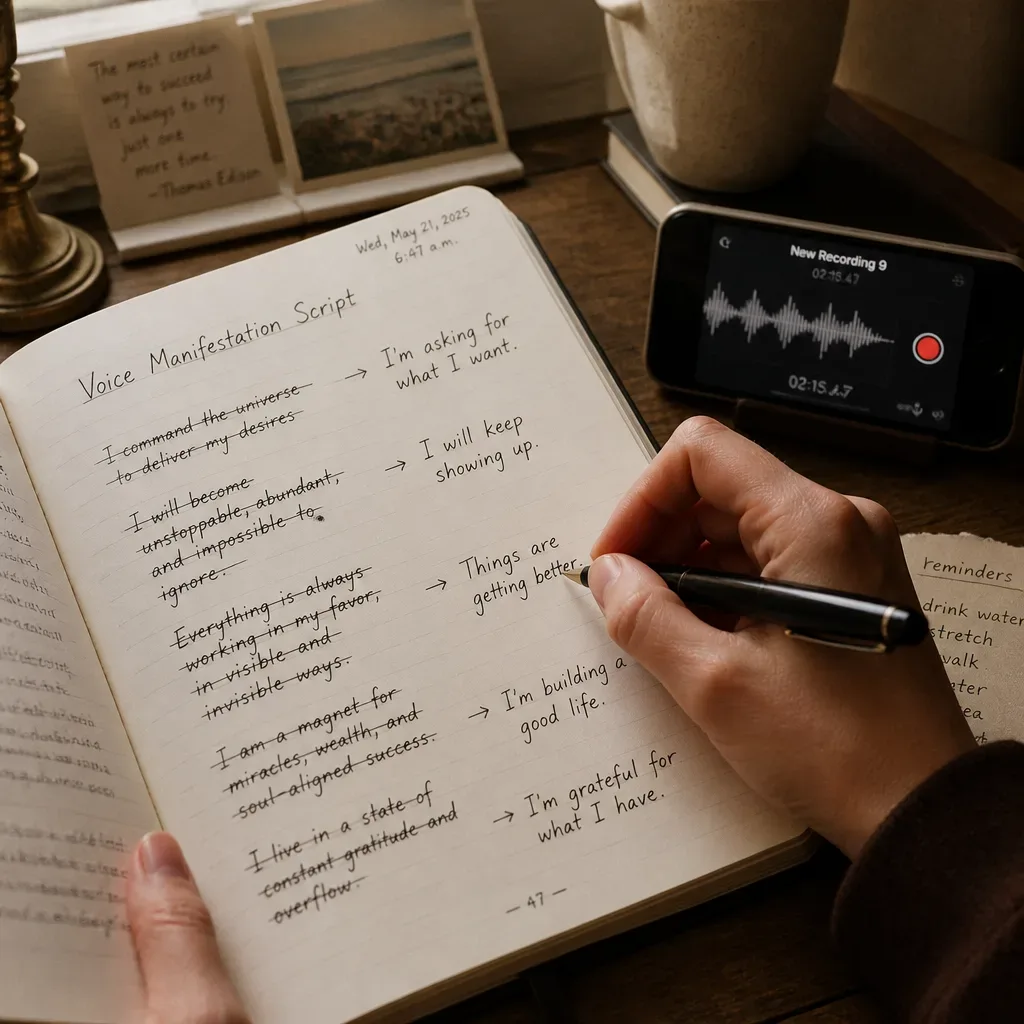
How do you record the audio without performing?
You record the audio without performing by speaking more slowly than usual and aiming for a private note, not a public result.
Put the phone down. Sit close enough that you do not need a stage voice. Most phone microphones work best within about 6 to 12 inches, which is also close enough to make you speak gently. Record in a room with fabric nearby: a bed, a curtain, a coat over a chair. You do not need a studio. You need less echo.
Before recording, read the script once silently. Then cut 10 percent. This is one of the few rules I trust from six years in venture: if a thing needs daily use, remove friction before you add features. The same is true here. The best wellness tool is the one you do not have to negotiate with at 7:13 a.m.
Try this three-pass method:
- Plain pass: read it with no emotion, like a note to yourself.
- Slow pass: record it 15 percent slower.
- Warm pass: add only enough softness that you believe it.
Then choose the pass you can listen to tomorrow. Not the one that sounds most spiritual. Not the one with the most feeling. Choose the one that does not make you flinch.
Dr. Andrew Huberman has often discussed how repeated cues can train attention and state over time, especially when paired with consistent timing. You do not need to borrow his full protocol to use the principle. A short audio, heard at the same moment each day, becomes a cue. The cue says: return here.
Voice manifestation is not acting. It is rehearsing belonging.
If your own voice still makes you close the app, use a personalized narrator. That is not cheating. The method is listening. Your future-self language can arrive through a voice that lets you stay with it.
When should you listen so the habit survives?
You should listen at the most repeatable moment of your day, not the most ideal one.
Morning is popular because attention has not yet been spent. But a morning practice that requires a new personality by 5:30 a.m. is usually a fantasy. If you already touch your phone before coffee, use that. If you walk the dog at 8:10, use that. If the house gets quiet after 10 p.m., use that. The right time is the time you can keep.
The 2023 Pew Research Center smartphone data showed that 90 percent of U.S. adults owned a smartphone. That means the device is not the problem. The problem is what gets to you first. If your first input is email, your body learns urgency. If your first input is a 3-minute Dream-Self Moment, your body gets a different opening.
Here is a simple timing map:
| Time | Best for | Watch for |
|---|---|---|
| Before getting out of bed | People who wake slowly | Falling back asleep |
| After brushing teeth | People who like anchors | Rushing the audio |
| During a walk | People with restless minds | Traffic and safety |
| Before sleep | People who soften at night | Turning it into analysis |
The app can include a daily affirmation and a Manifestation Board, but treat them as complements. The audio remains the method. If you use affirmations, let them echo the recording rather than replace it. One line can support the scene. It should not become another task.
Joe Dispenza often speaks about rehearsing a future state until the body begins to know it. You do not have to accept every claim around that work to use the practical center of it: repetition changes what feels familiar. Familiarity is not magic. It is training.
What if the words feel fake even when the audio sounds good?
If the words feel fake, lower the claim until your body can stay in the room with it.
This is where many manifestation practices break. They ask for belief too soon. A nervous system does not become safe because a sentence commands it. It becomes safe through evidence, repetition, and smaller steps. The National Institute of Mental Health reports that about 19.1 percent of U.S. adults had an anxiety disorder in the past year in older national estimates. That number matters because many people are not resisting the practice. They are protecting themselves from statements that feel unsafe.
Use bridge language. Bridge language does not pretend you are fully there. It points you toward the future self without making your present self wrong.
Try these replacements:
- Instead of I am completely confident, say I am learning what steadiness feels like.
- Instead of everything works out for me, say I notice one thing working today.
- Instead of I never doubt myself, say doubt can be here and I can still act.
- Instead of I have the perfect life, say this part of my life is becoming honest.
A believable sentence is kinder than a dramatic one.
There is a useful overlap here with cognitive behavioral methods. CBT often works by testing thoughts against evidence and building new responses through practice. Voice manifestation is not therapy, and it should not pretend to be. But the same basic respect applies: the mind accepts what it can work with.
You can also bring in timing from astrology and manifestation if timing helps you stay devoted. New moon, Monday morning, birthday, ordinary Thursday. Fine. Just do not make the timing more important than listening. A beautiful calendar will not save an audio you never play.
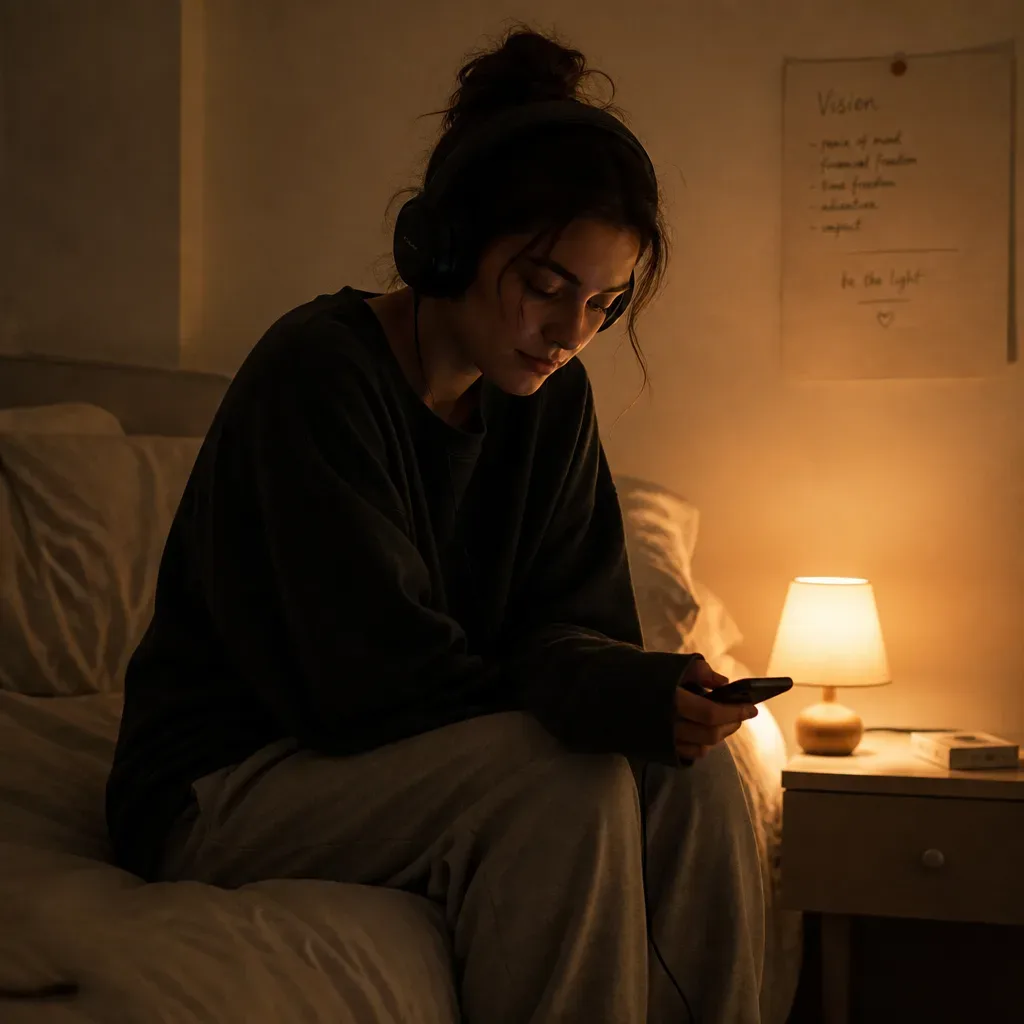
How do you make voice manifestation feel like yours after seven days?
You make it feel like yours by reviewing the audio after seven listens and editing only the lines that make you brace.
Seven days is enough to notice your resistance without turning the practice into a research project. Do not revise after one listen. First-listen cringe is noisy. By the seventh listen, the useful pattern appears. You will know which sentence softens you and which sentence makes your jaw tighten.
Use a 3-column note:
| Line in the audio | Body response | Edit |
|---|---|---|
| I speak with total certainty. | Tight throat | I speak one clear sentence. |
| I know I am chosen. | Eye roll | I stop chasing the room. |
| I wake up full of purpose. | Pressure | I wake up and choose the first true thing. |
Small studies on self-affirmation, including work by Claude Steele’s theory from 1988 and later health-behavior studies, suggest that personally relevant values can reduce defensiveness. The phrase personally relevant is the part to keep. Your audio should sound like it came from your life, not from a content calendar.
This is also where a Manifestation Board can help as a complement. If the recording says, I sit at the small table by the window and write before messages, the board can hold one image of that table. Not twenty symbols. One image. A visual reminder can steady the spoken scene, but it should not compete with the audio.
Review with these questions:
- Which line did I want to skip?
- Which line felt quietly true?
- Which word sounded unlike me?
- Which image stayed after the audio ended?
- Can I make the whole recording 20 seconds shorter?
The edit is not a failure of the first version. It is the practice getting honest.
How do you know if voice manifestation is working?
You know it is working when the future-self scene becomes easier to return to and your next action gets a little clearer.
Do not measure only by outer results in the first week. Measure by contact. Can you listen without flinching? Can you remember the scene at noon? Do you take one action that matches it? These are early signals. They are small, but they count.
There is a reason repetition shows up in so many behavior models. Wendy Wood’s habit research has shown that stable contexts make repeated actions easier over time. You are not trying to force a mood. You are creating a stable cue: same audio, same window of the day, same small return. After 14 days, many people can recite parts of the audio without trying. That is familiarity taking root.
Keep score lightly. Use a 10-day check, not a daily verdict.
- Did I listen at least 7 out of 10 days?
- Did the audio feel less strange by day 5?
- Did I edit one fake line instead of quitting?
- Did one next action become obvious?
- Did I feel more at home in the scene?
If you want the broader frame, the Manifestation pillar explains how intention, attention, and action relate. If you want the audio-first practice, return to the AYA Method. The distinction matters. Reading can clarify. Listening changes the daily cue.
Princeton Engineering Anomalies Research ran from 1979 to 2007 and logged millions of trials around intention and random systems. People still debate what that work means. Fair. For daily practice, you do not need a cosmic claim. You need a repeatable cue that helps you choose from the self you are becoming.
The audio is not there to impress you. It is there to bring you home.
Soft enough to hear again tomorrow.