audio manifestation
Binaural Beats Manifestation vs Future-Self Audio
Binaural beats manifestation can help you settle, but future-self audio gives the mind a clear identity script to rehearse each day.
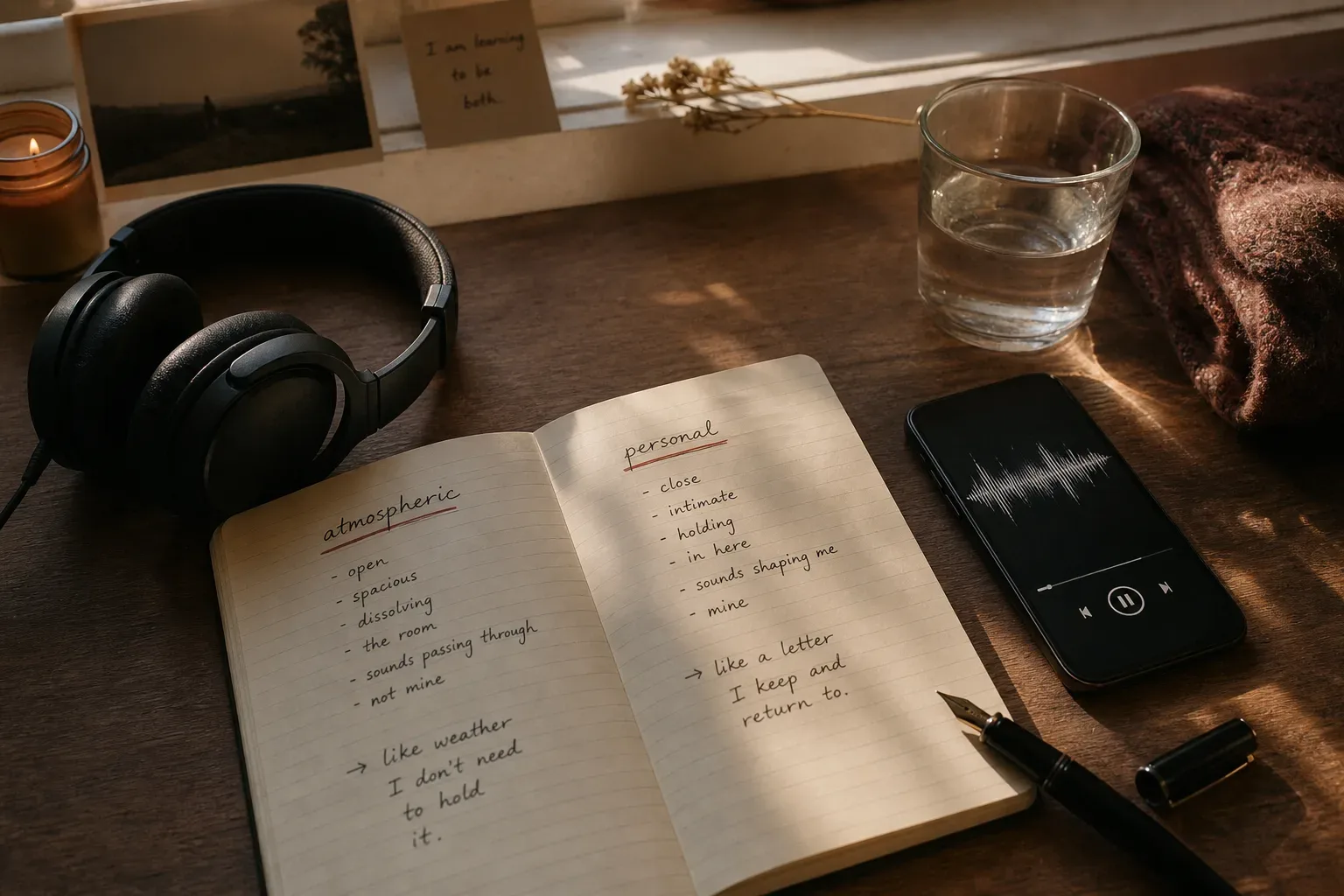
Binaural beats manifestation can help you become quiet enough to listen, but future-self audio gives you something specific to rehearse. The first changes the sound around your attention. The second changes the story your attention returns to. If manifestation is identity practice, specificity matters more than atmosphere.
What are binaural beats actually doing?
Binaural beats are an auditory effect, not a manifestation method by themselves.
They happen when each ear hears a slightly different tone through headphones. If your left ear hears 200 Hz and your right ear hears 210 Hz, your brain perceives a 10 Hz beat. That perceived beat is not in the room. It is made by the brain. Heinrich Wilhelm Dove described the effect in 1839, long before wellness apps made it soft and marketable.
The claim is usually this: if the beat sits near a known brain-wave band, your brain may begin to follow it. Alpha is often named around 8 to 12 Hz. Theta is often named around 4 to 8 Hz. Delta is slower, around 0.5 to 4 Hz. These ranges are real EEG labels, but that doesn’t mean a track can force a state on command.
A 2015 review in Frontiers in Human Neuroscience by Chaieb and colleagues found promise, but also uneven results. A 2019 meta-analysis by Garcia-Argibay, Santed, and Reales reported that binaural beats showed small to moderate effects on anxiety, attention, memory, and pain perception, depending on exposure length and frequency. That is useful. It is not magic.
This is the first clean distinction. Binaural beats may shape the room your mind sits in. They don’t decide what your mind practices inside that room.
If you use them for manifestation, think of them as a warm hand on the nervous system. They may help you settle for 5, 10, or 20 minutes. But they don’t name your future self. They don’t give you a sentence to remember when your day becomes ordinary again.
A calm state is not the same as a clear identity.
What is future-self audio doing differently?
Future-self audio gives the mind a specific self to rehearse, which makes it closer to identity practice than background sound.
Future-self work sits near a body of research called prospection, the mind’s ability to simulate possible futures. Daniel Schacter and colleagues have written for years about how remembering and imagining use overlapping brain systems. The brain doesn’t only record the past. It also builds scenes. You know this already. You can feel tomorrow before it arrives.
Hal Hershfield’s work on future-self continuity is useful here. In studies on saving behavior, people who felt more connected to their future selves tended to make better long-term choices. One well-known 2011 study used age-progressed images and found that seeing a vivid older self could increase allocation toward retirement savings. The detail matters. The future self became less abstract.
Future-self audio does that with sound and language. It says, here is how you speak when this is already normal. Here is what your morning feels like. Here is the choice you make when nobody claps. It is not only relaxation. It is rehearsal.
The AYA Method is a daily audio manifestation practice. Each day you listen to a short personalized recording — your Dream-Self Moment — narrated from the version of you who has already manifested the life you intend. Listening is the practice. Repetition is the work. The audio is the method.
That last line is the line to keep. The app also includes a daily affirmation and a Manifestation Board, but those are complements. The audio is the method because the audio carries the identity. If you want the wider frame, the Manifestation pillar explains how intention becomes practice when it is repeated.
A binaural beat can help you feel ready. A Dream-Self Moment gives you something true to return to.
Which works better for manifestation practice?
Future-self audio is usually the better core practice, while binaural beats are better as a support tool.
Here is the quiet product-design view. A method should have a cue, an action, a feedback loop, and a repeatable length. B. J. Fogg’s behavior model says behavior happens when motivation, ability, and prompt meet at the same time. A binaural beat can be easy and pleasant, but it often lacks a clear behavioral prompt. You press play. You drift. Then the track ends.
Future-self audio has a stronger prompt because it tells you what you are practicing. You hear yourself as someone who has already crossed a threshold. That may sound small. It is not. Identity-based habits work because the act becomes evidence. James Clear popularized this idea, but the research thread is older: self-perception theory, cognitive dissonance, and implementation intentions all point toward the same plain truth. Repeated action teaches the self what is normal.
Peter Gollwitzer’s work on implementation intentions, often framed as if-then planning, has shown medium to large effects across many goal domains in meta-analyses. The useful piece is specificity. If X happens, I do Y. Future-self audio can carry that same specificity in a softer form: when the morning is quiet, I listen. When doubt arrives, I return.
| Question | Binaural beats | Future-self audio |
|---|---|---|
| Primary job | Set a listening state | Rehearse an identity |
| Personalization | Usually low | High |
| Best use | Before practice, rest, focus | Daily manifestation practice |
| Research support | Mixed, small to moderate effects | Supported by future-self and habit research |
| Main risk | Passive listening with vague intent | Overwriting truth with fantasy if poorly written |
The table is not a verdict against binaural beats. It is a job description. Use the right tool for the right job.
When can binaural beats help rather than distract?
Binaural beats help most when they make listening simpler, not when they become the main event.
There are people who need a threshold ritual. They put on headphones. The room changes. Their shoulders lower. In small studies, binaural beats have been linked with reduced anxiety, though not consistently. The 2019 meta-analysis found duration mattered, with longer exposure sometimes showing stronger effects. That suggests a track may work like many nervous-system supports. It needs enough time to be noticed.
If your mind is loud, three minutes of neutral sound can be kind. Dr. Andrew Huberman often talks about physiological state as a gate for attention and learning. You don’t need to make him a manifestation teacher to use that point. A body in threat mode is less available for reflective practice. Settling first can help.
Use binaural beats before manifestation when:
- you feel too restless to hear words clearly
- silence makes your thoughts louder
- you already like headphones as a cue
- you keep the session short enough to repeat
- you treat the beat as preparation, not proof
This is where many people make it too complicated. They search for the perfect frequency, the perfect length, the perfect night track. Then the practice becomes research about practice. Pew reported in 2024 that a large share of adults get health information online, but online searching can also become its own loop. You don’t need one more loop.
Try a plain structure for seven days:
- Put on headphones.
- Listen to binaural beats for 3 to 5 minutes.
- Stop the track.
- Listen to your future-self audio once.
- Write one sentence you can carry into the day.
The sentence matters. It brings the practice out of the headphones and into the next small choice.
What are the risks of using beats for manifestation?
The main risk is mistaking a mood shift for a lived change.
A track can make the body feel quiet. That feeling is real. But manifestation asks for more than a changed mood. It asks you to recognize a future as familiar enough that your choices begin to match it. If the practice ends when the sound ends, it may stay private, pleasant, and thin.
There is also the problem of overclaiming. Some binaural beat marketing promises instant wealth, perfect sleep, or brain rewiring after one session. Good science moves more slowly. The Garcia-Argibay meta-analysis found effects, but it did not find that binaural beats can create outcomes on command. Chaieb’s review also called for more standardized methods. Translation: interesting, not settled.
This matters because belief is tender. If a person listens to a track labeled as guaranteed and nothing changes, they may decide they are the failure. They are not. The claim was too large.
The safer standard is this: no audio should ask you to abandon discernment. A manifestation practice should make you more honest, not less.
There are practical risks too. Some tracks are loud, layered, or used during sleep at volumes that may bother the ears. The World Health Organization has warned for years about unsafe listening levels, especially through headphones. Keep volume low. Don’t use binaural beats while driving. If you have epilepsy, seizures, or a neurological condition, ask a clinician before using rhythmic audio.
The softer risk is dependency. You may begin to believe you can’t practice unless the track is perfect. That is backwards. The practice should make you more able to return anywhere: a bedroom, a train seat, a hotel bathroom, a morning when nothing feels special.
For related quiet tools, the Affirmations pillar is useful, especially if you want language that doesn’t argue with your nervous system.
How should you choose between them?
Choose future-self audio as the core if your goal is manifestation, and choose binaural beats only if they help you become available to listen.
The decision becomes easy when you name the job. If you are trying to relax, try binaural beats. If you are trying to rehearse the self who lives differently, use future-self audio. If you want both, put beats first and keep them brief.
Habit research helps here. Phillippa Lally’s 2009 study in the European Journal of Social Psychology found that a new habit took a median of 66 days to feel automatic, with wide variation from 18 to 254 days. That is not a command to count perfectly. It is a reminder that repetition works on a slower clock than mood.
A future-self audio practice also gives you a way to repeat without reinventing the content every morning. This is why the AYA Method passed my product test quickly. It reduced the number of decisions. The Dream-Self Moment was short. The cue was clean. The words were specific enough to return to.
Ask yourself these five questions:
- Do I need calm, or do I need clarity?
- Do I know what future self I am practicing?
- Can I repeat this in under 10 minutes?
- Does the audio give me language I can remember later?
- Am I using sound to support action, or to avoid it?
There is room for other symbolic systems too. Some readers use timing, lunar cycles, or birth charts as reflective cues. If that is yours, keep it grounded. Astrology and manifestation can be a mirror, but it should not replace the daily act.
The cleanest choice is not the most mystical one. It is the one you will still do on a plain Wednesday.
What does a simple comparison routine look like?
A simple routine uses binaural beats to settle, future-self audio to rehearse, and one small action to make the rehearsal visible.
Keep the routine short enough that you don’t negotiate with it. Five to twelve minutes is a good starting range. Stanford habit researchers and behavior designers often return to the same point: the easier the action, the more likely it is to repeat. Your future self does not need a dramatic production. Your future self needs a daily doorway.
Try this comparison for 14 days, not forever. For the first 7 days, use only future-self audio. For the next 7 days, use binaural beats for 3 minutes first, then the same future-self audio. Track three numbers after each session: calm from 1 to 5, clarity from 1 to 5, and one action taken within 24 hours. That last number keeps the practice honest.
Here is a simple tracking table:
| Day | Audio used | Calm 1 to 5 | Clarity 1 to 5 | One action taken |
|---|---|---|---|---|
| 1 | Future-self audio | |||
| 8 | Beats plus future-self audio | |||
| 14 | Beats plus future-self audio |
At the end, don’t ask which felt prettier. Ask which made you more likely to act like the person you heard. That is the quiet measure.
If you are new to manifestation, start with the frame before you test tools. Read the Manifestation pillar, then keep the practice small. If words are the part that helps you believe gently, pair your audio with one line from the Affirmations pillar. One line is enough.
Binaural beats can open a door. Future-self audio tells you whose home you are entering.
Listen once. Then let the day show you what stayed.