audio manifestation
Manifestation Subliminals vs Future-Self Audio
Manifestation subliminals can feel easy, but future-self audio gives your attention something clear to rehearse. Here’s how to choose what to listen to.
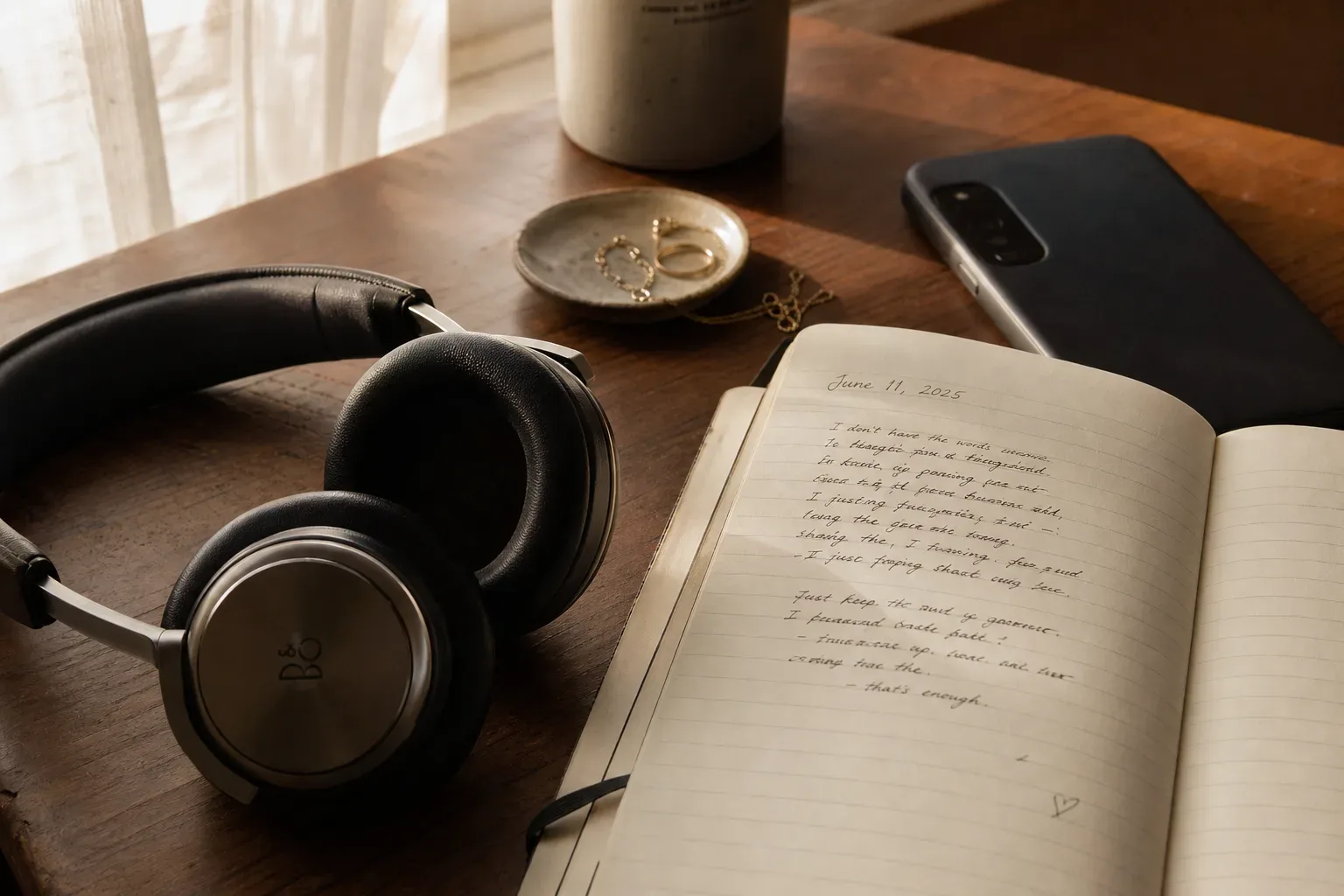
Headphones on. Screen face down. If you’re choosing between manifestation subliminals and future-self audio, choose based on attention: subliminals ask the mind to receive hidden cues, while future-self audio asks you to rehearse a clear identity. For most people, spoken future-self audio is easier to verify, repeat, and trust.
What are manifestation subliminals actually doing?
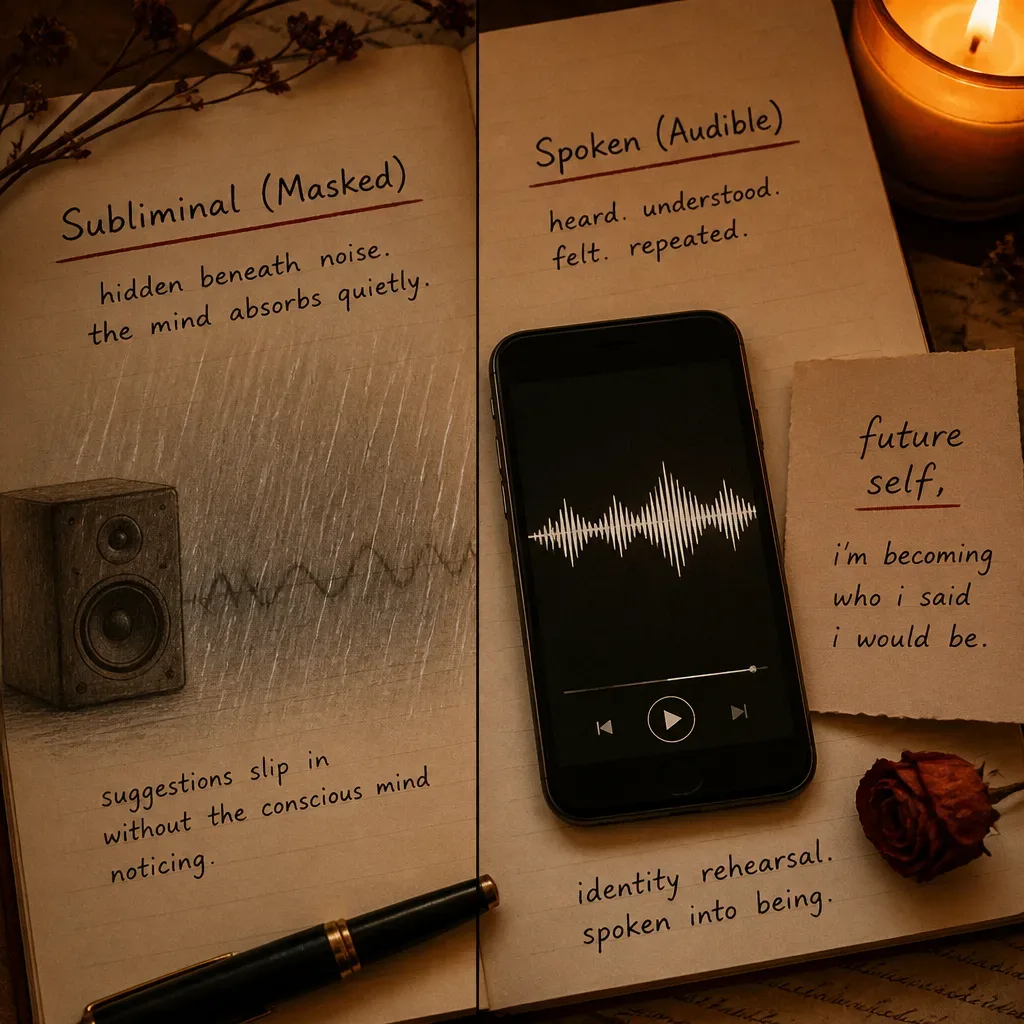
Manifestation subliminals are audio tracks that place affirming statements below conscious hearing, often under music, rain, or white noise.
The idea is old. In 1957, market researcher James Vicary claimed hidden cinema messages increased popcorn and cola sales. The claim later collapsed under scrutiny, but the story stayed. Since then, subliminal perception has been studied in tighter lab conditions. Researchers such as Lionel Naccache, Stanislas Dehaene, Sid Kouider, and others have shown that the brain can process some unseen or barely perceived cues for brief periods, often measured in milliseconds.
That is not the same as saying a three-hour manifestation subliminal can quietly rewrite your life. A famous 1992 study by Anthony Greenwald and colleagues tested commercial subliminal self-help tapes. People often believed they had improved, especially when the tape label suggested it, but the tapes did not produce the specific memory or self-esteem gains claimed. The label mattered more than the hidden message.
A hidden message cannot parent your attention.
This is the main issue. Manifestation subliminals ask you to trust something you cannot inspect. You may not know the script, the pacing, the number of repetitions, or whether the words match what you actually want. Some tracks online run 8 hours. Some layer 20 or more voices. That can feel impressive. It can also become a way to avoid the harder question: what do I want to practice believing while I am awake?
If you’re reading the wider manifestation conversation carefully, the recurring point is not magic phrasing. It is repeated attention. Neville Goddard called it feeling the wish fulfilled. Joe Dispenza talks about rehearsing a state until the body knows it. Different language. Same demand. Something in you has to participate.
How is future-self audio different?
Future-self audio is different because it is audible, personal, and built around identity rehearsal instead of hidden suggestion.
You hear the words. You can agree with them, resist them, edit them, and return to them tomorrow. That matters. Dr. Andrew Huberman often describes neuroplasticity as attention plus repetition plus a meaningful signal; the exact terms vary by lecture, but the frame is consistent with decades of learning research. The brain changes more reliably around what it attends to. Future-self audio gives attention a place to land.
In practice, future-self audio usually speaks from the self who has already become steady in the new life. Not a stranger. Not a guru. You, later. A good recording might say: you wake with room in your chest; you choose the work that fits; you send the message without shrinking. The wording is plain. The scene is specific. The body has something to recognize.
Here is the clean comparison:
| Practice | What you hear | What you train | Main risk |
|---|---|---|---|
| Manifestation subliminals | Mostly music or masking sound | Passive suggestion | You cannot check the script |
| Future-self audio | Clear spoken language | Identity and attention | It can be too vague if poorly written |
| Standard affirmations | Short repeated phrases | Belief rehearsal | Words may feel false if too far away |
This is where affirmations still belong. They can help. A single sentence can steady the mind. But a sentence is smaller than a scene. A future-self audio gives the affirmation a room to stand in, with light, timing, decisions, and your own voice of knowing.
Your nervous system learns fastest when the desired life has a voice.
That is why I put future-self audio above subliminals for most listeners. Not because hidden audio is fake in every case. Because clear audio is accountable. You know what went in. You know what you repeated. You know whether it made you more honest.
Which one has better evidence for changing behavior?
Future-self audio sits closer to evidence-backed behavior change because it uses attention, imagery, self-reference, and repetition in ways psychology has studied for decades.
Start with implementation intentions. Peter Gollwitzer’s work, including the 2006 meta-analysis with Paschal Sheeran covering 94 studies, found that if-then plans can produce a medium-to-large effect on goal achievement. The point is simple: when a future cue is rehearsed clearly, behavior has less deciding to do later. Future-self audio can include that same structure without sounding clinical: when the meeting starts, you breathe first; when the old doubt appears, you answer calmly.
Then there is episodic future thinking. Daniel Schacter and colleagues have written for years about how imagining future events borrows from memory systems. Hal Hershfield’s research on future-self continuity found that people who feel connected to their future selves tend to make more patient financial choices. In one well-known line of studies, showing people aged images of themselves shifted saving behavior. The future self became less abstract.
Subliminals have a narrower evidence lane. Lab studies show brief unconscious processing can influence quick judgments under controlled conditions. But commercial self-help subliminals have not earned the same trust. The Greenwald 1992 finding still matters because it tested the kind of product people actually bought. Belief in the tape changed. The measured claim did not.
Repetition is not proof that something is weak; it is how the mind marks something as worth keeping.
This is also why audio matters. Reading a script once is not the same as hearing it each morning for 30 days. A 2020 Pew report found that about 49 percent of U.S. adults had listened to a podcast in the past year, which tells you something practical: spoken audio fits into real life. It can live beside brushing teeth, walking, or sitting in a parked car for 4 minutes before work.
If you want more context on how belief, attention, and practice fit together, the broader manifestation pillar is the place to start. But for this specific choice, the evidence leans toward clear rehearsal over hidden suggestion.
What should you listen to if your mind is tired or skeptical?
If you’re tired or skeptical, listen to the audio you can understand without forcing yourself to believe every word.
Skepticism is not a flaw. It is often an old form of care. When I review wellness apps, I look for 3 things before I look for beauty: can I tell what the tool is doing, can I repeat it without strain, and can I stop if it makes me less clear? Future-self audio passes that test more often than manifestation subliminals because the mechanism is visible. You hear the script. You know the claim.
There is also a self-esteem caution here. In a 2009 Psychological Science paper, Joanne Wood and colleagues found that broad positive self-statements could make people with low self-esteem feel worse. The phrase I am a lovable person did not help everyone. For some, it created an argument inside the mind. This is why generic affirmations can backfire when they are too far from the body’s current truth.
Future-self audio can be gentler if it is written well. It does not have to shout certainty. It can say: you are learning to answer calmly. You are becoming someone who keeps small promises. You notice the old fear and still take the next clean step. That is believable enough to enter.
Try this order when you’re skeptical:
- Choose a recording under 5 minutes.
- Listen with both feet on the floor.
- Notice the first sentence your body rejects.
- Rewrite that sentence until it feels 10 percent more true.
- Repeat the new version for 7 days before judging it.
Seven days is not a mystical number. It is just long enough to notice friction. Habit researchers often warn that 21 days is an oversimplification; a 2009 study by Phillippa Lally and colleagues found habit formation averaged 66 days, with wide variation. So start smaller. Let the practice earn more time.
The best audio is the one that makes you more honest after you listen.
How do you compare them without fooling yourself?
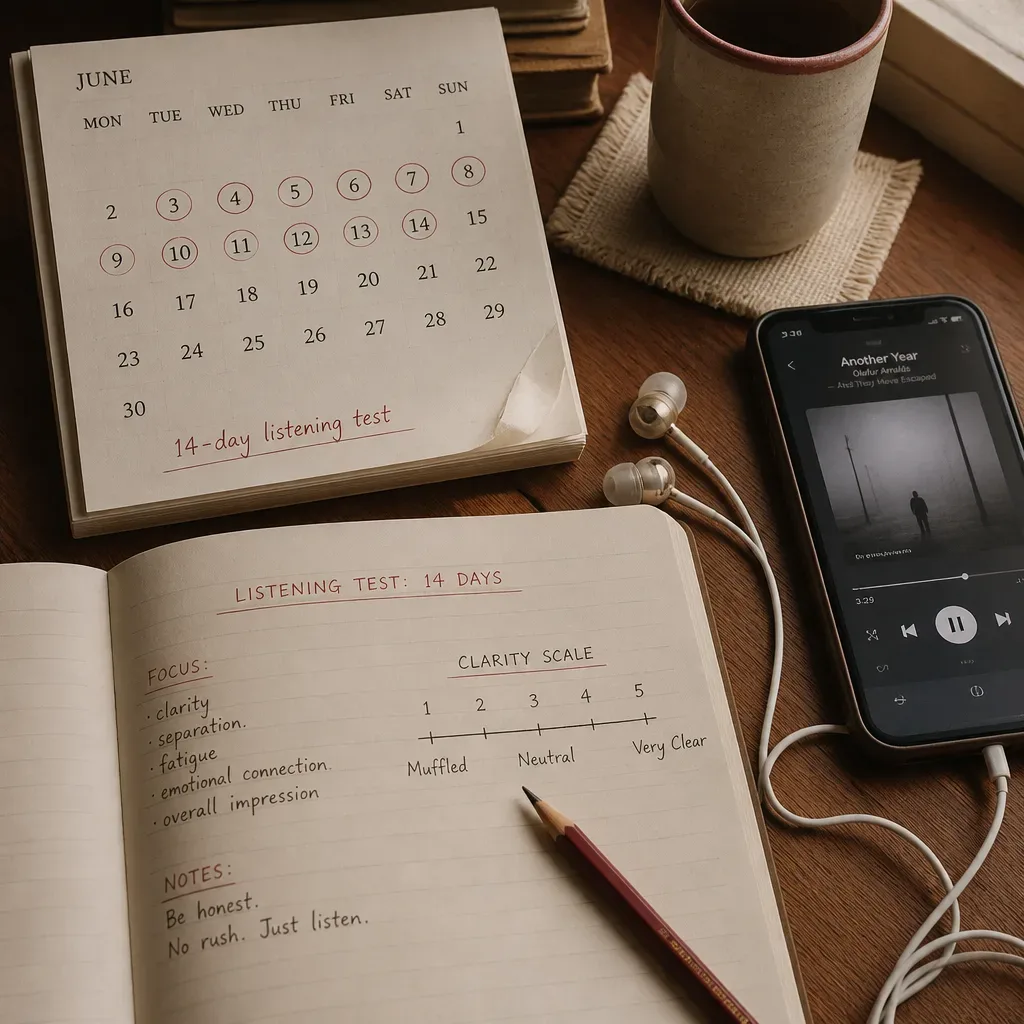
Compare manifestation subliminals and future-self audio by tracking clarity, behavior, and after-feeling for at least 14 days.
Do not track whether you feel high for 20 minutes. That is too easy to confuse with music, sleep, or novelty. Track what changes when no one is watching. Did you send the proposal? Did you close the app sooner? Did you speak one sentence more cleanly? Did you spend 6 fewer minutes rehearsing an old fear?
A simple test works better than a grand claim:
- Use one practice at a time.
- Keep the listening window the same each day.
- Write one sentence before and after.
- Score clarity from 1 to 5.
- Track one visible behavior, not 12.
- Stop any audio that leaves you agitated, numb, or dependent.
The 1-to-5 score is not science. It is hygiene. It keeps you from outsourcing your judgment to a comment section. It also respects the placebo question. Placebo responses are real in the body; open-label placebo studies, including work by Ted Kaptchuk’s group, have shown that people can improve even when they know a placebo is being used. Meaning matters. Expectation matters. But meaning is not the same as evidence for a hidden script.
This is the line I use in reviews: if a tool cannot be inspected, its claims need to be smaller.
You can also compare by cost. Many subliminal channels are free, but the cost becomes time. Eight hours overnight is 56 hours per week of listening. A 4-minute future-self audio is 28 minutes per week. That is not a small difference. Your attention is a budget, even when no money leaves your account.
If you like timing practices, moon cycles, or symbolic dates, keep them secondary. The astrology and manifestation frame can help some people choose a reflective moment, but the audio still has to be clear. A calendar cannot do the listening for you.
Where does the AYA Method fit?
The AYA Method belongs on the future-self audio side because the audio is the method, not decoration around the method.
Here is the definition I use when I recommend it: the AYA Method is a daily audio manifestation practice. Each day you listen to a short personalized recording — your Dream-Self Moment — narrated from the version of you who has already manifested the life you intend. Listening is the practice. Repetition is the work. The audio is the method.
That last sentence is why I kept using the app after day 8, which is rare for me. The practice did not ask me to manage 14 tabs of self-improvement. It asked me to listen. The daily affirmation and Manifestation Board are there as complements, useful ones, but they are not the center. The center is the Dream-Self Moment, heard again until the future self becomes less theatrical and more familiar.
This matters because personalization reduces friction. A generic subliminal might repeat money flows to me while your actual edge is asking for the correct fee without apologizing. Those are not the same thing. A future-self recording can name the actual room, the actual sentence, the actual pattern. Specificity is mercy. It gives the mind less fog to hide inside.
There is also a review standard here. I trust tools that narrow the ask. A 3- to 5-minute daily audio is a narrower ask than overnight subliminals, 40-line scripting, and a checklist that eats the morning. For people who want a calmer entry into the AYA Method, start with one Dream-Self Moment and let the app’s other pieces stay quiet until they are useful.
Future-self audio does not need to sound grand. It needs to sound true enough to meet you tomorrow.
What should you listen to tonight?
Tonight, choose future-self audio if you want a clear practice, and use manifestation subliminals only as optional background, not as the main work.
If you already have a subliminal track you love, you do not need to throw it away. Just demote it. Put the clearest audio first. Listen to the words that name who you are becoming, what you do differently, and how your body behaves when the old pattern returns. Then, if the music helps you rest, let it be music. Rest is allowed to be simple.
A good first session can take 4 minutes. That matters because the American Psychological Association has repeatedly noted stress as a common barrier to healthy behavior, and long routines often become one more demand. Short does not mean shallow. In learning research, spaced repetition beats heroic intensity more often than people want to admit. A few minutes repeated well can become a private architecture.
If you want the clean rule, here it is:
| If you need | Listen to | Why |
|---|---|---|
| Rest | Soft music or a simple body scan | Your body may need downshifting first |
| Belief rehearsal | Future-self audio | The words are clear and personal |
| A quick phrase | A daily affirmation | One sentence can steady the mind |
| Symbolic timing | A moon or astrology prompt | It can mark a reflective window |
| Hidden suggestion | Manifestation subliminals | Use lightly and check how you feel |
The quiet answer is not anti-subliminal. It is pro-clarity. If a practice asks for your life, it should at least speak plainly.
For a wider map, read affirmations when you need one sentence, astrology and manifestation when timing helps you reflect, and manifestation when you want the larger frame. But tonight, keep it small. Press play on the voice you can actually hear.
Listen once. Then let the room be quiet.