audio manifestation
Audio Meditation Manifestation When You Can’t Sit Still
Audio meditation manifestation gives restless minds a gentle way to practice without forcing stillness, using short listening sessions and repetition.

Your earbuds are already in. Your foot is tapping. Audio meditation manifestation is for that exact moment: you listen to a short, specific recording of the self you’re becoming, without making stillness the price of entry. The practice works best when it’s brief, repeated, and honest.
Why does audio help when sitting still feels impossible?
Audio helps because it gives your attention a place to land while your body finds its own way to settle.
Stillness is often treated like the doorway. For restless people, it can feel like a locked door. You sit down, close your eyes, and suddenly your knee needs to move. Your jaw tightens. Your brain starts listing 14 tasks. The practice becomes a fight before it becomes a practice.
Sound changes the entry point. A voice arrives from outside the loop of your own thoughts. In attention research, external cues often reduce the burden on working memory; cognitive load theory, first developed by John Sweller in 1988, named how limited that mental space can be. When the recording holds the next sentence for you, you don’t have to hold the whole practice alone.
There is also evidence that brief guided meditation can matter. In a 2010 study in Consciousness and Cognition, Fadel Zeidan and colleagues found that 4 days of 20-minute mindfulness training improved attention and working memory on specific tasks. That doesn’t mean every audio will do the same thing. It means attention can be trained in short, repeated sessions.
Manifestation adds a second layer: identity rehearsal. You’re not only calming down. You’re listening for what becomes normal. If you want the wider map, Manifestation pillar explains the practice as more than wishing. It’s attention, belief, emotion, and action placed in the same room.
Stillness is not the proof that you’re practicing. Returning is.
For a person who can’t sit still, the kindest instruction is small: listen once. Let the hands fidget if they need to. Let the breath be uneven. The voice is the rail. Your body can arrive later.
How do you begin in under two minutes?
Begin by choosing one recording, one cue, and one low-friction place to listen.
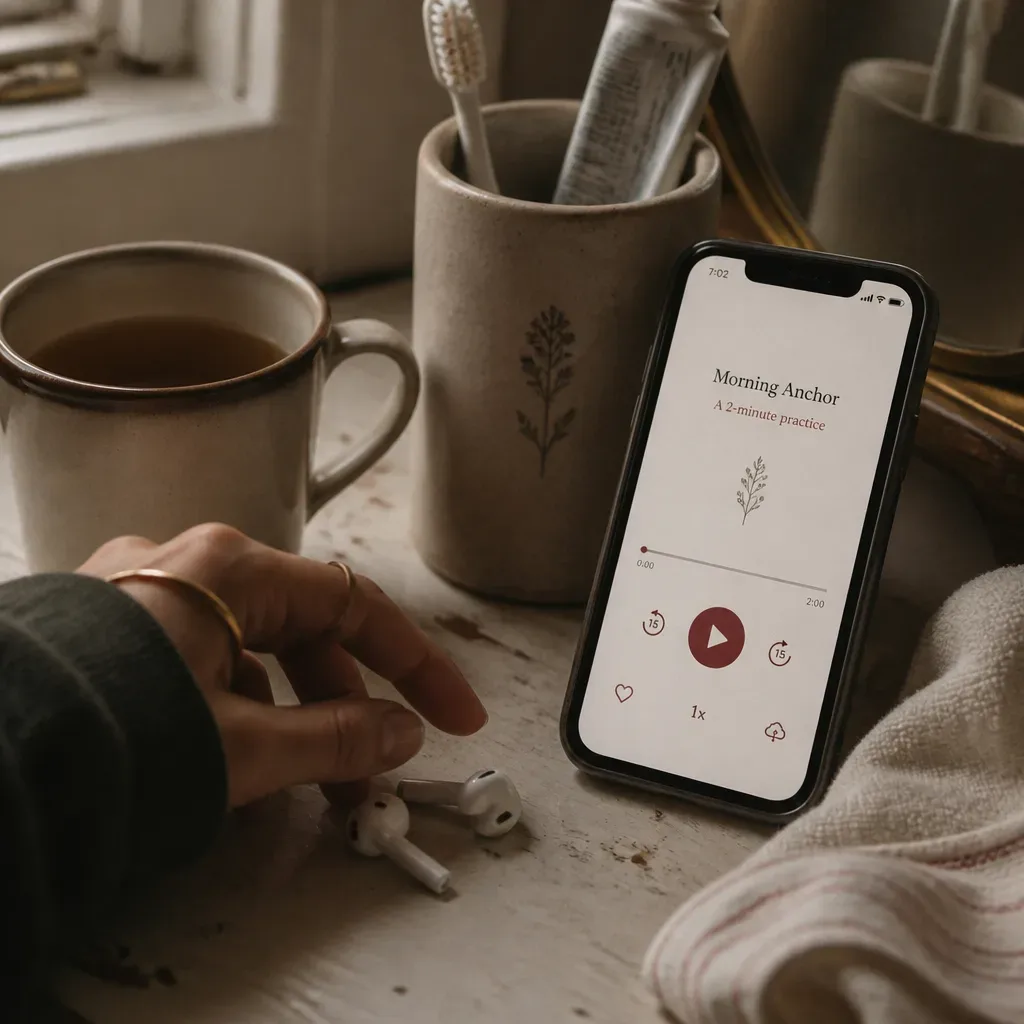
Do not build a ceremony you’ll abandon by Thursday. The first version should fit inside a normal day. If you already put on headphones for a commute, a walk, or dishes, use that. BJ Fogg’s behavior model, published in Tiny Habits in 2020, keeps returning to the same idea: behavior happens when motivation, ability, and a prompt meet at the same time.
Here is the 2-minute setup:
- Pick one audio, not a folder of options.
- Choose one cue you already trust, such as after brushing your teeth.
- Put the audio where it takes 2 taps or fewer.
- Decide the minimum: one full listen, even if restless.
- Mark it done in one place, not five.
A 2009 study by Phillippa Lally and colleagues in the European Journal of Social Psychology found that habits took an average of 66 days to become automatic, with wide variation. That number is useful because it softens the fantasy of instant discipline. You’re not late if day 6 still feels manual.
| If you usually | Try listening |
|---|---|
| Pace when thinking | While walking one slow block |
| Check your phone in bed | Before the first app opens |
| Make coffee or tea | While the water heats |
| Sit in the car before work | Before opening messages |
| Clean to calm down | During one small task |
The recording should be short enough that your body doesn’t revolt. Two minutes counts. Three minutes counts. A single faithful listen counts more than a 30-minute plan you keep rescheduling.
What should you listen to, and what should you ignore?
Listen to audio that is specific, believable, and spoken from the self you are practicing becoming.
Generic language can feel pretty and still miss you. Your nervous system knows when words are too far away. A line like I am calm forever may irritate the part of you currently chewing the inside of your cheek. A truer line might be: I answer one message at a time. I leave the room before I raise my voice. I keep the promise I made this morning.
This is why the AYA Method is defined so precisely: The AYA Method is a daily audio manifestation practice. Each day you listen to a short personalized recording — your Dream-Self Moment — narrated from the version of you who has already manifested the life you intend. Listening is the practice. Repetition is the work. The audio is the method.
The audio matters because voice carries sequence. You don’t have to invent the image every time. You hear it. You follow it. You let it become familiar. In a 2011 Psychiatry Research: Neuroimaging paper, Sara Lazar’s group reported structural brain changes after an 8-week mindfulness-based stress reduction program. That study wasn’t about manifestation, but it supports a quieter point: repeated mental practice can leave traces.
Ignore audio that shames your body. Ignore anything that tells you a wandering mind has ruined the session. Ignore the pressure to stack ten tools at once. The daily affirmation may help. A Manifestation Board may give you a visual reminder. But they are complements. The audio remains the practice.
For language that stays grounded, Affirmations pillar is a useful companion. The best words don’t try to hypnotize you. They help you recognize yourself.
How do you practice without forcing your body to be still?
You practice by giving the body permission to move while the mind keeps returning to the voice.
There are people who soften when told to sit. There are people who tighten. If you’re in the second group, don’t make your body the enemy. Restlessness can be information: too much caffeine, too little sleep, stress that hasn’t had a place to go. The CDC reported in 2022 that about 1 in 3 adults in the United States don’t get enough sleep, and tired bodies are rarely elegant bodies.
Try a movement container instead of a stillness rule. Walk the same hallway. Stretch your calves. Hold a warm mug. Fold one towel. Keep the movement simple enough that the audio stays primary. If the task needs decisions, it will compete with the recording.
Use this sequence when you feel scattered:
- Press play before you feel ready.
- Name one body sensation: foot, hand, jaw, belly.
- Let one small movement continue.
- Return to the next sentence you hear.
- When the audio ends, take one matching action.
A matching action is small. If the recording describes you as financially steady, open the budgeting app for 60 seconds. If it describes you as kinder in conflict, send the repair text. Peter Gollwitzer’s 1999 work on implementation intentions showed that if-then plans can improve goal follow-through across many contexts. Manifestation becomes more honest when it has a next action.
The body doesn’t have to be quiet for the choice to be real.
If you miss the middle of the recording, stay. Missing is not moral failure. It is data. Come back to the sentence that is still speaking.
How do you make audio meditation manifestation repeatable?
Make it repeatable by shrinking the practice until it can survive a bad day.
A practice that only works when you slept well, woke early, and felt inspired is not yet yours. Build the floor first. The floor might be one listen in bed with one earbud. It might be listening in the bathroom while the shower warms. It might be sitting on the edge of the bed for 3 minutes, eyes open, because closing them makes you anxious.
Repetition is easier when the cue is stable. In habit research, context is often the quiet engine. Wendy Wood’s work on habits, including her 2019 book Good Habits, Bad Habits, emphasizes that repeated behavior in stable contexts becomes less dependent on mood. That is mercy. You don’t need to feel devoted every morning. You need a place where the practice belongs.
Build a simple rule:
| Practice piece | Keep it simple |
|---|---|
| Cue | After teeth, tea, keys, or car door |
| Length | 2 to 5 minutes |
| Body | Still, walking, stretching, or lying down |
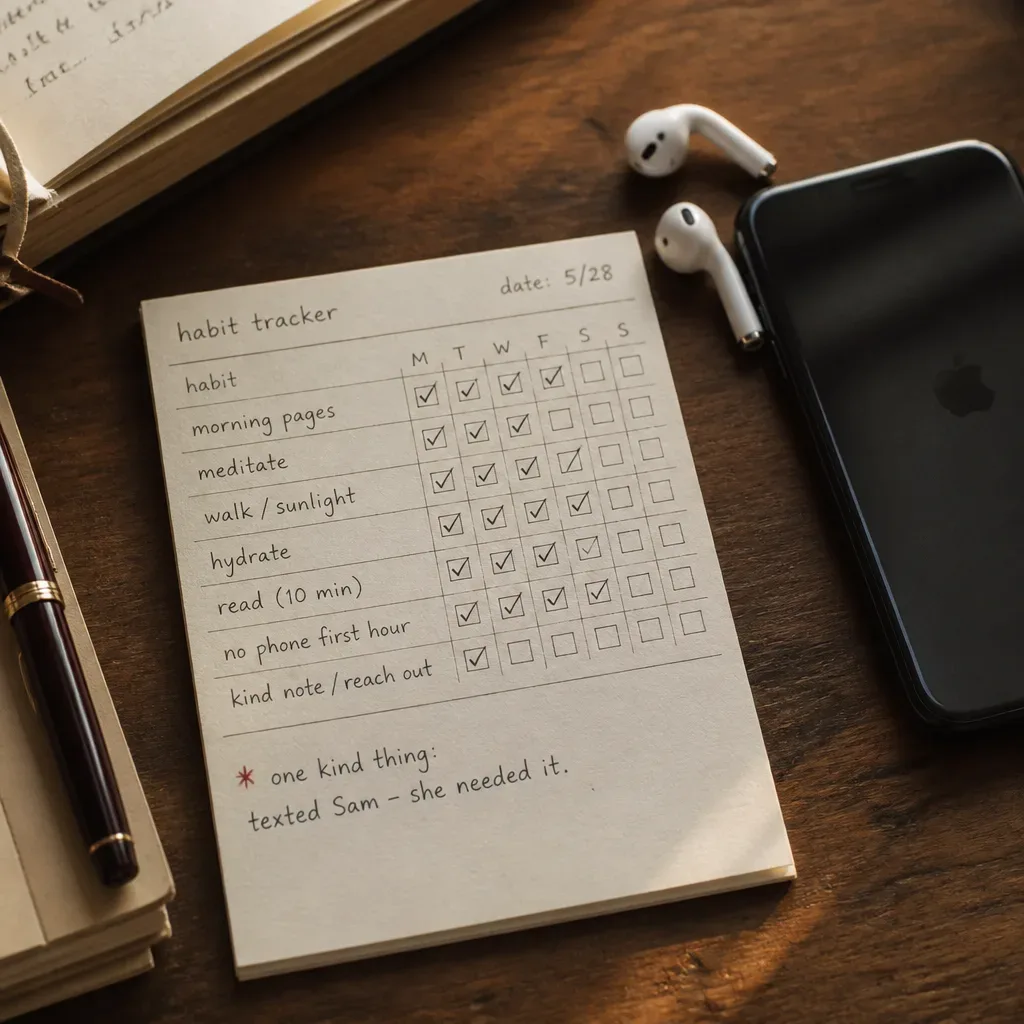
| Tracking | One check mark |
| Next action | One visible act under 2 minutes |
If you like timing, use 7 days as the first test. Seven is not a sacred number here. It is short enough to finish and long enough to notice patterns. In behavioral studies, self-monitoring is one of the more reliable behavior-change techniques; a 2011 review in the British Journal of Health Psychology found stronger effects when self-monitoring was combined with at least one other self-regulation tool, such as goal setting.
You can also pair your audio with Astrology and manifestation if cycles help you remember. Use it as timing, not as permission. The recording still asks for your attention today.
What should you track after seven days?
Track whether you listened, how your body felt, and what action followed.
Do not track everything. Too many metrics can turn a soft practice into another dashboard that scolds you. I say this as someone who ships software and has tracked meditation streaks, sleep scores, heart rate, and mood tags in the same week. More data is not always more knowing.
Use a 7-day note with three columns:
- Listened: yes, no, or partial.
- Restlessness: 1 to 5.
- Matching action: one sentence.
That is enough. After 7 days, look for one pattern. Maybe walking made listening easier. Maybe late-night sessions became foggy. Maybe the audio felt false on day 1 and familiar on day 6. A 2023 Pew Research Center report found that 41 percent of U.S. adults said they regularly listened to podcasts, which tells us something plain: many people already know how to receive spoken words as part of daily life.
The number you want is not perfection. It is return rate. If you listened 5 out of 7 days, you have a baseline. If you listened twice, ask what made those two possible. If you never listened, make the practice smaller or move the cue.
For a wider foundation, keep The AYA Method (canonical) close. For the belief side, return to Manifestation pillar. For the sentence-level support, use Affirmations pillar. Let each piece have its right size.
What you repeat becomes easier to believe because it becomes easier to find.
The quiet metric is this: did the recording help you act like the person it described, even once?
Stay close to the voice that sounds like home.