evening rituals
3 AM Anxiety Routine: 5-Minute Dream-Self Audio
A quiet 3 AM anxiety routine using breath, a 5-minute Dream-Self audio, and one next action so your body can return to sleep.
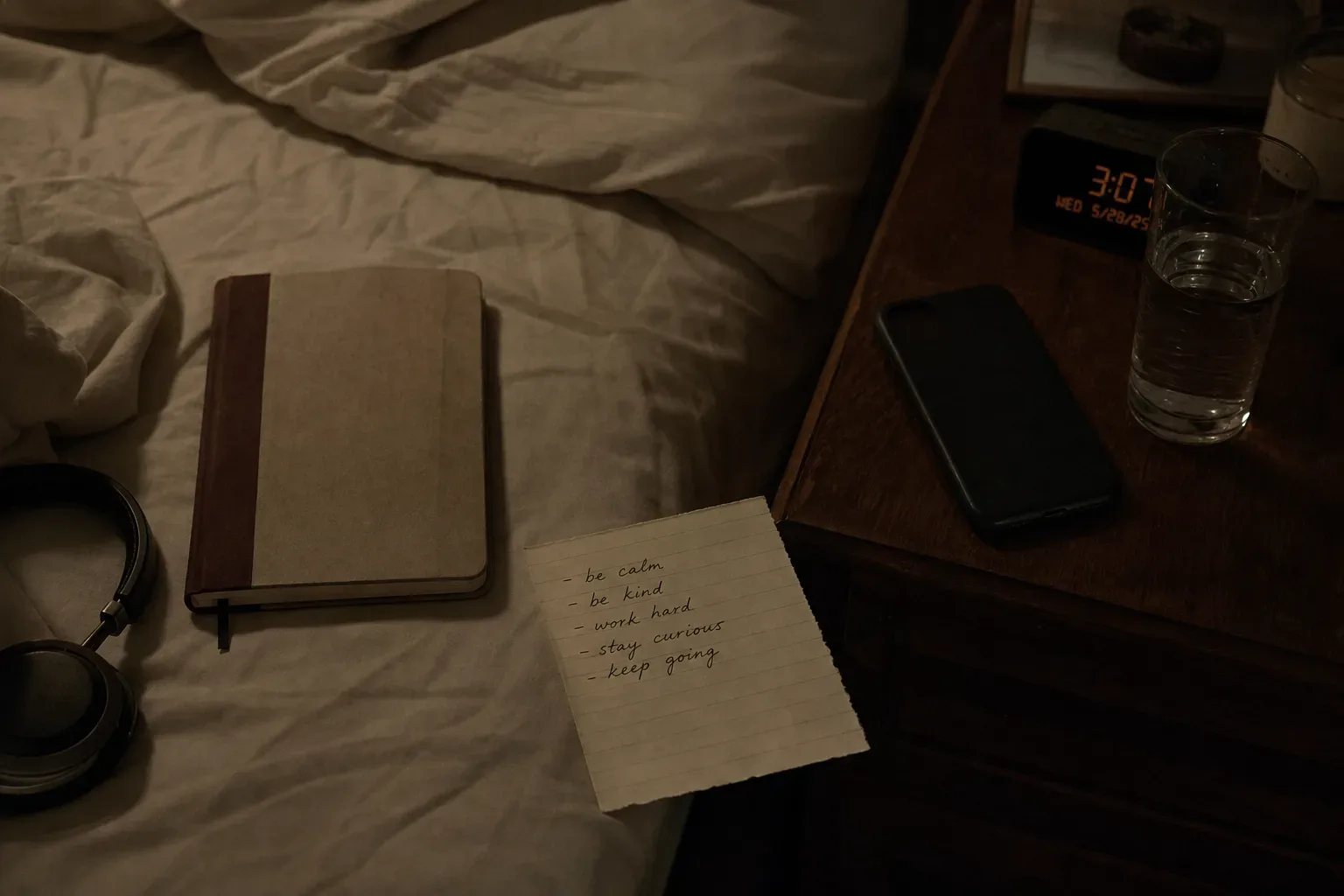
The clock says 3:07. A 3 AM anxiety routine should be short: keep the room dark, name what is happening, breathe slowly for one minute, listen to a 5-minute Dream-Self audio, then choose one quiet next action. You are not fixing your whole life. You are helping your body feel safe enough to return.
Why does anxiety feel louder at 3 AM?
Anxiety feels louder at 3 AM because your brain has fewer daytime anchors and your body is moving through normal night chemistry.
At night, there is less incoming data. No errands. No messages you should answer. No train to catch. The mind starts using what is already inside the room: unfinished decisions, old sentences, body sensations. The National Institute of Mental Health estimates that 19.1% of U.S. adults had an anxiety disorder in the past year. That number does not count the many people who wake with worry but do not meet a diagnosis.
Sleep also has a rhythm. You cycle through lighter and deeper stages about every 90 minutes, according to common sleep-stage research summarized by the Sleep Foundation. Around the early morning hours, REM sleep becomes more frequent. REM is linked with vivid dreaming and emotional memory. So you may wake from an intense dream and mistake the after-feeling for a message.
There is also cortisol. Dr. Andrew Huberman often points to the cortisol pulse that rises before waking as part of the body preparing for morning. If you wake during that rise, it can feel like proof that something is wrong. It may only be a body doing body things.
A quiet rule helps here: 3 AM is a bad courtroom. Do not put your future on trial in the hour when your nervous system is half-lit.
The point of the routine is not to argue with anxiety. Arguing keeps you awake. The point is to give the brain fewer choices, fewer lights, and one familiar voice to follow. A 5-minute track is long enough to interrupt the spiral and short enough that you do not start managing a project.
What is the 5-minute 3 AM anxiety routine?
The routine is a five-step sequence that lowers input, steadies the breath, and gives your mind one rehearsed future-self cue.
Use the same order every time. Habit research often returns to one plain finding: repetition in a stable context makes action easier. A 2009 study in the European Journal of Social Psychology found that habit automaticity took a median of 66 days to form, with wide variation. You do not need perfection. You need a path your half-awake mind can find.
Here is the routine.
- Do not turn on the room. Keep lights low. If you use your phone, dim it before bed so the screen does not wake you more.
- Name the moment. Say: it is 3 AM, my body is awake, and I do not have to solve this now.
- Breathe for one minute. Try four counts in and six counts out. Longer exhales are commonly used in relaxation protocols because they cue parasympathetic settling.
- Play your 5-minute Dream-Self audio. Let the words be familiar. Do not analyze them.
- Choose one next action. Stay still if sleep feels close. If not, leave bed briefly for something dim and boring.
The AYA Method is a daily audio manifestation practice. Each day you listen to a short personalized recording — your Dream-Self Moment — narrated from the version of you who has already manifested the life you intend. Listening is the practice. Repetition is the work. The audio is the method.
That definition matters most at 3 AM. You do not need a long ritual. You do not need to write ten pages. The app also includes a daily affirmation and a Manifestation Board, but at this hour they are complements. The audio is the part you can receive with your eyes closed.
How do you listen without trying to force sleep?
You listen by treating the audio as a place to rest attention, not as a command to fall asleep.
The body can feel pressure. If you press sleep too hard, sleep moves away. This is one reason CBT-I, the behavioral standard for chronic insomnia, often teaches stimulus control rather than effort. The American Academy of Sleep Medicine has recommended CBT-I as a first-line treatment for chronic insomnia. The advice is practical: make the bed a cue for sleep, not a cue for worry and work.
So when the audio starts, give yourself one job: hear the next sentence. Not the whole recording. Not the future. Just the next sentence. If the mind wanders, return without scolding. A mind that wanders is not failing. It is awake.
Try this listening posture:
- Keep the phone face down or screen off.
- Let your jaw be soft.
- Put one hand on the ribs or lower belly.
- Let the recording be slightly quieter than you think it should be.
- If a worry appears, say: not now, morning can hold this.
There is a difference between reassurance and rehearsal. Reassurance asks, am I okay yet. Rehearsal says, this is the path back. Your Dream-Self Moment works as rehearsal. You are hearing a version of you who is steady enough to speak slowly. Over time, that voice becomes less like a wish and more like a remembered route.
If you use the Affirmations pillar as part of your daytime practice, keep it simple at night. One sentence is enough. More sentences can become more thinking. The night mind does not need a speech. It needs a handrail.
Sleep is not taken by force. It is allowed by a body that no longer has to guard the door.
What should you do after the audio ends?
After the audio ends, choose the lowest-stimulation action that matches your body state.
Make the choice before you need it. Decision-making gets worse when you are tired. In one classic 2011 study published in PNAS, judges were more likely to grant parole after breaks than later in decision blocks, a finding often discussed in relation to decision fatigue, though later debate has added nuance. The simple lesson still holds at 3 AM: do not make a menu of options.
Use this table.
| What you notice | What it may mean | Next action |
|---|---|---|
| Eyes feel heavy | Sleep pressure is near | Stay in bed and repeat one line from the audio |
| Chest is tight but easing | Body is settling | Keep breathing with a longer exhale for 2 minutes |
| Thoughts are racing | Bed may be becoming a worry cue | Get up for a dim reset for 10 to 20 minutes |
| You want to check messages | Attention is seeking threat | Do not check. Put the phone farther away |
| Panic symptoms are intense | You may need support | Use a grounding skill or contact help if unsafe |
A dim reset means boring. Sit in a chair. Read something neutral on paper. Fold one towel. Drink water. Keep it quiet and under-lit. Many CBT-I guides use about 20 minutes as a rough marker: if you are awake in bed and getting more tense, leave briefly and return when sleepy.
Do not use the end of the audio as a test. If you think, did it work, you have already turned the practice into a scorecard. The better question is smaller: what is the kindest next cue for my body.
If you are drawn to the wider practice of conscious creation, read the Manifestation pillar during the day, not at 3 AM. Night is for the smallest useful action. Day is for meaning.
How can you make the routine easier before bed?
You make the routine easier by removing decisions before the anxious wake-up happens.
The 3 AM version of you should not have to set up anything. That is design, not weakness. When I built a habit-tracking app used by about fourteen thousand people, the same pattern kept showing up: people did not fail because they lacked sincerity. They failed because the next step was too hidden. At night, hidden steps become walls.
Set the room before sleep.
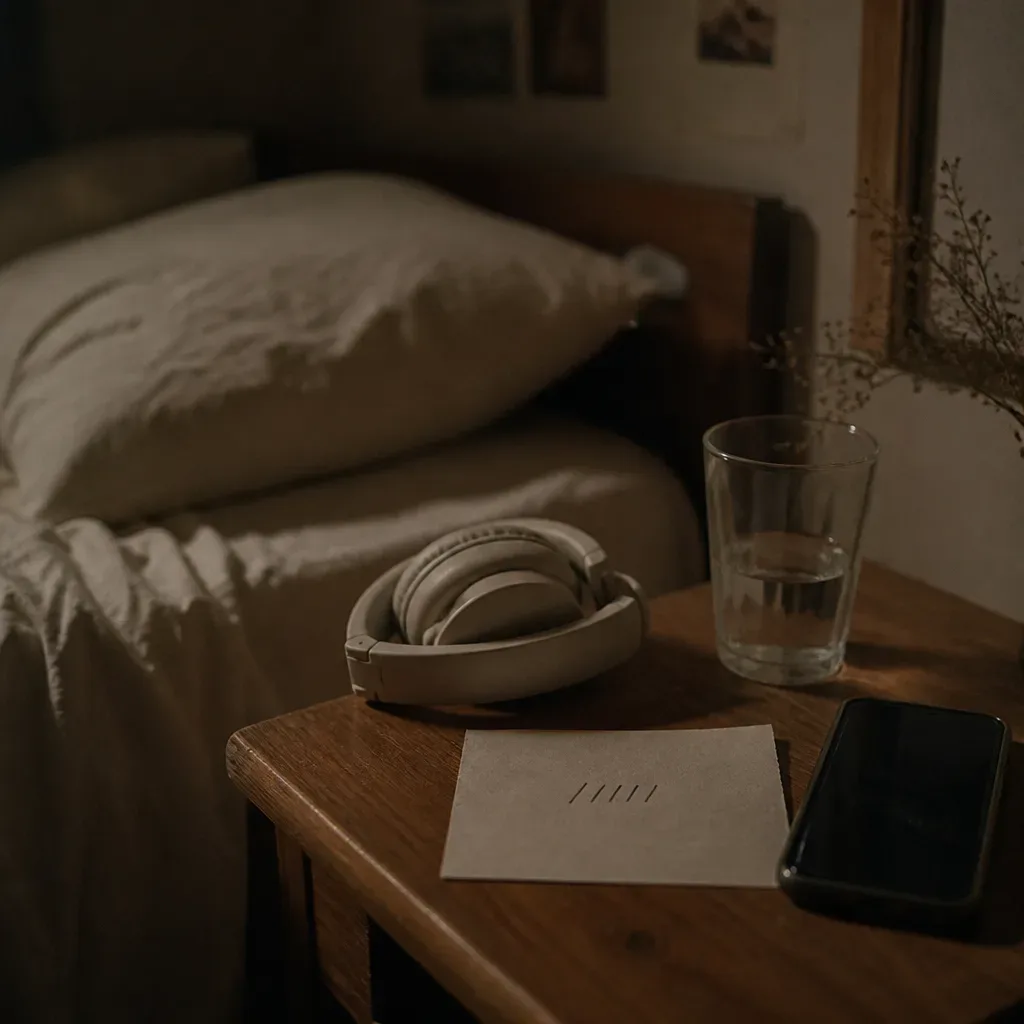
- Put headphones where your hand can find them.
- Download the audio so buffering is not part of the ritual.
- Set your phone to dim and do-not-disturb.
- Place a paper note by the bed with the five steps.
- Decide your dim-reset place in advance.
The Centers for Disease Control and Prevention has reported that about 1 in 3 U.S. adults do not get enough sleep. So if this happens to you, you are not rare. You are a person with a nervous system living inside a noisy century. Still, the routine should not become another thing to optimize. Five minutes means five minutes.
You can also prepare the content of your Dream-Self Moment in daylight. The words should feel believable enough for your body to accept. Not grand. Not glossy. A good night sentence sounds like: I know how to meet this hour softly. Or: I have handled hard nights before, and morning still came.
If you use astrology and manifestation as a reflective lens, keep that reflection out of the bed. Put it in the evening, with tea, before the room goes dark. The 3 AM routine should stay plain. The fewer interpretations you bring to the wake-up, the less fuel anxiety has.
When should you get more support?
You should get more support when 3 AM anxiety is frequent, severe, unsafe, or changing how you live during the day.
A routine can help. It is not a replacement for care. If you wake with panic several nights a week, avoid sleep because you fear waking, use alcohol or sedatives to get through the night, or have thoughts of harming yourself, please contact a licensed clinician or emergency support in your area. The World Health Organization has noted that anxiety disorders are among the most common mental disorders worldwide, with hundreds of millions affected. Common does not mean small.
There are also medical reasons to ask for help. Night waking can be linked with sleep apnea, thyroid changes, medication effects, perimenopause, reflux, pain, or substance use. If you wake gasping, sweating heavily, or with chest pain, treat that as medical, not symbolic. Meaning can wait. Safety comes first.
For many people, the best care is layered. A clinician can help with panic patterns. CBT-I can rebuild sleep cues. A doctor can rule out body causes. Your audio practice can stay as a daily anchor, especially if you already use the AYA Method in the morning or evening. The method does not need to carry what care should carry.
A 3 AM anxiety routine is a bridge, not a verdict. It says: this is a hard hour, and I know the next five minutes. That is enough to begin.
Keep one small light inside reach, and let the rest stay dark.