evening rituals
Evening Manifestation Routine for Racing Thoughts
An evening manifestation routine for racing thoughts using Dream-Self audio, quiet prompts, and a 12-minute sequence you can repeat tonight.

The lamp is low. Your phone is face down. An evening manifestation routine helps racing thoughts by giving your mind one soft track to follow: name the thought, listen to Dream-Self audio, choose one true sentence, and close the day without trying to fix your whole life tonight.
Why do racing thoughts get louder at night?
Racing thoughts often get louder at night because the day has finally stopped giving your mind other things to hold.
The quiet can feel suspicious at first. There are no messages to answer, no train to catch, no kitchen sound covering the inner noise. So the mind starts filing. It remembers the sentence you said too sharply. It reopens tomorrow’s meeting. It counts money. It rehearses a future that hasn’t arrived.
Sleep researchers have a name for part of this. Cognitive arousal is one of the common features of insomnia, and it means the mind stays active when the body is trying to power down. The American Academy of Sleep Medicine estimates that about 30% to 35% of adults report brief insomnia symptoms, while about 10% meet criteria for chronic insomnia. That is a lot of people lying still with a mind that won’t sit down.
There’s also the basic arithmetic of attention. During the day, your mind is interrupted dozens of times. At night, there may be fewer interruptions, but that doesn’t mean there’s more peace. A 2022 Pew Research Center report found that 31% of U.S. adults say they are online almost constantly. If your nervous system has been fed novelty all day, silence can feel like withdrawal.
A manifestation practice doesn’t need to fight the thoughts. It gives them a new order. The aim isn’t to become blank. Blank is not the goal. The mind quiets when it trusts that it has somewhere to place what matters.
This is where an evening practice can help more than another hour of scrolling. It doesn’t demand belief on command. It asks for a repeatable return. One cue. One voice. One small ending.
What makes an evening manifestation routine different from a bedtime routine?
An evening manifestation routine is different because it rehearses who you’re becoming, while a bedtime routine mainly prepares the body for sleep.
A bedtime routine might include brushing teeth, lowering lights, or setting an alarm. Good. Keep those. The Sleep Foundation often recommends a 30- to 60-minute wind-down window because the body responds to repeated signals. But manifestation adds a particular kind of inner direction. It asks, gently: what future self am I practicing as I fall out of the day?
That distinction matters. If the routine becomes only skincare, supplements, and a perfect glass of water, it can be soothing but still leave the mind alone with its old story. If it becomes only desire and mental effort, it can become too charged for night. The better middle is quiet and specific.
| Practice | Main question | Best evening use |
|---|---|---|
| Bedtime routine | How do I prepare to sleep? | Lower stimulation and repeat familiar cues |
| Journaling | What am I still carrying? | Name one thought without solving everything |
| Manifestation | What am I rehearsing as true? | Return attention to the self you’re becoming |
| Dream-Self audio | What can I listen to instead of looping? | Let a guided future-self recording hold the frame |
Neville Goddard often taught the state akin to sleep as a tender threshold for imaginal practice. You don’t have to take that as doctrine to see the practical point. At night, attention is more suggestible because the day is less defended. In cognitive psychology, imagery rehearsal has been studied for nightmares for decades; a 2001 randomized trial in JAMA found imagery rehearsal therapy reduced chronic nightmares among sexual assault survivors. The principle is simple: repeated inner scenes can change what the mind returns to.
A routine is not a personality test. It is a place you can come back to when the day has been too loud.
How do you use Dream-Self audio when your mind won’t stop?
Use Dream-Self audio by treating listening as the whole practice, not as background sound for more thinking.
The AYA Method is a daily audio manifestation practice. Each day you listen to a short personalized recording — your Dream-Self Moment — narrated from the version of you who has already manifested the life you intend. Listening is the practice. Repetition is the work. The audio is the method.
That last line matters most at night. Racing thoughts love extra steps. They want to negotiate, improve, compare, optimize. Audio cuts through some of that because it gives the mind a track. You don’t have to generate the sentence yourself. You receive it. You listen. You come back when you drift.
In mindfulness studies, attention wandering is expected, not treated as failure. A widely cited 2010 Science paper by Killingsworth and Gilbert used experience sampling and found that people’s minds wandered 46.9% of the time. The useful part wasn’t pretending the mind never leaves. It was noticing where it went and returning with less drama.
Try this simple listening sequence:
- Put the phone on Do Not Disturb for 12 minutes.
- Sit or lie down with one hand resting somewhere steady.
- Play your Dream-Self Moment once.
- When your mind runs, don’t argue. Hear the next sentence.
- After the audio ends, write one phrase you remember.
The app also includes tools like a daily affirmation and a Manifestation Board, but those are complements. At night, don’t turn them into more work. If you’re curious about the difference between a spoken future-self recording and written lines, the affirmations guide is a clean place to start.
The practice is not stronger because you strain. It becomes real because you return.

What should the 12-minute evening manifestation routine look like?
A 12-minute routine should move from body, to thought, to audio, to one small close.
Twelve minutes is long enough to mark a change, and short enough not to become a new burden. BJ Fogg’s behavior design work at Stanford has long emphasized that tiny habits are easier to repeat when they attach to an existing cue. Your cue can be ordinary: after brushing your teeth, after putting the cup in the sink, after turning off the big light.
Here is the whole routine:
| Minute | Step | What you do |
|---|---|---|
| 0-2 | Lower the room | Dim light, reduce sound, put the phone away from your face |
| 2-5 | Empty one line | Write the loudest thought in one sentence |
| 5-10 | Listen | Play your Dream-Self audio once, without multitasking |
| 10-11 | Choose one sentence | Write or whisper one line that feels true enough |
| 11-12 | Close | Name one tiny action for tomorrow, then stop |
The one-line emptying matters because unfinished tasks cling. The Zeigarnik effect, first described in the 1920s, suggests that incomplete tasks are more memorable than completed ones. Later research has complicated the effect, but the everyday truth remains useful: the mind keeps touching what has no container. A sentence can be a container.
Examples:
- “I’m worried I’ll forget the invoice tomorrow.”
- “I’m still hurt by what she said.”
- “I don’t know how this plan works yet.”
- “I want to feel more at home in my own life.”
Then listen. Don’t improve the recording in your head. Don’t make a plan while it plays. If one phrase lands, let it land. If nothing lands, the listening still counts. You are teaching the evening that it doesn’t have to end in a mental argument.
You can also bring in the manifestation pillar earlier in the day if you want more context, but at night the practice should stay small. A night routine should be easy enough for the tired version of you.
What do you do with thoughts that keep returning?
You give returning thoughts a place to wait, instead of treating every thought like an emergency.
Some thoughts return because they are meaningful. Some return because they are sticky. Some return because the body is tired and the mind has lost its editing function. You don’t need to know which one it is at 11:17 p.m. You need a humane next move.
Cognitive behavioral therapy for insomnia, often called CBT-I, uses tools like scheduled worry time and stimulus control. The American College of Physicians recommended CBT-I as first-line treatment for chronic insomnia in a 2016 guideline. One reason it helps is that it stops the bed from becoming the place where every unresolved problem gets a meeting.
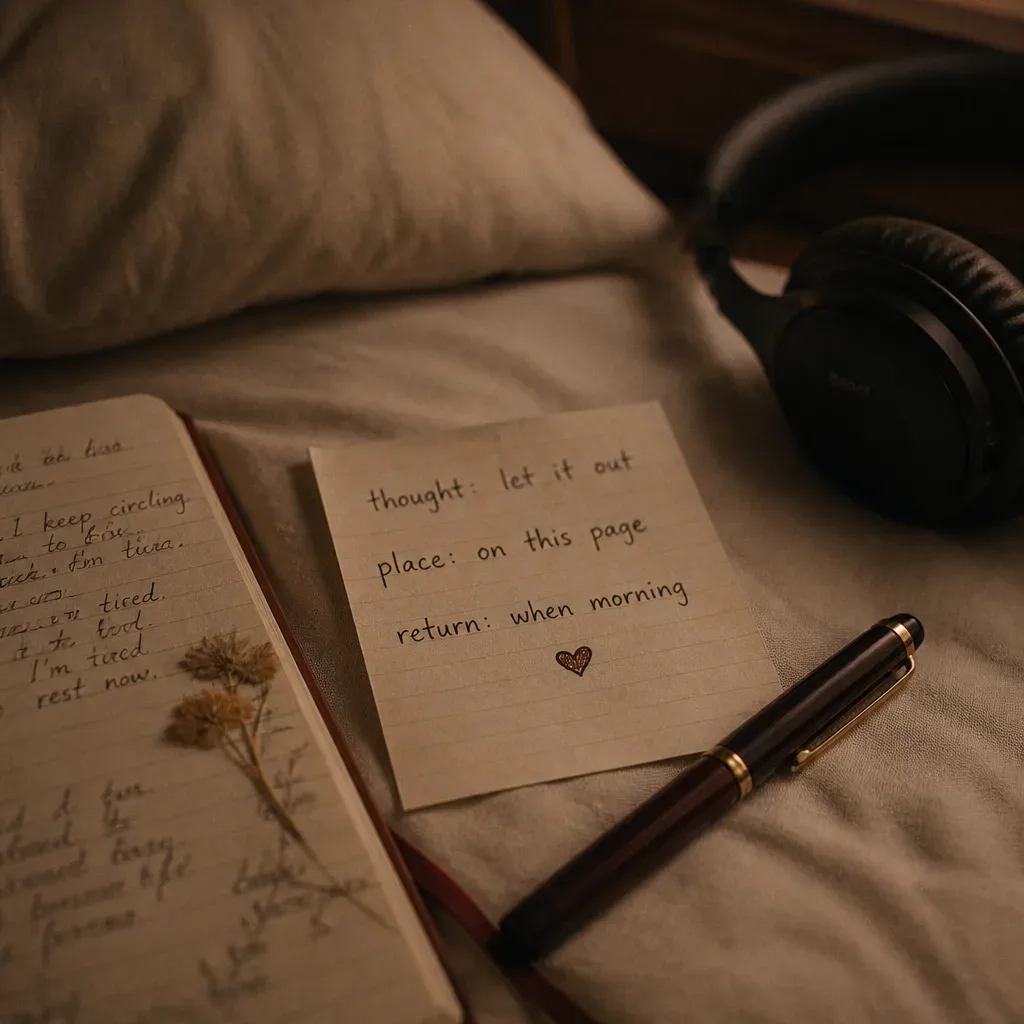
For a manifestation routine, the gentlest version is a waiting list. Keep a small note beside the bed. When a thought returns for the third time, write it under tomorrow. Not a full journal entry. Not a solution. Just the title of the thought.
Use this three-line format:
- Thought: “I might not be ready.”
- Place: “Tomorrow, 10:00, after coffee.”
- Return: “For now, I listen.”
Expressive writing research gives this some support. James W. Pennebaker’s studies beginning in the 1980s found that brief writing about emotional events can improve some health markers, though results vary by person and context. You don’t need a cathartic writing session at bedtime. In fact, too much emotional excavation may wake you up. One clear line is usually kinder.
If the thought is practical, schedule it. If it’s emotional, name it. If it’s fear, let the Dream-Self audio answer with a wider frame. You are not trying to win a debate with the mind. You are teaching it where to rest.
A thought written down is no longer the only light in the room.
How can you make the routine feel real without making it another task?
You make it real by lowering the standard until the practice can survive an ordinary night.
Most routines fail because they are built for the person we are on our best day. That person has clean sheets, charged headphones, and no resentment. But most nights are mixed. Dinner runs late. Someone sends a message. You feel behind. The routine has to fit that person too.
App use data often shows this pattern. A 2019 analysis from retention platform AppsFlyer reported that many apps lose a large share of users within the first 30 days, with uninstall rates varying widely by category and region. Wellness apps can be especially vulnerable because people download them when they feel ready, then leave when the practice asks for too much. The answer is not more intensity. It’s better friction.
Keep the friction low:
- Put headphones where the routine happens.
- Use the same chair, side of bed, or floor cushion.
- Keep the notebook open to a blank page.
- Decide in advance that one listen is enough.
- Let the daily affirmation be optional, not required.
- Save the Manifestation Board for daytime if it wakes the mind.
This is also where timing can be personal. Some people like to pair evening practice with moon phases or personal timing systems. If that helps you feel connected without becoming rigid, the piece on astrology and manifestation can give the practice a quiet calendar. But don’t let timing become another reason to postpone tonight.
You can miss a night and still be someone who practices. You can listen while imperfect and still be listening. You can feel doubtful and still repeat the future you want to know as yours.
Repetition is not glamour. Repetition is how the mind learns where home is.
What changes after seven nights of this practice?
After seven nights, you may not have a silent mind, but you should have a more familiar return path.
Seven nights is a useful test because it is long enough to reveal friction and short enough not to become a life project. Track only three things: whether you listened, how loud the thoughts felt before, and how loud they felt after. Use a 0 to 10 scale. No essays. No moral score.
The Pittsburgh Sleep Quality Index, a standard sleep questionnaire developed in 1989, uses a one-month frame to assess sleep quality, but you don’t need to wait a month to notice patterns. After a week, you may see that the practice works better before you are exhausted, or that writing too much keeps you alert, or that one phrase from the audio follows you into the next morning.
A simple seven-night tracker:
| Night | Listened? | Thought volume before | Thought volume after | One phrase remembered |
|---|---|---|---|---|
| 1 | Yes/No | 0-10 | 0-10 | |
| 2 | Yes/No | 0-10 | 0-10 | |
| 3 | Yes/No | 0-10 | 0-10 | |
| 4 | Yes/No | 0-10 | 0-10 | |
| 5 | Yes/No | 0-10 | 0-10 | |
| 6 | Yes/No | 0-10 | 0-10 | |
| 7 | Yes/No | 0-10 | 0-10 |
Some manifestation teachers, including Joe Dispenza, speak often about rehearsal and identity. You don’t have to accept every claim to use the plain practice underneath: what you repeat becomes easier to access. Behavioral research says something similar in quieter language. Repetition builds cue-response links. The evening cue becomes: I don’t spiral alone; I listen.
If you want to keep going, keep the routine at 12 minutes for another week before adding anything. If you want more daytime support, read about affirmations or return to the broader guide to manifestation. But keep the night simple.
The day can end without being solved.
Stay here. Listen once. Let that be enough.