manifestation 101
Scripting Manifestation vs Future-Self Audio
Scripting manifestation and future-self audio both rehearse a wanted life. See which practice is easier to repeat, remember, and keep.
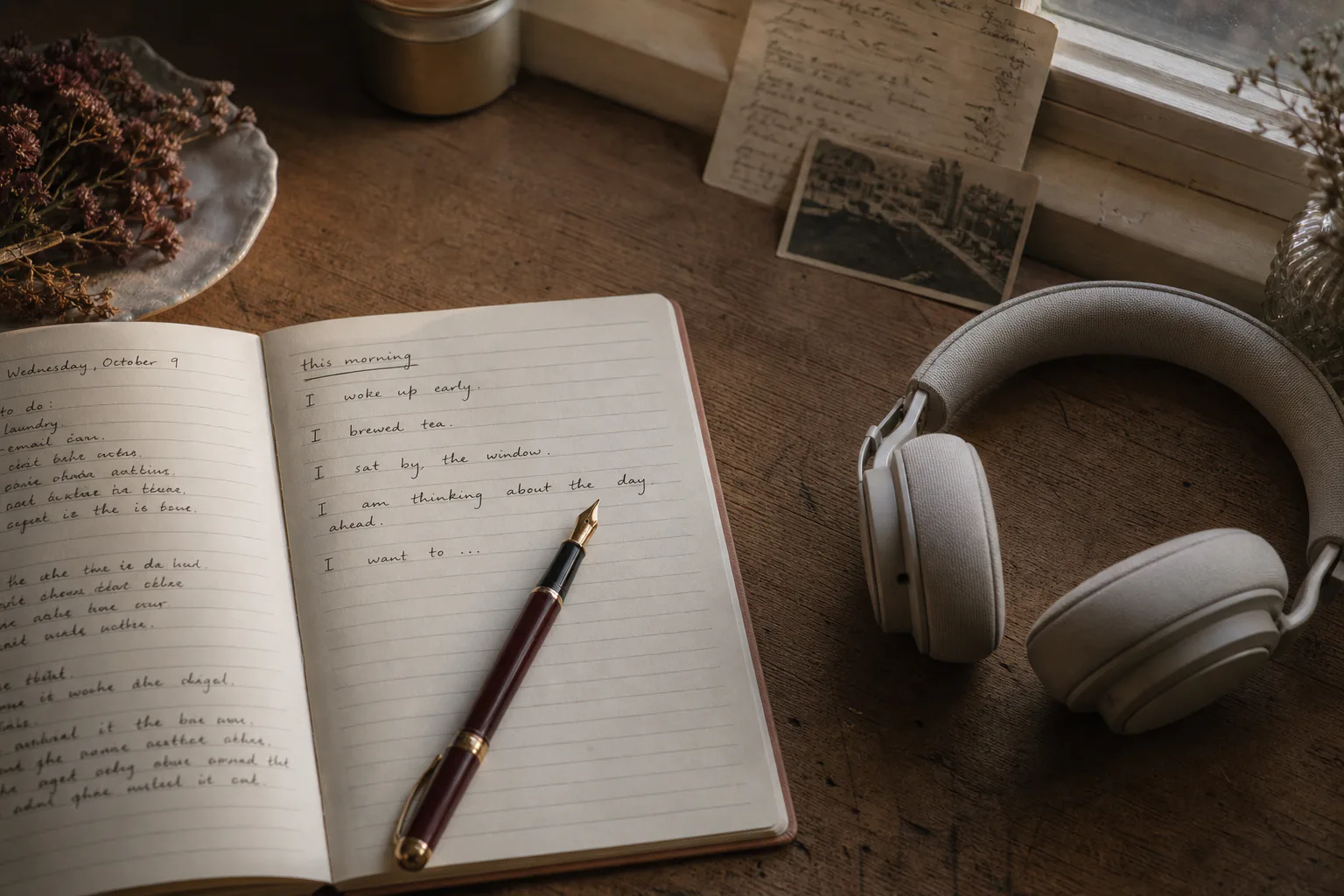
A notebook sits open. Headphones rest beside it. Scripting manifestation works when writing helps you feel and specify a future scene; future-self audio often sticks better because it lowers effort and repeats the same identity cue daily. If you miss practices when life gets full, audio usually wins.
What is scripting manifestation, and when does it stick?
Scripting manifestation is writing a scene from the life you intend as if it’s already real.
A script is not a wish list. It has a point of view, a setting, and a felt detail. You write, “I wake up rested in the home that feels quiet and mine,” not only “I want a better home.” The difference matters. A 2001 study by psychologist Laura King found that writing about a “best possible self” was linked with improved mood among participants. The page can make a vague want more specific.
Good scripting uses present tense. It asks you to notice the small evidence of the new life. The mug on the counter. The calendar with fewer panicked blocks. The body that doesn’t brace before opening email. In manifestation, the practice is less about forcing events and more about rehearsing perception until your choices start to change.
It sticks best for people who already turn to language under stress. If you’ve kept a diary, written morning pages, or used notes apps to think, scripting may feel like home. A 2006 review of expressive writing research by Pennebaker and Chung described benefits across emotional processing and health-related outcomes, though effects vary. Writing can steady you because it slows thought to the speed of a sentence.
The page is honest, too. If you write the same desire for 3 weeks and never take one small action toward it, the gap becomes visible. That’s useful. A script is not proof that you believe. It is a mirror for what you keep practicing.
The future gets clearer when you stop writing to impress yourself.
What is future-self audio, and why can it feel easier to repeat?
Future-self audio is a spoken rehearsal you listen to, usually in the voice and language of the person you’re becoming.
The AYA Method is a daily audio manifestation practice. Each day you listen to a short personalized recording — your Dream-Self Moment — narrated from the version of you who has already manifested the life you intend. Listening is the practice. Repetition is the work. The audio is the method.
That last line is the quiet difference. Scripting asks you to create the practice each time. Audio asks you to return to one prepared signal. Habit researchers often call this reduction of friction. In BJ Fogg’s behavior model, a behavior is more likely when motivation, ability, and prompt meet at the same moment. Listening has high ability because the action is small: press play.
The repetition matters. In a 2009 European Journal of Social Psychology study, Phillippa Lally and colleagues found that habit formation took 66 days on average, with a wide range from 18 to 254 days. A practice that fits tired days has an advantage over one that requires a clean desk and a strong mood.
Audio also uses tone. A written line may say, “I’m safe being seen,” but a voice can carry pace, warmth, and certainty. Neuroscience research on self-referential processing, including studies of the medial prefrontal cortex, shows that material tied to the self is processed differently than neutral material. You don’t need to overstate that. You can simply know this: hearing your future self speak to you can feel more immediate than reading a paragraph you wrote last week.
The practice that sticks is often the practice with the fewest doors to open.
Which one has the stronger habit mechanics?
Future-self audio has stronger habit mechanics for most people because it is easier to start, repeat, and keep consistent.
This doesn’t make scripting manifestation weak. It makes it more effortful. A blank page has many hidden decisions: where to write, what to describe, how long to go, whether it sounds right, whether you’re doing it correctly. Each decision costs attention. A 2010 paper by Gollwitzer and Oettingen on mental contrasting and implementation intentions found that pairing desired futures with specific action cues can improve goal pursuit. The cue is the missing piece for many scripts.
Audio solves for cue. It can attach to an existing moment: after brushing your teeth, before opening your laptop, during a slow walk. In habit design, this is often called anchoring. You place the new action beside a stable action. If you already reach for headphones each morning, future-self audio has a natural doorway.
| Practice | Setup needed | Best for | Main risk | Stickiness cue |
|---|---|---|---|---|
| Scripting manifestation | Notebook or notes app, 10 to 20 minutes | Clarity, detail, emotional truth | Overthinking the wording | Same time, same place |
| Future-self audio | Headphones or speaker, 3 to 8 minutes | Daily repetition, identity rehearsal | Passive listening without attention | Press play after an existing habit |
| Both together | Weekly writing, daily listening | Turning written details into a repeatable cue | Making it too complex | Write once, listen daily |
If you’re deciding by evidence, look at adherence. Meditation app studies often show steep drop-off after the first week; one 2019 JMIR study on mindfulness app use noted that engagement tends to decline quickly without simple prompts and routines. Manifestation practices follow the same human rules. The nervous system does not care how beautiful the method sounds. It cares whether you repeat it.
Try this test for 14 days:
- Choose one desired identity, not ten outcomes.
- Script for 10 minutes on days 1, 4, 8, and 12.
- Listen to future-self audio every day for 5 minutes.
- Mark only one thing: did you return or not?
- At the end, keep the practice with the least resistance.
The clean metric is not drama. It is return rate. If you came back 12 out of 14 days for audio and 2 out of 4 days for writing, your data has spoken softly.
How do writing and listening compare in the body?
Writing clarifies through motor attention, while listening settles through auditory repetition and emotional tone.
When you write by hand, you slow down. You feel the sentence form before it lands. Studies on handwriting and learning, including work by Pam Mueller and Daniel Oppenheimer in 2014, suggest that slower note-taking can support conceptual processing because it reduces verbatim capture. Scripting manifestation can borrow that strength. It makes you choose the true word instead of the impressive one.
Listening works differently. It asks less from the hands and more from the ear. This matters on days when you’re depleted. The American Psychological Association has reported that stress affects attention and decision-making, and many adults report stress levels that interfere with daily life. A practice that can be done lying down may survive days when writing feels like one more task.
There is also memory. Spoken repetition has a long history in prayer, study, and music. You remember what you hear often, especially when the phrasing repeats. Dr. Andrew Huberman often points to the role of attention and salience in learning: the brain changes more readily when something matters and is repeated. You don’t need to make it grand. A sentence heard daily becomes part of the room inside you.
Still, audio can become background noise. If you press play while scrolling, the practice thins. If you write while judging every line, the page closes. Both methods need presence. One asks for active construction. The other asks for receptive attention.
Useful signs your practice is landing:
- You remember one phrase later in the day.
- You make one smaller, truer choice without forcing it.
- You feel less need to explain your desire to everyone.
- You notice old patterns sooner.
- You can return after missing a day without punishment.
A method is not better because it asks more from you. It is better when it brings you back to what is true.
For deeper basics, the Affirmations pillar is useful here, because a line you repeat has to be believable enough to enter. A daily affirmation can complement the audio. It is not the method itself.
What should you choose if your life is already full?
Choose future-self audio as the daily base, then use scripting manifestation when you need clarity.
A full life is not a character flaw. It is data. If you have a job, caregiving, school, illness, grief, or a nervous system that tires easily, the practice has to be kind enough to survive real conditions. Pew Research Center reported in recent years that many adults feel time pressure around work and family demands. You don’t need another practice that depends on a rare perfect morning.
Future-self audio can fit inside an existing edge of the day. Three to eight minutes is enough to create a repeatable contact point. That is why audio belongs at the center of the AYA Method. The app also includes a daily affirmation and Manifestation Board, but those are complements. The audio is the method because it carries the Dream-Self Moment back to you again and again.
Scripting still has a place. Use it when your desire feels foggy, when your audio needs better details, or when you’re trying to tell the difference between a true want and borrowed pressure. Neville Goddard wrote often about assuming the feeling of the wish fulfilled; writing can help some people name that feeling. Joe Dispenza often speaks about rehearsing a new self through repeated inner practice. You can listen, write, and still stay grounded.
A simple choice map:
| If this is true | Choose this today |
|---|---|
| You have less than 7 minutes | Future-self audio |
| You feel mentally crowded | Future-self audio first, then one sentence |
| You don’t know what you want | Scripting manifestation |
| You keep changing your desire | Scripting once a week |
| You want daily consistency | Future-self audio |
| You want visual support | Add a board after the audio |
You can read more about timing and belief in the wider manifestation guide. If symbols and timing help you reflect, astrology and manifestation can be a soft companion, not a rulebook.
Can scripting manifestation and future-self audio work together?
Yes, they work well together when writing shapes the message and audio carries the repetition.
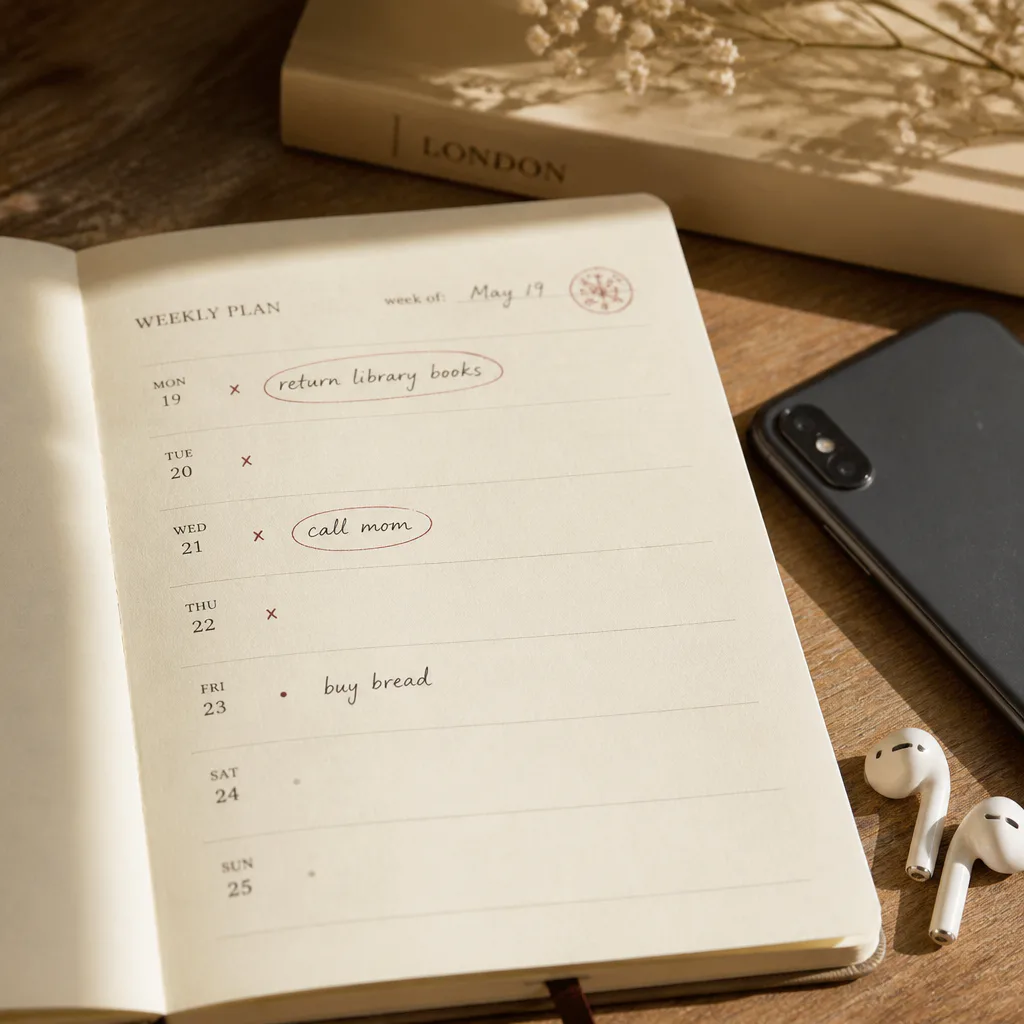
Think of scripting as drafting the truth. Think of audio as returning to it. Once a week, write a short scene. Keep it plain. Name where you are, how your body feels, what has changed, and what you do next. Then choose 3 to 5 lines that feel clean enough to hear daily. Those lines become the seed of your Dream-Self Moment.
This pairing respects cognitive load. George Miller’s classic 1956 paper proposed that working memory has limited capacity, often remembered as 7 plus or minus 2 items, though newer research refines that number downward. Either way, less is kinder. If your script has 18 desires, your attention scatters. If your audio returns to one identity, your day has something to answer to.
Here’s a quiet weekly rhythm:
- Sunday: write one page in present tense.
- Circle the 3 lines that feel most honest.
- Remove anything that sounds like performance.
- Listen daily to your future-self audio.
- Friday: note one choice you made that matched it.
- Repeat only if the desire still feels true.
Keep the written practice short enough that it doesn’t become a second job. Keep the audio steady enough that it becomes familiar. If you want more structure, the AYA Method gives the daily audio a home, with the Dream-Self Moment at the center and the board and affirmation as supports.
The question is not which method sounds more spiritual. The question is which method you can meet when you’re ordinary, tired, and still willing.
Repetition is not proof that nothing is happening. Repetition is how the new self learns your name.
For a broader set of practices, you can compare this with other manifestation techniques, but keep the rule simple. Don’t collect methods to avoid listening. Choose one. Return to it. Let the evidence be your own behavior over 30 days.
The page can tell the truth, and the voice can bring it home.