manifestation 101
Lucky Girl Syndrome as 5-Minute Audio Practice
Lucky girl syndrome becomes steadier when you make it a 5-minute future-self audio practice: clear words, daily listening, and honest proof.
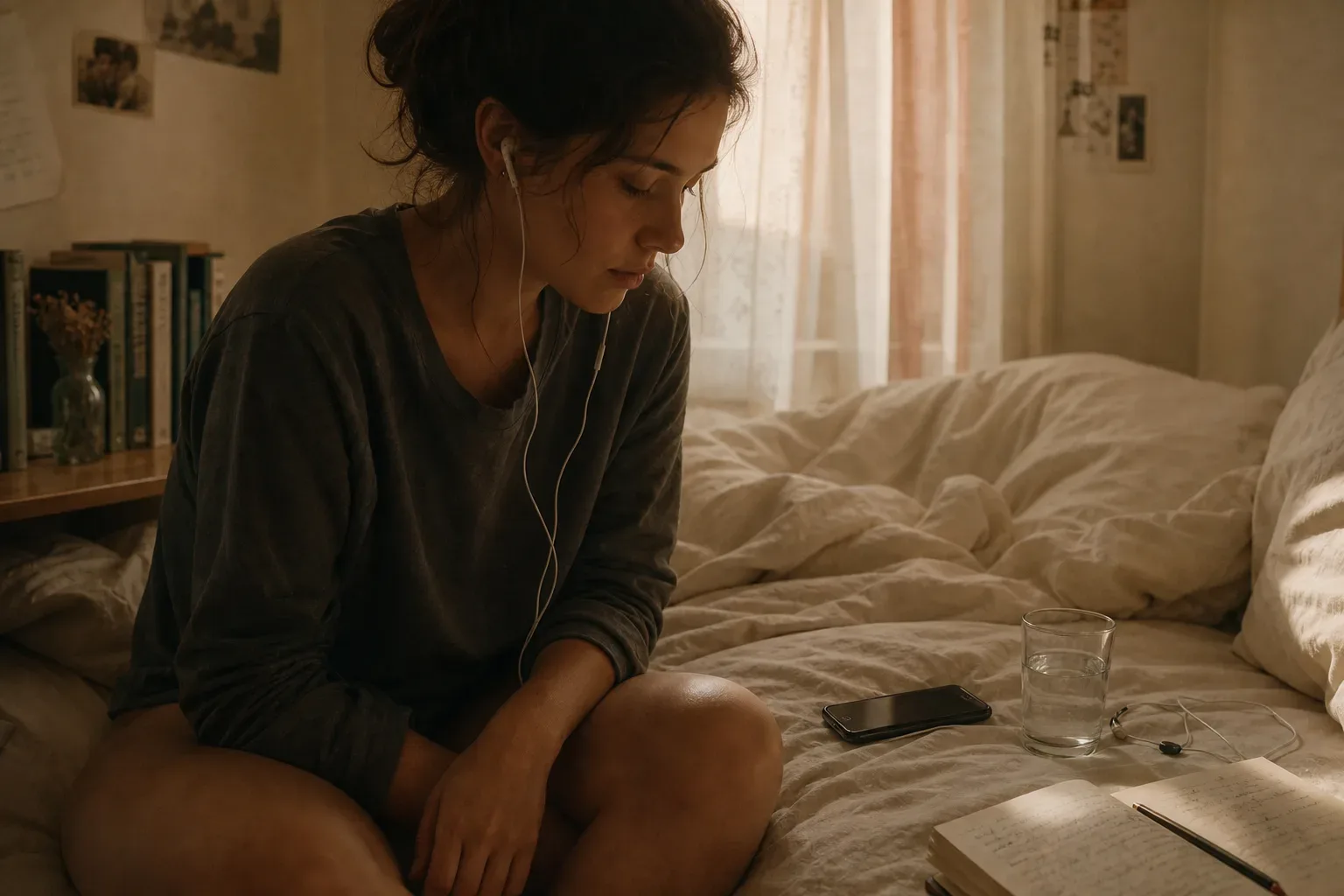
Your phone is still face down. The room has not asked anything of you yet. Lucky girl syndrome becomes useful when it stops being a slogan and becomes a 5-minute future-self audio practice: one short recording, listened to daily, that teaches your attention what to notice and how to act.
What is lucky girl syndrome when it becomes a practice?
Lucky girl syndrome is the assumption that life can meet you kindly, made repeatable through daily listening.
The phrase spread through TikTok because it was small enough to remember. One sentence. I’m so lucky. Everything works out for me. The appeal is clear: you say the line, and for a second your nervous system stops bracing. TikTok reported more than 1 billion monthly active users in 2021, and social phrases can move fast when they fit into a 10-second clip. But a phrase alone is thin. It can pass through you without changing how you choose.
A practice asks for more. It gives the mind a place to return. In manifestation, the question is not whether you can say a nicer sentence. The question is whether you can rehearse a truer identity often enough that your next action has a different shape. That is why lucky girl syndrome is better as audio. You are not only reading words. You are hearing a self you can recognize.
Researchers have studied self-talk with mixed results. In a 2009 Psychological Science paper, Joanne Wood and colleagues found that very broad positive self-statements could make some people with low self-esteem feel worse. That matters here. If the statement feels false, the body argues. The practice must be close enough to be believed and far enough to call you forward.
A good lucky girl practice is not denial. It is trained receptivity. You are teaching yourself to notice the open door, the reply, the second chance, the quiet yes. Luck is easier to receive when you are not rehearsing refusal.
A belief you can repeat is not small. It becomes the room you keep entering.
Why use future-self audio instead of just repeating a line?
Future-self audio works because it gives your mind context, sequence, and a voice to return to.
A line can be beautiful. It can also be slippery. You say it while brushing your teeth, then forget it before breakfast. Audio has duration. Five minutes gives your attention enough time to settle into a scene. In cognitive psychology, mental rehearsal is often used in sport and performance because the brain responds to imagined action in measurable ways, though not identically to physical action. A 2012 review in Frontiers in Human Neuroscience described motor imagery as a useful training support when paired with real practice.
The future-self frame matters too. It is not you begging from lack. It is you listening from a version of yourself that already knows how to behave. Neville Goddard called this living from the end. Joe Dispenza often speaks about rehearsing a future state until the body recognizes it as familiar. You do not need to accept every claim around those teachers to understand the plain mechanism: repeated attention changes what feels normal.
The AYA frame is exact about this. The AYA Method is a daily audio manifestation practice. Each day you listen to a short personalized recording — your Dream-Self Moment — narrated from the version of you who has already manifested the life you intend. Listening is the practice. Repetition is the work. The audio is the method.
That last sentence is the hinge. If you only have 5 minutes, you do not need a complicated ritual. You need the recording. The daily affirmation can support it. A Manifestation Board can make the image visible. But the audio is the method.
Here is the difference in plain terms:
| Practice | What it gives you | Risk if used alone |
|---|---|---|
| Lucky phrase | A quick cue | It can become empty repetition |
| Written affirmation | Clear wording | It may stay intellectual |
| Vision image | Something to see | It can become comparison |
| Future-self audio | Voice, time, feeling, behavior | It needs honest wording |
A sentence can start the change. A voice can keep you company while it takes root.
How do you write a 5-minute lucky girl audio?
You write it by choosing one believable assumption, one future scene, and one small proof you would recognize.
Start with the sentence. Keep it close to the truth. If everything works out for me feels too sharp, soften it without weakening it. Try: things often work out when I stay open and respond. Or: I notice help sooner now. The wording should lower resistance. In self-affirmation research, Claude Steele’s theory and later reviews by Cohen and Sherman in 2014 suggest that affirming valued identity can reduce defensiveness under stress. The key is relevance. The words have to belong to you.
Then choose one scene. Not the whole life. One morning at your desk. One train ride after receiving a message. One quiet kitchen after the bill is paid. The more ordinary the scene, the easier it is for the body to believe. Your future self should sound like someone who has lived the change, not someone performing certainty.
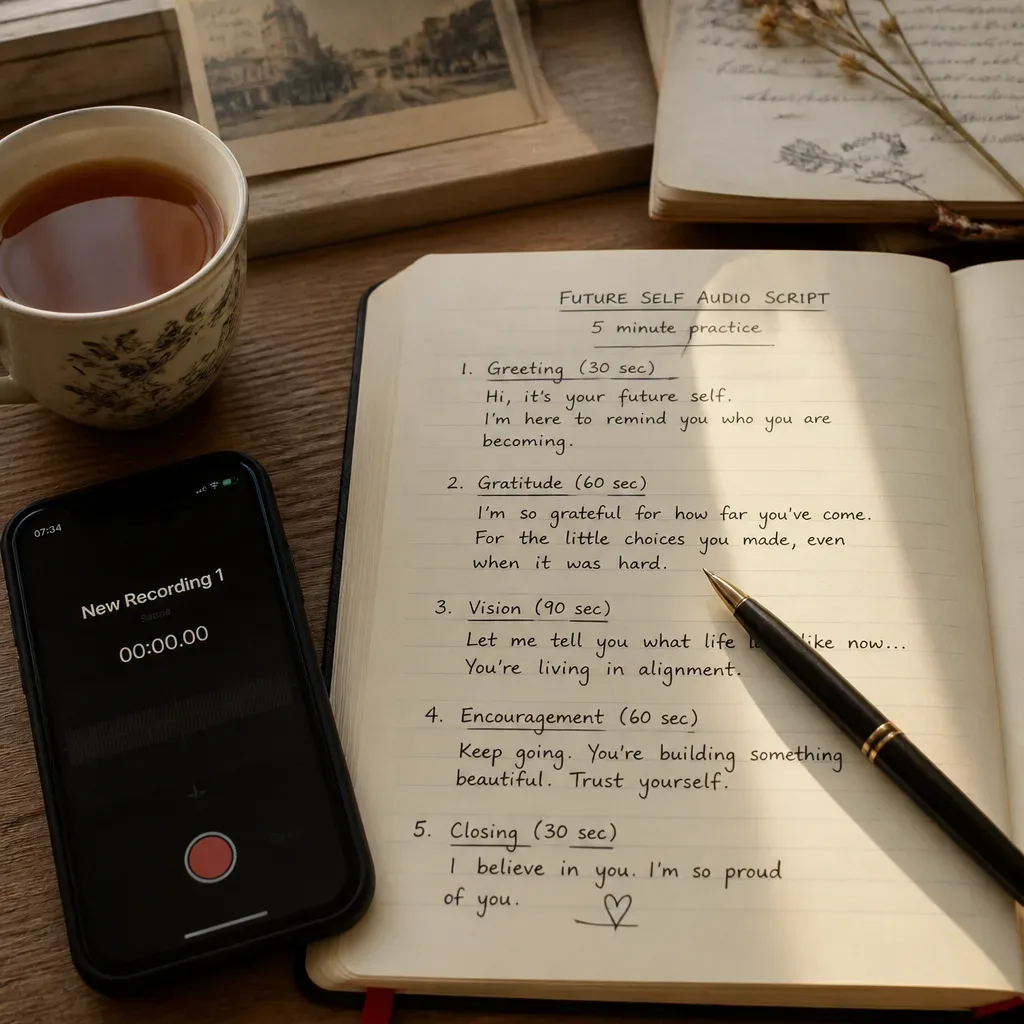
Use this 5-minute structure:
- First 30 seconds: name the future self and the date, gently.
- Next 90 seconds: describe one ordinary scene in present tense.
- Next 90 seconds: name how you respond to uncertainty now.
- Next 60 seconds: mention two pieces of proof you notice.
- Final 30 seconds: close with one lucky sentence you can carry.
You can write 550 to 700 spoken words for a 5-minute recording, depending on pace. Most people speak around 125 to 150 words per minute in calm narration. Slower is better here. The point is not to impress the mind. The point is to let it listen.
If you use affirmations, let one affirmation become the refrain, not the whole practice. For example: I receive what is meant for me without gripping. Say it once at the beginning and once at the end. Let the middle be lived detail.
What should the recording actually say?
The recording should speak from the future self, name real behavior, and include uncertainty without worshiping it.
Here is a short sample you can adapt:
I’m walking into the kitchen and the morning is quiet. I check my messages after I drink water, not before. There is a reply I hoped for. I feel my chest soften, but I do not rush to prove anything. This is how it happens now. I stay close to myself. I answer clearly. I let the good thing arrive without asking it to explain why it chose me.
That is lucky girl syndrome with a spine. It does not say life is perfect. It says you are available for support and capable of response. Dr. Andrew Huberman has often discussed the role of attention and state in behavior change, especially the usefulness of clear cues and repetition. You do not need to make the claim bigger than that. Repeated cues help behavior become easier to access.
Notice the verbs. Drink. Check. Soften. Answer. Let. These are actions. Manifestation without action becomes a private theater. Action without inner rehearsal can become force. The middle path is quiet: you rehearse, then you move.
Keep these lines out of your script:
- I never struggle.
- Everyone is obsessed with me.
- Money comes without me doing anything.
- Nothing bad can happen.
- I am better than other people.
They may sound bold online. They often teach the body to split from reality. A better script has room for the day as it is. In a 2019 Pew Research Center report, about 72 percent of U.S. adults said they used some type of social media. That means comparison is not rare. Your practice should make you more honest, not more performative.
The future self is not louder than you. She is steadier.
When should you listen, and what should you do afterward?
Listen once a day at the same cue, then take one small action that matches the recording.
Morning works because the day has not gathered too much noise. You do not have to wake earlier. Put the audio where your hand already goes: next to water, before messages, after brushing your teeth, during the first 5 minutes of a walk. BJ Fogg’s behavior design model is simple here: tiny behavior, existing prompt, felt success. A practice survives when it is easy to start.
The cue matters more than the mood. If you wait until you feel inspired, you will train inconsistency. In the 2009 European Journal of Social Psychology study by Phillippa Lally and colleagues, habit automaticity took a median of 66 days, with wide variation from 18 to 254 days. That number is humbling. It tells you not to judge the practice after three mornings.
After listening, choose one action. Not ten. One. Send the message. Open the document. Walk into the meeting without apologizing for existing. Save the receipt. Ask the question. Lucky girl syndrome becomes grounded when it changes the next observable behavior.
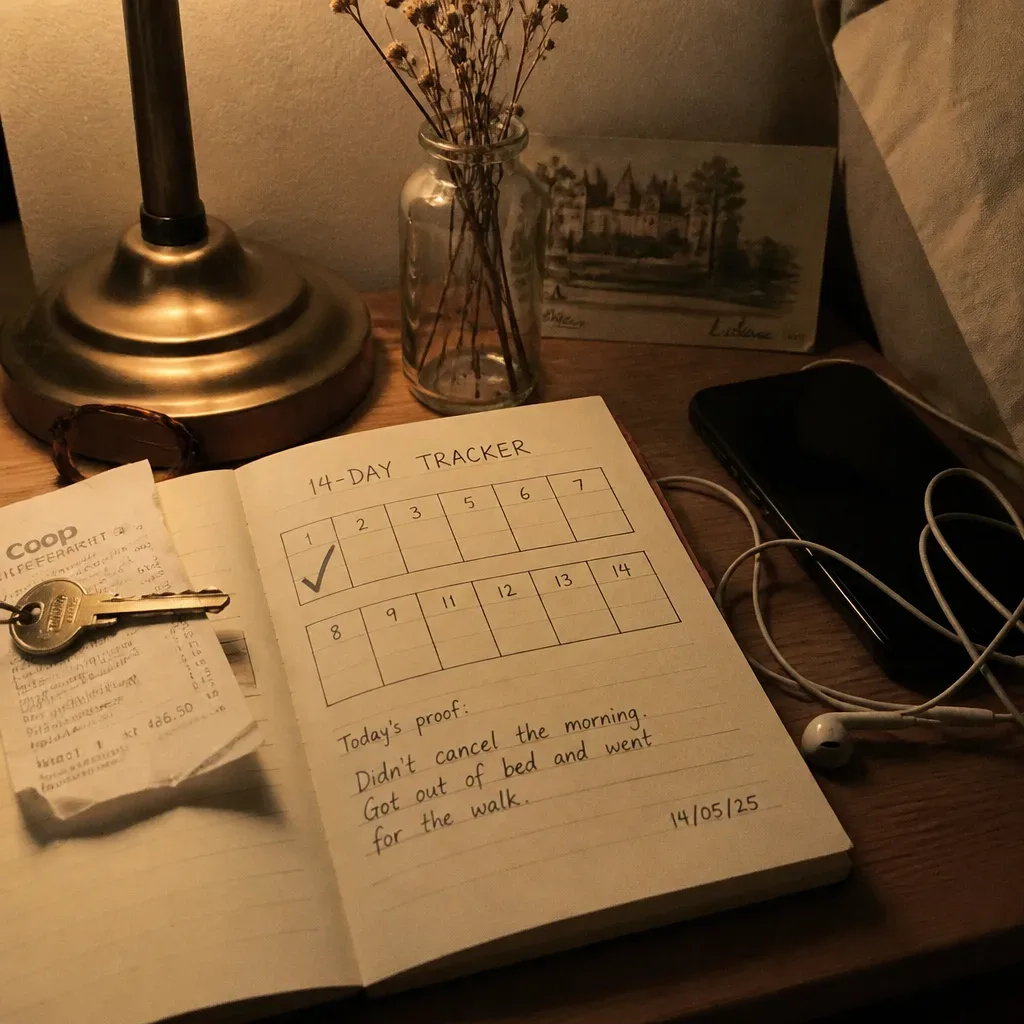
Try this tiny tracker for 14 days:
| Day | I listened? | One proof I noticed | One action I took |
|---|---|---|---|
| 1 | Yes / No | A reply, a calm moment, a chance | Sent the email |
| 7 | Yes / No | A pattern I can name | Asked directly |
| 14 | Yes / No | What feels easier now | Chose without spiraling |
Fourteen days is long enough to see friction. It is short enough that you will not turn the practice into another performance review. You are not grading your worth. You are collecting evidence.
How do you keep lucky girl syndrome honest?
You keep it honest by pairing receptivity with evidence, boundaries, and real-world care.
This matters because positivity can become another way to silence yourself. If you are grieving, anxious, burnt out, or unsafe, you do not need a prettier sentence. You may need rest, support, medical care, legal help, or a hard conversation. A future-self audio practice can sit beside those things. It cannot replace them. The Journal of Behavioral Medicine has published many studies on stress management and self-regulation over the years; the pattern is clear enough: practices help most when they support, not avoid, reality.
Use a three-part honesty check before you record:
- Is it believable at 60 percent? If your body says no, rewrite it softer.
- Does it include behavior? If nothing changes after listening, add one action.
- Does it allow support? If the script makes you isolated, add receiving help.
The word lucky can be tender when you use it well. It does not mean chosen above others. It means available to the good that is already trying to reach you, while you do your part. That distinction is quiet, but it changes the whole practice.
There is also a cultural piece. Online lucky girl syndrome can sometimes sound like privilege pretending to be mindset. Be careful. Your script can honor context. You can say: I notice the help I have. I use it well. I ask for what I need. I do not confuse ease with superiority. This is not less magnetic. It is more true.
The cleanest manifestation practice does not ask you to lie. It asks you to stop rehearsing defeat.
What if you already use astrology, a board, or affirmations?
Use them as supports, but let the 5-minute audio remain the center of the practice.
If astrology helps you name timing, pattern, or reflection, keep it gentle. A moon phase can be a cue. A transit can be a prompt. It should not become a verdict. You can read more about astrology and manifestation if that language already feels familiar. The useful question is simple: what does this help me notice, and what does it help me practice today?
If you keep a Manifestation Board, let it hold images that match the audio. One room. One sentence. One receipt. One place your future self walks. The board is visual proof, not the engine. The audio carries the daily repetition. In memory research, spaced repetition works because returning to material over time strengthens recall. The same ordinary principle applies here: what you revisit becomes easier to access.
If affirmations are your entry point, choose one and make it specific. The affirmations page can help you keep the wording clean. For lucky girl syndrome, try lines like these:
- I notice support without dismissing it.
- Good timing is allowed to find me.
- I respond to chance with courage.
- I let one kind thing count.
- I am available for the next right opening.
Then place the affirmation inside the recording. Do not stack tools because you are afraid one is not enough. Five minutes of daily listening is already a full practice when you do it with care.
For a wider foundation, return to the manifestation guide and then come back to the sound of your own future voice. You do not need more noise. You need a repeatable way to remember.
The morning is still here, waiting for the first kind thought you will believe.