manifestation 101
Whisper Method Manifestation With Future-Self Audio
Learn whisper method manifestation with future-self audio: a quiet 7-minute practice using repetition, attention, and one honest scene for daily listening.

The room is quiet. Your phone is face down. Whisper method manifestation with future-self audio means you hear one clear sentence from the version of you who already lives what you intend, then repeat the listening daily. The whisper is not a spell. It is a cue for attention, memory, and choice.
What is whisper method manifestation, really?
Whisper method manifestation is a short practice where one sentence is spoken softly inside a clear imagined scene.
The usual version is simple. You picture yourself near the person, outcome, or state you want. You lean in. You whisper a sentence as if it is already true. Then you let the scene close. On social platforms, the practice often gets dressed up as a way to make someone text, apologize, or notice you. That is the loud version, even when it says whisper.
The quieter version is cleaner. You whisper to your future self. You speak to the part of you who already knows how to choose, receive, rest, ask, begin, or stop. This matters because attention is trainable. The CDC’s 2017 National Health Interview Survey estimated that 14.2% of U.S. adults had practiced meditation in the prior 12 months, up from 4.1% in 2012. People return to small inner practices because attention shapes what becomes available to notice.
A whisper works because it is specific. One sentence is easier to remember than ten. A 2009 Psychological Science paper by Joanne Wood, W. Q. Elaine Perunovic, and John Lee found that broad positive self-statements could make some people with low self-esteem feel worse. The lesson is not that affirming is bad. The lesson is that the sentence has to be close enough to the body’s truth.
A sentence that your body rejects will not become a home.
That is why future-self audio can be useful. It gives the whisper a stable voice, pace, and return point. If you want a larger frame for this work, start with the Manifestation pillar. If you want the daily audio practice itself, the AYA Method names it plainly: The AYA Method is a daily audio manifestation practice. Each day you listen to a short personalized recording — your Dream-Self Moment — narrated from the version of you who has already manifested the life you intend. Listening is the practice. Repetition is the work. The audio is the method.
Why use future-self audio instead of only whispering in your head?
Future-self audio helps because it removes performance and gives the practice a repeatable cue.
When you do the whisper method only in your head, the practice can change every day. Monday’s sentence becomes Tuesday’s paragraph. Wednesday turns into bargaining. By Friday, you are not practicing anymore. You are checking if reality has obeyed you. Audio interrupts that drift. It holds the same scene for you when your mind is tired.
Habit research gives this a practical backbone. In a 2009 European Journal of Social Psychology study, Phillippa Lally and colleagues followed 96 people building new habits and found the average time to automaticity was 66 days, with a wide range from 18 to 254 days. The number is not a promise. It is a reminder. Repetition likes a cue.
Audio also changes the felt role. You are not trying to convince yourself with force. You are receiving a line from the version of you who is already steady enough to speak it. That is different. In the AYA Method, the Dream-Self Moment is the center because listening keeps the practice small. The app also includes a daily affirmation and Manifestation Board, but those are complements. The audio is the method.
Here is the difference in plain terms:
| Practice style | What you do | What can go wrong | What helps |
|---|---|---|---|
| Silent whisper | Repeat a line in your mind | You keep editing it | Use one sentence only |
| Spoken whisper | Say the line softly | You may feel self-conscious | Practice when alone |
| Future-self audio | Listen to the line inside a scene | You may expect instant proof | Repeat daily for 7 days |
| Written script | Write the scene by hand | It can become too long | Keep it under 5 lines |
Dr. Andrew Huberman often describes the brain as changing through attention, repetition, and emotional salience in public teaching on neuroplasticity. You do not need to make that mystical. A repeated audio cue tells your attention, “this matters.” Then your day gives you chances to act like it does.
How do you build a 7-minute whisper method practice?
You build it by choosing one scene, one sentence, one audio cue, and one small action.
Start smaller than your ambition. A good scene is not a movie. It is one frame. You are opening an email. You are walking into your room after a calm conversation. You are looking at your bank app without tightening. You are hearing your own voice say no without explaining for 12 minutes. The scene should be specific enough that you can see it in under 10 seconds.
Then choose the whisper. Present tense helps, but only if it is believable. “I am safe to be seen” may work. “Everyone adores me now” may not. Sherman and colleagues published a 2013 PLOS ONE study suggesting self-affirmation can improve problem-solving under stress, especially when people reflect on values that matter to them. The useful line often points to value, not fantasy.
Use this 7-minute structure:
- Minute 1: Arrive. Sit or lie down. Let your shoulders drop. No need to perfect your breathing.
- Minute 2: See the scene. Pick one frame that proves your intention is becoming normal.
- Minute 3: Hear the whisper. One sentence, softly spoken by your future self.
- Minutes 4 and 5: Listen to the audio. Let the Dream-Self Moment carry the scene.
- Minute 6: Stay quiet. Do not check for results. Let the body settle.
- Minute 7: Name one action. Choose one small thing that matches the scene today.
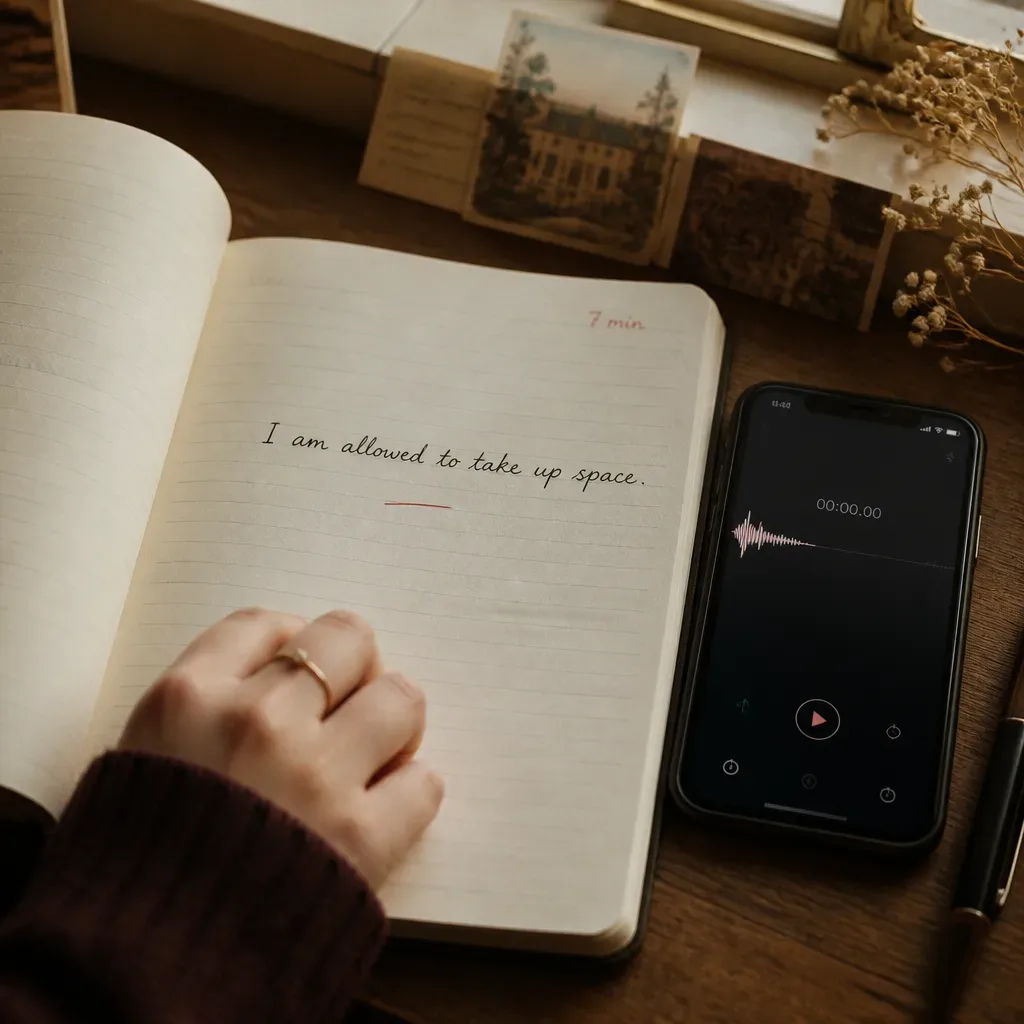
If you already work with affirmations, keep them close to the whisper, not bigger than it. One daily affirmation can support the sentence. It should not become a wall of declarations you secretly do not believe.
The smaller the practice, the less room the mind has to turn it into theatre.
Try it for 7 days before changing the wording. Seven days is long enough to notice friction and short enough to stay honest. If you miss a day, do not restart with punishment. Press play the next day. Quiet repetition is allowed to be imperfect.
What should your whisper sentence say?
Your whisper sentence should name the state you are practicing, not the person or outcome you are trying to control.
This is where many people make the method too sharp. “Text me now” may feel satisfying for three seconds, but it trains the mind to grip. A future-self sentence is different. It might say, “I am easy to reach when love is mutual,” or “I speak clearly and let the answer be real.” That moves the center back into your own life.
Neville Goddard often taught the feeling of the wish fulfilled. You do not have to accept every claim to use one careful idea: rehearse the inner state of already being the person who can live the thing. The detail matters. A state is livable. A demand is brittle.
Use this filter before recording or choosing audio:
- Is the sentence under 12 words?
- Can you hear it every day without flinching?
- Does it describe you, not someone else’s obedience?
- Does it create one clear image?
- Is there one small action you could take after listening?
A 2015 review in Social Cognitive and Affective Neuroscience by Cascio and colleagues connected self-affirmation with brain systems involved in self-related processing and valuation. That does not mean every sentence works. It means personally meaningful language can matter. The line has to feel like yours.
Here are quiet examples:
| Intention | Whisper sentence | One matching action |
|---|---|---|
| Love | “I receive steady care without chasing.” | Wait before sending the second message |
| Work | “My work is seen by the right people.” | Send one clear pitch |
| Money | “I can look directly and choose well.” | Open the account and note one number |
| Body | “I return gently to what supports me.” | Drink water before coffee |
| Voice | “I say the true thing simply.” | Ask one direct question |
For more context on how signs and timing can support a practice without taking it over, read Astrology and manifestation. Keep the order clean. The sky can be a mirror. The listening is still yours.
When should you listen, and how often is enough?
Listen once a day at the same natural cue, because consistency matters more than mood.
The best time is the time you can repeat. Not the most aesthetic time. Not the time a stranger says is sacred. If you wake at 6:40 and leave at 7:15, do not invent a 45-minute ceremony. Listen after brushing your teeth. Listen on the bus with one earbud. Listen before sleep if that is the only quiet hour you have.
Gollwitzer’s work on implementation intentions, summarized across studies from the late 1990s onward, found that “if-then” plans often improve follow-through because they attach behavior to a cue. You can use the same structure here: “After I plug in my phone at night, I listen.” Or, “After I make coffee, I listen before opening messages.”
Do not chase a feeling every time. Some days the audio will feel close. Some days it will feel like weather behind glass. That is normal. Meditation and habit studies often show variable daily response; the practice is not invalid because one session is flat. You are laying down a return path.
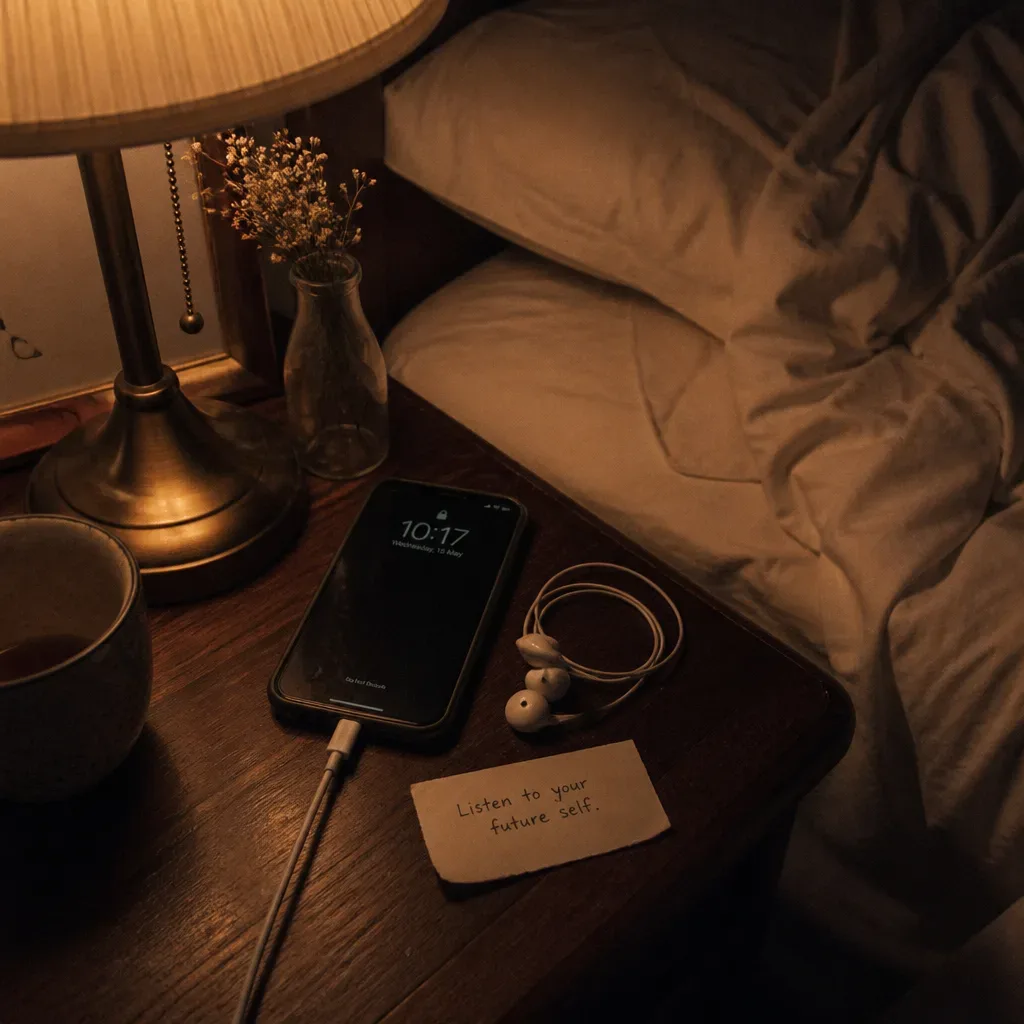
A simple 7-day rhythm can look like this:
- Day 1: Choose the scene and sentence.
- Day 2: Listen without editing.
- Day 3: Notice resistance without arguing.
- Day 4: Take one matching action.
- Day 5: Listen at the same cue again.
- Day 6: Write one real-world sign of ease.
- Day 7: Decide whether the sentence still feels true.
If you like structure, pair the audio with a tiny note. One line only. “Today I asked.” “Today I waited.” “Today I sent it.” The note is not proof for the cosmos. It is evidence for your own attention.
What you repeat quietly begins to feel available.
What mistakes make the whisper method feel worse?
The practice gets harder when you use it to monitor, force, or measure your worth.
The first mistake is checking too soon. You listen for three minutes, then open the app, scan the inbox, watch the person’s status, and call it intuition. It is not intuition. It is surveillance. The whisper method becomes kinder when you separate practice from checking. Listen first. Live after.
The second mistake is using a sentence that is too far from your nervous system. Wood, Perunovic, and Lee’s 2009 study is worth remembering here because “I am a lovable person” did not help everyone. For people who already felt low self-worth, the statement could bring up contradiction. A better whisper might be, “I am learning to stay when care is steady.” Softer. More true.
The third mistake is making the method about another person’s free will. Your future-self audio should not need someone else to become a puppet. If the desire involves love, speak to the version of you who receives mutual care. If it involves work, speak to the version of you who sends the email, names the price, or finishes the draft.
Keep these boundaries:
- Do not use the practice to stalk or pressure.
- Do not replace medical, legal, or financial help with a whisper.
- Do not make one missed day mean failure.
- Do not keep a sentence that makes your body tighten every time.
- Do not confuse silence with lack of movement.
A 2022 American Psychological Association report found that 76% of U.S. adults said stress had affected their health in the prior month. Under stress, practices can become another way to judge yourself. Make this one small enough that it does not become a test.
If you need a wider base, return to what manifestation means in practice and keep the method grounded in behavior. The whisper is not a replacement for action. It is a way to hear the self who can take it.
How do you know if the practice is working?
You know it is working when your choices start to resemble the future-self scene before the outcome fully appears.
Look for small evidence. You pause before replying. You ask for the number. You sleep instead of scrolling. You send the portfolio. You stop auditioning for care that is not being offered. These are not dramatic signs. They are better. They belong to your day.
The Princeton Engineering Anomalies Research program, often called PEAR, studied intention and random event generators for nearly three decades, from 1979 to 2007. Its results remain debated, and you do not need to build your life on them. The useful takeaway is humbler: people have long tried to study whether intention and attention interact with outcomes. In daily life, the clearest data is still your behavior.
Use a 3-column check once a week:
| Question | Example answer | Why it matters |
|---|---|---|
| What did I hear? | “I receive steady care.” | Keeps the sentence clear |
| What did I do? | “I did not chase the reply.” | Links listening to action |
| What felt easier? | “Waiting did not feel like collapse.” | Shows nervous system change |
If nothing shifts after 14 days, do not shame yourself. Edit the sentence. Make it truer, smaller, and more tied to action. If the practice brings up grief, fear, or old pain, that does not mean you are doing it wrong. It may mean the desire touches a tender place. Support matters. Therapy, community, and rest are allowed in the same life as manifestation.
You can also use a visual complement, like a Manifestation Board, after the audio. Keep it secondary. The board helps you see the scene. The daily affirmation helps you name it. The Dream-Self Moment is still the practice. Listening is where you return.
Your future self is not louder than you. Just steadier.
Put the phone down for one breath, and let the sentence find you.