mindset
Limiting Beliefs Manifestation With Audio Loops
Use limiting beliefs manifestation practice with a future-self audio loop: a short daily listening ritual that helps old thoughts loosen.

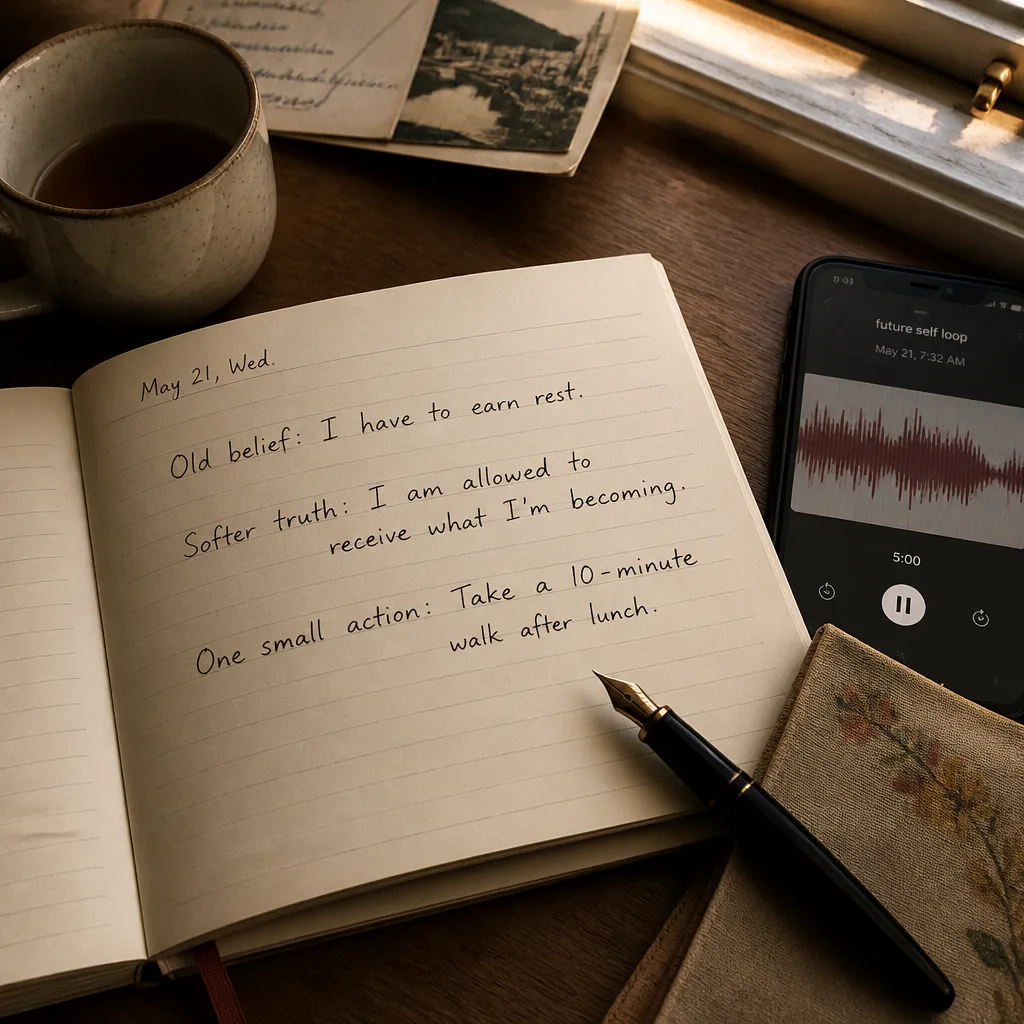
A phone rests beside the bed. You press play before the room asks anything from you. Limiting beliefs manifestation works best when you stop arguing with old thoughts and give your mind a repeated future-self cue instead: one short audio loop, heard daily, followed by one small matching action.
What are you actually trying to rewire?
You’re trying to rewire the expectation underneath the thought, not erase the thought itself.
A limiting belief usually sounds simple. “I’m bad with money.” “I always lose momentum.” “People like me don’t get chosen.” Under it sits a prediction. Your mind is trying to save you from surprise by predicting the same result again. In cognitive psychology, predictive processing models describe the brain as constantly comparing what it expects with what it senses; Karl Friston’s work on the free-energy principle is often cited here, though the model is debated in everyday application.
For manifestation, this matters because manifestation is not only a wish. It is also a rehearsal of identity, attention, and behavior. If the old prediction keeps running, you may say the new sentence and still choose the old room. The practice has to reach the part of you that expects.
A belief is a practiced conclusion. It can be softened by a practiced alternative.
The goal is not to make yourself fearless. Fear has data. A 2022 American Psychological Association report found that 27% of U.S. adults said most days they were so stressed they could not function. Your mind may be carrying real history, real pressure, real evidence. So the first move is respect. You name the belief as something learned, not something holy.
Write the sentence down as plain speech. Not “I carry scarcity.” Too vague. Write, “If I ask for more, I’ll be punished.” That sentence gives you something to work with. It has a trigger, a prediction, and a cost.
Why does audio work better than thinking harder?
Audio works because it turns a new belief into a repeated cue your body can recognize.
Thinking harder often becomes court. One side argues for the future. One side argues for the past. The nervous system sits there listening to both lawyers. A future-self audio loop changes the format. It gives you one voice, one cadence, one time of day, and one repeated return.
The AYA Method is a daily audio manifestation practice. Each day you listen to a short personalized recording — your Dream-Self Moment — narrated from the version of you who has already manifested the life you intend. Listening is the practice. Repetition is the work. The audio is the method.
That definition matters. The daily affirmation and Manifestation Board can help, but they are complements. The audio is the method because sound enters differently than a sentence on a page. Research on auditory memory suggests spoken words use timing, tone, and rhythm as part of recall. In a 2017 review in Frontiers in Psychology, researchers described inner speech as tightly connected to self-regulation and planning.
You do not need to feel inspired. You need to become familiar with a truer line.
This is also why the loop should be short. BJ Fogg’s behavior design work at Stanford has long argued that tiny behaviors repeat more reliably because they ask less from motivation. A 3-minute loop heard 30 times will usually do more than a 25-minute recording you avoid after Tuesday.
Use the audio like a rail. The old belief may still speak. Let it. Press play anyway.
How do you write a future-self script that doesn’t feel fake?
You write it from the nearest believable future, not from a fantasy version of yourself.
The script should sound like you after the belief has softened by one layer. If your old sentence is “I can’t be consistent,” do not record “I am perfectly disciplined forever.” Your body will object. Record this: “I keep returning. I don’t need a perfect streak to be someone who follows through.” That is close enough to enter.
Neville Goddard wrote often about assuming the feeling of the wish fulfilled. The useful part, stripped of theatre, is rehearsal. You speak from the state you intend to practice. Joe Dispenza often talks about mental rehearsal as a way to pair thought and feeling; some claims around his work are debated, but the behavioral point is simple: repeated rehearsal makes a response easier to access.
Here is a small structure:
- Name where you are, kindly.
- Speak as the future self who remembers this moment.
- Describe one concrete behavior that now proves the new belief.
- End with a line you can carry into the day.
A future self is not a costume. It is a set of repeated choices that finally feels like home.
Use details your mind can verify. “I opened the invoice.” “I sent the message.” “I rested without making it a moral failure.” Specificity lowers resistance. In a 2011 study in the Journal of Experimental Social Psychology, self-affirmation practices were associated with lower defensive responses under threat, though effects vary by context.
| Old belief | Too-far line | Believable future-self line |
|---|---|---|
| I always quit | I never quit anything now | I return faster than I used to |
| I’m not chosen | Everyone wants me | I let myself be seen by the right people |
| Money slips away | I’m rich now | I can look at my money without shrinking |
| I don’t trust myself | I trust every decision | I can make one clean decision today |
For more on sentence-level practice, keep affirmations close, but let the audio carry the daily repetition.
What is the exact 11-minute practice?
The practice is: write for 3 minutes, listen for 5 minutes, act for 3 minutes.
Keep it small enough to survive a bad morning. Habit formation research often cites a 2009 study by Phillippa Lally and colleagues in the European Journal of Social Psychology, where automaticity took 18 to 254 days, with an average of 66 days. That range is the mercy. You do not need a dramatic day. You need a repeatable one.
Use this sequence:
- Minute 0 to 3: Write the old line. Write the limiting belief exactly as it appears. Then write one softer sentence under it. Do not decorate it.
- Minute 3 to 8: Listen to the loop. Sit still if you can. Walk if you need to. The rule is simple: no multitasking that steals attention.
- Minute 8 to 11: Take one matching action. Send the email. Open the document. Put $5 aside. Drink water before coffee. Make the belief physical.
The action matters because belief is not only what you repeat. It is what your day has evidence for. Dr. Andrew Huberman often describes neuroplasticity as requiring focused attention followed by states that allow consolidation, especially sleep and rest. You do not have to turn this into a lab. You just have to give your brain a cue and a receipt.
A new belief needs evidence, but the evidence can be very small.
If you use the app, the Dream-Self Moment can be your daily loop. The app also includes a daily affirmation and Manifestation Board, but keep the hierarchy clean: listen first. If you want a wider frame for how intention practices work, read the Manifestation pillar after your practice, not instead of it.
Do this for 14 days before judging it. Two weeks gives you enough repetitions to notice friction without pretending the whole belief is gone.
How do you choose the right daily cue?
Choose a cue that already happens, even when your mood is low.
The best cue is not noble. It is reliable. Sitting up in bed. Starting the kettle. Putting on shoes. Parking the car. James Clear popularized “habit stacking,” but the behavior science underneath is older: stable context helps behavior repeat. Wendy Wood’s research on habit shows that repeated actions in stable contexts become less dependent on conscious intention over time.
Do not attach the loop to a fantasy morning. Attach it to a real one. If you have children, shift work, a shared room, or a nervous dog, choose the least romantic cue available. Press play while standing in the bathroom. Press play before opening messages. Press play on the train with one earbud.
Here are good cues:
- After your alarm stops, before your feet hit the floor
- While the kettle heats
- After brushing your teeth at night
- Before opening your laptop
- After parking, before leaving the car
- During a slow walk around the block
One quiet rule helps: same cue, same loop, same first action. That is the circuit. In small studies on implementation intentions, Peter Gollwitzer found that “if-then” plans can increase goal follow-through by making the next move more automatic. “If the kettle starts, then I press play” is better than “I’ll listen when I feel ready.”
Readiness is often just fear wearing a polite coat.
If your practice has a spiritual layer, you can still keep it grounded. Some people pair astrology and manifestation with timing rituals, new moons, or personal cycles. Fine. Just don’t let timing become avoidance. The loop works because it repeats, not because the day is perfect.
What do you do when the old belief talks back?
You let it talk, then you return to the loop without making the resistance a problem.
This is the part most people misread. They hear the old belief after five days and think the practice failed. It did not. The old belief is a memorized safety strategy. Of course it checks the door. In clinical language, cognitive defusion practices from Acceptance and Commitment Therapy often teach people to notice thoughts as thoughts, not commands. A 2015 meta-analysis in Behavior Research and Therapy found ACT showed small to medium effects across several conditions, though outcomes differ.
Try this when resistance appears:
- Say, “This is the old prediction.”
- Put one hand somewhere steady, like your chest or the table.
- Press play again, or listen to the last 60 seconds.
- Take the smallest matching action available.
You are not trying to win an argument inside your head. You are trying to stop treating every old thought as an instruction.

The old belief may get louder when the new behavior gets real. If your belief is “I shouldn’t ask,” expect noise right before sending the ask. If your belief is “I’m not safe being visible,” expect noise right before posting, pitching, or speaking. This is not proof to stop. It is proof that the belief has been contacted.
Use a 0 to 10 scale. Before listening, rate how true the old belief feels. After the matching action, rate it again. You are not looking for zero. You are looking for movement. A shift from 8 to 6 is data. In behavior change, visible feedback often increases adherence; even simple tracking has been linked with better self-monitoring in weight, sleep, and health studies.
Keep the tone kind. Shame may create motion, but it rarely creates trust.
How will you know the belief is changing?
You’ll know because your recovery time shortens and your next action gets easier.
Do not measure only by feelings. Feelings move like weather. Measure return time. How long did it take to come back after doubt? How long before you opened the document again? How long before you told the truth? In the habit app I built years ago, used by about fourteen thousand people, the users who lasted were rarely the most intense. They were the ones who made restarting small.
Track four signs for 14 to 30 days:
- Intensity: How true does the old belief feel from 0 to 10?
- Recovery: How quickly do you return after the old thought appears?
- Behavior: What matching action did you take today?
- Language: What new sentence is starting to sound normal?
This is where the AYA Method earns its place. The loop is not there to entertain you. It is there to become familiar. Princeton Engineering Anomalies Research, often called PEAR, studied intention and random systems for decades; its conclusions are controversial and not accepted as settled science. You do not need to build your practice on disputed claims. You can build it on repetition, attention, and behavior.
The most honest manifestation practice is the one you can repeat when no one is watching.
After 14 days, edit the loop only if needed. If a line still feels too far away, bring it closer. If a line now feels natural, make the next behavior slightly braver. A daily affirmation can hold the new sentence during the day, and affirmations can help you refine that language. But do not keep rewriting to avoid listening. Revision is useful. Restlessness is not.
Your future self does not need a louder voice. Just a steadier one.