manifestation for life areas
Health Manifestation Without Symptom-Checking
Health manifestation can support calm action when it uses future-self audio, not compulsive body scanning or late-night search spirals.

Your phone is face down. That is the first health manifestation move here. This practice uses future-self audio to rehearse calm care, not symptom-checking. You listen once, act on one grounded health choice, and let medical questions belong to qualified care.
What is health manifestation when you are not checking symptoms?
Health manifestation is the practice of becoming someone who cares for the body steadily, without turning the body into a problem to solve every hour.
That distinction matters. Symptom-checking can look responsible from the outside. You search the new ache. You measure again. You ask one more person. But the nervous system often reads repeated checking as evidence that danger is near. Pew Research Center reported in 2013 that 35% of U.S. adults had gone online to figure out a medical condition. The number is old, but the habit is not.
Health manifestation, done cleanly, is not denial. It does not say, “I am well, so I will ignore the test result.” It says, “I am someone who listens, books the appointment, rests, and does not make fear my doctor.” That is a quieter standard. Also a more useful one.
A safe practice has three parts:
- It respects medical care.
- It reduces checking loops.
- It rehearses the identity of someone who follows through.
If you need a broader frame for the practice, the Manifestation pillar explains manifestation as attention, repetition, and lived choice. For health, that means the proof is ordinary. You take the medication as prescribed. You sleep. You stop searching at midnight. You call when something needs care.
The body is not a search bar. It is a place you live.
Why does symptom-checking make health manifestation feel less safe?
Symptom-checking makes health manifestation less safe because it trains attention toward threat instead of care.
Health anxiety research often describes a loop: sensation, interpretation, reassurance, brief relief, renewed doubt. The reassurance can be a search result, a mirror check, a heart-rate reading, or another question to someone you love. In cognitive behavioral models of health anxiety, checking and reassurance keep the fear alive because relief is temporary. The mind learns, “I survived because I checked.” Then it asks you to check again.
The internet adds speed. A 2020 review in medical informatics found that symptom checker tools varied widely in accuracy, and even the better ones were not a substitute for clinical assessment. That does not mean never use trusted sources. It means search is a tool, not a ritual. Ten minutes on a reputable medical site is different from ninety minutes moving through forums at 1:14 a.m.
Here is the quiet difference:
| Checking loop | Care loop |
|---|---|
| “What if this means something terrible?” | “What is the next responsible step?” |
| Searches until fear drops | Uses one trusted source or clinician |
| Measures for certainty | Measures only when medically useful |
| Asks the body to prove safety | Gives the body stable care |
| Repeats until exhausted | Stops after one clear action |
You do not need to hate the part of you that checks. It is trying to keep you here. But care has a different voice. It is slower. It knows that certainty is not the same as safety.

How do you set a boundary before you listen?
You set a boundary by deciding, before the audio begins, what you will not use the practice to do.
This is the step most wellness apps skip. I used to review products that treated every feeling as data. That sounds smart until you have a person with health anxiety counting, logging, comparing, and calling it self-knowledge. In behavioral psychology, what gets repeated gets reinforced. A 2006 meta-analysis by Gollwitzer and Sheeran looked at 94 tests of implementation intentions and found that “if-then” plans had a medium-to-large effect on goal achievement. A boundary works because it is an if-then plan with teeth.
Use this simple format:
- If I feel the urge to search symptoms after listening, then I will write the question down for my clinician or a trusted medical source window later.
- If I want to measure again, then I will ask whether a clinician told me to measure this often.
- If I want reassurance from a person, then I will ask for presence, not diagnosis.
- If I notice a true red flag, then I will seek medical help instead of meditating around it.
Red flags belong to care. Chest pain, trouble breathing, fainting, sudden weakness, severe allergic symptoms, thoughts of self-harm, or any symptom your clinician has told you to treat as urgent should not be handled by manifestation. Call emergency services or a qualified professional.
Your boundary can be small. One search window a day. No checking in bed. No asking the same question twice. Small rules protect soft practices from becoming compulsions.
A health ritual is only clean if it leaves you freer than it found you.
How do you write future-self audio for health manifestation?
You write future-self audio by speaking from the version of you who already practices steady care, in clear scenes and ordinary verbs.
This is where the AYA Method comes in without drama: The AYA Method is a daily audio manifestation practice. Each day you listen to a short personalized recording — your Dream-Self Moment — narrated from the version of you who has already manifested the life you intend. Listening is the practice. Repetition is the work. The audio is the method.
For health manifestation, the Dream-Self Moment should not say, “My body is perfect.” That can make the scared part of you argue back. It should say what the future self does. “I speak to my body gently.” “I keep the appointment.” “I stop searching when the boundary is met.” “I rest before I am forced to.” These are believable. More important, they are livable.
Mental rehearsal has a long research trail. Sports psychology studies have used imagery for decades, and clinical settings use guided imagery for stress and pain support, though results vary by condition and study design. The point is not magic. The point is repeated inner rehearsal paired with action. Your brain hears a script often enough to recognize the next step faster.
Try this structure for a 3-minute audio:
- Opening, 20 seconds: “I am here. I am safe enough to listen.”
- Future-self scene, 90 seconds: A normal day where you care for your body without checking.
- Care identity, 45 seconds: “I am someone who follows through.”
- One action, 20 seconds: The next appointment, meal, walk, rest, or message.
- Closing, 5 seconds: “I do not need to solve my whole body tonight.”
The app also includes a daily affirmation and a Manifestation Board, but those are complements. The audio is the method. If you only do one thing, listen.
When should you listen, and for how long?
Listen once a day for 2 to 5 minutes, at a time that does not invite more checking.
Morning can work if it does not become a scan of the body before your feet touch the floor. Night can work if it does not send you into search. Pick the anchor with the least drama: after brushing your teeth, after making tea, before a walk, or right after closing your laptop. Habit researchers often point to stable cues because they reduce decision load. You do not want the practice to require a fresh vote every day.
Dr. Andrew Huberman has often discussed short breathing protocols, including the physiological sigh, as a way to downshift stress in the moment. You do not have to turn your audio into breathwork, but you can begin with one slow exhale. The body hears pace before it hears language.
A quiet routine might look like this:
| Time | Action | Boundary |
|---|---|---|
| 7:30 a.m. | Play future-self audio | No symptom searching before breakfast |
| 12:00 p.m. | Take prescribed care step | Only track what clinician asked you to track |
| 8:30 p.m. | Write one care note | No medical forums in bed |
Keep the practice boring. That is praise. Boring is repeatable. Boring does not ask for a mood. Boring builds trust because it shows up on days when you are not convinced.
If your health manifestation routine gets longer than your actual care actions, shorten the routine. Five minutes of listening and one phone call can do more than forty minutes of trying to feel certain.
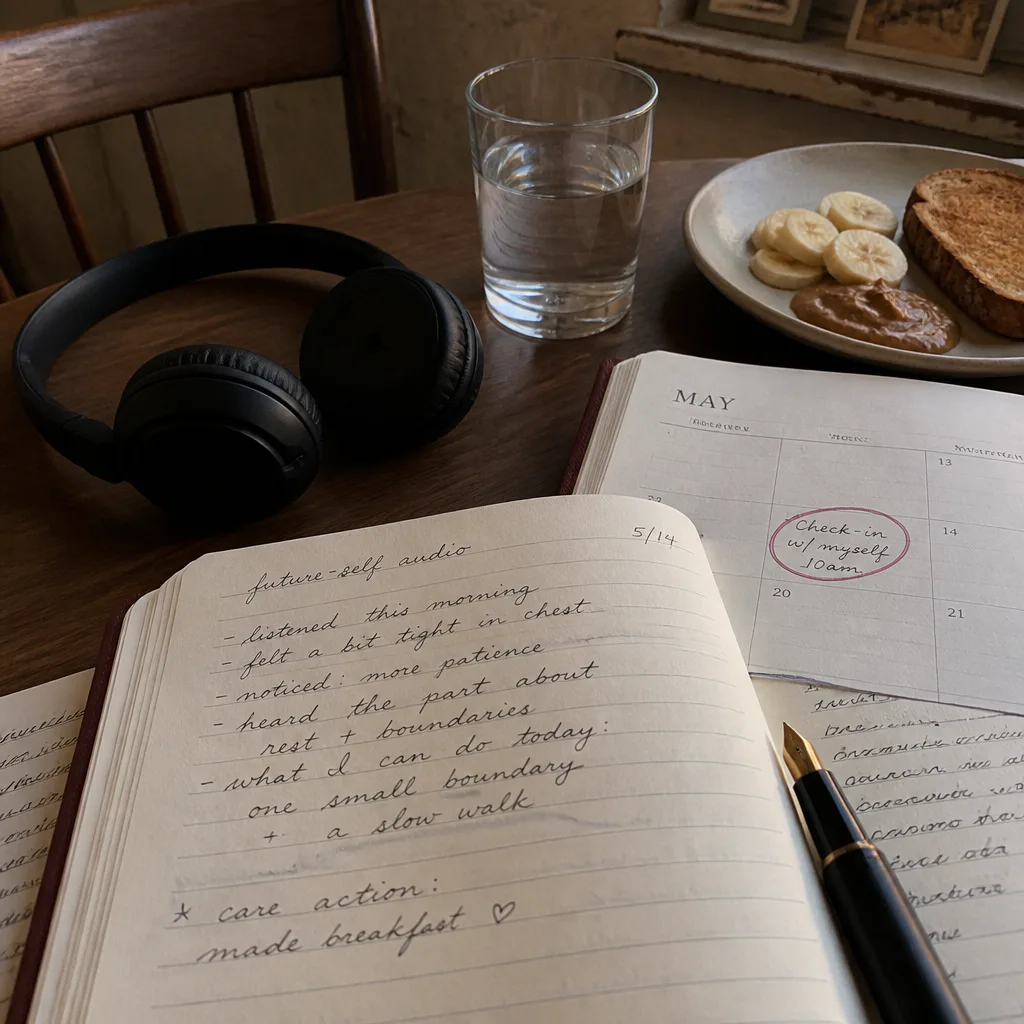
What do you do after the audio ends?
After the audio ends, you take one ordinary care action and then leave the practice alone.
This is where manifestation becomes measurable in the right way. Not by whether a symptom vanished during the audio. Not by whether you felt perfectly calm. The measure is follow-through. Did you drink water because you were thirsty? Did you book the checkup? Did you step outside for 10 minutes? Did you stop reading after your set limit?
In the Journal of Behavioral Medicine and related health psychology research, self-regulation is often tied to small repeatable behaviors rather than one dramatic decision. Sleep, medication adherence, movement, nutrition, and stress support are not glamorous. They are the quiet machinery of care. A practice that points you toward them is more useful than one that asks you to stare inward for signs.
Use this after-listening rule:
- Name one action.
- Make it smaller than your fear wants.
- Do it within 10 minutes if possible.
- Do not check for proof afterward.
Examples:
- Send the appointment request.
- Put the prescription refill date in your calendar.
- Prepare a simple meal.
- Take a slow walk without tracking pace.
- Put the phone outside the bedroom.
- Write the question for your clinician instead of searching it.
You can pair this with Affirmations pillar work if the phrase is brief and behavioral. “I keep my promises to my body” is cleaner than “Nothing is wrong with me.” The second may be true. It may not. The first is yours to practice.
The future self does not need you to feel certain. She needs you to keep one promise.
How do you know the practice is helping rather than feeding fear?
You know it is helping when checking decreases, care actions increase, and your day gets wider again.
Track behavior for 14 days, not symptoms. That time frame is short enough to stay honest and long enough to see a pattern. Use numbers that do not require body scanning: minutes spent searching, number of reassurance asks, care actions completed, bedtime phone use, appointments kept. If the numbers move in the right direction, the practice is serving you.
A simple scorecard can stay in a notebook:
| Measure | Day 1 | Day 14 | What you want |
|---|---|---|---|
| Symptom search minutes | 45 | 15 | Lower |
| Reassurance asks | 4 | 1 | Lower |
| Care actions | 1 | 5 | Higher |
| Phone in bed | Yes | No | Less often |
If you use spiritual timing or reflection tools, keep them secondary. Astrology and manifestation can offer language for seasons and attention, but it should not overrule a doctor, therapist, or your own red-flag plan. For health, tenderness must stay practical.
You can also read the broader Manifestation pillar again when you need the larger frame: repetition, identity, and chosen action. Health manifestation is not a way to control every outcome. It is a way to stop abandoning yourself while outcomes are still unknown.
If the practice increases fear, checking, or avoidance of medical care, that is data. Stop or scale down. Bring it to a clinician, especially if health anxiety has been loud for more than a few weeks. A good tool does not ask to be defended. It shows you by what it changes.
Calm is not the absence of sensation. Calm is the end of interrogation.
The phone stays face down. You are still here.