manifestation for life areas
Manifest a New Home With 5-Minute Future-Self Audio
Learn how to manifest a new home with a 5-minute future-self audio, using clear cues, daily repetition, and grounded action without forcing the timing.

A key on the table can begin as a sound you repeat for 5 minutes a day. To manifest a new home, use future-self audio to rehearse the identity, choices, and calm attention of the person who already lives there, then pair it with one real action each day.
What does it mean to manifest a new home without forcing it?
To manifest a new home is to train your attention toward a specific lived reality while taking grounded steps that match it.
This matters because a home is not only a purchase, lease, move, or room. It’s a daily nervous system. It decides where your shoes land, where your body rests, who hears you in the morning, and how much quiet you can keep. In the 2022 American Time Use Survey, people in the United States spent about 62 percent of their waking and sleeping time at home. The place is not background. It shapes you.
Manifestation, in this piece, is not pretending the keys are already in your hand when the bank account, lease terms, or search page says otherwise. It’s a practice of repeated inner rehearsal. You name what is true enough to return to. You let the mind hear it often enough that it becomes easier to notice matching choices.
If you need a fuller foundation, start with the Manifestation pillar. Here, the frame is smaller and more practical: 5 minutes, one audio, one home, one next step. No strain. No spiritual performance.
| Part of the practice | What it does | What it does not do |
|---|---|---|
| Future-self audio | Rehearses identity and attention | Replace money, timing, or paperwork |
| Daily repetition | Builds familiarity over time | Guarantee a date |
| Practical action | Creates visible movement | Control every person involved |
| Nervous system calm | Helps you stay available to options | Remove every doubt |
Manifestation is attention with a receipt. If it never changes what you notice, choose, ask, save, release, or apply for, it stays decorative.
Why use a 5-minute future-self audio for a home?
A 5-minute future-self audio works because hearing the same believable scene each day gives the brain a repeated cue for who you’re becoming.
Five minutes is 300 seconds. That’s short enough to repeat before your mind negotiates, and long enough to create a full sensory scene. In cognitive psychology, the encoding specificity principle, described by Tulving and Thomson in 1973, shows that cues present during learning can help later recall. A repeated audio can become a cue for a chosen identity: the person who looks calmly, saves clearly, asks well, and receives a home that fits.
This is where the AYA Method belongs. The AYA Method is a daily audio manifestation practice. Each day you listen to a short personalized recording — your Dream-Self Moment — narrated from the version of you who has already manifested the life you intend. Listening is the practice. Repetition is the work. The audio is the method.
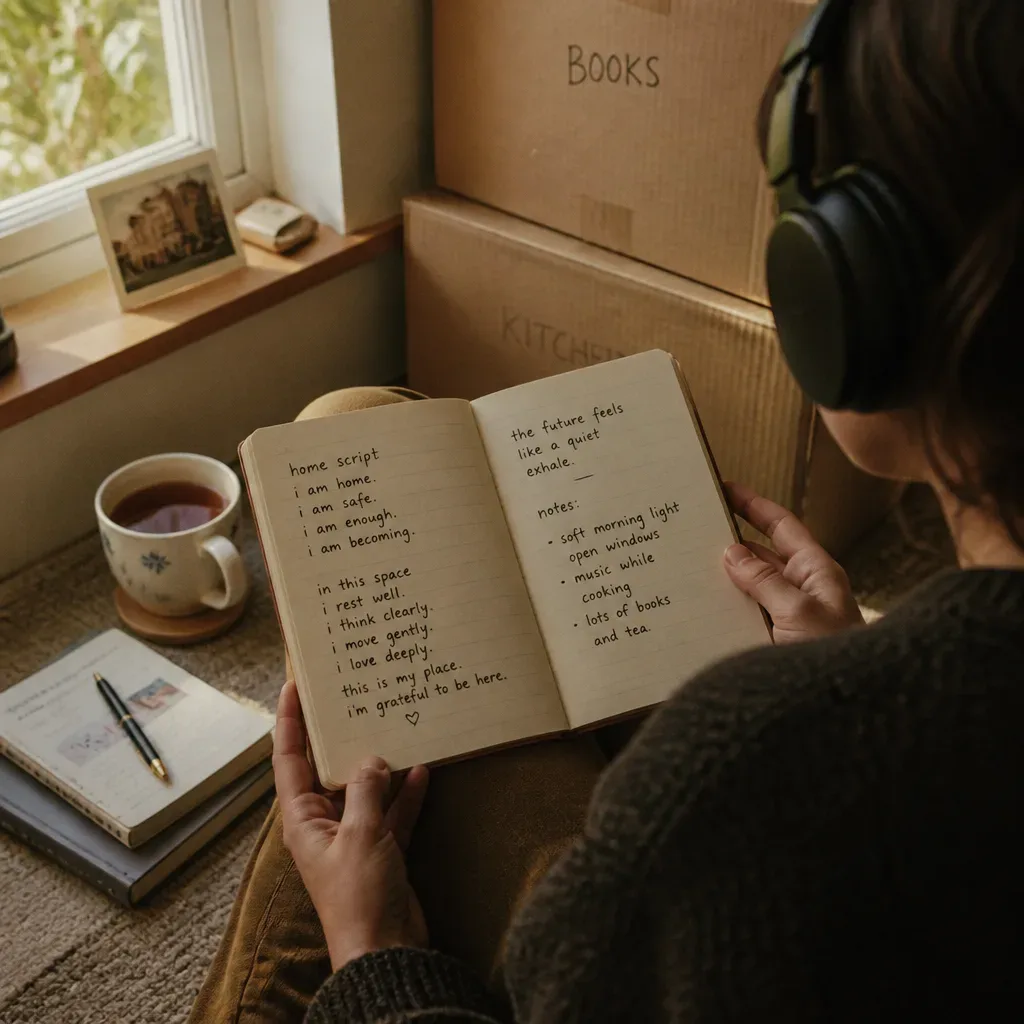
For a new home, the Dream-Self Moment might begin with one ordinary detail: your hand on the door, light across the floor, the first night with boxes still unopened. The ordinary detail matters. Mental imagery research led by Emily Holmes and colleagues has repeatedly found that imagery tends to produce stronger emotional responses than verbal thought alone. A voice plus a scene gives your mind something to return to.
The app may also include a daily affirmation and a Manifestation Board. Let them support the audio. Don’t make them carry the practice. If affirmations help you choose better words, the Affirmations pillar can keep them clean and specific.
A home becomes easier to move toward when your inner speech stops treating it as forbidden.
How do you write a future-self audio for the home you want?
You write it from the version of you who already lives there, using concrete details your body can believe.
Start with limits as well as longing. A new home may need to be close to school, under a clear monthly number, near care, near work, away from noise, or safe for your body. Specificity is not a lack of faith. It’s respect for the life that has to be lived there. In housing research, affordability is often measured by the 30 percent rule: spending more than 30 percent of income on housing costs is commonly considered cost-burdened by the U.S. Department of Housing and Urban Development.
Use this 5-part script. Keep each part to about 45 to 60 seconds, then let the final minute repeat the strongest lines.
- Arrival: name the door, the entry, the first breath inside.
- Belonging: describe one ordinary daily act, like making tea or opening a window.
- Stability: name the cost, agreement, or support that lets you rest.
- Identity: speak as the person who can receive and care for this home.
- Next action: close with one practical step for today.
A simple script can sound like this:
I'm standing in the kitchen of my new home.
The light is soft in the morning.
The payment is clear, and I can hold it.
I chose slowly. I asked the right questions.
I listened when something felt true.
This home supports my work, my rest, and my real life.
Today I take one clean step toward it.
Don’t make the audio too perfect. A 2020 review in the journal Social Cognitive and Affective Neuroscience notes that self-related processing uses distributed brain networks, including medial prefrontal regions. In plain terms, the mind listens differently when a statement feels like you. If the line sounds fake, soften it.
Try: I am learning to choose a home that fits. Then later: I live in a home that fits.
How should you listen each day so the practice stays real?
Listen once a day at the same cue, then take one small action before the day closes.
The cue is the quiet skeleton of the habit. After brushing your teeth. Before sleep. In the parked car before a viewing. After making coffee. Phillippa Lally and colleagues found in a 2009 European Journal of Social Psychology study that habits took an average of 66 days to become automatic, with a range from 18 to 254 days. So don’t panic if day 6 still feels like effort.
Your 5-minute practice can look like this:
| Minute | What happens | What to notice |
|---|---|---|
| 0:00-1:00 | Settle and breathe | Jaw, shoulders, hands |
| 1:00-3:30 | Hear the home scene | Images that feel true |
| 3:30-4:30 | Hear the identity lines | The self who chooses well |
| 4:30-5:00 | Name today’s step | One action, not ten |
A small body cue helps. Put one hand on your chest or hold a real key while you listen. The object doesn’t have to be symbolic to anyone else. It only has to be repeated. In learning science, repeated pairing is the point: cue, state, action. Three parts. Again and again.
You may want to listen with headphones. That’s fine. You may want to play it softly in the room. That’s fine too. What matters is attention. Dr. Andrew Huberman often describes attention as a gate for plasticity in public neuroscience teaching; the lab literature is more nuanced, but the practical point holds. If you’re scrolling while the audio plays, you’re not practicing.
After the audio, write one line: Today I act like the person who lives there by _____. Then fill the blank. One call. One saved search. One transfer. One honest conversation.
The future self is not a fantasy self. It’s the self you rehearse until your choices recognize her.
How do you pair the audio with real-world steps toward a new home?
Pair the audio with one daily action that makes the home more possible, visible, or ready to receive.
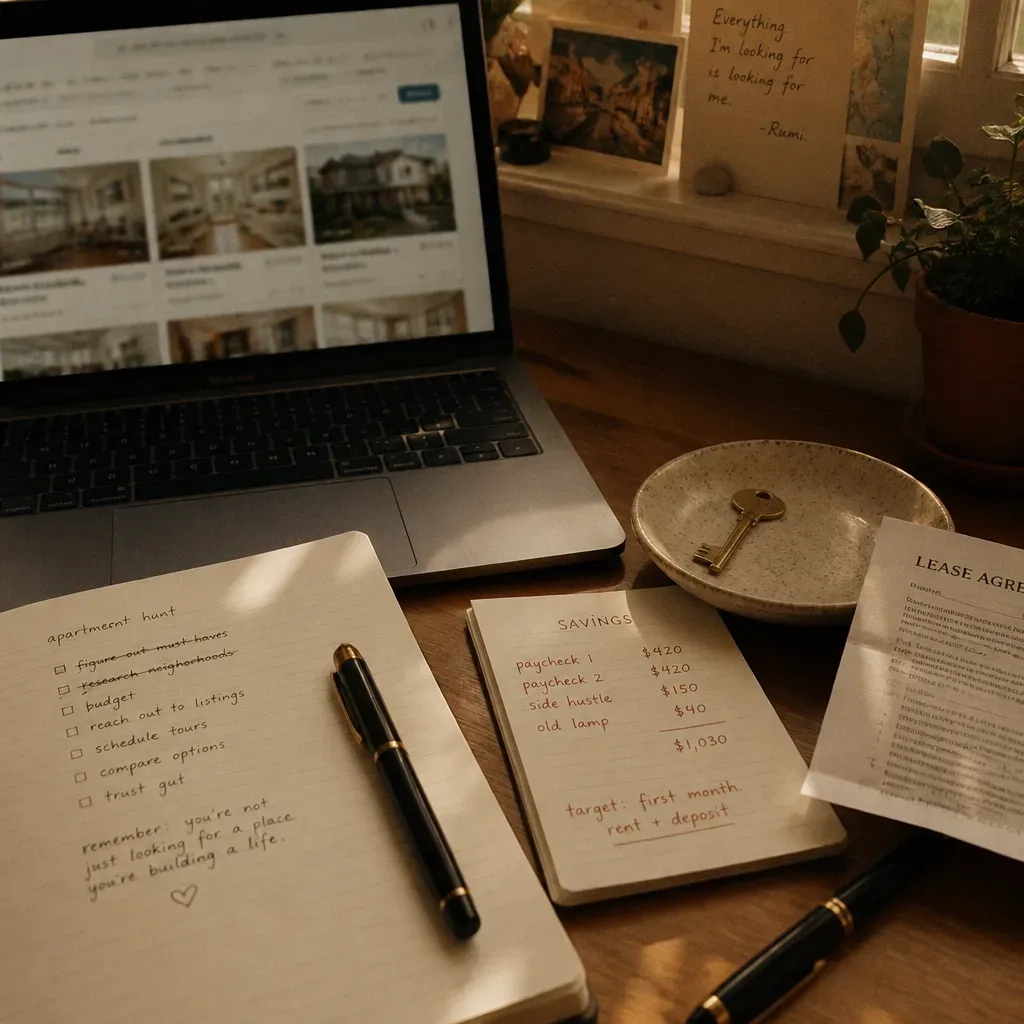
The practice becomes cleaner when you decide what kind of movement counts. Edwin Locke and Gary Latham’s goal-setting research, summarized across more than 35 years of studies, found that specific and challenging goals tend to improve performance compared with vague goals. For a home, vague sounds like I want something better. Specific sounds like I want a quiet one-bedroom under this number, within 30 minutes of work, with morning light.
Use the audio first. Then choose one of these actions:
- Save or review one realistic listing.
- Move a small amount into a home fund.
- Ask one person about a lead, room, lender, agent, or area.
- Remove one item you won’t take with you.
- Read one lease, policy, inspection note, or mortgage term.
- Visit one neighborhood at the time of day you’d live there.
- Tell the truth about one boundary, such as noise, safety, cost, or commute.
The action does not have to be dramatic. In BJ Fogg’s behavior model, tiny behaviors work because motivation rises and falls, while prompts and ability can be designed. A 2-minute action after a 5-minute audio is often more reliable than a grand plan you avoid.
Keep a simple tracker for 30 days. Three columns are enough: listened, action taken, what shifted. What shifted may be practical or internal. You noticed a listing. You admitted the old place is done. You stopped looking at homes that ask you to betray your budget. You made a call you’d delayed for 4 months.
For timing practices, some readers like adding symbolic dates or lunar rhythms. If that helps you remember, keep it gentle. Astrology and manifestation can be a calendar, not a command.
You don’t have to chase the home. You have to become steady enough to recognize the door that is yours.
What if doubt, delay, or grief comes up while you listen?
Doubt doesn’t mean the practice is failing; it means your mind is comparing the audio with present evidence.
This is especially true with home. A home can carry grief. Maybe you lost one. Maybe you never had one that felt safe. Maybe rent rose faster than your pay. The Harvard Joint Center for Housing Studies reported in 2024 that a record 22.4 million renter households in the U.S. were cost-burdened in 2022. If your body tightens around housing, that isn’t a mindset flaw. It’s information.
So make the audio believable enough to let the nervous system stay with it. Joanne Wood and colleagues published a 2009 study in Psychological Science suggesting that broad positive self-statements can make some people with low self-esteem feel worse. The lesson is not to avoid hope. The lesson is to use words your system can hold.
Try these softer substitutions:
| If this feels false | Say this instead |
|---|---|
| I have my dream home now | I’m becoming ready for the home that fits my life |
| Everything is easy | I can take the next honest step |
| I never doubt | Doubt can be here while I still listen |
| The perfect home is mine | I can recognize a true home when I see it |
Self-affirmation research is also relevant. In a 2013 PLOS ONE study, Creswell and colleagues found that self-affirmation improved problem-solving under stress. Not because a sentence changed reality by itself, but because it helped people stay more available to their own capacity. That’s the quiet aim here.
If you miss a day, return the next day. If you cry, lower the volume. If the script starts to feel stale after 14 days, revise one line, not the whole practice. If the home you wanted changes shape, tell the truth and record again.
You don’t have to believe harder. You have to return more cleanly.
How will you know the future-self audio is working?
You’ll know it’s working when your attention, choices, and tolerance for the wrong home begin to change.
Don’t measure only by keys. Keys matter, yes. But before keys, there are signals. You stop clicking on places that shrink you. You ask about mold, light, noise, fees, transit, repairs, and safety. You save with less resentment. You become less available for chaos dressed as opportunity.
Use 4 markers after 30 days:
- Clarity: you can describe the home in 3 to 5 grounded details.
- Calm: you recover faster after a no, delay, or bad listing.
- Action: you’ve taken at least 20 small steps in a month.
- Discernment: you can feel the difference between urgency and truth.
That last one is easy to miss. Neville Goddard wrote often about living from the fulfilled wish, and Joe Dispenza teaches rehearsal of a chosen future state. As a neuroscience researcher, I’d say this carefully: rehearsal can change self-talk and readiness, but it doesn’t remove housing systems, money, or other people’s decisions. Both can be true.
If you want to widen the practice beyond this one life area, return to the manifestation guide and keep your method simple. If your words need care, use affirmations as a support, not a substitute for listening.
A new home is not only found outside you. It is also practiced inside you, until the outside has somewhere to land.
Softly, the key becomes familiar.