manifestation for life areas
Family Manifestation Without Fixing Everyone Else
Family manifestation can help you practice a calmer role at home without trying to control your relatives, repair them, or carry every outcome.

The kitchen light is low. A phone sits face down. Family manifestation means practicing the version of you who meets family with steadier choices, not trying to repair everyone’s wounds. You work with your own attention, words, boundaries, and timing. Their lives stay theirs. Yours becomes more honest.
What is family manifestation when you are not fixing everyone?
Family manifestation is a practice of becoming clear about the family pattern you intend to live, while leaving other people their own will.
That line matters. A lot of manifestation advice gets strange around family because love can disguise control. You want your parent to be softer. You want your sibling to stop competing. You want your child, partner, aunt, or cousin to finally see what you see. Very human. Also not yours to command.
A cleaner practice starts with a smaller question: who am I when I am no longer performing the old role? In family systems theory, Murray Bowen wrote about differentiation of self in the 20th century. The simple version: you can stay connected without becoming fused. That is the center of this work.
For this piece, I mean the AYA Method in its precise sense: The AYA Method is a daily audio manifestation practice. Each day you listen to a short personalized recording — your Dream-Self Moment — narrated from the version of you who has already manifested the life you intend. Listening is the practice. Repetition is the work. The audio is the method.
The audio is not a spell you cast on your relatives. It is a daily place to hear your future self speak from a settled home inside you. The app also includes a daily affirmation and a Manifestation Board, but they are complements. The listening is the method.
Research on mental rehearsal is not new. Sports psychology has used imagery for decades, and a 2012 review in Frontiers in Human Neuroscience described motor imagery as linked with overlapping brain networks used in action. Family life is not a tennis serve. Still, rehearsal teaches the body what to reach for first.
A family can change around one person who stops auditioning for the same role.
Why does trying to fix family usually make the pattern louder?
Trying to fix family usually makes the pattern louder because control invites resistance, and old roles need your participation to survive.
Think of the last circular conversation you had. Someone said the thing. You felt the heat rise. You gave the lecture you promised you would not give. They defended. You proved. They withdrew. Ten minutes later, everyone was back in the old room, even if the topic looked new.
The American Psychological Association’s 2023 Stress in America report found that money, health, and family responsibilities remain common sources of strain for adults. When people are stressed, they do not become easier to manage. They become more protective of their familiar defenses.
This is why family manifestation has to be ethical. You can intend a softer relationship. You can practice repair. You can become less reactive. You cannot use manifestation as a private pressure campaign. Consent still exists in quiet rooms.
Use this distinction:
| Fixing someone else | Practicing your future self |
|---|---|
| “They need to apologize.” | “I can stop begging for an apology.” |
| “She has to understand me.” | “I can speak once, clearly.” |
| “He must be calmer.” | “I can leave when shouting starts.” |
| “They need to change.” | “I can stop feeding the loop.” |
The table is not cold. It is kind. It puts responsibility back where it can move. In behavioral science, implementation intentions, studied by psychologist Peter Gollwitzer since the 1990s, use if-then plans to increase follow-through. “If my brother mocks my job, then I will say, ‘I’m not discussing work that way,’ and change the subject.” That is not glamorous. It is usable.
Control looks like care when you are afraid. Care becomes real when it respects separateness.
How do you set an intention for family without scripting other people?
Set an intention by naming the quality of your own conduct, the boundary you will honor, and the kind of contact you can truthfully sustain.
Start with the part you can touch. Not “my mother is warm and emotionally fluent by August.” Try: “I speak to my mother for twenty minutes without selling myself for approval.” Not “my family finally supports my work.” Try: “I describe my work without asking the room to vote on it.”
That difference is not a downgrade. It is the door. The Manifestation pillar goes deeper into how desire becomes practice rather than fantasy. Here, your desire needs a body. A calendar. A sentence. A limit.
A good family intention has three parts:
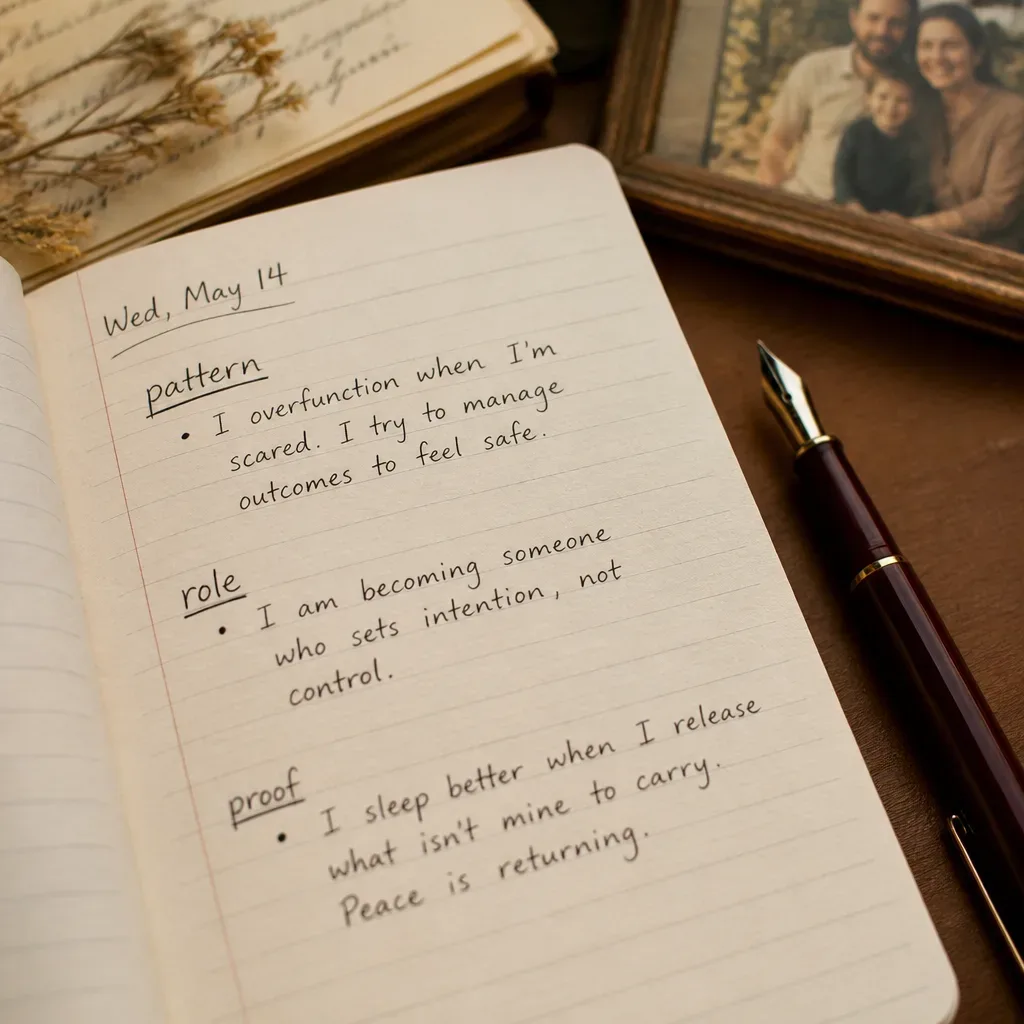
- The pattern you are leaving. Name it without drama. Rescuing. Explaining. Freezing. Performing. Disappearing.
- The role you are practicing. The adult who pauses. The daughter who does not over-explain. The father who repairs quickly. The sibling who refuses the old contest.
- The smallest proof. One call ended cleanly. One meal without a private collapse. One sentence spoken once.
Self-affirmation research helps here when it stays grounded. A 2016 Carnegie Mellon study found that brief self-affirmation improved problem-solving under stress in participants who were under pressure. The point is not to chant until life obeys. It is to remember your values before your nervous system grabs the oldest script.
You might use an affirmation like: “I can love them without becoming the family shock absorber.” If you want a deeper primer, the Affirmations pillar explains why a sentence works best when it is believable enough to repeat.
The sentence does not have to impress anyone. It has to bring you back.
What is the ten-minute family manifestation practice?
The ten-minute practice is a short daily sequence of listening, choosing, and rehearsing one family behavior you can live today.
I like ten minutes because it is hard to romanticize. It fits before a call. It fits after brushing your teeth. It fits in the car before walking into a holiday meal. The CDC has reported that more than one third of U.S. adults sleep less than seven hours in a 24-hour period, so I am not going to ask you to build a sacred hour at dawn.
Use this:
- Minute 0 to 1: Sit where you are. Feet on the floor. Hand on the chest if that helps. No performance.
- Minute 1 to 4: Listen. Play your Dream-Self Moment or a short recording in the voice of the future self who is already living the family pattern you intend.
- Minute 4 to 6: Name today’s contact. Text, call, dinner, memory, no contact. All count.
- Minute 6 to 8: Choose one behavior. One pause. One boundary. One repair. One exit.
- Minute 8 to 10: Write the line. “If the conversation turns cruel, I will end it.” “If I get praised for overgiving, I will still rest.”
The daily audio matters because it reduces decision fatigue. In a 2006 paper, Roy Baumeister and colleagues described self-control as vulnerable to depletion after repeated acts of regulation, though later replication debates have made the model more careful. Either way, family can tire you fast. A recorded practice gives you a place to return without inventing yourself from scratch.
If astrology is part of how you listen to timing, keep it secondary and clean. The note on astrology and manifestation can help you use symbolic timing without handing your agency away.
Do not measure the practice by whether they were pleased. Measure it by whether you stayed true.
How do you handle a difficult relative without rehearsing the conflict all day?
You handle a difficult relative by rehearsing your response once, then refusing to keep the argument alive in your mind.
The mind loves a courtroom. It calls witnesses. It replays the tone. It improves the comeback. It pretends this is preparation, but often it is exposure. Your body has lived the fight five times before the person even arrives.
Rumination has been linked with higher distress in many studies. Susan Nolen-Hoeksema’s work on depressive rumination, widely cited since the 1990s, showed that repetitive negative thinking can prolong low mood. Family conflict gives rumination excellent material. Manifestation practice interrupts the rehearsal, not by denying what happened, but by giving your attention a truer task.
Try this three-line script before contact:
- “I know the old pattern.”
- “I know my chosen role.”
- “I know the exit if the pattern takes over.”
Then stop practicing the fight. If your aunt comments on your body every year, you do not need 40 imagined replies. You need one. “I’m not discussing my body.” If she continues: “I’m going to step outside.” That is enough.
The Gottman Institute often cites a 5:1 ratio of positive to negative interactions in stable couples, based on John Gottman’s longitudinal marital research. Your cousin is not your spouse, and every family bond has its own rules. Still, the number points to something plain: repeated harsh contact leaves a mark. You are allowed to reduce the dose.
A boundary is not a punishment. It is a door with a handle on your side.
If no contact is the cleanest option for now, the practice can hold that too. Family manifestation does not require constant access. Sometimes the manifested family pattern is the first peaceful month without a call.
What tools keep you close without becoming fused?
The best tools are the ones that help you stay connected to yourself while you decide how much connection with family is safe and real.
I review apps for a living, and I am suspicious of anything that turns pain into a dashboard. Still, a simple tool can help when it keeps you honest. The tool should make the next right behavior easier, not make you track your humanity like a sales funnel.
Here is the small kit I would actually use:
| Tool | Use it for | Keep it clean by |
|---|---|---|
| Dream-Self Moment audio | Hearing your future-self role daily | Listening before contact, not during conflict |
| Daily affirmation | One believable sentence | Making it about you, not their obedience |
| Manifestation Board | Visual cues for the home pattern you intend | Choosing symbols of conduct, not control |
| If-then note | Boundary follow-through | Writing one line only |
| After-contact log | Small proof | Tracking your behavior, not judging theirs |
The Princeton Engineering Anomalies Research lab, often called PEAR, ran intention-related studies from 1979 to 2007. Its claims remain debated, and many scientists do not accept them as proof that intention changes external events. I mention it because it shows how long people have wanted intention to reach beyond the private mind. For family, the safer claim is also the more useful one: intention changes what you practice.
A Manifestation Board can be tender here. Put a photo of a quiet table. A phrase like “speak once.” A calendar with two protected evenings. Not a picture of your father becoming someone he has not chosen to become.
The Affirmations pillar can help you write a sentence that does not collapse under pressure. The Manifestation pillar can help you keep desire connected to action. And if you are using the AYA Method, let the audio remain first. The rest supports the listening.
Good tools do not replace courage. They reduce the number of times you have to find it from nothing.
How do you know family manifestation is working?
You know it is working when your own pattern changes in observable ways, even before anyone else admits that the room feels different.
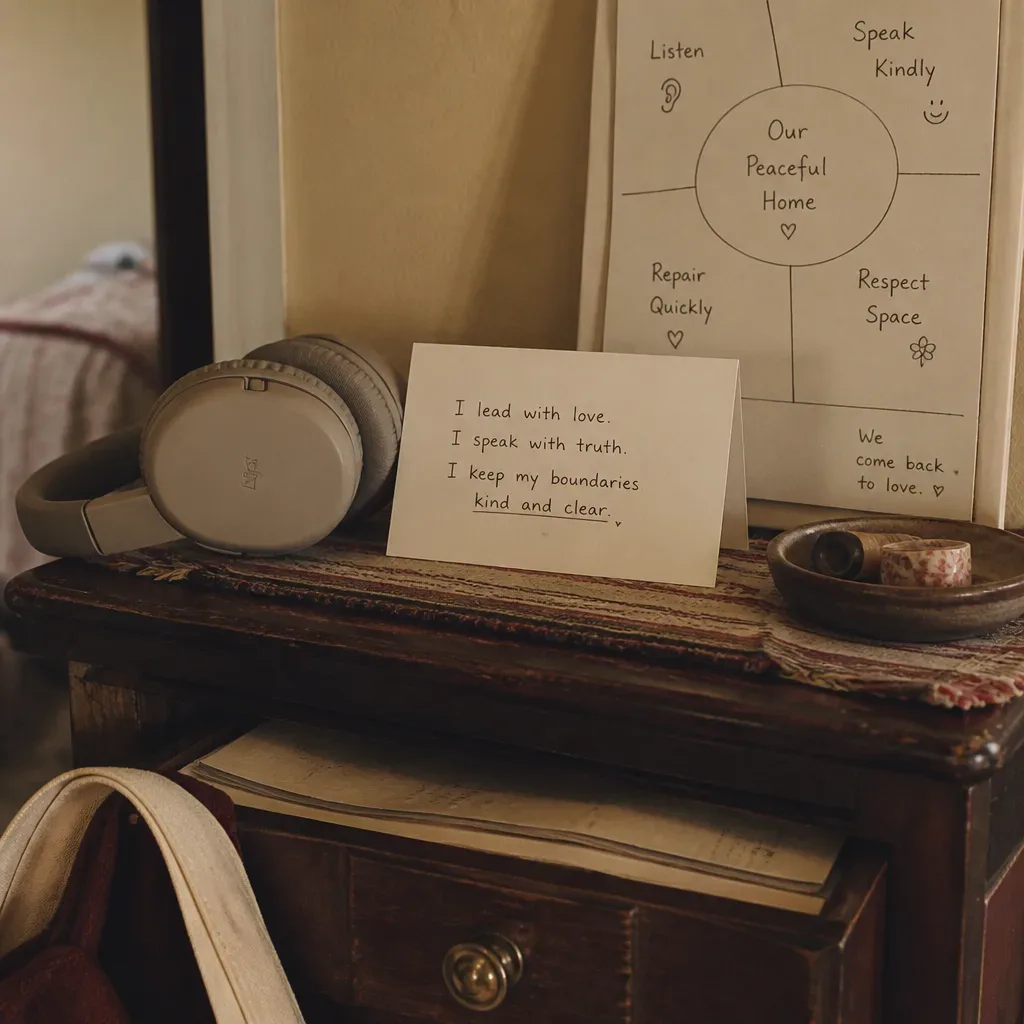
Look for small proof. You no longer send the six-paragraph text. You wait twelve minutes before replying. You say “I can’t host this year” without adding a legal brief. You notice guilt without letting it drive. You repair faster when you do speak sharply.
Use a weekly check, not a daily verdict. Family patterns can be decades old. The Pew Research Center reported in 2019 that family remained one of the most important sources of meaning for Americans, with 69% mentioning family when asked what gives life meaning. Meaningful bonds can take time to soften because the stakes feel high.
Track these five signs:
- You can name your role before contact.
- You can leave a conversation without rehearsing it for hours.
- You can feel love and still keep a limit.
- You can hear disappointment without rushing to fix it.
- You can tell the truth in shorter sentences.
There may be outer changes too. A sibling stops baiting you because it no longer works. A parent adjusts to the new length of the call. A holiday becomes less theatrical. Good. Receive that. But do not make their reaction the only evidence.
In behavior change research, small wins matter because they make identity visible. Teresa Amabile and Steven Kramer’s work on the progress principle found that small progress can improve inner work life in organizations. Home is not an office. Still, the human signal is familiar: when you can see progress, you keep returning.
The quietest proof is this: you do not abandon yourself to be loved.
What should you do when the old family role pulls you back?
When the old role pulls you back, repair what is yours, return to the practice, and refuse to turn one relapse into an identity.
You will over-explain again. You will take the bait. You will stay too long on the phone. You will say yes with your mouth while your body says no. That does not mean the practice failed. It means the old path is well worn.
Neuroscience is careful about the phrase “rewiring,” but repetition does matter. Dr. Andrew Huberman often speaks about neuroplasticity requiring focus, repetition, and rest; the general point is consistent with mainstream learning science. A family manifestation practice gives you repeated focus on a new role. Sleep, space, and time help it settle.
After a hard contact, use this repair sequence:
- Tell the truth privately. “I went back into proving.”
- Repair outwardly if needed. “I spoke harshly. I’m sorry.”
- Do not over-repair. One clean apology is not a surrender of your boundary.
- Replay the future-self version once. Not twenty times. Once.
- Choose the next smallest proof. A shorter call. A clearer text. A pause.
If the situation includes abuse, addiction, coercive control, or threats, bring in trained support. The National Domestic Violence Hotline in the U.S. notes that safety planning can be personalized and practical; local services in your country may offer similar help. Manifestation is not a substitute for protection.
For ordinary painful patterns, come back tomorrow. Ten minutes. The same chair if you want. The same line if it still tells the truth. Family manifestation works best when it becomes plain enough to repeat on an unremarkable Tuesday.
You do not have to heal the whole house to stop living as its alarm.
Stay soft where you can, and boundaried where you must.