money manifestation
Abundance Mindset Shift With 5-Minute Future-Self Audio
An abundance mindset shift can begin in five quiet minutes: use a future-self audio to rehearse safer money choices before the day asks.

Your headphones are on. The kettle is getting loud. An abundance mindset shift begins when money stops feeling like a threat and starts becoming a set of choices you can meet. A 5-minute future-self audio helps by rehearsing that calmer response daily, before the day asks you to prove it.
What is an abundance mindset shift, really?
An abundance mindset shift is the movement from fear-led money reactions to steadier, choice-led money behavior.
It is not pretending that rent is easy. It is not smiling at a credit card balance. It is also not a personality test where calm people win and anxious people fail. Money stress is real in the body. The American Psychological Association has reported money as a repeated major source of stress in its Stress in America surveys for more than a decade, and anyone who has avoided a banking app knows the feeling without needing a chart.
Scarcity has a cognitive cost. In the book Scarcity, Sendhil Mullainathan and Eldar Shafir describe how pressure narrows attention. A widely cited 2013 Science paper by Mani and colleagues found that sugarcane farmers performed worse on cognitive tests before harvest, when money was tight, than after harvest, when money pressure had eased. The often-repeated estimate was around 13 IQ points in that context. The point is not the number alone. The point is how much room fear can take.
So the shift begins small. You are not trying to become a different person overnight. You are teaching your nervous system a new money sequence: see the number, breathe, choose the next step. A true money practice does not ask you to deny the bill. It asks you not to disappear from yourself when the bill appears.
That is why a future-self audio can help. It gives your mind a simple, repeatable picture of you staying present with money. Repetition matters because the brain learns from familiar cues. Five minutes may sound too small, but small is often the only size a practice can keep.
Money changes first in the moment you stop leaving yourself alone with fear.
If you want the wider frame, the Manifestation pillar explains how intention, attention, and action belong in the same room. For money, that room has to be honest.
Why use future-self audio instead of another money affirmation?
Future-self audio works differently because it gives you a scene to inhabit, not only a sentence to repeat.
The AYA Method is a daily audio manifestation practice. Each day you listen to a short personalized recording — your Dream-Self Moment — narrated from the version of you who has already manifested the life you intend. Listening is the practice. Repetition is the work. The audio is the method.
That definition matters. Audio leads. A daily affirmation can support the practice, and the Manifestation Board can help you see what you are moving toward, but they are complements. They are not the pillars. The core is listening to a Dream-Self Moment until the future version of you becomes less theatrical and more available.
Affirmations can be useful when they feel believable enough to enter the body. They can also create inner argument. A 2009 study by Joanne Wood and colleagues in Psychological Science found that very positive self-statements could make some people with low self-esteem feel worse, not better. That does not mean affirmations are bad. It means the wording needs to meet the person where they are.
Audio has one quiet advantage. It can include texture. You can hear yourself opening the banking app, seeing the balance, and not flinching. You can hear yourself sending the invoice without apologizing twice. You can hear the pause before buying something you do not actually want. A sentence says, I am safe with money. A scene shows you acting like someone who is learning safety.
The Affirmations pillar is helpful if you want to understand the language side. For this practice, though, let the affirmation be one thread inside the recording. Let the audio carry the change.
How do you set up the five minutes?
You set up the five minutes by choosing one money scene, listening to it daily, and pairing it with one small action.
Do not begin with your whole financial life. Begin with one place where you leave your own body. Maybe it is checking your account. Maybe it is asking to be paid. Maybe it is grocery shopping after a hard day. BJ Fogg, a behavior researcher at Stanford, has written for years that tiny habits become more reliable when they attach to an existing routine. Five minutes after brushing your teeth is usually stronger than a vague promise to listen sometime.
Here is the simplest setup:
- Choose one money scene that feels alive this week.
- Write 4 to 6 present-tense lines from your future self.
- Listen to the audio for five minutes at the same cue each day.
- Take one matching money action within 24 hours.
- Keep the same script for seven days before editing it.
Phillippa Lally and colleagues published a habit study in the European Journal of Social Psychology in 2009. The median time for a behavior to become automatic was 66 days, though the range was wide. That number is useful because it lowers the drama. You are not failing on day three. You are still laying the track.
| Part of practice | Keep it this small | Why it helps |
|---|---|---|
| Listening | 5 minutes | Short enough to repeat |
| Script | 4 to 6 lines | Specific enough to feel real |
| Action | 1 task | Keeps the body involved |
| Review | 7 days | Gives you evidence before changing |

The mistake is making the practice beautiful before it is repeatable. A plain recording you hear seven times is better than a perfect script you avoid. The nervous system trusts what returns.
What should your future self say about money?
Your future self should speak in ordinary, specific language about how you handle money when you are steady.
Start with the scene, not the slogan. If the scene is opening your banking app, your audio might say: I open the app before coffee. I look at the number without making it a verdict. I know what is due. I choose the next payment. I am here. That is enough for today. Notice how nothing is inflated. The lines are calm because the behavior is calm.
Neville Goddard often wrote about living from the fulfilled state, but in practice this gets misunderstood. Living from the end does not mean ignoring the middle. It means letting the chosen identity guide the next honest move. For money, that might be sending one follow-up email, moving 10 dollars to savings, or writing down the real total you have been avoiding.
Good future-self money audio often includes:
- the exact money moment you tend to avoid
- one body cue, such as unclenching your jaw
- one phrase that reduces shame
- one practical action you can take today
- one sentence that names enough without pretending
Dr. Andrew Huberman often explains behavior through cues, actions, and reward signals. You do not need lab language to use the principle. If listening is followed by one visible action, the audio becomes tied to proof. Proof is not a miracle. Proof is a receipt, an email sent, a balance checked, a small boundary kept.
If you use timing, cycles, or lunar prompts as reflection tools, keep them in service of action. The piece on Astrology and manifestation can help you hold symbolic timing without handing away your agency. The future self still has to open the invoice.
The future self is not louder than your current life. She is clearer inside it.
How do you listen without forcing belief?
You listen without forcing belief by letting the audio be familiar before you require it to feel true.
Belief is often late. That is normal. The body may hear a calmer money sentence and answer, not yet. Let it. You are not trying to win a debate in your head. You are giving the mind a repeated alternative to panic. Claude Steele’s self-affirmation theory, first developed in the 1980s, suggests that people can become less defensive when they remember a broader sense of self. Later reviews, including work by Cohen and Sherman in 2014, describe effects that depend on context and fit.
Try this listening pattern for seven days:
- Sit or stand where you will not be interrupted for five minutes.
- Put one hand on the chest or table, somewhere steady.
- Press play and do not multitask.
- When resistance appears, say quietly: noted.
- After listening, write one line of evidence.
Evidence is simple. I checked the balance. I paid the bill. I did not buy the thing. I asked the question. In a 2019 report, the Federal Reserve found that many adults could not cover a 400 dollar emergency expense without borrowing or selling something; the exact percentage has shifted in later reports, but the tenderness remains. Many people are not trying to be dramatic about money. They are trying to feel safe in a system that often does not feel safe.
This is where the abundance mindset shift becomes grounded. It is not a mood. It is a pattern of return. You return to the number. You return to the plan. You return to the voice that says you can stay.
For a broader practice map, the AYA Method gives the daily container. The app also includes a daily affirmation and Manifestation Board, but in this money practice, keep them secondary. Listen first. Then act.
How will you know the shift is becoming real?
You will know the shift is becoming real when your money behavior changes before your mood has fully caught up.
Track behavior, not performance. Do not ask, do I feel wealthy? Ask better questions. Did I look? Did I respond? Did I ask? Did I pause? Did I keep one promise to my future self? These are small indicators, but small indicators are often the first honest ones. A 2023 Bankrate survey reported that more than half of U.S. adults felt behind on emergency savings; exact numbers vary by year, but the pattern is familiar across many households.
Use a seven-day scorecard:
| Day | Did I listen? | One money action | Evidence line |
|---|---|---|---|
| 1 | yes or no | checked balance | I stayed present |
| 2 | yes or no | sent invoice | I did not apologize |
| 3 | yes or no | delayed purchase | I waited 24 hours |
| 4 | yes or no | moved a small amount | I kept it simple |
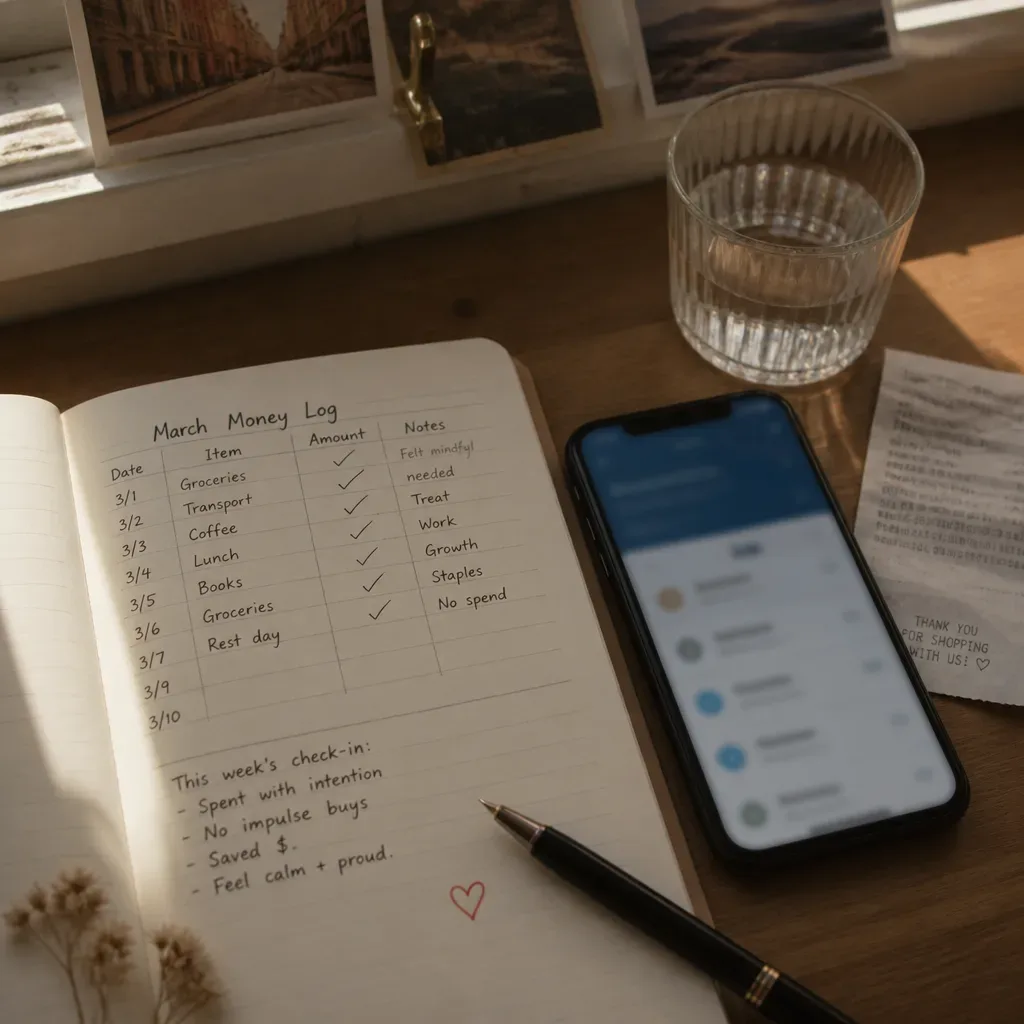
After seven days, look for one of three signs. First, less avoidance. Second, quicker recovery after fear. Third, more precise action. You may still feel tight in the chest. You may still dislike the numbers. But if you are returning faster, something has changed.
There is also a social layer. Pew Research Center has reported for years that many adults use digital tools for banking, budgeting, and planning, though adoption varies by age and income. Tools can help, but tools do not replace the inner moment when you decide not to abandon yourself. Your phone can show you the balance. It cannot teach you tenderness. That is the part you practice.
A real abundance mindset shift is not measured by how grand your vision sounds. It is measured by how gently you can meet the next number.
If you want the full money frame, start with manifestation, then bring it back to one daily recording. If you want language support, use affirmations as a small companion. If you want symbolic timing, use astrology and manifestation as a calendar, not a substitute for choice.
The practice is quiet because money fear is already loud enough.
What if you miss a day?
If you miss a day, return the next day without making the miss part of your identity.
A missed day is data. Maybe the cue was wrong. Maybe the script was too grand. Maybe five minutes before work felt crowded. Change the container, not your worth. Behavior change research is full of this lesson: friction matters. If the headphones are in another room, if the audio is hard to find, if the script feels false, the practice will ask too much before it gives anything back.
Make the return smaller. Put the recording on your home screen. Listen while sitting on the edge of the bed. Use the same cue for three days before judging it. In implementation intention research, Peter Gollwitzer has shown that if-then planning can improve follow-through across many settings. The money version is plain: if I finish brushing my teeth, then I listen to my future-self audio.
You can also lower the script. Instead of I always feel safe with money, try: I can look at one number and stay with myself. Instead of money comes easily, try: I notice one way I can receive, ask, save, or choose today. The softer line may be the truer doorway.
Keep the work ordinary. Five minutes. One scene. One action. Seven days. Then another seven. The shift does not need to announce itself. It can arrive as the first morning you open the account and breathe.
Return softly. The door is still open.