money manifestation
Manifest a Raise with Future-Self Audio
Manifest a raise with a quiet future-self audio practice before your salary talk, using evidence, rehearsal, and one clear ask.

Your notes are open. The number is written once, not decorated. To manifest a raise, use future-self audio to rehearse the salary talk before it happens, then pair that inner rehearsal with evidence, timing, and a direct ask. The practice works best when it makes action feel familiar.
What does it mean to manifest a raise before a salary talk?
To manifest a raise is to practice being the person who can ask clearly, receive an answer calmly, and keep moving with evidence.
It is not pretending payroll bends because you thought the right thought. It is also not making yourself smaller in the name of being realistic. You are preparing your nervous system, your words, and your proof. The salary talk is a behavioral event. In behavior design, the event matters because it has a date, a room, a person, and a sentence you must be able to say.
Pew Research Center reported in 2023 that about 60% of U.S. workers were extremely or very satisfied with their pay, while only 51% said the same about promotion opportunities. That gap matters. Many people are doing acceptable work and still feel quiet tension around money. A raise conversation is often where that tension becomes visible.
Manifestation, at its cleanest, is the practice of rehearsing a chosen future until your present behavior begins to match it. If you want the wider frame, keep Manifestation pillar nearby. For this piece, keep it narrower. One raise. One conversation. One number.
A raise talk is not a wish. It is a remembered case for your value, spoken before someone who can say yes, no, or not yet.
That is why future-self audio helps. Listening gives the mind a script. Repetition gives the body a pattern. Driskell, Copper, and Moran’s 1994 meta-analysis in the Journal of Applied Psychology found that mental practice improved performance across tasks, especially when the task had clear steps. Salary negotiation has steps. You can practice them.
Why use future-self audio instead of only writing affirmations?
Future-self audio gives your brain a spoken rehearsal of the exact identity and behavior you need in the room.
Writing is useful. A sentence on paper can slow you down. A daily affirmation can be a clean complement, especially if you tend to spiral before asking for money. But sound does something different. It arrives when your eyes are closed. It carries timing. It lets you hear yourself say the number before your manager hears it.
The AYA Method is a daily audio manifestation practice. Each day you listen to a short personalized recording — your Dream-Self Moment — narrated from the version of you who has already manifested the life you intend. Listening is the practice. Repetition is the work. The audio is the method.
That paragraph matters because it keeps the method honest. The app also includes a daily affirmation and a Manifestation Board, but those are complements. The audio is not a warm-up for the method. The audio is the method.
Research on self-affirmation is helpful here, but it should be read carefully. Cohen and Sherman’s 2014 Annual Review of Psychology article describes self-affirmation as a way to reduce defensiveness when identity feels threatened. Asking for more money often feels like an identity threat. You may hear old lines in your head: be grateful, do not ask, wait to be noticed. Audio lets a steadier voice interrupt that pattern.
Use the voice that tells the truth without theatre. Not I am rich by Friday. More like: I ask for 12% because my scope changed in March, I led the migration, and I reduced weekly support load by 9 hours. Quiet is not weak. Quiet can be exact.
How do you prepare the raise case before recording the audio?
Prepare the raise case by choosing a number, collecting proof, and deciding what you will say if the first answer is not yes.
Start with the number. You need a target, not a fog. Look at salary ranges from credible sources: job postings in your city, recruiter ranges, compensation reports, and peers when the conversation is safe. In the United States, the Bureau of Labor Statistics publishes wage data by occupation and region; it is not perfect for one company, but it gives a grounded starting point.
Then gather proof from the last 6 to 12 months. Keep it measurable where possible. Money is not the only metric. Time saved, risk reduced, clients retained, quality improved, and scope increased all count. The brain respects specifics. So does a manager with a budget meeting next week.
Use this small table before you write the audio:
| What you need | Quiet version | Stronger version |
|---|---|---|
| Raise target | More pay | A 10% raise to match my current scope |
| Proof 1 | I helped the team | I led the launch that shipped 2 weeks early |
| Proof 2 | I am reliable | I covered 3 roles during the hiring gap |
| Proof 3 | I improved work | I cut review time from 5 days to 2 days |
| Response plan | I hope they agree | If not now, I ask for criteria and a date |
Negotiation researchers often teach BATNA, the best alternative to a negotiated agreement. The term comes from Fisher and Ury’s Getting to Yes, first published in 1981. In plain words: know what you will do if the answer is no. You do not need to threaten. You need inner ground.
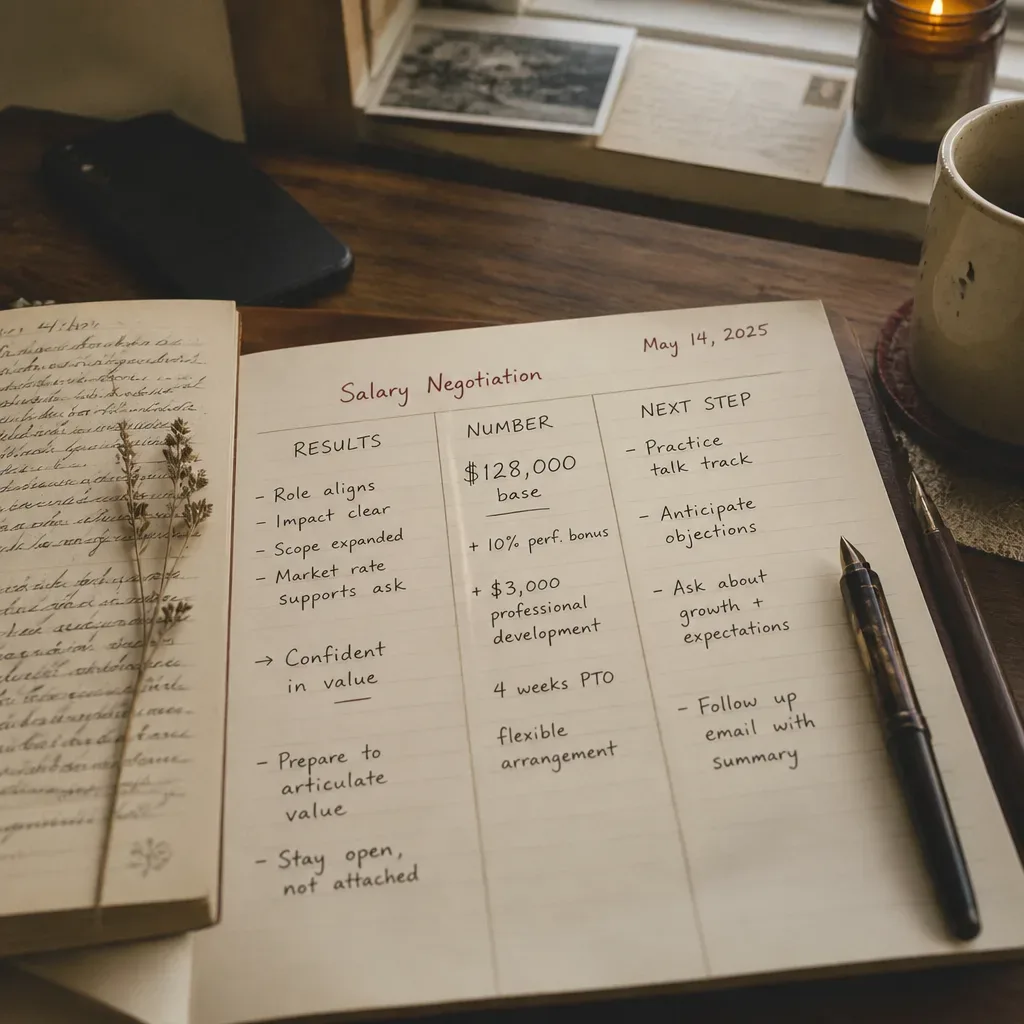
If you are underpaid, your body may want the talk to carry every old resentment. Do not let it. Put the resentment somewhere else first. Walk for 10 minutes. Type the angry draft and delete it. Then return to the case. A clear ask has more leverage than a crowded ask.
A useful raise case has 4 parts:
- The number or range you are requesting.
- The business reason for the request.
- The recent proof that supports it.
- The next step if the answer is not immediate.
You are not asking to be seen as special. You are asking to be paid in proportion to the work now being done.
How do you write a Dream-Self Moment for salary negotiation?
Write it from the future self who has already asked, stayed calm, and left with clarity.
Keep it short enough to listen to every day. Five to 8 minutes is enough for most people; BJ Fogg’s Tiny Habits work often points back to the same principle: smaller behaviors repeat more easily. If your audio is 25 minutes, you may skip it. If it is 6 minutes, you can listen before coffee, on a train platform, or outside the meeting room.
The Dream-Self Moment should be narrated as already true. Not because you are denying reality. Because you are giving your attention a place to stand. Neville Goddard used the phrase living in the end for this kind of inner rehearsal. You can use the idea without making it theatrical: hear the conversation after it went cleanly.
Include sensory and behavioral details, but keep them ordinary. Your hand around the mug. Your notes on the left side of the screen. Your feet flat. The exact number. The pause after you speak. One sentence can change the whole body: I say the amount once, and I do not rush to soften it.
Here is a simple structure:
- Arrival: I sit down with my notes and breathe for 4 slow counts.
- Identity: I am someone who can speak about money without apology.
- Evidence: I name 3 results from the last 6 months.
- Ask: I request the raise clearly, with the number included.
- Pause: I let silence do its work.
- Response: If the answer is not yes, I ask for criteria, date, and next step.
Dr. Andrew Huberman has often described visualization as most useful when paired with action and when the imagined action is specific. That fits this practice. You are not visualizing a vague payday. You are rehearsing the 90 seconds that matter most.
If you want language support, Affirmations pillar can help you understand why short, repeated statements need to be believable enough for the body to accept. But keep your audio central. The spoken future-self scene is where the work lives.
When should you listen before the salary talk?
Listen daily for 7 days if possible, then once within the hour before the meeting.
Seven days is not magic. It is just enough repetition for the script to stop feeling new. Hermann Ebbinghaus wrote about memory and forgetting in the 1880s, and later memory research has kept confirming a simple idea: repetition over time beats one hard cram. Your salary talk deserves spaced rehearsal, not panic rehearsal.
If your meeting is already on the calendar, use this timing:
| Time | What to do | Why it helps |
|---|---|---|
| 7 days before | Listen once daily | Builds familiarity |
| 24 hours before | Review proof and number | Reduces last-minute edits |
| Morning of | Listen without multitasking | Keeps the script clean |
| 20–60 minutes before | Listen once, then stop | Prevents over-rehearsal |
| Right after | Write what happened | Turns outcome into data |
Gollwitzer and Sheeran’s 2006 meta-analysis of implementation intentions reviewed 94 studies and found that if-then planning had a medium-to-large effect on goal achievement. Use that. If my manager asks why now, then I say: my scope changed in March, and the compensation has not yet caught up. If they say budgets are closed, then I ask when the next compensation decision is made.

Do not listen so many times on the day that you become brittle. A practice should make you more available to the room, not trapped inside your own script. I like one listen, one review of proof, then a quiet 2-minute reset. The body needs a last signal: nothing is chasing you.
The clearest salary talk is often the one you have already heard yourself survive.
What do you say in the actual meeting?
Say the number, say the reason, say the proof, and stop before you explain yourself smaller.
Here is a plain script you can adapt:
I’d like to talk about compensation. Since March, my scope has changed in three ways: I now own the client reporting process, I led the handoff that reduced missed deadlines by 30%, and I am training the new hire. Based on that scope and current market ranges, I am asking for a salary adjustment to 84,000. What would need to happen to approve that?
The exact number will be yours. The structure can stay. The last question is useful because it gives the other person a path. It also turns a vague no into information. Harvard Law School’s Program on Negotiation has long taught the value of objective criteria in negotiation. Your proof and market data are those criteria.
If your manager says yes, pause before filling the air. Ask when it takes effect and whether the decision will be confirmed in writing. If your manager says not now, ask for the decision date. If your manager says no, ask what would make the request credible in the next review cycle. Write those words down.
Keep 3 sentences ready:
- I am asking for this adjustment because the role has changed.
- I would like to understand the criteria for approval.
- If now is not possible, I would like to set a review date today.
The silence after your ask is part of the ask. Do not rescue someone from having to consider your value.
This is where manifestation becomes behavior. You heard the future self. You prepared the proof. Now your mouth does the small brave thing. For more on using timing as a reflective layer rather than an excuse to wait forever, you might read Astrology and manifestation. The calendar can support you. It cannot ask for you.
What should you do after the answer?
After the answer, capture the facts, regulate your body, and choose the next clean action within 24 hours.
Do not grade the whole practice by one yes or no. Compensation is shaped by budgets, managers, bands, timing, and politics you may not see. That is why your after-meeting notes matter. Write what was said, what was promised, what was unclear, and what date was named. A 2022 Microsoft Work Trend Index reported that many workers were rethinking work and pay after the pandemic years; salary talks now happen inside larger company constraints. Get the specifics.
If the answer is yes, let it land. Then do the unglamorous part. Ask for written confirmation. Check the effective date. Note whether bonus, title, equity, or scope changed too. A raise without clarity can still become a future confusion.
If the answer is not yet, turn it into a plan. Ask for 2 or 3 measurable outcomes that would support approval. Ask who decides. Ask when. Then update your future-self audio. The new Dream-Self Moment is not about begging harder. It is about acting from clearer information.
Here is the 24-hour aftercare list:
- Write a factual meeting note while memory is fresh.
- Send a short thank-you with the agreed next step.
- Add the review date to your calendar.
- Update your proof document once a week.
- Listen to the revised audio for the next specific conversation.
Joe Dispenza often writes about rehearsing a future state until the body recognizes it. I read that through habit science: the body trusts what it has practiced repeatedly. The future self is not a fantasy figure. It is a behavioral model you return to until the next action feels possible.
You can keep learning the wider money practice through The AYA Method money work and the broader manifestation practice. Just remember the center here. Audio first. Evidence beside it. The ask spoken plainly.
Enough can begin as one sentence you finally let yourself say.