astrology manifestation
Waning Moon Ritual: Release With Dream-Self Audio
A quiet waning moon ritual for release: use a short Dream-Self audio, one written note, and five minutes of repetition to loosen what you're done carrying.

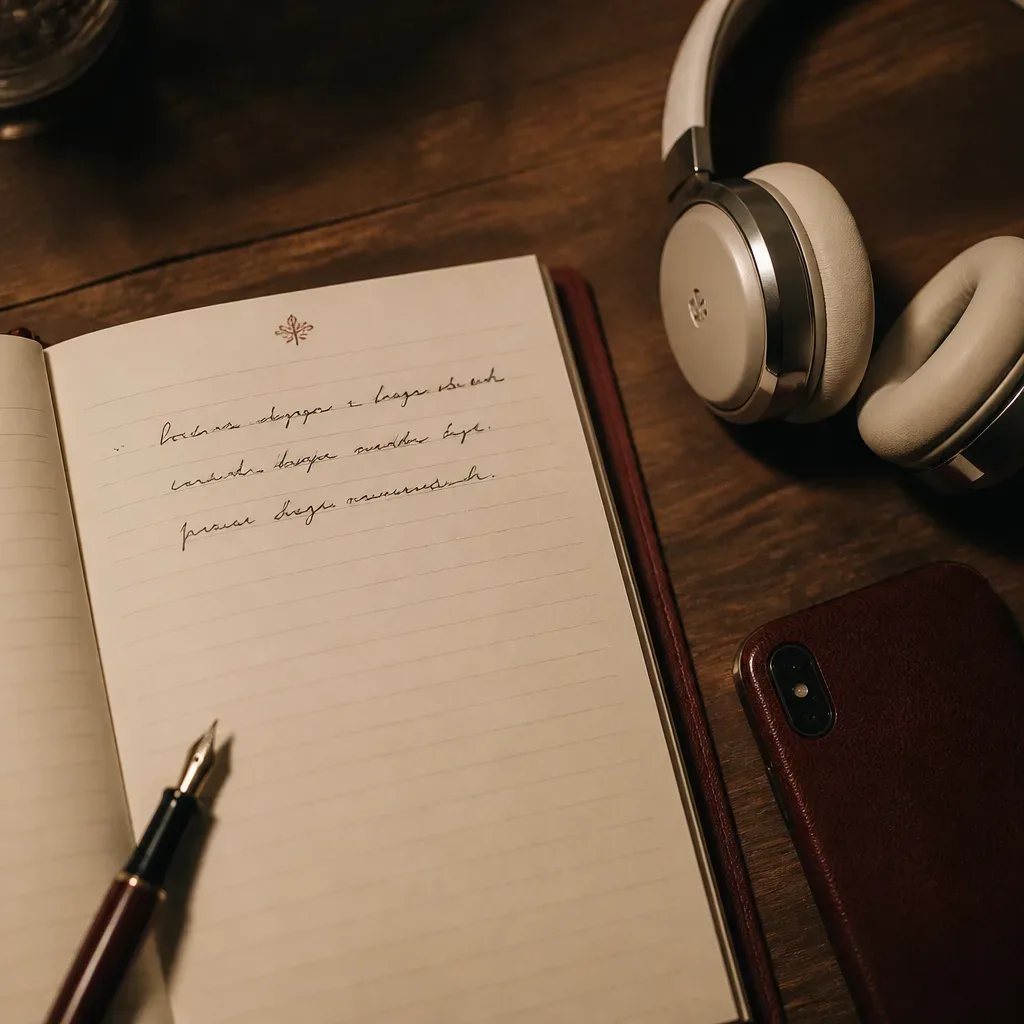
A cup sits beside the notebook. The moon is thinning outside the window. A waning moon ritual is a short release practice done after the full moon: you listen to your Dream-Self audio, name one pattern you’re done feeding, and choose one small act that proves it.
What is a waning moon ritual actually for?
A waning moon ritual is for releasing one pattern with enough clarity that your next day can recognize the change.
The waning moon is the half of the lunar cycle after the full moon, when the visible bright part grows smaller each night. NASA gives the average synodic lunar cycle as about 29.53 days, so the waning period lasts roughly 14 days. That’s useful because it gives the mind a rhythm. Not a rule. A rhythm.
You don’t need to make the moon responsible for your life. You can let it be a quiet clock. Pew Research Center reported in 2018 that 29% of U.S. adults said they believe in astrology, which means many people already use sky timing as personal language. Still, belief isn’t the point here. Repetition is.
A good ritual doesn’t make you dramatic. It makes you honest. The waning moon asks a simple question: what has been taking up space that no longer belongs to you? That can be a habit, a fear, a repeated sentence, a digital reflex, a friendship pattern, or a version of ambition that has started to taste like punishment.
The practice in this piece uses audio first. The AYA Method is a daily audio manifestation practice. Each day you listen to a short personalized recording — your Dream-Self Moment — narrated from the version of you who has already manifested the life you intend. Listening is the practice. Repetition is the work. The audio is the method.
The moon gives the evening a doorway. The audio gives your attention somewhere true to go.
When should you do the ritual in the lunar cycle?
Do this ritual any night after the full moon and before the new moon, with the last quarter moon as the cleanest middle point.
If you like exact timing, the last quarter moon arrives about 7.4 days after the full moon in a 29.53-day cycle. That’s the visible half-moon that appears to be decreasing. Many astrology calendars mark it clearly. If you don’t follow an app or almanac, choose one evening in the week after the full moon and keep it simple.
The timing matters less than the repeat. In behavior design, a stable cue helps an action come back. Wendy Wood and David Neal wrote in 2007 that habits are strongly tied to recurring contexts, not just strong intentions. The waning moon can become that context: same window, same candle, same audio, same page.
Here is a simple way to choose your night:
| Timing | Best for | Keep it this simple |
|---|---|---|
| 1–3 nights after full moon | Emotional decompression | Name what peaked and now can soften |
| Last quarter moon | Clear decisions | Choose one behavior to stop repeating |
| 1–3 nights before new moon | Emptying before a reset | Clear space for the next intention |
If you’re new to astrology and manifestation, don’t try to learn every phase at once. The full moon shows what has become visible. The waning moon reduces. The new moon begins. That’s enough for a first month.
Ritual fails when it becomes too large to repeat. A five-minute practice done 12 times a year will teach you more than a perfect two-hour ceremony you never return to. The moon doesn’t need your performance. It needs your attention.
What do you need before you begin?
You need a quiet cue, your Dream-Self audio, one page, and a release sentence small enough to be lived tomorrow.
Set out four things: headphones, a notebook, water, and one soft light. That’s it. If you want a candle, use one. If you don’t, don’t. The ritual should take about 12 minutes. A 2020 paper in the British Journal of Health Psychology found that short, specific action plans are more likely to be followed than broad intentions, especially when tied to a cue.
Before you press play, write the pattern in one sentence. Make it plain. Not I release fear. Try: I release checking for approval before I trust what I know. Not I release the past. Try: I release rereading old messages when I’m tired.
Use this four-part setup:
- Name the pattern in present language.
- Notice what it costs you in one line.
- Listen to your Dream-Self Moment once.
- Write the smallest next behavior that proves release.
The Dream-Self audio matters because it moves the practice from analysis into rehearsal. You’re not only naming what you don’t want. You’re listening from the self who no longer organizes the day around that pattern. In manifestation, that difference matters. The mind needs a felt reference for what you’re choosing, not only a complaint about what hurt.
You can keep the app’s daily affirmation nearby, if it helps you phrase the line. You can also glance at a Manifestation Board after the audio. But they are complements. The audio is the method. The board is something you see. The affirmation is something you say. The Dream-Self Moment is something you listen to until the new pattern feels available.
How do you use Dream-Self audio to release something?
Use the audio as a rehearsal of the self who has already stopped returning to the old pattern.
Start with your headphones on. Let your shoulders drop before you play anything. Andrew Huberman has often pointed to the role of the nervous system in attention and behavior, and while a moon ritual isn’t a clinical protocol, your body still matters. If your breathing is rushed, your mind tends to chase. Give yourself 30 seconds first.
Then play the Dream-Self Moment once. Don’t clean. Don’t scroll. Don’t prepare a better sentence while it plays. Listening is active. It asks you to stay with one version of yourself long enough for it to become familiar.
A release ritual is not a rejection of who you’ve been. It is a refusal to keep rehearsing what trained you to be smaller.
After the audio, write three lines:
- What I am releasing: one concrete pattern.
- What I now remember: one sentence from the Dream-Self point of view.
- What I will do within 24 hours: one visible behavior.
For example: I am releasing the need to explain my no three times. I now remember that my calm answer is complete. Within 24 hours, I will send the shorter reply and not reopen the thread for one hour.
Specificity is mercy. A vague release gives you nothing to practice. A specific release gives your day a door handle.
Research on expressive writing from James Pennebaker and colleagues often uses 15 to 20 minute writing sessions across several days, and results vary by person and context. This ritual is shorter, so don’t ask it to do the whole work of healing. Ask it to mark the turn. Then let daily repetition carry the rest.
What should you write after listening?
Write one release line, one replacement line, and one proof action you can complete before tomorrow night.
The page should not become a confession chamber. Keep it practical. If the release is too big, you may leave feeling blurred. If it’s too small, you may not feel the shift. Aim for one pattern you can catch in real time. According to a 2006 implementation intention meta-analysis by Peter Gollwitzer and Paschal Sheeran, if-then planning had a medium-to-large effect on goal achievement across many studies. That is the shape you want.
Use this template:
I release [specific pattern] when [specific cue appears]. When [cue] happens, I will [small replacement behavior].
Examples:
- I release saying yes before I check my body. When a request arrives, I will wait ten minutes before answering.
- I release making my work acceptable to an imagined critic. When I start editing from fear, I will read the first paragraph out loud once.
- I release looking for signs that I’m behind. When I compare myself, I will return to the next true task for 15 minutes.
This is where affirmations can help as a complement. A good affirmation doesn’t decorate the page. It gives language to the behavior. I choose the quiet yes. I let the shorter answer stand. I return to what is mine now.
Don’t burn the paper unless you truly want to and can do it safely. Fire can become theatre very quickly. Folding the page and placing it under a glass of water is enough. Tearing it once is enough. Closing the notebook is enough.
The nervous system learns through proof, not poetry alone. Give it one proof before the next moonrise.

How do you keep the ritual from becoming another task?
Keep the ritual under 12 minutes and remove every part you added to impress an imaginary witness.
A ritual becomes heavy when it tries to solve your whole life at once. This is one reason small practices last. BJ Fogg’s behavior model, used widely in habit design, says behavior happens when motivation, ability, and prompt meet. The waning moon is the prompt. The short audio keeps ability high. The release sentence gives motivation a shape.
Here is the 12-minute version:
| Minute | Action | Why it matters |
|---|---|---|
| 0–2 | Sit, breathe, set the page | Lowers friction |
| 2–6 | Listen to Dream-Self audio | Makes the future self feel near |
| 6–9 | Write release and replacement | Turns feeling into language |
| 9–11 | Choose one proof action | Makes the ritual behavioral |
| 11–12 | Drink water, close the notebook | Gives the practice an ending |
You can repeat this every waning moon, or every Sunday during the waning phase. Twelve lunar cycles give you 12 clean release points in a year. That’s not a small number. It’s enough to see patterns that ordinary weeks hide.
If you use the AYA app daily, let this ritual sit inside that rhythm rather than beside it as a second life to manage. The Dream-Self Moment stays central. The daily affirmation may give you a sentence. The Manifestation Board may remind your eyes where you’re headed. But the practice is still listening.
The quietest ritual is often the one that changes your next ordinary choice.
What if nothing feels different afterward?
Nothing has to feel different right away; the ritual is successful if it changes the next repetition by even one inch.
People often expect release to feel like a door slamming. More often, it feels like noticing the handle before you grab it again. That is progress. In mindfulness research, even brief practices can improve attention for some people, but effects depend on consistency, instruction, and baseline stress. A single moon night is a marker, not a cure.
Track one thing for the next seven days: did I notice the pattern sooner? Not did I become a new person. Not did I never do it again. Just sooner. If you used to notice after three hours of spiraling and now notice after 20 minutes, the ritual has entered the day.
You may also find that the release sentence changes. Good. The first sentence is often too broad. By the second waning moon, you might see the real pattern underneath. I release procrastination becomes I release waiting until pressure makes me feel real. I release people pleasing becomes I release offering warmth so I won’t risk being disliked.
For more on using moon timing without losing the center of the practice, keep astrology and manifestation close as a reference. For the larger frame, manifestation is not wishful thinking here. It’s repeated attention, felt identity, and small proof in the day.
If you want a one-line closure, use this: I don’t have to carry this to be loyal to who I was.
Then stop. Let the night be ordinary again.
The moon thins, and you don’t reach for the old weight.