manifestation 101
Two Cup Method vs Future-Self Audio
A quiet comparison of the two cup method and future-self audio for identity shifts, with research, ritual notes, and a simple way to test both.
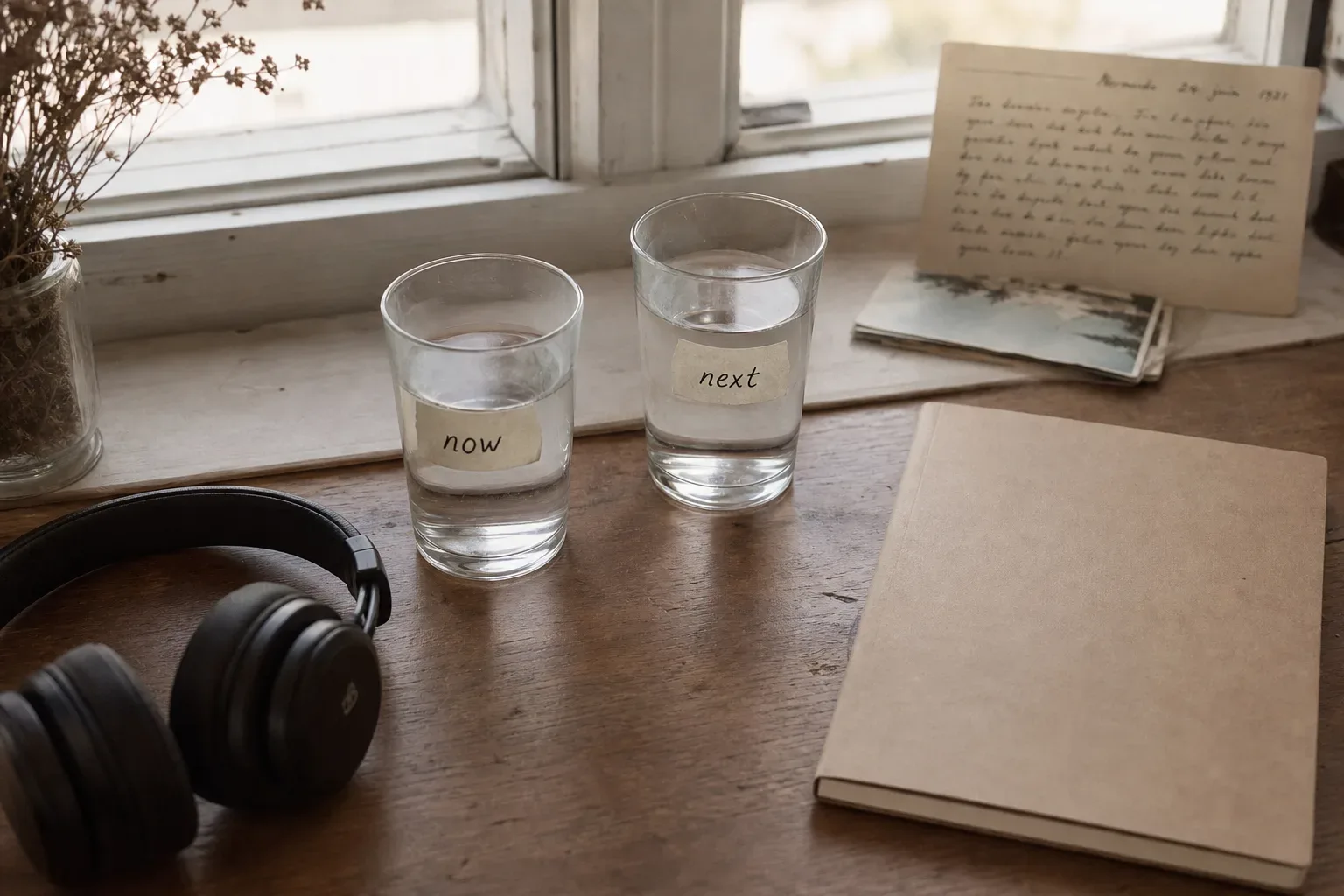
Two cups sit on the counter. One says “now.” One says “next.” The two cup method is a short symbolic ritual for shifting identity, while future-self audio is a repeatable listening practice. If you want lasting change, the ritual can begin it. Daily audio is better suited to keep it alive.
What is the two cup method actually doing?
The two cup method turns an inner decision into a visible act you can touch.
The practice is simple. You label one cup with your current state and a second cup with the state you want to inhabit. You fill the first with water, pour it into the second, then drink. The whole thing can take 3 minutes. That matters. Short rituals are easier to complete, and completion gives the mind a clean edge.
Most people describe the two cup method as a manifestation ritual, but it may be more accurate to call it symbolic rehearsal. You’re not just thinking, “I’m different now.” You’re making a small scene for your senses. The labels, the pour, the drink. A 2010 paper in Psychological Science by Norton and Gino found that rituals can reduce grief and restore a sense of control after loss. That doesn’t prove this method changes outer events. It does suggest ritual can change how you stand inside a moment.
There is also a memory effect. You may forget a vague intention by lunchtime. You’re less likely to forget pouring water from “uncertain” into “steady” at 7:12 a.m. Specificity helps the brain tag a moment as meaningful. In behavior research, Gollwitzer’s work on implementation intentions shows that “if-then” plans can make goal behavior more likely across dozens of studies. The cup ritual is not an if-then plan, but it shares one useful trait: it gives intention a structure.
A ritual is a door. It is not the house.
What does future-self audio do differently?
Future-self audio gives identity a voice you can return to each day.
The difference is repetition. The two cup method is usually done once, or only when the desire feels urgent. Future-self audio is designed for daily contact. You listen to a version of yourself speaking from the life you intend, not as a distant fantasy, but as a remembered normal. In habit research, Lally and colleagues found in the European Journal of Social Psychology that automaticity took a median of 66 days to form, with a wide range from 18 to 254 days. Identity needs return.
This is where the AYA Method matters. The AYA Method is a daily audio manifestation practice. Each day you listen to a short personalized recording — your Dream-Self Moment — narrated from the version of you who has already manifested the life you intend. Listening is the practice. Repetition is the work. The audio is the method.
Audio is intimate because it enters through time. You don’t stare at it. You receive it. Dr. Andrew Huberman often speaks about neuroplasticity requiring attention, repetition, and salience; those 3 conditions are not a promise, but they are a useful frame. A short recording can gather attention. Personal words can create salience. Daily listening supplies repetition.
The app also includes a daily affirmation and Manifestation Board, but they are complements. They are not the core practice. If you only do one thing, listen. The voice is where the identity starts to feel less borrowed.
Which one supports identity shifts more reliably?
Future-self audio is usually stronger for identity shifts because it repeats the self-image until it becomes familiar.
Identity change is not only a thought. It is a pattern of recognition. You notice what you do, what you tolerate, what you choose, and what you call “like me.” James Clear popularized the phrase “identity-based habits,” but the research beneath it is older: self-perception theory, proposed by Daryl Bem in 1972, suggests people infer who they are partly by observing what they do. A daily listening practice gives you one observed act: I am the kind of person who returns.
The two cup method can still be beautiful. It creates a moment of symbolic discontinuity. Neville Goddard wrote often about assuming the feeling of the wish fulfilled; the cup ritual gives that assumption a small stage. Joe Dispenza’s followers often speak about mentally rehearsing a future self. You don’t have to adopt every claim to see the useful point: the self changes more easily when the new identity is rehearsed as already known.
Future-self audio has one practical advantage. It can meet you when your belief is weak. You don’t have to generate the whole state from scratch. You press play. A 2016 self-affirmation fMRI study by Cascio and colleagues found that future-oriented affirmations were associated with activity in brain regions linked to self-processing and valuation. That does not prove manifestation. It does show that words about a valued future can be neurologically meaningful.
What you repeat becomes less strange.

How do they compare in daily life?
The two cup method is a threshold ritual, while future-self audio is a maintenance practice.
Here is the quiet comparison. Not to crown one and dismiss the other. To see what each one asks from you.
| Question | Two cup method | Future-self audio |
|---|---|---|
| Time needed | About 3 to 5 minutes | Often 2 to 7 minutes daily |
| Main sense used | Sight, touch, taste | Hearing, attention, inner imagery |
| Best use | Marking a decision | Rehearsing identity repeatedly |
| Weak point | Can become a one-time wish | Requires daily return |
| Research fit | Ritual, symbolism, intention | Repetition, self-talk, guided imagery |
| Aya placement | Not part of the method | Core of the method |
One cup ritual can be enough when you need a clean beginning. For example, you’re leaving a role that made you shrink, and you want a physical way to say, “I don’t live from that name anymore.” That can be real. The body often understands what the mind keeps debating. In small ritual studies, including Norton and Gino’s work, the mechanism seems to be perceived control, not magic certainty.
Future-self audio is different because it doesn’t rely on one charged moment. It builds a rhythm. In 2023, Pew Research reported that 41% of U.S. adults had used some form of meditation or mindfulness practice at least once, depending on the measure and survey wording. Many people are not looking for more complexity. They’re looking for a practice they can actually keep. Listening is small enough to survive an ordinary Tuesday.
If you’re studying manifestation, this distinction matters. A method should be judged not only by how it feels at the start, but by whether it brings you back when the mood has passed.
Where does belief fit without forcing it?
Belief works best when it is practiced gently, not demanded all at once.
The two cup method can feel hard if you treat it as a test. You pour the water, drink, and then scan the day for proof. That scanning can become stress. The nervous system does not usually soften under surveillance. A 2014 review in Annual Review of Psychology noted that stress affects attention, memory, and decision-making in measurable ways. If a ritual makes you more tense, it may be working against the identity you want.
Future-self audio gives belief a softer entry. You can listen before you agree. You can let the words pass through without checking whether they’re “true enough” yet. This is close to how affirmations work at their best: not as a command, but as repeated contact with a sentence you’re learning to inhabit. Some research on self-affirmation, including work by Cohen and Sherman, suggests benefits are strongest when the statement connects to values, not empty praise.
There is also the question of evidence. Manifestation communities sometimes cite the Princeton Engineering Anomalies Research lab and the Princeton Global Consciousness Project. Those projects reported small statistical deviations in random systems, but their interpretations remain contested. That is important to say plainly. You don’t need shaky certainty to use ritual well. You can hold mystery without making false claims.
Belief is not a switch. It is a room you enter more than once.
When might the two cup method be enough?
The two cup method may be enough when you need closure, a clean choice, or a single symbolic reset.
Use it when the change is simple and immediate. You’re done sending the message. You’re done delaying the application. You’re done calling yourself disorganized because one week went badly. A visible ritual can create what psychologists call a “fresh start effect.” In a 2014 Management Science paper, Dai, Milkman, and Riis found that temporal landmarks, like birthdays or the start of a week, can increase goal-related behavior. A cup ritual creates a self-made landmark.
It may also help when you’re too tired for more language. Not every practice has to be verbal. Sometimes water, paper, and the small sound of pouring are enough. If you already have a strong daily structure, the two cup method can mark a shift inside that structure. It can be the bell, not the whole prayer.
Try this if you use it:
- Name the current state in plain words, not drama.
- Name the next state as something livable.
- Pour slowly enough to feel the act.
- Drink without bargaining with the result.
- Take one matching action within 24 hours.
That last step matters. In a meta-analysis of 94 studies, Gollwitzer and Sheeran found implementation intentions had a medium-to-large effect on goal achievement. Ritual becomes sturdier when paired with behavior. After the cup, send the email. Put the shoes by the door. Open the document. Let the symbol touch the day.
The method is quietest when it asks for one honest action.

How can you test both without turning practice into pressure?
You can test both by giving each one a clear role and watching your behavior for 14 days.
Start with one two cup ritual. Keep it concrete. Instead of “I am successful,” try “I speak clearly in the meeting.” Instead of “I am loved,” try “I let myself receive care without apologizing.” Specific language reduces the mind’s need to argue. In goal-setting research, Locke and Latham found that specific, challenging goals tend to improve performance more than vague goals across many task types.
Then listen to future-self audio daily for 14 days. If you use Aya, let the Dream-Self Moment be the practice. If you’re making your own recording, keep it under 5 minutes, speak in the first person, and write from the assumption that the identity is already normal. You might say, “I answer slowly now. I don’t rush to earn my place.” That is different from hype. It is a remembered self.
Track only observable signals. Not omens. Not sudden proof. Watch for these:
- Did I take the next action faster?
- Did I recover from doubt more gently?
- Did my language about myself change?
- Did I avoid one old pattern at least once?
- Did I return to the practice after missing a day?
If you like symbolic timing, you can read astrology and manifestation as a way to choose a date, but don’t hand your agency to the calendar. The date can support the ritual. It cannot do the listening for you. You might also place one image on a Manifestation Board as a complement, not as the central practice.
For more background on how desire, attention, and action meet, the Manifestation pillar gives the wider map. But here is the smaller truth: the practice that changes you is the one you can return to when nothing dramatic is happening.
Stay with the voice that brings you home.