evening rituals
Sleep Manifestation: 5-Minute Dream-Self Audio
Sleep manifestation can be quiet and brief: a 5-minute Dream-Self audio before bed that trains attention, memory, and next-day behavior.
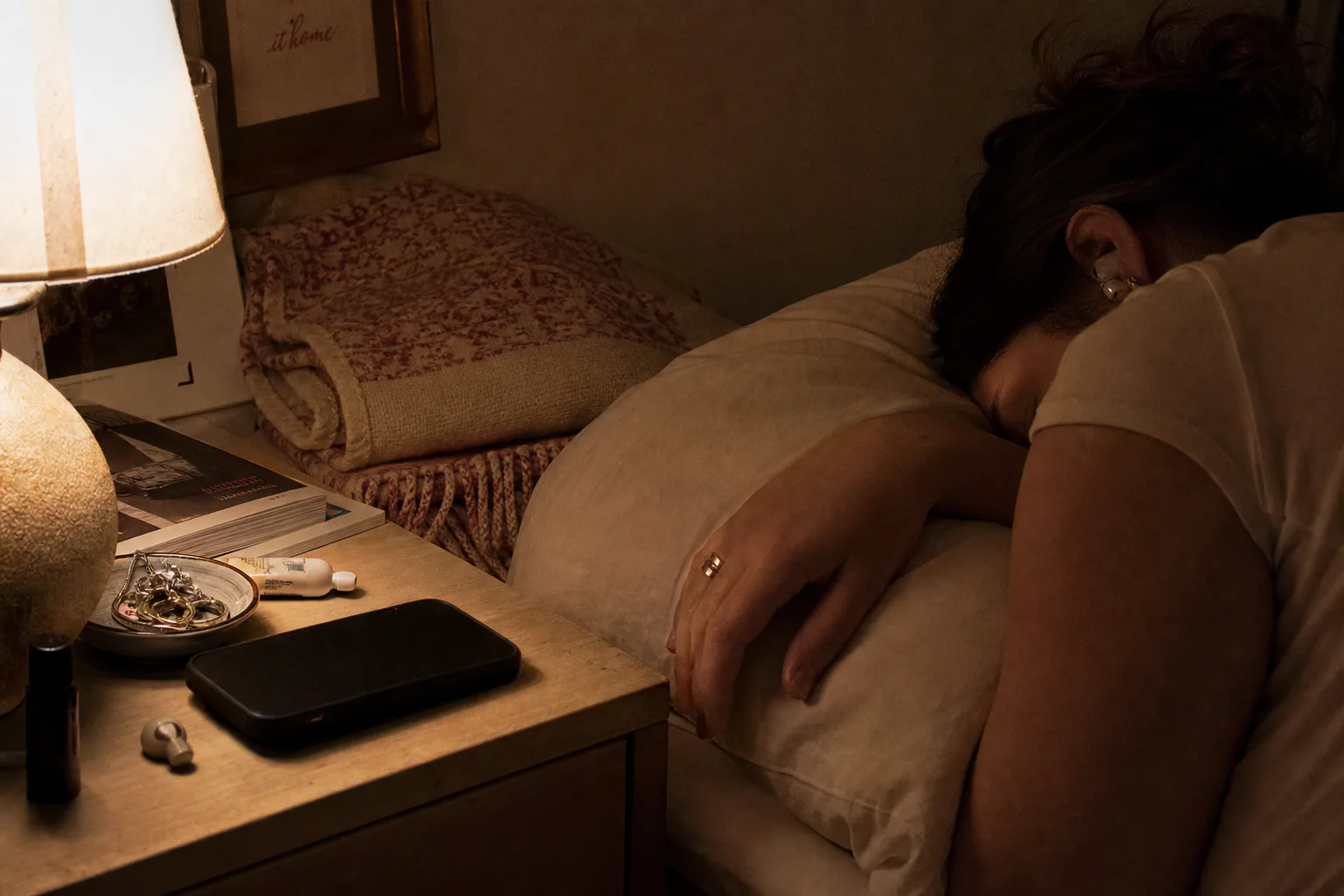
The phone is face down. The lamp is low. Sleep manifestation means using the last 5 minutes before bed to listen to your Dream-Self audio, so your mind closes the day with one clear identity cue. You do not need a long ritual. You need repetition, softness, and a cue you can return to.
What is sleep manifestation, really?
Sleep manifestation is a bedtime attention practice that pairs future-self language with a stable sleep cue.
It is not wishing harder in the dark. It is not making your room look like a ceremony. It is a small piece of behavior design. You choose what your attention hears right before sleep, then you repeat it enough times that the cue becomes familiar. The American Academy of Sleep Medicine recommends at least 7 hours of sleep for most adults, and the practice should protect that sleep, not steal from it.
In Aya, the cleanest form is audio. The AYA Method is a daily audio manifestation practice. Each day you listen to a short personalized recording — your Dream-Self Moment — narrated from the version of you who has already manifested the life you intend. Listening is the practice. Repetition is the work. The audio is the method.
That definition matters because it keeps the method honest. The audio comes first. The mind does less when the voice is already there. You do not have to write three pages, build a perfect board, or argue yourself into belief at 11:42 p.m. You listen. Then you sleep.
If you are new to manifestation, think of this as training attention rather than controlling outcomes. Attention is not everything, but it is the door you keep walking through. A 2010 Harvard study by Killingsworth and Gilbert found people reported mind-wandering about 47% of waking time. Bedtime is one place to offer the mind a quieter direction.
What you repeat at the edge of sleep becomes easier to remember in daylight.
Why does five minutes before bed work?
Five minutes works because it is short enough to repeat and close enough to sleep to become a strong cue.
The bedtime window is sensitive. Light drops. speech slows. The day stops asking for replies. Sleep researchers often recommend a wind-down period of 30 to 60 minutes, but the actual practice inside that window can be brief. The National Sleep Foundation has long pointed to consistency in sleep timing as one of the basics of sleep hygiene. Your 5-minute audio can become one small consistent part of that structure.
There is also memory. Sleep helps consolidate learning; that is not mystical language, it is basic cognitive science. A 2013 review in Physiological Reviews described sleep as active in memory processing, not just rest. When you listen to a future-self script before bed, you are not programming yourself like a machine. You are placing a repeated cue near a known memory process.
The length matters because tired people are honest. A 25-minute ritual may sound beautiful at lunch and feel impossible at midnight. Behavior researcher BJ Fogg often teaches that tiny behaviors survive because they ask less from motivation. Phillippa Lally’s 2009 habit study found automaticity took a median of 66 days, with wide variation. That means the ritual has to be built for many ordinary nights.
A five-minute Dream-Self audio gives you three useful constraints:
- It is brief enough to do when you are not inspired.
- It is structured enough that you do not have to invent words.
- It is repeatable enough to become associated with sleep.
The practice is not strong because it is dramatic. It is strong because it is repeatable.
How do you practice the Dream-Self audio tonight?
You practice by lowering stimulation, playing one personalized audio, and choosing one small proof for tomorrow.
Here is the plain version. Do not add more unless you have already kept it for 7 nights. The Centers for Disease Control and Prevention has reported that about 1 in 3 U.S. adults do not get enough sleep. So the ritual must not become another thing that delays rest.
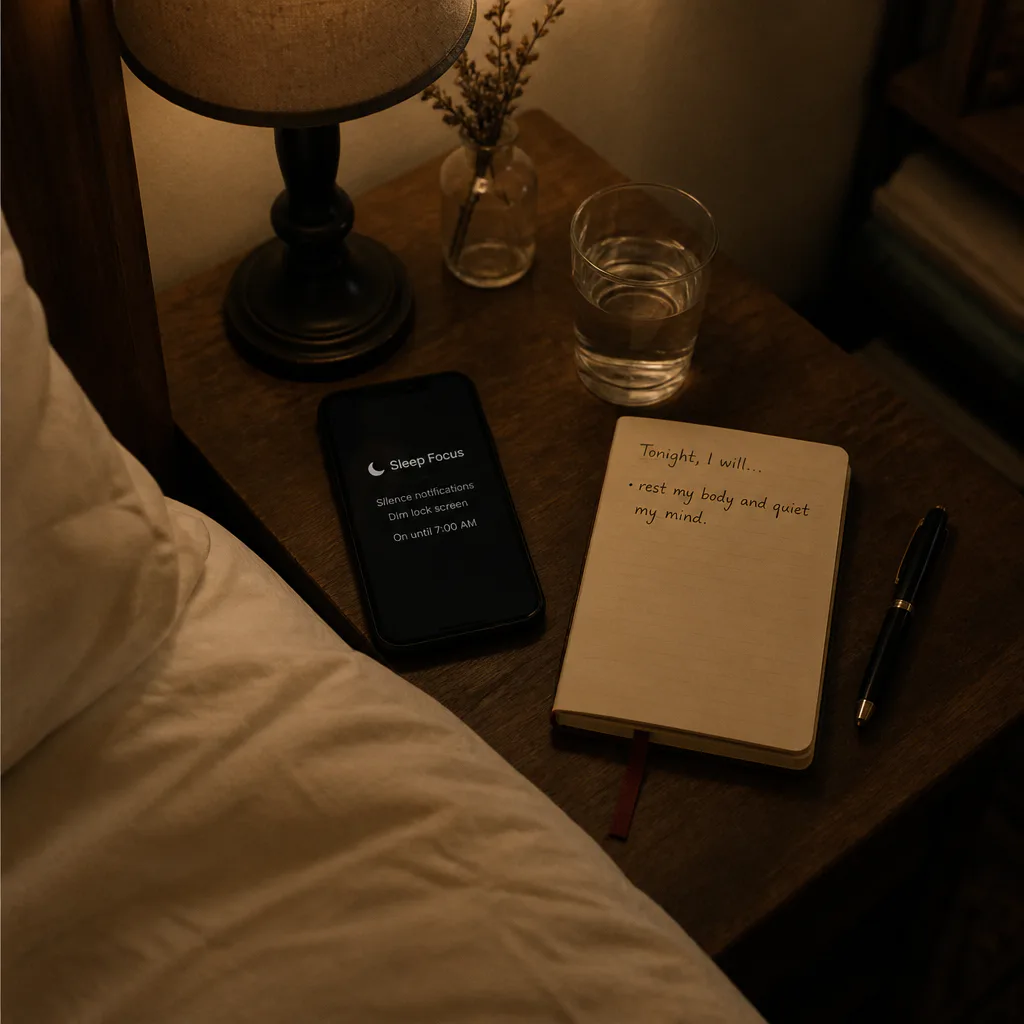
- Set the room for sleep. Dim the lights. Put your phone on sleep focus. If you can, keep the screen down after the audio starts. Dr. Andrew Huberman has often emphasized evening light as a signal that can delay sleep timing, and clinical sleep guidance agrees that bright light close to bed can work against the body clock.
- Play your Dream-Self Moment once. One play is enough. Let the voice carry the words. If you miss a sentence, do not rewind.
- Notice one line. Not the best line. The line your body softens around.
- Name tomorrow’s smallest proof. A proof can be sending the email, walking for 10 minutes, drinking water before coffee, or opening the draft.
- Stop. Sleep is part of the method’s mercy. More effort is not always more care.
The smallest proof is important because identity needs behavior. In a 1999 paper, psychologist Peter Gollwitzer showed that implementation intentions, simple if-then plans, can improve follow-through across goals. After the audio, you might say: If I open my laptop at 9, I write the first bad paragraph. That is enough.
| Bedtime moment | What to do | Why it helps |
|---|---|---|
| Lights low | Reduce brightness for 5 minutes | Fewer wake cues |
| Audio starts | Listen once, no rewinding | Less performance |
| One line lands | Let it be enough | Attention narrows |
| Morning proof | Pick one visible action | Identity meets behavior |
What should the audio say?
The audio should sound like your future self describing a real day, not a stranger reciting perfect slogans.
Good sleep manifestation language is specific, sensory, and calm. It does not need to be grand. Neville Goddard wrote often about assuming the feeling of the wish fulfilled, but the useful part here is concreteness. What would a normal Tuesday feel like if the change were already integrated? What would you stop checking? What would you start doing without an audience?
A strong Dream-Self Moment usually includes 4 kinds of lines. First, identity: I am the kind of person who returns to the work. Second, evidence: I sent the proposal before noon. Third, sensation: My shoulders are lower when I read the reply. Fourth, care: I do not punish myself for being human. This is not theatre. It is rehearsal.
Mental imagery has been studied for decades in sport and clinical settings. A 2016 review in the Journal of Behavioral Medicine noted that imagery-based interventions can influence health-related behaviors, though results depend on design and context. That is a careful claim. Your bedtime audio is not a guarantee. It is a repeated cue that may make the next right behavior easier to see.
Try writing the audio in the present tense, from the future self who is already living the change:
- I wake without negotiating with myself.
- I keep the promise small enough to keep.
- I answer the message before I build fear around it.
- I let one honest action count.
- I rest when the day is complete, not when every worry is solved.
A believable sentence can do more than a beautiful one.
Keep the script under 650 words if it will be read slowly for about 5 minutes. Most spoken audio lands around 120 to 150 words per minute. Slower is better at night. Leave space. Let the nervous system hear that nothing is chasing it.
How is this different from affirmations or a Manifestation Board?
The difference is that the audio is the method, while affirmations and the Manifestation Board are complements.
This matters because too many tools can blur the practice. Affirmations can help when they are simple and believable. A Manifestation Board can help when you need to see the direction in images. But at bedtime, more inputs can keep the mind awake. If you can only do one thing, play the Dream-Self audio.
The app also includes a daily affirmation and a Manifestation Board, but they are not co-equal pillars. Think of them as quiet supports. The audio gives you the voice. The affirmation gives you one sentence. The board gives you a visual reminder for daytime. At night, the voice is usually enough.
There is a habit reason for this. Wendy Wood and David Neal’s work on habits has emphasized context cues and repetition. The more consistent the cue, the easier it is for behavior to run with less decision. If your bedtime ritual changes every night, your brain has to keep choosing. If it is always lamp, audio, one proof, sleep, the pattern becomes easier.
A simple comparison helps:
| Tool | Best time | Main use | Risk at bedtime |
|---|---|---|---|
| Dream-Self audio | Before sleep | Guided identity rehearsal | Very low if brief |
| Daily affirmation | Morning or after audio | One sentence of focus | Can become overthinking |
| Manifestation Board | Daytime | Visual reminder | Screen time may wake you |
| Journaling | Earlier evening | Sorting thoughts | Can turn into problem-solving |
If you like timing practices, you may also read about astrology and manifestation, but do not let timing become another way to postpone. The bed does not need a perfect sky. It needs a repeatable cue.
The practice you can keep while tired is the practice that has a chance to become yours.
What if your mind is too loud at night?
If your mind is loud, make the practice more physical and less verbal before you press play.
Night worry is common. The American Psychological Association has reported stress as a frequent sleep disruptor, and insomnia symptoms affect a meaningful share of adults in population studies. You are not failing if your thoughts get louder when the room gets quiet. The mind often waits until there is space.
Start with the body. Put both feet on the floor for 30 seconds. Feel the sheet under your hand. Exhale longer than you inhale for 5 rounds. This is not a test. It is a bridge. Then play the audio at low volume. If the words feel too intimate, let them be background. Listening still counts.
For anxious nights, edit the Dream-Self Moment so it does not make claims your system rejects. Instead of I am never afraid, try I know how to take the next small step while fear is here. Instead of Everything works out, try I answer what is in front of me. Cognitive behavioral therapy for insomnia, recommended as first-line care by the American College of Physicians in 2016, often works partly by changing behaviors and thoughts around sleep. Gentle accuracy matters.
You can also set a worry container earlier in the evening. Give yourself 10 minutes, not in bed, to write the concerns and one next action. Then bedtime does not become the first meeting of the day. If thoughts return during the audio, do not fight them. Return to the voice. Return again.
Use this quieter version on hard nights:
- Lower the volume.
- Choose the shortest audio.
- Skip extra journaling.
- Let one line be enough.
- Do not restart if you drift.
How do you know if sleep manifestation is working?
You know it is working when it becomes easier to return to the chosen identity in small daytime moments.
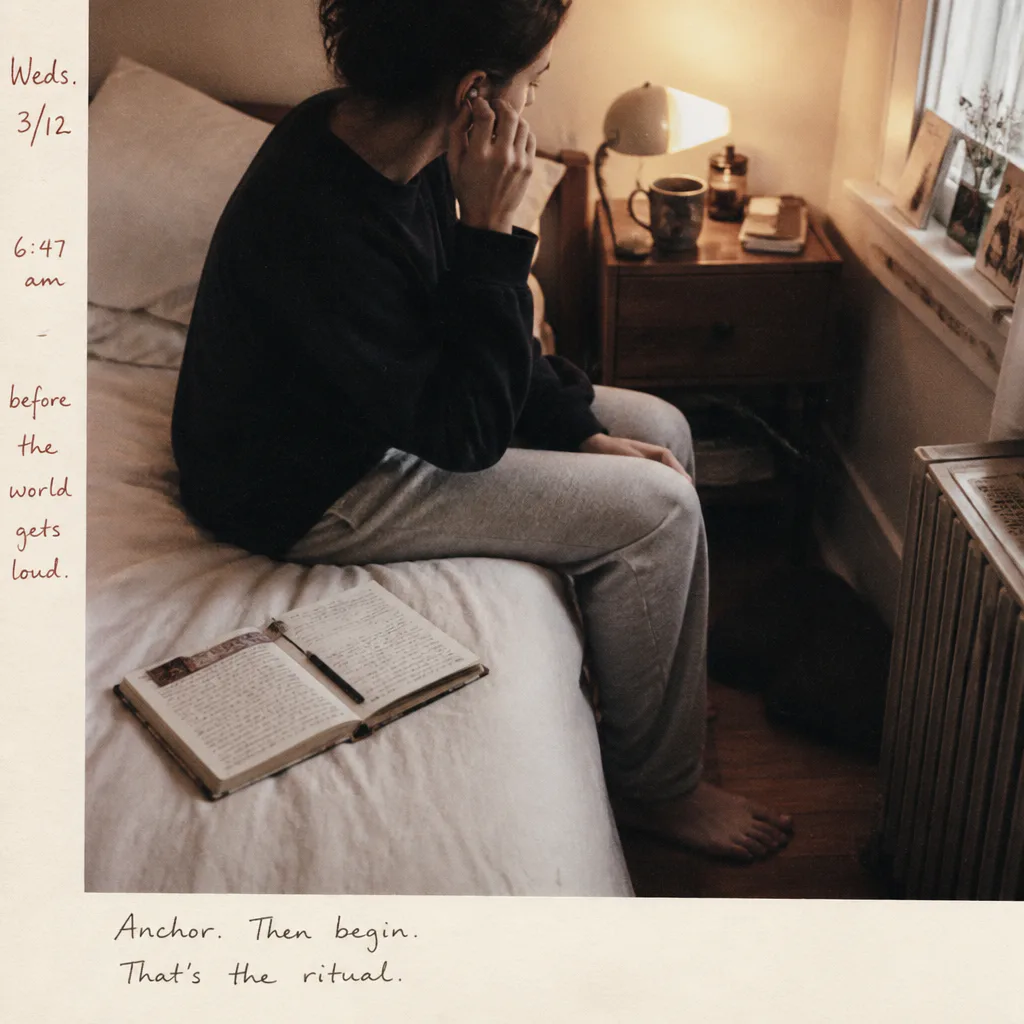
Do not measure it by whether every desire arrives on schedule. That makes the nervous system bargain with sleep. Measure the practice by behavior, memory, and tone. Did you listen 5 nights out of 7? Did one line come back when you wanted to quit? Did tomorrow’s smallest proof happen twice this week? Those are real signals.
A simple 7-night tracker is enough. The Lally habit study is useful here because it reminds you that automaticity is uneven. Missing one day did not erase progress in that research. The point is not a perfect streak. The point is a cue you return to.
Track only these 3 things:
- Listened? Yes or no.
- One remembered line? Write 3 to 8 words.
- One proof tomorrow? Name the action, not the mood.
After 7 nights, look for patterns. If the audio feels too long, shorten it. If the language feels false, make it plainer. If you keep scrolling afterward, move the audio to a device or setting that does not invite the feed. Pew Research Center has reported that large majorities of adults keep smartphones near them; the tool is close, so the boundary has to be clear.
You can also revisit the AYA Method when you want the full frame, or read the broader manifestation guide if you want to understand how attention, action, and repetition work together. Keep the night practice simple. The day can hold the analysis.
The proof of a bedtime practice is often found at 10 a.m.
Leave the room soft enough to hear yourself return.