manifestation 101
Pillow Method Manifestation Before Sleep: My Quiet Guide
A practical pillow method manifestation guide: listen before sleep, write one clear intention, reduce checking, and let repetition do the work.

Saturday night. The kettle clicked off and I left the blue mug by the sink. Pillow method manifestation is a bedtime practice where I place one clear desire at the edge of sleep, usually through a sentence or audio, then stop checking for proof. I use it to train attention, not to bully reality.
What is pillow method manifestation, really?
Pillow method manifestation is a simple night ritual: I choose one intention, bring it close to sleep, and let the mind carry it without more effort.
The old version is almost plain enough to miss. You write a desire on paper, fold it, place it under your pillow, and sleep. Some people read it once. Some repeat it 3, 7, or 10 times. Some pair it with a short visualization. Neville Goddard wrote often about the drowsy state before sleep, what he called the state akin to sleep, and his students still treat that window as unusually receptive.
I am an engineer, so I get suspicious when a method promises too much. I also get curious when a practice survives because people keep returning to it. The sleep window is not random. Sleep researchers describe memory consolidation as one of sleep’s core functions, especially during slow-wave sleep and REM cycles. The National Institute of Neurological Disorders and Stroke notes that adults generally need 7 to 9 hours of sleep, and that sleep supports learning, mood, and decision-making.
That is enough for me to treat bedtime with respect. Not as a mystical vending machine. As a threshold. If I feed my mind fear for 40 minutes before sleep, I tend to wake with the same tabs open. If I feed it one steady sentence, I give the night a cleaner input.
A desire gets quieter when I stop asking it to prove itself every hour.
I keep the practice small because small survives tiredness. My rule is one intention, one listen, one night. The paper under the pillow is allowed to be symbolic. The symbol matters only if it helps me return.
If you want the broader map, I keep this practice beside the Manifestation pillar, where the language is more general. At bedtime, I do not need a theory. I need a sentence I can sleep beside.
Why do I listen before sleep instead of trying harder?
I listen before sleep because effort is a poor bedtime instrument, and audio lets the intention arrive without turning into a debate.
This is where the AYA Method fits into my own nights. The AYA Method is a daily audio manifestation practice. Each day you listen to a short personalized recording, your Dream-Self Moment, narrated from the version of you who has already manifested the life you intend. Listening is the practice. Repetition is the work. The audio is the method.
I usually listen in the morning, before brushing my teeth. Some weeks, when my mind is loud at night, I listen again from bed. Not as an extra pillar. Just as the same audio practice meeting a different hour. Dr. Andrew Huberman has said many times, in his public sleep education, that light, temperature, caffeine timing, and arousal affect sleep onset. I notice the same thing in my own logs: if I am overstimulated after 10:30 p.m., no sentence can rescue the night completely.
Still, audio helps because it reduces friction. A 2021 review in the journal Sleep Medicine Reviews described pre-sleep cognitive arousal as a common factor in insomnia. My version is not clinical insomnia most nights. It is the engineer’s bedtime curse: one more scenario, one more fix, one more imagined Slack message. Listening interrupts that loop without requiring me to win an argument with it.
Here is the difference I keep taped inside my head:
| Bedtime mode | What it feels like | What I do instead |
|---|---|---|
| Forcing | Repeating a sentence until my body tightens | Play the audio once |
| Checking | Looking for a sign before sleep | Put the phone down |
| Bargaining | Trying to earn the desire by worrying | Breathe and let the cue land |
| Returning | Letting one phrase be enough | Sleep |
A bedtime practice should lower the volume of self-surveillance. If it makes me more frantic, I make it smaller.
How do I do the pillow method step by step?
I do the pillow method by making the intention specific, placing it into a short bedtime cue, and refusing to turn the bed into a courtroom.
I learned this the unglamorous way. Three Tuesdays ago, I wrote five desires on one page. Better health. More money. Less tension with my mother. A clean apartment. A calm launch week. By the time I got into bed, the page felt like a project plan. I slept badly and gave the method a false bad grade. The problem was not the pillow. The problem was scope creep.
Now I use 6 steps, and the whole thing takes about 12 minutes if I include washing my face. The practice itself is closer to 3 minutes.
- Choose one desire. I name one thing I can bear to hold gently.
- Write one sentence. I use present tense, but not theatrical language.
- Make it believable enough. If my body rejects it, I soften the wording.
- Read or listen once. I do not perform intensity.
- Place the paper under the pillow, if I wrote it. The paper is a cue.
- Leave it alone until morning. This is the hardest step.
A sentence that works for me sounds like this: I am learning to feel steady in the work I chose. A sentence that does not work for me sounds like a poster in a coworking space. The nervous system has taste. It knows when I am lying.
The American Psychological Association has covered implementation intentions, the classic “if-then” planning format studied by Peter Gollwitzer since the 1990s. Those studies are not about pillow rituals, but they do show something useful: specific cues support follow-through better than vague wishing. Bedtime is the cue. The sentence is the instruction.
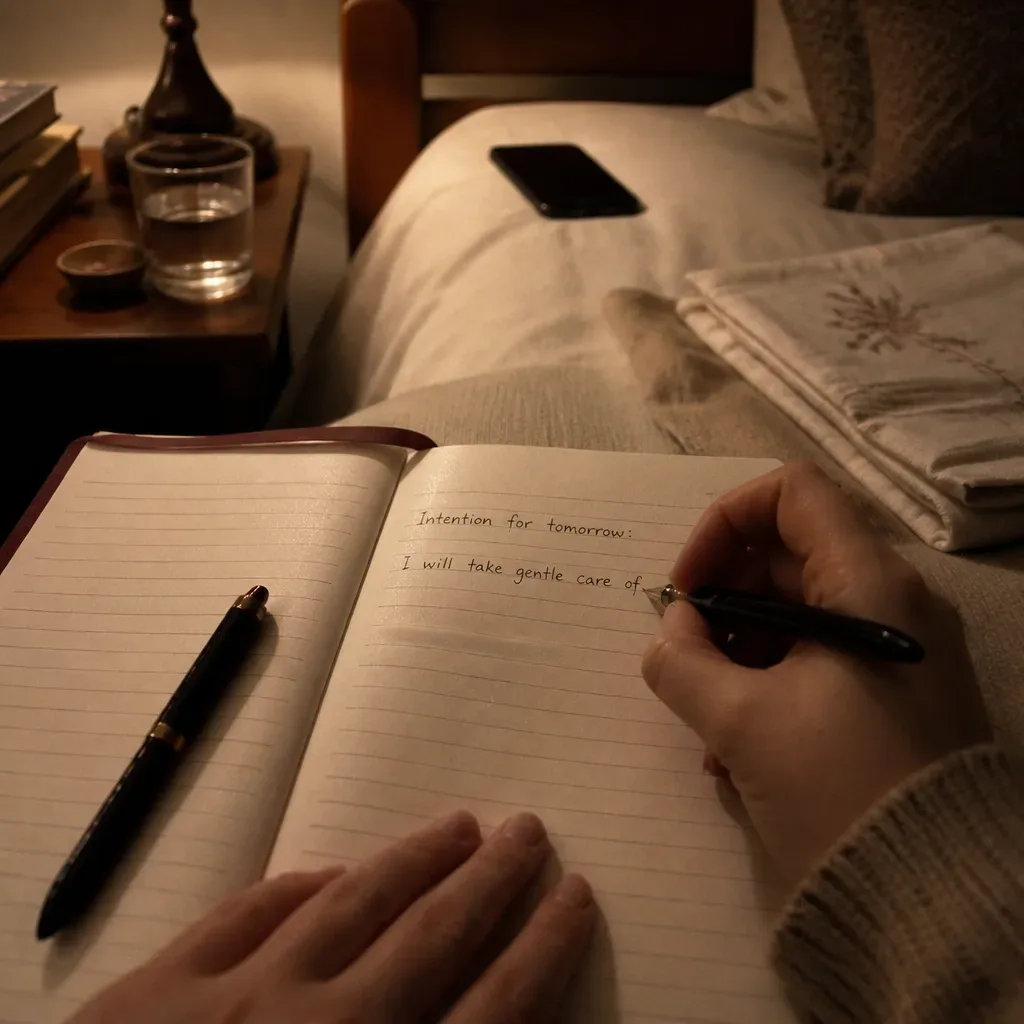
I also keep my phone across the room after the listen. Not because phones are evil, but because mine contains every open loop I own. Pew Research Center reported in 2021 that 31% of U.S. adults say they are online almost constantly. I am not morally stronger than a statistic. I move the device.
What should I write under the pillow?
I write one short sentence that names the desired state as already familiar, while staying close enough to reality that my body does not fight it.
There are two kinds of bedtime sentences I avoid. The first is the giant sentence: Everything is perfect and all of my problems are gone. My nervous system treats that as fiction and starts producing counterevidence. The second is the desperate sentence: Please let this happen or I cannot be okay. That one turns the pillow into a panic object. Neither helps me sleep.
I learned from Affirmations pillar that wording matters because repetition builds grooves. Cognitive psychology has studied self-talk for decades, especially in sports performance. In small studies, instructional and motivational self-talk have been associated with improved task performance, though effects vary by person and context. That seems honest enough to use carefully.
These are examples I would actually write:
I am safe to receive a clear answer about the role.I let my body learn steadiness around money.I am becoming someone who keeps promises to myself.My next good step is allowed to be simple.I can be loved without performing for it.
I keep the sentence under 15 words when I can. Short sentences behave better at midnight. They are easier to remember, easier to listen to, and less likely to become a legal contract with the sky.
The best bedtime sentence is not the most impressive one. It is the one my body can hear without bracing.
Sometimes I borrow astrology language when the week already has that flavor. If the moon or a transit gives me a useful frame, I use it lightly, the way I use weather. I wrote more about that relationship in Astrology and manifestation. I do not let astrology make the decision for me. I let it help me name the emotional weather.
Before I forget, the sentence does not need to be positive at all costs. It needs to be clean. Clean language does not deny fear. It gives fear a smaller chair.
How long should I practice before I expect anything to change?
I give the pillow method at least 7 nights for a light intention and 21 to 30 nights for a desire that touches fear, identity, or grief.
One night can matter. I have had one-night practices soften a conversation the next morning, mostly because I arrived less defended. But if I am measuring honestly, one night is noisy data. My sleep could be better because I ate earlier, walked more, cried, or finally stopped reading deployment logs at 11:48 p.m. In my personal tracking, I do not trust a pattern until I have at least 14 entries.
Habit researchers often point to a 2009 study by Phillippa Lally and colleagues in the European Journal of Social Psychology. The average time for a new habit to become automatic was 66 days, with wide variation from 18 to 254 days. That number gets repeated too neatly online, but the messy range is the important part. Humans are not cron jobs.
For pillow method manifestation, I track 4 things in the morning, each in one line:
- Sleep quality from 1 to 5
- Mood on waking from 1 to 5
- Whether I checked my phone after the practice
- One thing I noticed, if anything
This is not to turn desire into a dashboard. Dashboards lie by omission more than by error. I track because memory edits itself. If I do not write down that I felt calmer for 5 mornings in a row, my anxious mind will later claim nothing changed.
A quiet practice often works first by changing what I repeat, then what I notice, then what I choose.
I keep the morning note boring on purpose. Slept 4. Mood 3. Did not check phone. Dreamed about a train. That is enough. The desire can have privacy. Not every sacred thing needs analytics.
What mistakes made my practice feel worse?
The mistakes that made my practice worse were overloading the desire, checking for signs, using sentences I did not believe, and sacrificing sleep hygiene for ritual.
I wish I could say I learned this elegantly. I did not. I once repeated a sentence for 22 minutes because I thought more repetition meant more seriousness. My jaw hurt. My sleep score dropped. The next morning I was irritable in a stand-up meeting and called it resistance, when really I was tired.
The Sleep Foundation often recommends keeping a consistent sleep schedule, reducing bright light before bed, and creating a wind-down routine of about 30 to 60 minutes. None of that is glamorous. It is also the container that makes any night practice kinder. If my caffeine was at 5 p.m. and my laptop stayed open until bed, the method is now doing cleanup work it never agreed to do.
Here are the rules I keep now:
- I do not use the pillow method to avoid sending an email I need to send.
- I do not ask one night to repair ten years.
- I do not confuse intensity with trust.
- I do not keep repeating after my body says it is done.
- I do not call anxiety a sign.
The Princeton Engineering Anomalies Research program, often mentioned in manifestation circles, studied mind-machine interaction for decades before closing in 2007. Its results remain debated and are not a blanket proof for personal desires. I mention it because I want my practice to be honest. Wonder is allowed. Sloppy claims are not required.
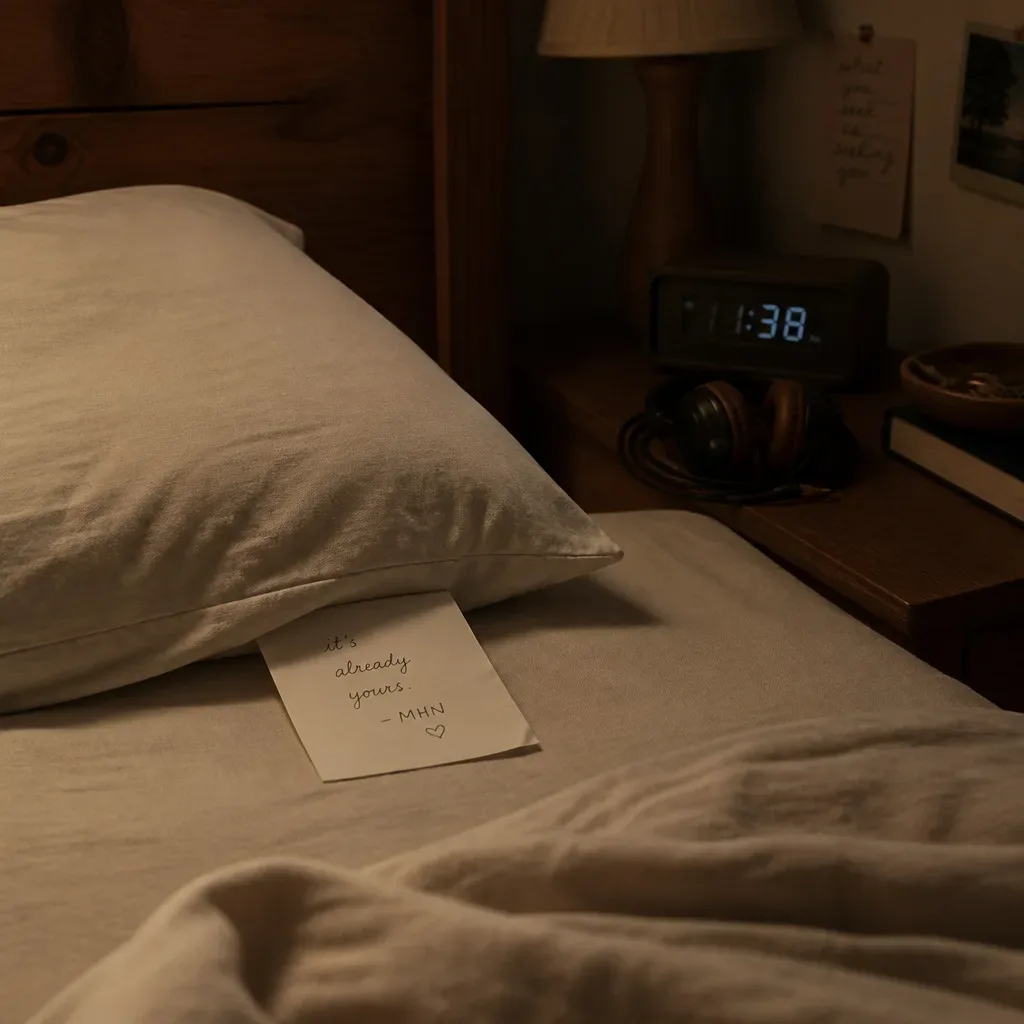
If I need a daytime reset, I go back to the AYA Method in the morning instead of adding more pressure at night. I might also read the Manifestation pillar when I want broader language, or return to one plain line from the Affirmations pillar. The audio remains the practice. The written line is a bedside companion.
How do I let go after I put the note under the pillow?
I let go by making sleep the next action, not by pretending I no longer care.
This distinction saved me. Letting go used to sound like emotional amnesia. I thought I had to want the thing less, which made me monitor how much I wanted it, which meant I was not letting go at all. Now I define letting go operationally, like a small system state: after the sentence, I stop input. No more searching. No more rehearsing. No more midnight negotiation.
I use a 90-second body cue because emotions have physiology. Neuroscientist Jill Bolte Taylor has often described the chemical life cycle of an emotion as roughly 90 seconds, though real emotional patterns can be retriggered many times by thought. I do not treat 90 seconds as magic. I treat it as a generous timer. For 90 seconds, I loosen my hands, soften my tongue, and let the breath come without improving it.
Then I say, sometimes silently, Done for tonight. It is not dramatic. It is a commit message. Small, dated, sufficient.
If my mind keeps grabbing the desire, I do not scold it. I give it one of these replacements:
Not tonight. Morning can hold this.The next step is sleep.I already placed the cue.I can care and still rest.
That last one is the line I needed most. Caring is not the problem. Clutching is the problem. A desire can be loved without being watched all night.
In clinical mindfulness research, including programs derived from Jon Kabat-Zinn’s Mindfulness-Based Stress Reduction, nonjudgmental attention is often studied as a way to reduce stress symptoms. The pillow method is not MBSR, and I do not pretend it is. But I borrow the ethic: notice, name, return.
I put the note under the pillow. I turn away from the phone. I let the room be dark enough to do its old work.
Sunday now. The paper is still there.