morning rituals
Morning Routine for Moms: 5-Minute Dream-Self Audio
A morning routine for moms that fits into five minutes: Dream-Self audio, one sentence of intention, and a calmer return to the day.
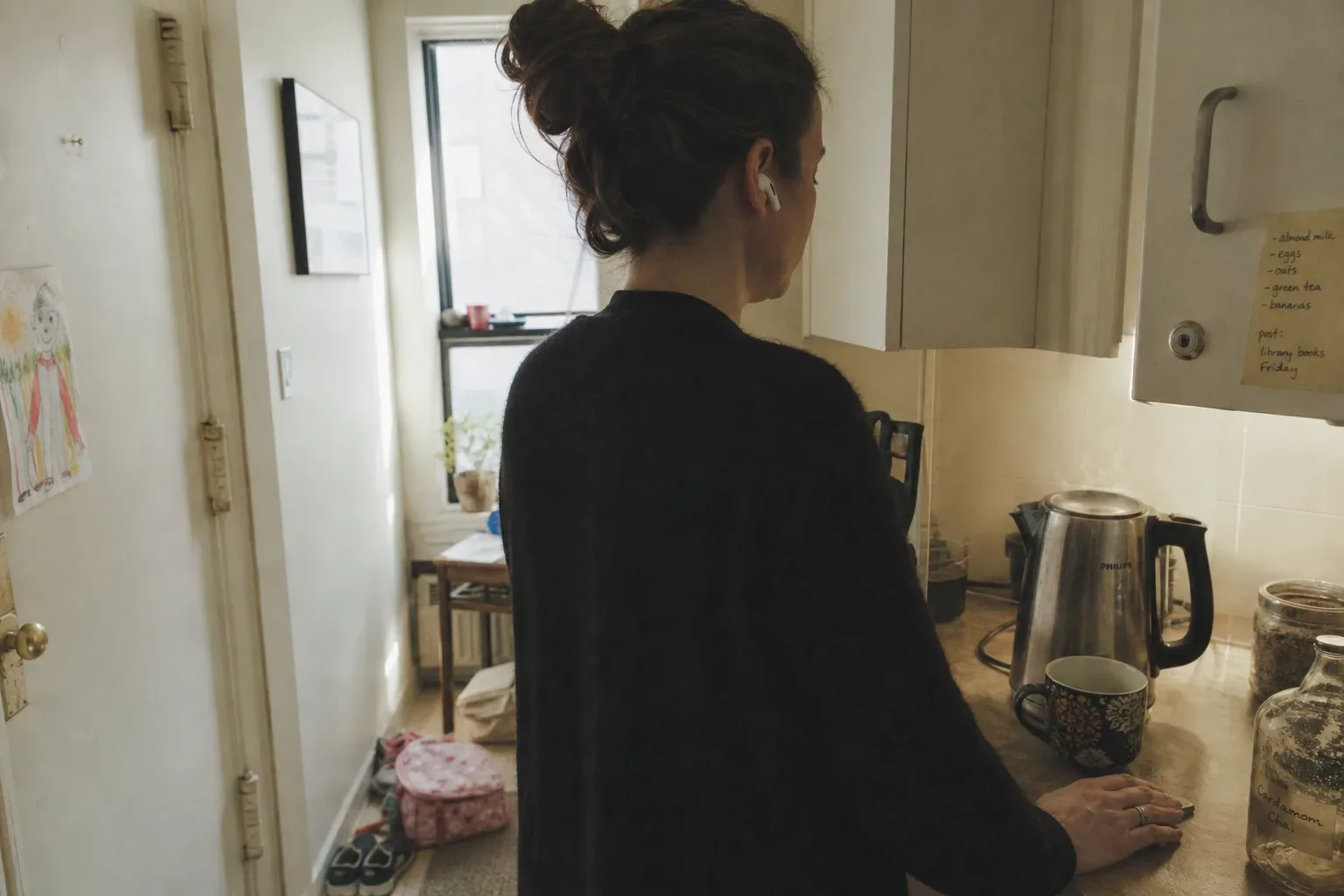
Friday. The kettle clicked off at 6:18, and my sister sent me a voice note from her kitchen with a toddler crying somewhere near the fridge. A morning routine for moms has to fit inside real noise, so I keep it to five minutes: listen to Dream-Self audio, name one sentence, return.
What can a morning routine for moms actually be when the house is already awake?
A morning routine for moms can be a small listening practice attached to a task that already happens, not a new performance added to a full morning.
I am writing this from São Paulo with coffee cooling beside my laptop, but the morning I have in mind belongs to my sister. She has two children under 7, a job that begins before her inbox does, and a dog that believes 6 a.m. is a moral contract. When she asked me what I would keep, after years of testing wellness apps, I told her: keep the thing that survives interruption.
The Bureau of Labor Statistics American Time Use Survey reported in 2023 that women in households with children under 6 spent more daily time on childcare than men, often by more than an hour depending on employment status. Pew Research Center has also tracked the same unevenness for years. I do not cite that to make a speech. I cite it because advice that ignores the arithmetic of care becomes another chore.
So I do not mean a candle, a notebook, dry brushing, lemon water, and thirty silent minutes. I mean one cue and one audio. I mean the bathroom door closed for 5 minutes. I mean the parked car after drop-off. I mean the chair beside the crib before the baby notices you have become a separate person.
A useful morning practice does not ask a mother to become unavailable to her life. It helps her meet the life she already has with one less open loop.
I keep coming back to the AYA Method because the core behavior is plain: The AYA Method is a daily audio manifestation practice. Each day you listen to a short personalized recording, your Dream-Self Moment, narrated from the version of you who has already manifested the life you intend. Listening is the practice. Repetition is the work. The audio is the method.
For mothers, that matters. A screen asks for the eyes. A checklist asks for management. Audio can live beside the kettle.
Why does five minutes work better than a perfect hour?
Five minutes works because it lowers the starting cost until repetition becomes possible.
Phillippa Lally and colleagues published a habit formation study in the European Journal of Social Psychology in 2009 that found new habits took a median of 66 days to become automatic, with wide variation across people and behaviors. The useful part for my kitchen notebook is not the exact number. It is the finding that repetition in a stable context mattered more than intensity.
I have tested apps that asked for twenty minutes on day one, then sent me six notifications by day three. They were not practices. They were small landlords. Mothers do not need another product trying to occupy the morning. They need one behavior that can be repeated while someone asks where the blue socks went.
Here is the five-minute version I wrote on a receipt and sent to my sister:
- Minute 0 to 1: stand or sit where you already are, and take three slow breaths.
- Minute 1 to 4: listen to your Dream-Self audio without checking messages.
- Minute 4 to 5: write or say one sentence about the person you are practicing being today.
The sentence can be painfully ordinary. I keep the morning steady before I keep the whole life steady. I answer from the future I am building, not from the panic I woke with. I do not need my whole mood to change before I choose my next action.
Dr. Andrew Huberman has often explained that the nervous system learns through repeated states paired with behavior; I take that cautiously, not as a magic formula, but as a reason to make the cue consistent. If the kettle is the cue, the kettle becomes a small bell. If the car seat buckle is the cue, the buckle becomes the same.
Five minutes is not less serious than an hour. It is more honest about the morning.
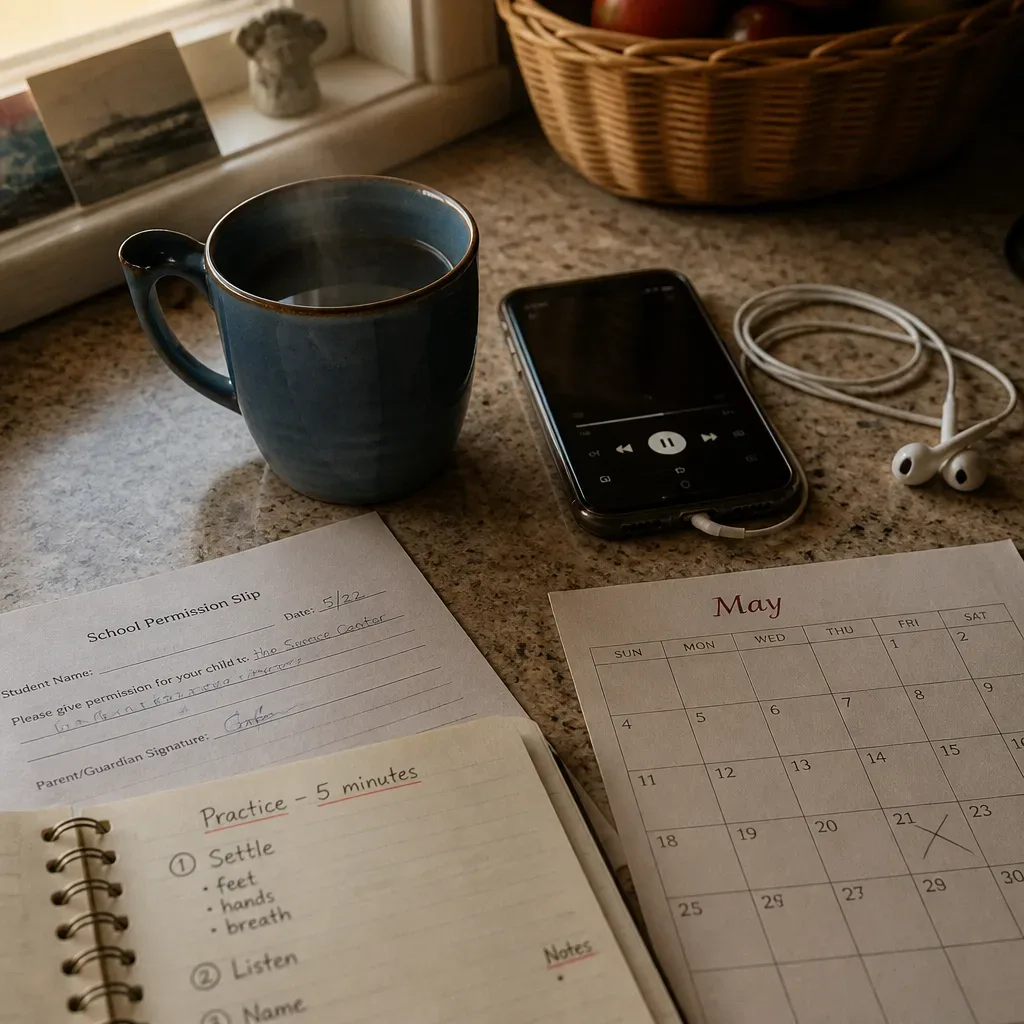
How do I set up the 5-minute Dream-Self audio practice?
I set it up by choosing one cue, removing one friction point, and deciding what will count as done.
The cue comes first. BJ Fogg of Stanford Behavior Design Lab writes about making habits tiny enough to attach to existing prompts. I used to roll my eyes at this because productivity people have turned prompts into a personality. Still, the principle holds. A behavior with no cue has to be remembered. A behavior attached to the kettle gets carried by steam.
For a busy mother, I would choose from four cues, and I would not romanticize any of them:
| Morning cue | Why it works | What to avoid |
|---|---|---|
| Kettle or coffee machine | It already has a 3 to 5 minute wait | Opening messages while waiting |
| Bathroom door | It gives a thin wall of privacy | Turning it into mirror criticism |
| School-run car | The seat creates a pause | Scrolling after the audio |
| Baby feeding chair | The body is already still | Adding extra tasks afterward |
A 2022 report from Data.ai estimated that people were spending around 4 to 5 hours a day on mobile devices in many major markets. I do not think the phone is evil. I write on one, shop on one, and once tracked a delayed bus for 47 minutes on one. But the first unlock of the morning has a way of becoming a corridor with no windows.
So I would download the audio, put it on the first screen, or use whatever setup makes it one tap. If you practice manifestation in a way that needs ten decisions before breakfast, the decisions become the practice. This is where mothers get blamed for not being consistent when the system was too ornate to begin with.
The setup I keep is almost boring:
- Put headphones in the same bowl as keys.
- Keep the audio ready before sleep.
- Choose one cue for weekdays.
- Decide that listening counts, even if the house interrupts.
- Do not stack journaling, stretching, and planning on top of it.
I like the daily affirmation as a complement when it arrives naturally. I do not let it become a second pillar. One sentence is enough for the morning.
What should the Dream-Self audio say for a mom who feels pulled apart?
The audio should speak from a future self who is calm, specific, and believable enough that the body does not reject her.
This is where I become suspicious of grand language. I have watched the same idea relaunch under forty names, each one promising a bigger self by Monday. Mothers are already asked to be infinite. I would rather hear a recording that says: I put the lunchbox down before I answer the message. I make one clean decision at a time. I can be kind without disappearing.
Neville Goddard wrote often about assuming the feeling of the wish fulfilled. People quote him in many directions, some careful and some careless. The part I can use at 6:18 is simple: the mind rehearses identity. Cognitive rehearsal has been studied in sports psychology for decades; a 1994 meta-analysis by Driskell, Copper, and Moran found mental practice had a positive effect on performance, especially when paired with physical practice.
For a mother, the physical practice may be packing a bag without resentment taking the wheel. It may be pausing before answering a child in the sharp voice that arrives when sleep was broken at 3:40. It may be asking for help in one clear sentence instead of hoping someone notices.
The Dream-Self voice should not sound like a guru standing on a stage. It should sound like you after enough mornings of keeping your word to yourself.
I would include details that touch the day:
- The kitchen is loud, and I stay with myself.
- I choose the next right action, not the whole week.
- My body is allowed to move slowly for 30 seconds.
- I receive help without auditing whether I deserved it.
- I finish one thing before carrying ten.
If affirmations have felt too thin before, it may be because they floated above the actual morning. Audio helps because tone carries what text cannot. A voice can make a sentence feel lived-in.
Where can this fit if mornings are unpredictable?
It fits wherever the morning reliably pauses, even if the pause is not peaceful.
I keep a private list of unglamorous openings because they are the only ones that matter. The first minute after the baby is placed safely in the crib. The dishwasher hum. The elevator down to the garage. The bus stop. The two minutes before a video call when the camera is still off. None of these look like the photos used to sell calm. They are better than photos because they exist.
A 2019 Pew Research Center report found that roughly 56% of U.S. adults said they sometimes feel they have too little time. Among parents with children at home, time pressure tends to show up even more sharply in Pew family surveys. I think mothers know this without a chart, but the chart gives permission to stop pretending the problem is personal laziness.
Here are the places I would test for one week:
- Before the first app opens. The phone can play the audio before it becomes a mailbox.
- After the first caregiving task. Feed, change, pack, then listen.
- During a necessary wait. Coffee, bottle warmer, elevator, school gate.
- In the parked car. Engine off, 5 minutes, no apology.
- In the bathroom. Not glamorous. Often available.

I would choose one and date it. Monday, bathroom. Tuesday, car. Wednesday, kettle. By Friday, the pattern usually tells the truth. The best cue is not the prettiest cue. It is the one that keeps appearing.
This is also where astrology and manifestation can be kept in proportion. If someone likes marking the moon or noting a transit, fine. I have no quarrel with symbols when they help someone pay attention. But the morning still asks for behavior. Listen first. Interpret later.
A routine fails when it requires a different life. It begins to hold when it respects the life already in the room.
How do I keep doing it after the first week?
I keep doing it by making the measure so small that a difficult day can still count.
The first week is often carried by novelty. By the second week, the ordinary returns. Someone gets sick. A meeting moves earlier. A child refuses shoes with a legal seriousness. This is the point where many routines break because the person thinks the broken morning means the practice is broken too.
In behavior research, consistency is helped by what psychologists call implementation intentions, a term associated with Peter Gollwitzer. The format is simple: if situation X happens, I will do behavior Y. Studies over several decades have found these if-then plans can improve follow-through across goals, from health behaviors to study habits. I write them like a tired person, because tired people are who they are for.
My if-then list for a mother would look like this:
- If the children wake before me, I listen after the first bathroom break.
- If I miss the kitchen cue, I listen in the car.
- If I cannot use headphones, I listen at the lowest useful volume.
- If I am interrupted, I count the minutes I heard.
- If the whole morning collapses, I listen before lunch and still mark the day kept.
The phrase mark the day kept matters to me. I do not say perfect. I say kept. A kept practice changes the self-image quietly. After 14 days, the question becomes less, Do I feel inspired? and more, Am I the person who returns?
Joe Dispenza often talks about rehearsing a future state before the day begins. I am careful with any teacher whose language gets treated as a cure-all, but I understand the appeal. The morning mind is suggestible because it has not yet been fully colonized by other people’s needs. For mothers, five minutes before the full day can be a boundary drawn in pencil. Pencil still counts.
I also like one visible mark. Not a tracker with guilt in it. Just a dot on a page. Seven dots in a row can be strangely persuasive.
What should I do when guilt shows up?
I treat guilt as a signal to simplify, not as evidence that the practice is selfish.
This is the paragraph I wrote twice because I kept making it too tidy. Mothers are praised for needing nothing, then sold elaborate systems for becoming better at everything. No wonder five minutes can feel like theft. But five minutes of listening is not abandonment. It is a small act of returning to the person who is doing all the caring.
The American Psychological Association has reported for years that women often report higher stress levels than men in its Stress in America surveys, with caregiving and household labor named again and again in family research. I do not need every statistic to land perfectly across every country to see the pattern. The mother is often the morning’s operating system.
When guilt appears, I use questions that do not bully me:
| Guilty thought | Smaller reply |
|---|---|
| I should be doing something useful | This is useful if it changes my next action |
| I do not have time | I am using a wait that already exists |
| Everyone needs me | They need me less frayed than I become when I vanish |
| I missed yesterday | Repetition includes returning |
There is also a practical boundary here. If listening to audio becomes another secret standard you punish yourself with, make it shorter for a week. Three minutes. One minute. The nervous system learns safety partly through completion. A tiny completed promise is better than a large abandoned one.
I have written about the AYA Method before because it passes my app test when stripped down. Without the visual identity, without the marketing, what remains is a few minutes of personalized listening. That is rare enough to keep.
A mother does not need a morning that looks sacred. She needs one moment that is not negotiated away.
What does a real 5-minute morning look like tomorrow?
Tomorrow looks like one cue, one audio, one sentence, and then the next ordinary task.
Here is the version I would tape inside a cabinet if I were designing it for my sister’s kitchen. It is not elegant. Good. Elegant things often fail at 6:23.
The 5-minute morning routine for moms
- Put the kettle on, or choose your existing cue.
- Place one hand on the counter, the sink, the steering wheel, or the chair.
- Listen to the Dream-Self audio for 3 minutes.
- Say one sentence: Today I return before I react.
- Do the next visible thing, not the whole invisible list.
If you want a wider frame for the practice, I would read the Manifestation pillar once, not every morning. If you are working specifically with spoken sentences, keep the Affirmations pillar nearby for later. Morning is not the time to research the whole subject. Morning is the time to press play.
There is a line from the Journal of Behavioral Medicine literature that I think about often, though not as a direct quote: adherence usually depends less on intention than on fitting the behavior into real life. Clinical studies on meditation apps and brief mindfulness practices often show benefits with sessions under 10 minutes, though results vary and dropout can be high. That sounds like a warning and a mercy at once.
The practice is not proved by how beautiful it feels. It is proved by whether it is still there on a Thursday with dishes in the sink.
Before I forget, I would keep the Manifestation Board for a different time of day if you use one. Evening, maybe. Sunday afternoon. The board can hold images. The morning audio holds the first behavior.
Friday, 7:12 now. The kettle has gone quiet.