morning rituals
ADHD Morning Routine With a 5-Minute Dream-Self Audio
An ADHD morning routine can stay short, sensory, and repeatable. Use a 5-minute Dream-Self audio to cue identity before tasks begin.
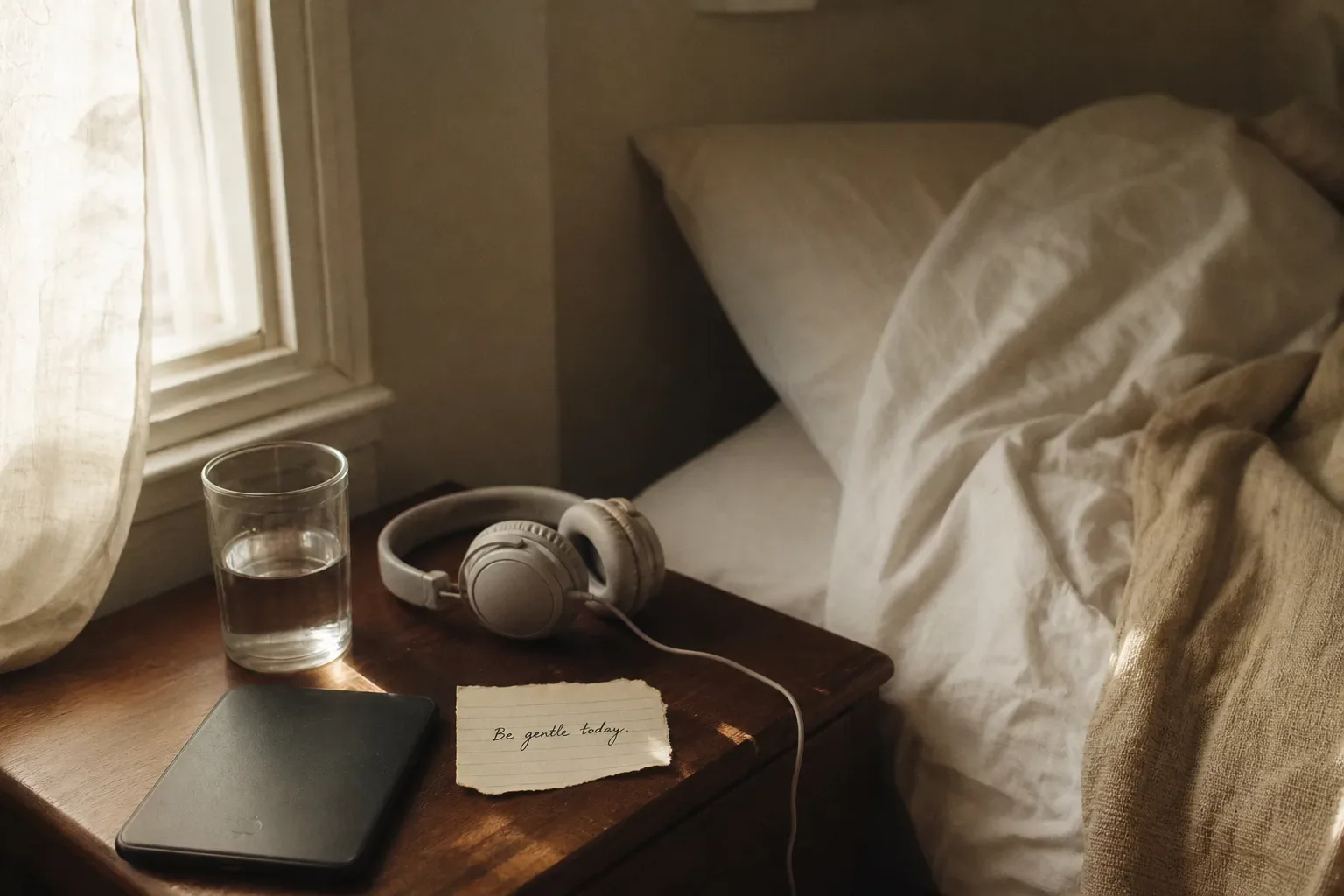
Your phone is on the floor, just far enough away. An ADHD morning routine works best when it gives you one cue, one sound, and one next action before the day can scatter. A 5-minute Dream-Self audio can become that first cue: short, repeatable, and already waiting.
What makes an ADHD morning routine different?
An ADHD morning routine has to protect attention before it asks for performance.
ADHD is not a character flaw hiding inside a messy morning. It is a neurodevelopmental pattern that often affects inhibition, working memory, time sense, and task initiation. Adult ADHD is commonly estimated around 2.5% globally, according to the World Federation of ADHD consensus statement published in 2021. In U.S. survey data, Kessler and colleagues estimated adult ADHD at about 4.4% in 2006. The numbers vary by country and method, but the lived morning is often familiar: too many steps, too little grip.
The first hour asks a lot. You have to wake, orient, remember plans, decide what matters, move your body, manage emotion, and not get pulled into the phone. Russell Barkley’s work on ADHD has long framed the condition around self-regulation across time. That matters here. A morning routine is not a moral test. It is a time bridge.
A strong ADHD morning routine is usually:
- short enough to repeat on a low-sleep day
- visible enough that you do not have to remember it
- sensory enough to pull you into the room
- forgiving enough to restart after a missed morning
- connected to one specific next action
The quiet rule is this: a routine that needs perfect executive function is not an ADHD routine.
If your current morning plan has 12 steps, it may be beautifully imagined and still too heavy. In a 2009 habit study, Phillippa Lally and colleagues found that automaticity took a median of 66 days, with a wide range from 18 to 254 days. That range is important. A new routine needs repetition, but it also needs mercy.
This is where audio can help. Not because sound fixes ADHD. It does not. But a repeated sound can reduce the number of decisions between waking and beginning. The brain hears the same entry point. The body starts to know what comes next.
Why start with a 5-minute Dream-Self audio?
Start with a 5-minute Dream-Self audio because listening asks less of the morning brain than planning, writing, or forcing motivation.
The AYA Method is a daily audio manifestation practice. Each day you listen to a short personalized recording — your Dream-Self Moment — narrated from the version of you who has already manifested the life you intend. Listening is the practice. Repetition is the work. The audio is the method.
For ADHD, that last sentence matters. The audio is the method. You do not have to build a perfect vision at 6:42 a.m. You do not have to journal three pages before your nervous system knows where it is. You press play. You listen. The future self is spoken to you in a voice you can return to.
In cognitive neuroscience, repeated cues can shape expectation and behavior. The mechanism is not magic. It is association, salience, memory, and self-referential processing. Research on implementation intentions by Peter Gollwitzer, first widely cited in 1999, found that “if-then” plans can improve goal follow-through because they bind a cue to an action. The morning version is simple: if I wake, then I play the audio.
A 5-minute length is not random. It is long enough to shift state, but short enough not to become a second bed. Many ADHD support strategies recommend reducing friction to the smallest viable action. NICE guideline NG87, updated in the UK, includes environmental changes and organizational strategies as part of ADHD support. A short audio is an environmental cue you can carry.
There is also the identity piece. Self-affirmation research, including work by Claude Steele and later health-behavior studies in the Journal of Personality and Social Psychology, suggests that values-based self-reflection can reduce defensiveness and support behavior change in some contexts. A Dream-Self audio is not the same as a lab affirmation task. Still, it gives your brain a repeated sentence of identity before the first demand.
The first sound of the day teaches the day what you are returning to.

How do you set it up the night before?
Set it up the night before by removing every morning decision you can see coming.
ADHD mornings often fail before morning begins. The phone is across the room but the headphones are missing. The water glass is in the kitchen. The first task lives inside an app with 40 other tasks. By the time you find the cue, the cue has lost you.
Use a two-minute night setup. Not a full reset. Not a new personality. Two minutes.
- Put your phone on charge outside the bed, but close enough to hear.
- Place headphones beside it, already untangled.
- Put water in sight.
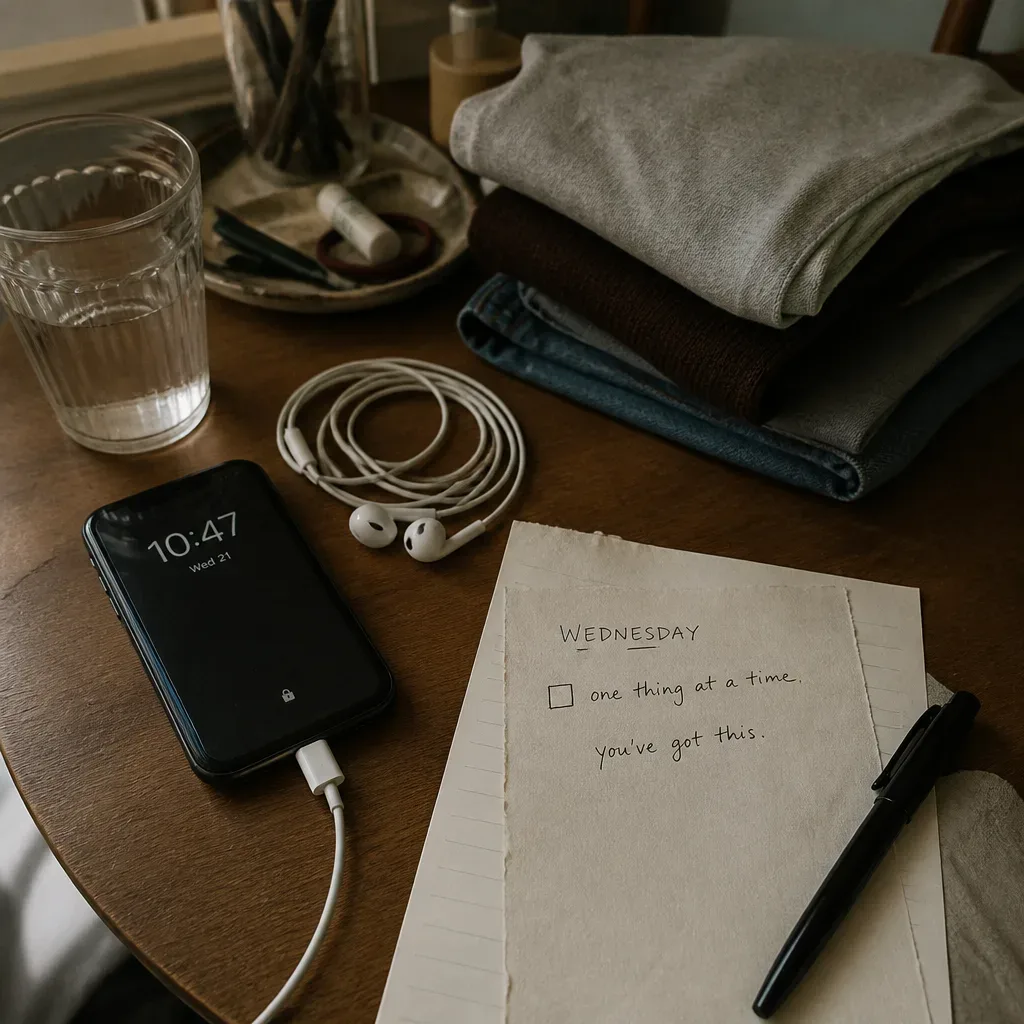
- Write one next action on paper.
- Choose clothes only if clothing blocks you often.
- Set the Dream-Self audio so it is easy to start.
A 2016 review by Wendy Wood and David Rünger described habits as context-response associations. In plain language: the same setting helps the same action return. For ADHD, context needs to be louder than intention. Put the cue where your hand will land.
Here is a simple setup table:
| Morning friction | Night-before answer | Why it helps |
|---|---|---|
| Phone scrolling | Audio app open or easy to find | Reduces the first decision |
| Lost headphones | Headphones beside phone | Removes a search task |
| No body cue | Water in reach | Adds a physical anchor |
| Task overwhelm | One paper next step | Protects working memory |
| Time blindness | 5-minute audio length | Creates a known container |
If you take ADHD medication, keep medical advice first. Some people keep prescribed medication and water in a safe, visible place; others cannot because of children, pets, storage rules, or prescription guidance. The point is not to copy someone else’s setup. The point is to lower the number of doors between waking and beginning.
You can also use a complement after the audio. A single sentence from the Affirmations pillar can be written on the paper if it helps. Keep it secondary. The listening comes first.
A good cue is not inspiring. It is findable.
What should the 7-minute morning actually look like?
The routine should look like one audio, one movement cue, one body anchor, and one written next step.
Seven minutes is enough. Five minutes for the Dream-Self audio. Two minutes for the smallest return to the day. You can add more later, but the base routine should survive a bad night, a late alarm, and a low-dopamine morning.
Try this sequence:
- Minute 0: press play before checking anything. Do not open messages first. Pew Research Center reported in 2024 that a large majority of U.S. adults use smartphones, and many people check them early. For ADHD, the phone can become 19 rooms at once. Let the audio be the first room.
- Minutes 1 to 4: listen without improving it. You can lie still. You can sit. You can stare at the wall. The task is listening.
- Minute 5: stand before the audio ends. Pair the ending with movement. Feet on floor. Body upright.
- Minute 6: drink water or wash your face. Choose one physical anchor. Same one each day if possible.
- Minute 7: read the paper next step. Do not review the whole life. Read one action.
This routine is small by design. ADHD support often works best when it externalizes memory and reduces initiation load. Dr. Andrew Huberman has spoken often about light, movement, and dopamine in morning behavior, though not as a substitute for ADHD care. Morning light can support circadian timing; a 2019 review in Sleep Medicine Clinics notes light as a key circadian signal. If sunlight is available after the audio, open the curtain.
For a broader frame on desire, attention, and repeated inner rehearsal, see the Manifestation pillar. If you like timing rituals, you may also enjoy Astrology and manifestation, but keep this routine grounded. The morning does not need a perfect date. It needs a repeatable door.
You are not behind because the routine is small. Small is how the brain agrees to begin.
How do you make it ADHD-friendly on hard mornings?
Make it ADHD-friendly by building a lower version before you need it.
Hard mornings are not exceptions. They are part of the design brief. Sleep loss, emotional residue, hormonal shifts, pain, stress, caregiving, and late-night scrolling can all change the morning brain. The CDC has reported that insufficient sleep is common among adults, and sleep problems are also frequently reported in ADHD research. A routine that only works after perfect sleep is a fragile routine.
Create three versions:
| Version | When to use it | What counts as done |
|---|---|---|
| Full | Normal morning | Audio, stand, water, next step |
| Low | Late or foggy morning | Audio while sitting, water |
| Floor | Very hard morning | Press play once, no extra demand |
The floor version is not failure. It is continuity. In behavioral design, keeping the cue alive matters. BJ Fogg’s tiny habits model, tested in applied behavior settings, uses very small actions after existing anchors. The ADHD version is even softer: after waking, press play. That is the floor.
You can also reduce shame by deciding what does not belong in the first seven minutes. No budgeting. No inbox. No weighing yourself. No argument with yesterday. No open-ended planning. If a thought arrives, write one word on the paper and return to sound.
Some mornings, the Dream-Self audio may bring emotion. That can be useful, but it can also be too much. If it feels activating in an uncomfortable way, lower the volume, sit upright, or choose a calmer recording. If you are working with a clinician for ADHD, anxiety, depression, trauma, or bipolar disorder, let clinical support lead.
The morning manifestation routine can be longer when life allows. This one is for the mornings that need less.
The lower version is not a loophole. It is how the practice stays in the room.
What should your Dream-Self audio say for ADHD?
Your Dream-Self audio should speak in concrete, believable language that points to identity and the next action.
For ADHD, vague language can drift. “I am successful” may be too wide to hold at 7:03 a.m. A better line is closer to the body: “I start with one visible step.” “I return without punishing myself.” “I let the first five minutes count.” The sentence should feel true enough that your nervous system does not reject it.
Neville Goddard wrote often about assuming the feeling of the wish fulfilled. Joe Dispenza teaches future-self rehearsal in a different vocabulary, often through meditation and emotion. You do not have to accept every claim from either teacher to use one practical thread: the self you rehearse becomes easier to access. In neuroscience terms, self-referential thought engages networks including medial prefrontal regions, as shown across many fMRI studies of self-processing.
Try building your audio around these parts:
- A present-tense identity: “I am someone who returns.”
- A sensory cue: “My feet meet the floor.”
- A time container: “Five minutes is enough to begin.”
- A repair line: “If I drift, I come back softly.”
- One first action: “I drink water and read the next step.”
Avoid making the audio a lecture. ADHD brains often hear correction everywhere. The Dream-Self voice should not become another authority telling you that you are late. It should sound like the version of you who knows how to begin without making a courtroom out of the bed.
A daily affirmation can come after this if you want one sentence to carry. The app also includes a Manifestation Board, which can help you see the life you are practicing toward. But the core remains listening. Audio first. Complements after.
If you want the science-forward sister practice, compare the language with values-based exercises studied in health psychology. In small studies, self-affirmation tasks have been linked with changes in health messaging receptivity, but effects vary. For your morning, the useful test is simpler: did the sentence help you start without adding shame?
How do you know if the routine is working?
You know it is working when the first action gets easier to touch, even if the whole morning is still imperfect.
Do not measure this routine by mood alone. ADHD mood can shift quickly, and mornings are noisy. Measure contact. Did you press play? Did you stand by the end or soon after? Did you touch the written next step? Did shame drop by even 5%? Those are real signals.
Track four numbers for 14 days:
- Audio started: yes or no.
- Time from waking to pressing play: rough minutes.
- First action touched: yes or no.
- Morning self-talk: kinder, same, or harsher.
Fourteen days is short, but it is long enough to see friction. It is also less intimidating than 66 days, the median habit-formation number from Lally’s 2009 study. If you miss a day, do not restart the count unless counting helps you. For many ADHD people, streaks can motivate at first and punish later.
Look for patterns. If you always scroll before audio, move the app icon, use Focus mode, or put the phone farther away. If you listen but never stand, pair the final line of the audio with a body command. If the written next step feels too large, cut it in half. “Open laptop” is a valid first step. “Finish project” is not.
You can also review your wider practice through the AYA Method page if you want the method named cleanly. For a broader practice vocabulary, the Manifestation pillar can help you separate intention from pressure.
The outcome is not a cinematic morning. It is a repeatable return. A working ADHD morning routine does not make you a different person by breakfast. It helps you meet the day without leaving yourself behind.
The morning can be small and still be yours.