affirmations
Mirror Affirmations Work Better After Dream-Self Audio
A quiet guide to using mirror affirmations after Dream-Self audio, so your words feel less forced and your nervous system has somewhere to land.

Wednesday, 7:10. I use mirror affirmations after Dream-Self audio because the audio gives my mind a scene before my mouth gives it a sentence. The order matters: listen first, speak second, leave quickly. Seven minutes is enough when the words are believable and repeated daily.
Why put Dream-Self audio before mirror affirmations?
Dream-Self audio should come first because it lowers the pressure on the mirror to create belief by itself.
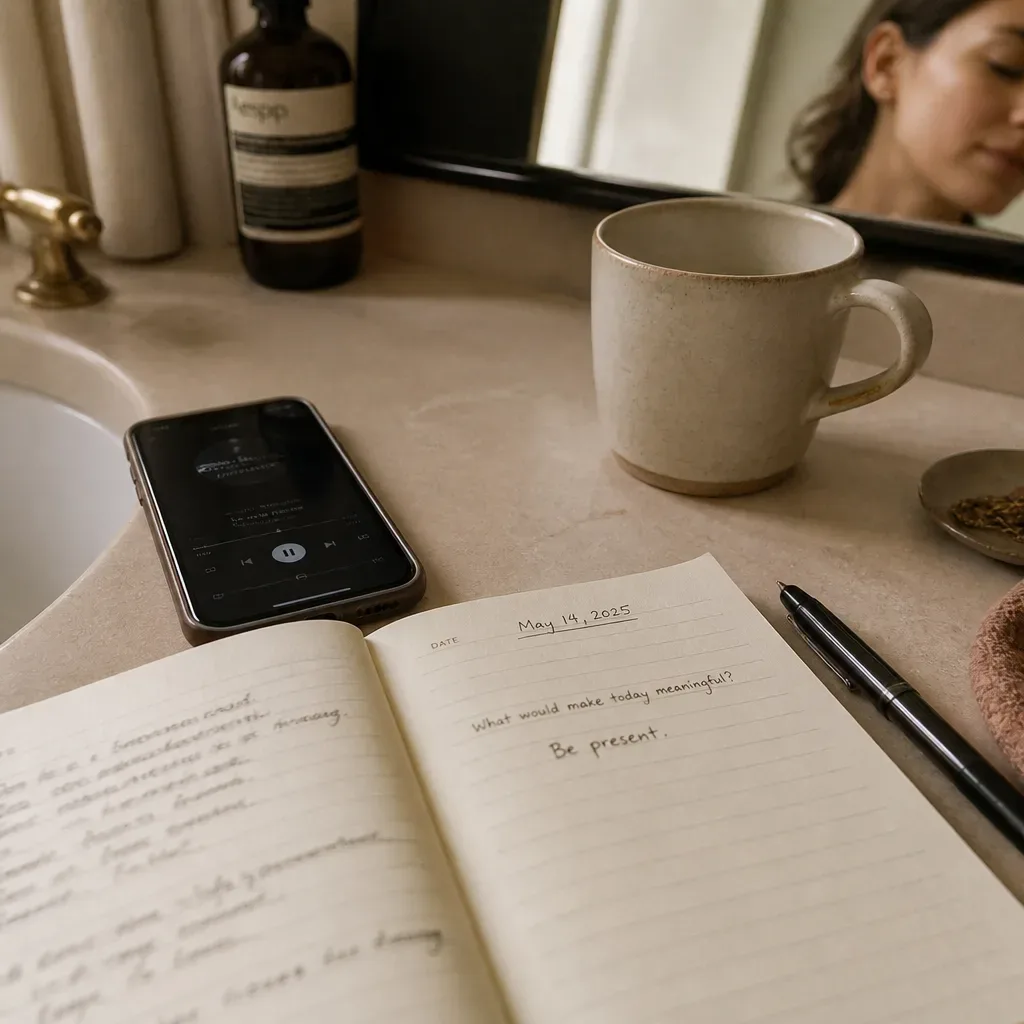
I learned this beside the bathroom sink, not in a clean notebook. The kettle was clicking off in the kitchen, my coffee was still too hot, and I had my phone balanced on the folded towel. I listened to my Dream-Self Moment before brushing my teeth. That is the order I do them in. Then I looked up and said one sentence to the mirror. It did not feel cinematic. It felt usable.
The distinction matters. In the AYA Method, the AYA Method is a daily audio manifestation practice. Each day you listen to a short personalized recording, your Dream-Self Moment, narrated from the version of you who has already manifested the life you intend. Listening is the practice. Repetition is the work. The audio is the method. The mirror affirmation is not the main event in this setup. It is the small sentence that follows the listening.
Self-affirmation research gives me a useful frame here. Claude Steele first described self-affirmation theory in 1988, and Cohen and Sherman reviewed the field in 2014 in the Annual Review of Psychology, noting that affirming valued identity can reduce defensiveness under threat. I read that as practical, not mystical. A nervous system that feels less cornered can hear a sentence differently.
A mirror is not a magic object; it is a place where avoidance becomes visible. If I go straight to the mirror with a sentence my body does not believe, I watch myself reject it in real time. If I listen first, I borrow a steadier internal voice before I add my own.
I keep the order like this:
- One minute standing still, no fixing my face.
- Three to four minutes listening to the Dream-Self audio.
- One minute of mirror affirmations.
- One sentence dated in my notebook.
That is the whole thing. Seven minutes, if I do not negotiate with the towel or the lighting.
How do I set up the practice without making it precious?
I set it up by removing decisions, choosing the same place, and letting the audio carry the first part.
I do it in the morning because that is when I am least likely to decorate the practice with opinions. The bathroom mirror works. The hallway mirror works. The dark phone screen on the bus has worked twice, although I would not recommend it as a lifestyle. The location matters less than the repeat. Lally and colleagues found in a 2009 European Journal of Social Psychology study that habit automaticity took 66 days on average, with a wide range from 18 to 254 days. That number made me kinder to myself. A practice is not weak because it still needs a cue on day 12.
Here is the small setup I use this week:
| Part | My rule | Why I keep it |
|---|---|---|
| Place | Bathroom mirror | Already in my morning path |
| Audio | Before any spoken line | The listening leads |
| Sentence | One line only | Fewer words, less performance |
| Time | Seven minutes total | Short enough to repeat |
| Record | Date plus one feeling | Keeps it honest |
I do not light a candle. I do not change clothes. I do not wait until the room feels right. Years of testing wellness apps taught me that the more a practice needs staging, the less likely it is to survive a Tuesday. Behavior that requires a perfect mood is not a practice; it is a fragile appointment.
If you already keep a broader manifestation practice, this order can slide into it without adding another pillar. Audio first. Mirror second. A written daily affirmation can sit beside it if that is already useful, but I would not make the page compete with the listening. The same goes for a board or image. Good complements stay in their lane.
The setup I trust is almost boring. That is why I trust it. Calm does not need a dramatic entrance. It needs fewer chances to be talked out of the room.
What should I say in the mirror after listening?
I say one believable sentence that matches the emotional direction of the audio, not a giant claim my body argues with.
This is where mirror affirmations can go wrong for me. If the audio has just placed me inside a calmer future self, and I then say something inflated, I break the spell of ordinary belief. I hear the sentence as advertising. Joanne Wood, W. Q. Elaine Perunovic, and John Lee published a 2009 paper in Psychological Science showing that repeating highly positive self-statements such as I am a lovable person made some people with low self-esteem feel worse. I keep that study close. It saves me from bullying myself with beautiful sentences.
A good mirror line is close enough to touch. It should make the shoulders drop by one centimeter, not demand a new personality by breakfast. Neville Goddard wrote often about assuming the feeling of the wish fulfilled, but in my bathroom I translate that into a humbler question: what sentence can I inhabit for the next 12 hours?
These are lines I would actually use:
- I can stay with myself while this changes.
- I am learning to receive the life I named.
- I do not need to rush the evidence.
- I can act today like the person I heard in the audio.
- I keep promises in small ways.
These are lines I would avoid on a hard morning:
- Everything is perfect now.
- I never doubt myself.
- I get everything instantly.
- Nothing can affect me.
The difference is not modesty. It is nervous system honesty. A sentence that feels 5 percent more truthful is more useful than a sentence that feels 500 percent more impressive.
I sometimes borrow from the affirmations guide when I am stuck, especially the idea that an affirmation should direct attention rather than deny reality. If my rent is late, I do not tell the mirror that money has never been a concern. I say, I can make the next clear call. That line has gotten me through more mornings than any grander one.
How long should the whole sequence take?
The whole sequence should take about seven minutes, with most of the time spent listening rather than talking.
I know this because I timed it for 14 mornings, partly because I am that kind of person and partly because I do not trust practices that expand without permission. My shortest version took 4 minutes and 40 seconds. My longest took 8 minutes and 15 seconds, because I could not find my earbuds and stood there judging a drawer. The sweet spot was seven minutes.
The science of repetition supports keeping it short. In the 2009 Lally habit study, missing one day did not ruin habit formation, but repetition in a stable context mattered. That is good news. It means the practice does not have to become a moral trial. It only has to become easy to return to. Andrew Huberman often describes the role of repeated cues in shaping attention and state, and whether or not one follows his protocols, the basic behavioral point is simple: the cue should be clear.
Here is my seven-minute version:
- Minute 0 to 1: Stand near the mirror and breathe normally. No performance.
- Minute 1 to 5: Listen to the Dream-Self Moment.
- Minute 5 to 6: Look softly at the mirror and say one sentence three times.
- Minute 6 to 7: Write the date and one word about how it felt.
I do not recommend making the mirror section long at first. There is a strange temptation to prove sincerity by repeating the line 30 times. For me, that turns the practice into a contest. Three repetitions are enough to mark the day. The listening has already done the deeper orientation.
If you like timing, use a timer. If timers make you feel managed, use a song length or the kettle. My kettle takes 3 minutes and 20 seconds to boil, which is not a peer-reviewed metric, but it has been more reliable than my mood.
What if mirror affirmations feel awkward or false?
If mirror affirmations feel awkward, I make the sentence smaller and let the awkwardness be part of the data.
I used to think awkward meant wrong. Now I think awkward often means unfamiliar. There is a difference. Saying a kind sentence to your own face can feel strange because many of us have practiced the opposite for years. A 2022 American Psychological Association Stress in America report found that 76 percent of adults said stress had affected their health in the prior month. I do not need to pretend that one morning sentence floats above that. Some days the body arrives carrying yesterday.
When the line feels false, I use a bridge. A bridge sentence is not the destination. It is the plank that holds my weight today.
Examples:
- Instead of I fully trust myself, I say, I am practicing one trustworthy choice.
- Instead of I am completely ready, I say, I can take the next step before I feel ready.
- Instead of I love everything about myself, I say, I can look at myself without leaving.
- Instead of my life is already changed, I say, I am becoming available to change.
The last one is near the edge for me. Some mornings I use it. Some mornings I do not. The rule is simple: if my chest tightens and my mind starts cross-examining the sentence, I revise it down. Smaller is not weaker. Smaller is often where truth begins.
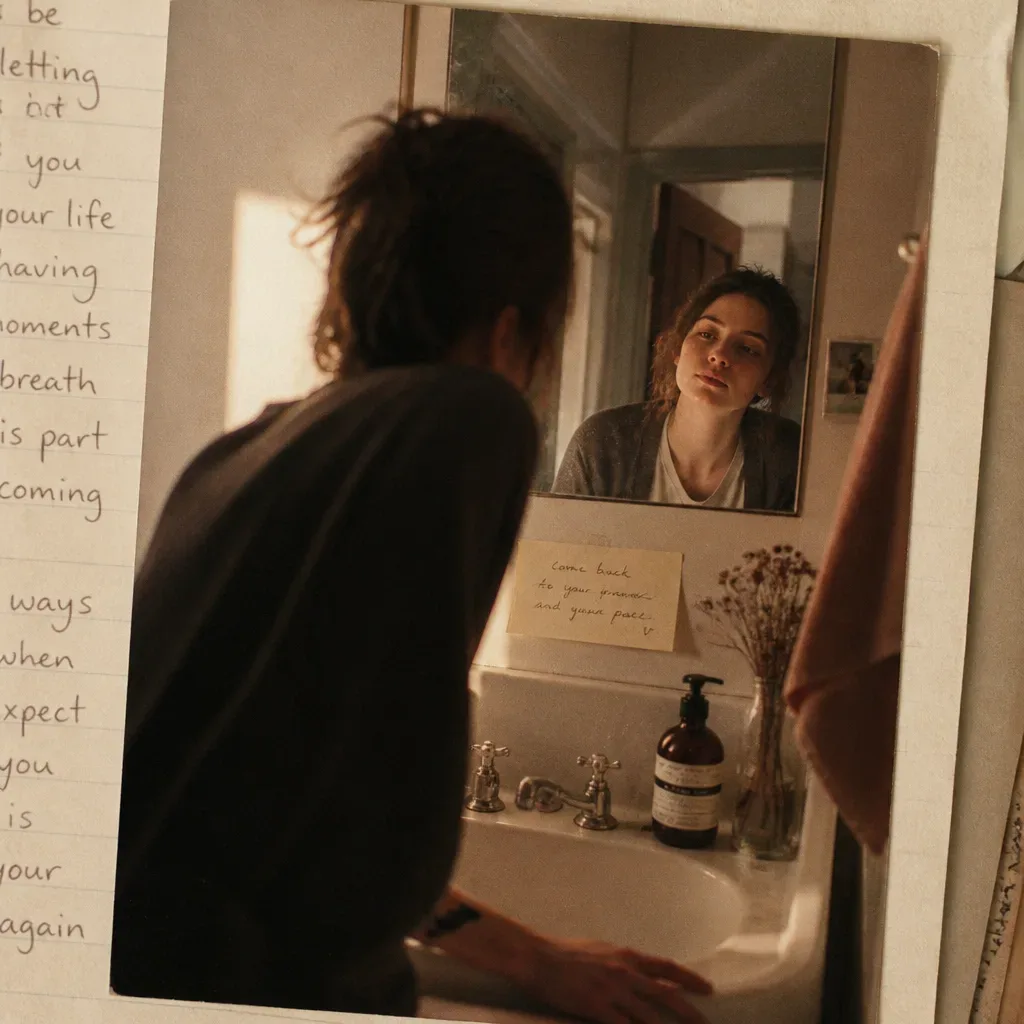
There is also the mirror itself. Eye contact can be too much. In clinical settings, mirror exposure has been studied for body image distress, and protocols are often structured carefully rather than thrown at people casually. I take that as permission to look softly. I can look at my forehead, my cheek, or the bridge of my nose. The point is presence, not staring.
The sentence is allowed to be quiet. The face in the mirror does not need to be convinced in one sitting.
Can this fit with astrology, journaling, or a manifestation board?
Yes, it can fit, but I keep those pieces as context or complements rather than making them co-equal with the audio.
On Sundays, I sometimes read the week ahead and glance at astrology and manifestation notes the way my grandmother checked the weather before washing sheets. Not as commandment. As texture. If the moon language helps me notice timing, fine. If it makes me outsource responsibility, I close the tab. The practice still happens the same way on Monday: audio first, mirror sentence second.
Journaling helps me more when it is small. I write one dated line after the mirror work. This morning it said: September 16, I can act today like the person I heard, felt resistant but not false. That took 18 seconds. James Pennebaker’s expressive writing research often used 15 to 20 minute writing sessions, and those have their place, but this practice is not that. This is a receipt. I want proof that I showed up, not an essay that becomes another open loop.
A Manifestation Board can be useful if it reminds me of direction, but I do not treat it as the engine. Same with a daily written affirmation. They are small supports. The listening remains the method. That distinction protects the morning from becoming crowded.
I have tested enough apps to know the pattern. First there is a timer. Then there are streaks. Then there are badges, boards, prompts, cards, and twelve notifications. By day 9 the user is managing the practice instead of doing it. I refuse that here. The ritual survives because it is narrow.
If you want a fuller map of the language around asking, attention, and repetition, the Manifestation pillar is the broader shelf. If the spoken sentence is your main question, stay close to the Affirmations pillar. I use both, but at the sink I only need one audio and one line.
How do I know the order is working?
I know the order is working when the practice changes my next action, not when the mirror moment feels dramatic.
This is the part I had to learn slowly. The evidence was not a thunderclap. It was an email sent before 9. It was saying no without writing a courtroom defense. It was washing the cup instead of leaving it for future me like a tiny unpaid invoice. Behavior is the receipt the body gives after belief has been rehearsed enough.
I track three things for two weeks at a time:
| Signal | What I write down | Why it matters |
|---|---|---|
| Felt sense | One word, like steady or tense | Shows whether the line is believable |
| Next action | The first useful thing I did | Keeps the practice connected to life |
| Return rate | How many days I came back | Measures the real habit |
Fourteen days is long enough to see a pattern and short enough that I do not turn the practice into a quarterly review. In small behavior-change studies, two weeks is often used as an early adherence window because drop-off shows up quickly. App retention data varies by category, but many consumer apps lose a large share of users within the first 7 to 30 days. I take that personally as a product reviewer. If a practice survives two ordinary weeks, it has earned more attention.
I do not grade the practice by whether I felt inspired. Inspiration is too moody to be the boss. I grade it by whether I was less avoidant by noon. Did I make the call? Did I open the document? Did I speak more gently to my mother? Did I stop rehearsing the same fear while walking to the bakery?
One useful test is the Monday test. If I can do the sequence on a Monday when the kitchen is messy and the phone is already making demands, the practice is real. If I can only do it after perfect sleep, it is decor.
The mirror gives me a face. The audio gives me a voice. The day asks for one kept action.
Wednesday now. The cup is washed.