love manifestation
Manifesting a Specific Person Without Spiraling
Manifesting a specific person can stay calm: use future-self audio to name the desire, regulate the loop, and return to yourself each day.

The phone is face down on the table. Good. Manifesting a specific person without spiraling means you hold the desire, listen daily to future-self audio, and stop using their silence as a verdict. The practice is not to control them. It is to become steady enough to love without leaving yourself.
What does manifesting a specific person mean when you are not spiraling?
Manifesting a specific person means rehearsing the version of you who is loved clearly, while refusing to make another person’s behavior your only source of safety.
The cleanest place to begin is consent. You can desire a person. You can imagine repair, romance, return, or a new beginning. You cannot use a practice to bypass someone’s no, their distance, or their right to be confused. Love manifestation gets unhealthy when it asks you to abandon the facts in front of you. In a 2023 Pew Research Center report, 30% of U.S. adults said they had used a dating site or app, which means a lot of modern love happens inside delayed replies, read receipts, and thin signals. That is exactly where spiraling grows.
Desire becomes unsafe when you make one person’s response the only proof that your life is moving. A specific person practice needs a wider frame. You are not only asking, can they love me? You are asking, who am I when I am no longer negotiating for crumbs? That question changes the whole tone.
If you want the wider foundation first, read the Manifestation pillar. It names manifestation as a practice of attention, repetition, and lived identity. For love, that matters. You are not trying to win a court case in your mind. You are making the state of being loved feel normal enough that you stop acting from panic.
A good specific person practice has three rules:
- It respects the other person’s freedom.
- It makes you more honest, not more avoidant.
- It returns you to your own day within minutes, not hours.
The first sign that the practice is working is not a message. It is the moment you do not check.
Why does future-self audio help when your mind wants to check?
Future-self audio helps because it gives your nervous system one repeated place to return before the mind builds a threat story.
The brain likes loops because loops feel like preparation. You replay the last conversation. You inspect a tone. You count the hours since they replied. But most checking does not create clarity. It creates more checking. The American Psychological Association’s 2023 Stress in America report found that adults commonly report stress affecting sleep, mood, and decision-making. Romantic uncertainty can become one more input in that same body system.
This is where audio earns its place. The AYA Method is a daily audio manifestation practice. Each day you listen to a short personalized recording — your Dream-Self Moment — narrated from the version of you who has already manifested the life you intend. Listening is the practice. Repetition is the work. The audio is the method.
That definition is practical, not decorative. Audio gives you pacing. It gives you a voice that does not argue with every thought. It lets the future self speak while the present self is still tight in the chest. Dr. Andrew Huberman has often discussed how exhale-lengthened breathing can shift arousal through the autonomic nervous system; one small way to use that idea is to listen while breathing out longer than you breathe in. The audio becomes a cue. The body starts to learn: here is where I return.
This does not mean you become passive. It means you stop letting panic write the next text. In mental rehearsal research, Driskell, Copper, and Moran’s 1994 meta-analysis found that mental practice can improve performance, especially when tasks have cognitive components. Love is not a sport drill. Still, the principle is useful: repeated inner rehearsal can make a chosen response more available when emotion rises.
Future-self audio gives the mind a place to return before it invents a threat.
How do you set the desire without making them your only oxygen?
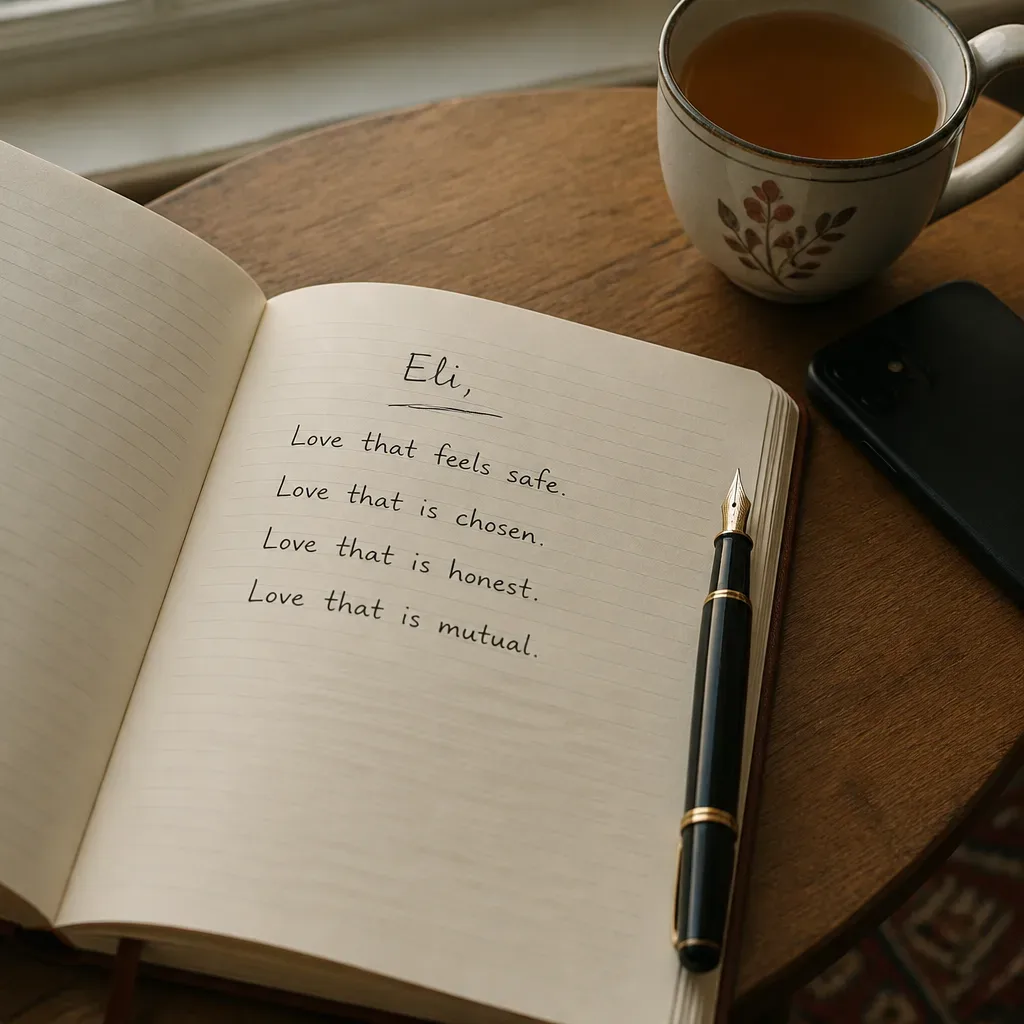
You set the desire by naming the person once, then naming the quality of love you refuse to live without.
This is the first step I would give anyone who tends to spiral. Write their name. Once. Then write the relationship state in plain words. Not ten pages. Not a thread of signs. One paragraph, under 100 words. In app terms, this is the difference between a useful prompt and a user interface that traps you. Too many options increase checking. One clear input reduces it.
Use this 4-part setup:
- Name the person: I desire a loving relationship with N.
- Name the quality: It feels safe, mutual, clear, and kind.
- Name your self-state: I am chosen without performing.
- Name the boundary: I only remain where love is available in real life.
That last line matters. Neville Goddard called the practice living in the end, but living in the end is not living in denial. The end you choose should include dignity. If the imagined relationship requires you to tolerate disrespect, the scene is not finished. It is just attachment with better lighting.
You can also use a supporting affirmation, as long as it does not become the main method. The Affirmations pillar is useful here because it explains how short phrases shape attention through repetition. Keep the phrase sober: I am loved clearly and consistently. That is enough. One affirmation. Not fifty.
A clean desire gives the practice a door. An obsessive desire gives it a maze.
What should your Dream-Self Moment say about this person?
Your Dream-Self Moment should speak from the future where love feels mutual, while leaving room for life to answer honestly.
The audio should not sound like a demand letter to fate. It should sound like the version of you who is no longer bargaining. I like scenes with ordinary details because ordinary details calm the fantasy. A hand on a kitchen counter. A message that does not require decoding. A walk where nobody is performing. Specific is good. Desperate is not.
Here is a simple structure you can use for the script before it becomes audio:
| Part | What it does | Example line |
|---|---|---|
| Arrival | Places you in the future self | I wake up knowing I am loved well. |
| Relationship quality | Names what matters | The connection is mutual, calm, and clear. |
| Body cue | Makes it physical | My shoulders are soft. My breath is easy. |
| Self-respect | Protects the boundary | I do not chase what cannot meet me. |
| Return line | Ends the loop | I am here, and I am already whole. |
In small studies on mindfulness apps, researchers have found modest reductions in stress and rumination when people practice consistently for several weeks. The details vary by study and app, so it is safer not to overclaim. The useful lesson is simple: consistency beats intensity. A 3-minute audio you actually hear every day is better than a 40-minute ritual you only do when you are scared.
If astrology is part of your timing language, keep it as a mirror, not a master. The Astrology and manifestation guide can help you use cycles for reflection without handing your agency to a transit. You are still responsible for your text, your silence, your standards, and your sleep.
Manifesting a specific person should make you more yourself, not less available to your own day.
How do you listen each day without turning it into a ritual of fear?
You listen at the same small time each day, then you stop and do something real with your body.
The timing can be plain. After brushing your teeth. Before opening messages. On the train. The less ceremonial it is, the less your anxiety can make it dramatic. I recommend one listen a day for 7 days before changing the script. Seven is not magic. It is just long enough to see a pattern and short enough that you will not build a shrine to the practice.
Here is a 12-minute version:
- Put the phone on Do Not Disturb for 3 minutes.
- Sit or stand with both feet touching the floor.
- Play the Dream-Self Moment once.
- Let the last sentence repeat silently for 30 seconds.
- Write one line: Today I return to myself by doing X.
- Do X within the next 10 minutes.
The last step is the part most people skip. Do something physical and ordinary. Wash a cup. Walk to the corner. Open a work file. Research on implementation intentions by Peter Gollwitzer has shown that if-then plans can improve follow-through across many behaviors. Your if-then here is simple: if I listen, then I re-enter my day.
The app can also include a daily affirmation and a Manifestation Board, and both can support the practice. But they are complements. They are not the pillars. If you only have time for one thing, listen to the audio. Repetition is not begging. Repetition is remembering.
Your phone is not an oracle; it is a device with bad timing.
What do you do when they do not text back?
You treat no reply as a nervous-system moment first, not as a spiritual emergency.
Start with the body. Not the story. A delayed reply can trigger the same old sequence: heat in the face, pressure in the chest, a sudden need to do something. The National Sleep Foundation has reported that screen use near bedtime is associated with poorer sleep patterns, and anyone who has waited for a message at 12:47 a.m. knows the cost. You do not make your clearest choices from a lit rectangle in the dark.
Use a 90-second interruption before you decide anything. Neuroscientist Jill Bolte Taylor has often said that the physiological lifespan of an emotion can be about 90 seconds when it is not fed by thought. The exact number is debated, but the instruction is useful. Give the wave a small room. Do not hand it the keys.

Try this no-text protocol:
- Put the phone in another room for 10 minutes.
- Name the sensation: tight throat, hot face, heavy stomach.
- Play the final 60 seconds of your audio.
- Ask: what would the loved version of me not do right now?
- Wait until the body drops by even 10% before acting.
If you still want to send a message after that, send the message you can respect tomorrow. No bait. No test. No paragraph designed to make them confess. If the connection cannot survive your clarity, it was already surviving on your silence.
The Manifestation pillar says the practice is not a substitute for reality. Good. Let reality speak. Let your body settle enough to hear it.
How can you tell whether the practice is working?
The practice is working when you become steadier before the outer story has fully changed.
Measure the first evidence close to home. Did you check less today? Did you sleep sooner? Did you stop yourself from sending the fourth message? Did you eat breakfast before analyzing their tone? These are not small things. In behavior change research, tiny repeated actions often matter because they reduce friction. James Clear popularized the 1% better idea, but the older research thread is broader: small cues and repeated behaviors shape identity over time.
Use a 7-day scorecard. Keep it boring. Boring is trustworthy.
| Signal | Day 1 | Day 7 question |
|---|---|---|
| Times you checked their profile | Count it | Is the number lower? |
| Minutes spent replaying conversations | Estimate | Did the loop shorten? |
| Sleep after listening | Note time | Did your body settle faster? |
| Self-respect choice | One line | Did you keep one boundary? |
| Real-life joy | One act | Did your day get wider? |
A specific person may come closer. They may not. That is the sentence nobody wants and everyone needs. The point is not to pretend you do not care. The point is to care without handing over your center. If you want a broader view of timing, doubt, and evidence, the AYA Method guide gives you the daily structure without making the practice bigger than your life.
There is also a clean exit test: if the audio keeps you attached to someone who is cruel, unavailable, or consistently unclear, edit the script. Make the love more honest. Make the future self less willing to settle. Sometimes the manifestation is not that they become ready. Sometimes it is that you do.
Put the phone down, and listen again tomorrow.