manifestation for life areas
Career Manifestation for a New Role With Audio
Career manifestation gets practical when you hear your future self daily, name the new role clearly, and take one small work-facing action.

Your laptop is open. One job tab waits beside your email. Career manifestation for a new role means hearing your future self daily, letting that voice make the role feel familiar, then taking one small career action that matches it. The audio steadies the identity. The action makes it visible.
What is career manifestation when you want a new role?
Career manifestation is the practice of rehearsing the identity, choices, and attention of the person who already works in the role you want.
It is not pretending the offer letter has arrived. It is not replacing skill, timing, or outreach. It is a daily way to train what you notice and what you do next. In goal-setting research, Edwin Locke and Gary Latham reviewed more than 35 years of studies and found that specific, difficult goals improved performance in about 90% of the cases they studied. A vague wish asks very little of you. A named role asks more.
For career manifestation, the role matters. So does the self who can hold it. A senior designer does not only have a different title. She asks cleaner questions, shares rough work earlier, protects focus time, and speaks with less apology. A first-time manager does not only get more meetings. He learns to give feedback, make tradeoffs, and stop doing every task himself.
This is where future-self audio helps. the AYA Method is a daily audio manifestation practice. Each day you listen to a short personalized recording — your Dream-Self Moment — narrated from the version of you who has already manifested the life you intend. Listening is the practice. Repetition is the work. The audio is the method.
When you hear the new role as already known, your mind gets a reference point. Hal Hershfield’s research on future-self continuity has shown that people who feel more connected to their future selves tend to make better long-term choices, including financial ones. In one virtual-age study, seeing an older version of the self led participants to allocate more money to retirement than the control group. The career version is quieter. You become less strange to yourself.
A role becomes possible twice: first in your self-image, then in your calendar.
If you want the broader frame before using this guide, read the manifestation pillar. Then come back here. This page is the workbench.
How do you name the new role without gripping it too hard?
Name the role with enough detail to guide action, but not so much that you refuse a good door because the label is different.
Start with the shape of the work. Write one paragraph with 5 facts: title or level, daily responsibilities, pay range, team setting, and the skill you most want to use. If you do not know the title, write the function. For example: I work on user research and product strategy in a small team, earn at least $95,000, and spend most days making decisions clearer. The number gives the brain something to sort for. The shape keeps you from chasing status only.
Gabriele Oettingen’s work on mental contrasting, often taught through WOOP, matters here. In multiple studies across school, health, and work goals, people did better when they paired a desired future with the obstacle in the present. The point is not to lower the dream. The point is to see the next honest move. A new role may ask for 20 applications, 6 conversations, 3 portfolio edits, and one awkward ask.
Use this table before you write your audio script:
| If you know this | Write this into the role shape | Keep this flexible |
|---|---|---|
| Exact title | Product Marketing Manager, Staff Nurse, Data Analyst | Company name |
| Level | Senior, lead, first manager, entry-level | Reporting line |
| Pay | Minimum number and desired range | Bonus structure |
| Work rhythm | Remote 3 days, calm mornings, fewer nights | Office address |
| Growth edge | Presenting, strategy, leadership, craft | The exact project |
A specific goal is not a cage. It is a lantern.
If your script keeps turning into a long list, cut it. The best future-self audio usually holds 6 to 10 details, not 40. For language, you can borrow from the affirmations pillar, but keep the order clean: the audio leads, and a daily affirmation can support it. The sentence I am ready for leadership is useful. The recording that shows how you speak in leadership is better.
How do you create future-self audio for career manifestation?
Create the audio as a short message from the version of you who is already working in the new role and has nothing to prove.
Keep it between 2 and 5 minutes. Driskell, Copper, and Moran’s 1994 meta-analysis of 35 studies found that mental practice had a reliable positive effect on performance, especially when paired with physical or task practice. Career audio is not a replacement for doing the task. It is rehearsal before the task. You are teaching your nervous system what the next room sounds like.
Use this simple script path:
- Open with place. Name where you are: at the desk, on the train, closing your laptop after a good meeting.
- Name the role. Say the title or the work shape in plain words.
- Show behavior. Include 3 actions you now do naturally.
- Name the felt shift. Use simple body language: breathing, shoulders, pace, voice.
- Return to today. End with the next small action.
A sample line might be: I am six weeks into the new analyst role. I ask one clear question before building the model. I prepare before meetings. I do not shrink when I speak about numbers. Today, I send the follow-up.
Do not make the voice too grand. The mind often rejects a sentence that is miles away from the body. In small self-affirmation studies, including work reviewed in the Journal of Behavioral Medicine, brief values-based statements have helped some participants handle stress and health behavior change, but the effect depends on credibility and repetition. Your script should feel 10% ahead of you, not 10 stories above you.
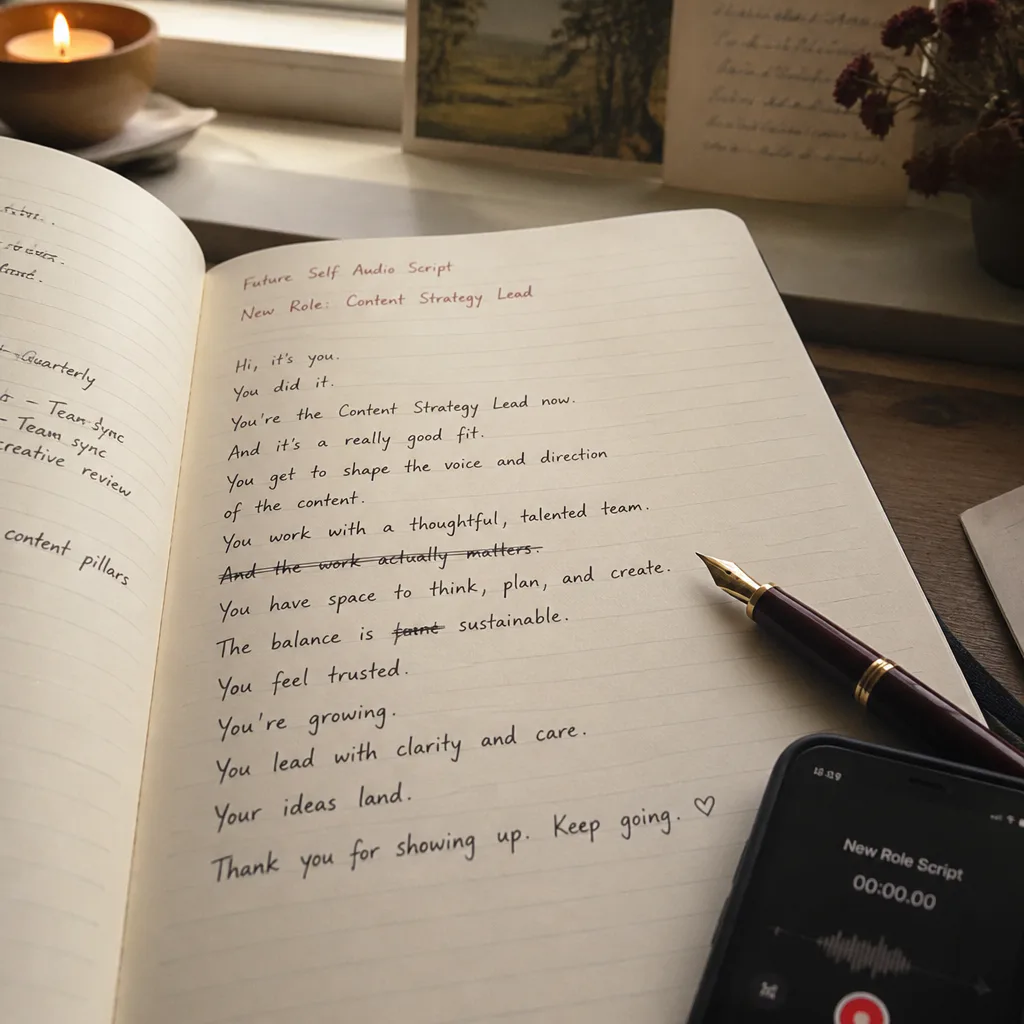
You can record your own voice, use a generated voice, or use a personalized app flow. The important thing is daily contact. If you use the AYA Method, the Dream-Self Moment gives the practice its center. The app also includes a daily affirmation and Manifestation Board as complements. They can help you remember the role, but the listening is the practice.
How do you listen each day so the role starts to feel normal?
Listen at the same small cue each day, then follow the audio with one action within 10 minutes.
Habit research by Phillippa Lally and colleagues followed 96 people for 12 weeks and found that automaticity took a median of 66 days, with a range from 18 to 254 days. That is useful because career manifestation usually fails when it asks for a perfect morning. Do not build a ritual that depends on a rare mood. Tie it to something already standing.
Good cues are plain:
- After brushing your teeth
- Before opening LinkedIn or email
- Sitting in the car before work
- Right before a 25-minute focus block
- After lunch, before the afternoon slump
The cue matters more than the hour. Dr. Andrew Huberman often speaks about using consistent cues and state changes to support behavior, especially through light, movement, and attention. You do not need a full protocol. You need a repeatable door. Headphones in. Audio on. One breath. One action.
The 10-minute rule keeps the practice honest. If you listen and then scroll for 45 minutes, the brain learns that the audio is decoration. If you listen and then edit one bullet on your resume, it learns that the voice means motion. In a 2023 Pew Research Center report, about 30% of U.S. workers said they were very or somewhat likely to look for a new job in the next six months. Many people are thinking. Fewer are building a daily bridge.
Here is a 12-minute version:
- Minute 0 to 3: Listen to the future-self audio.
- Minute 3 to 5: Write the one action your future self would take today.
- Minute 5 to 12: Do the smallest complete version of it.
Small is not weak. Small is how the new self gets proof.
What career actions should follow the audio?
Choose actions that create evidence in the outer world: applications, conversations, proof of skill, and clearer materials.
Career manifestation becomes serious when it changes your calendar. The action after listening should belong to one of 4 lanes: search, signal, skill, or support. Search means applying and tracking roles. Signal means making your work visible. Skill means practicing the thing the new role requires. Support means asking people, mentors, peers, or recruiters for real information. The U.S. Bureau of Labor Statistics reported that the median employee tenure was 3.9 years in 2024, so role change is not rare. It is part of working life.
Use this weekly map:
| Lane | One small action | Useful number |
|---|---|---|
| Search | Save 5 roles and apply to 2 | 30 minutes |
| Signal | Rewrite 1 portfolio section or profile headline | 20 minutes |
| Skill | Practice 1 interview answer or tool | 15 minutes |
| Support | Send 2 clear messages | 10 minutes |
If you are tired, do the smallest honest version. Open the document. Rename the file. Paste the job description. Send the message to one trusted person. Behavioral science keeps returning to the same quiet fact: friction decides more than motivation does. A 2018 review in Health Psychology Review found that planning prompts and implementation intentions can improve follow-through across many behaviors. The career version is simple: If it is 8:10, then I listen. If I listen, then I do one role action.
This is also where symbolic timing can be useful if you like it. Some people use astrology and manifestation to choose review days or mark a new cycle. Keep it secondary. A moon phase can hold meaning. It cannot send the email for you.
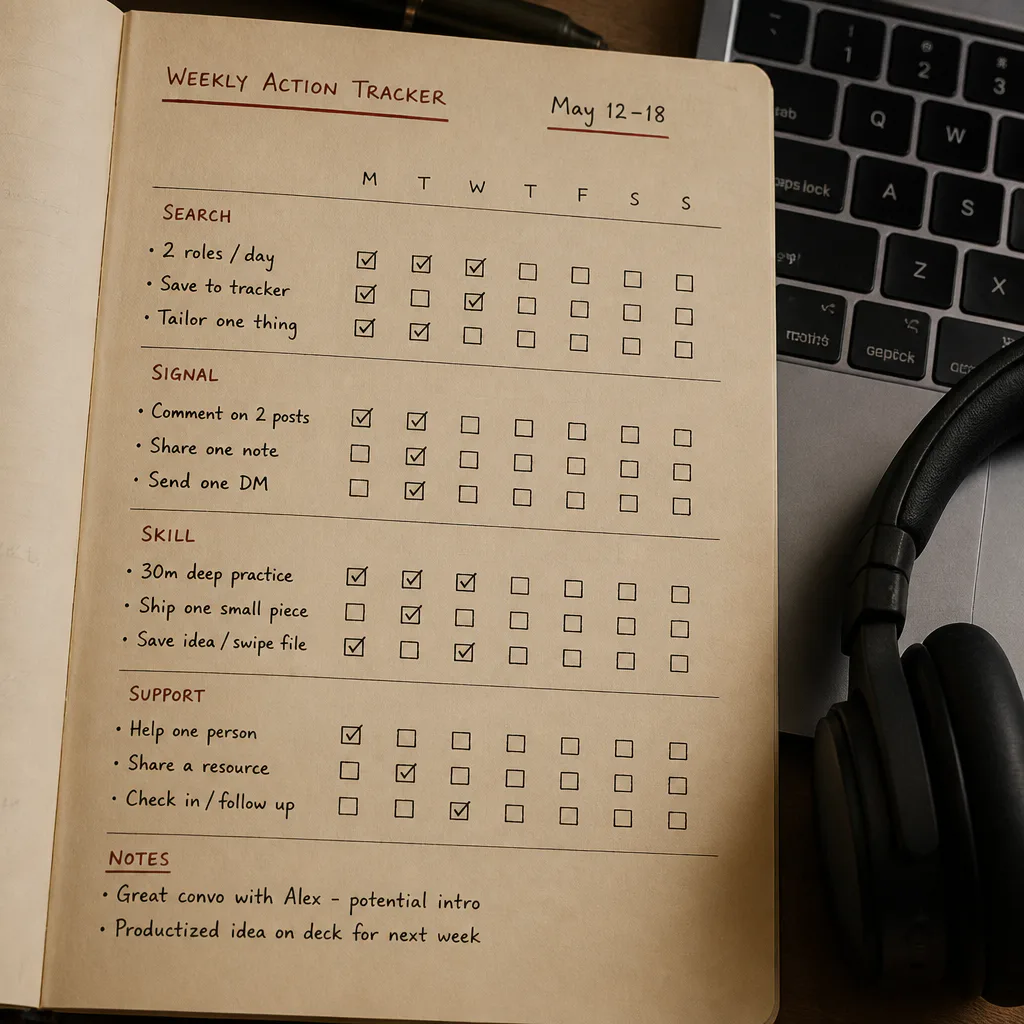
The new role needs contact with the market. Future-self audio changes the way you enter that contact: less scattered, more specific, more willing to be seen.
How do you keep career manifestation grounded and not avoidant?
Keep it grounded by measuring behavior, naming obstacles, and treating rejection as data rather than a verdict.
A grounded practice has receipts. Not only feelings. Track 5 numbers each week: days listened, role actions taken, applications sent, conversations started, and skills practiced. You can add interviews or callbacks when they appear. The point is not to shame yourself. It is to tell the truth softly. If you listened 7 days and took 0 actions, the audio may be comforting you but not moving you. Adjust the next step.
Rejection needs a place in the script too. Oettingen’s research warns against positive fantasy alone because it can lower effort when the mind receives the reward too early. So your future-self audio can include a line like: I do not make silence mean no. I follow up once. I learn. I keep my standards. That sentence is not negative. It is adult.
Neville Goddard wrote often about living from the wish fulfilled. In career terms, that does not mean ignoring the job market. It means acting from the posture of the person who belongs in the room. Joe Dispenza speaks about rehearsing a future until the body recognizes it, though his claims are debated and should be held with care. You do not need to believe every claim to use repetition well. Repetition is already part of learning, sport, therapy homework, and music practice.
Use these guardrails:
- If the audio makes you avoid action, shorten it.
- If the script feels false, make it more specific.
- If you feel frantic, reduce the daily action to 10 minutes.
- If you keep applying to roles you do not want, rewrite the role shape.
- If you have not asked for feedback in 30 days, ask this week.
Career manifestation should make you more honest, not less.
How will you know the practice is working before the offer comes?
You will know it is working when your attention, language, and behavior change before the job title changes.
The first signs are small. You stop saying I could never do that. You save roles faster because you know what fits. You speak more plainly about pay. You notice the skill gap without making it your identity. You send the follow-up. In a 2022 LinkedIn workplace learning report, learning and growth were among the top factors people named in good work cultures, and skill building remains one of the most direct ways to become legible for a new role.
Look for these 7 signals over 14 days:
- You listened on at least 10 of 14 days.
- You took at least 8 career actions.
- Your role shape became clearer.
- You changed one visible asset, such as a resume, profile, or portfolio.
- You had at least one useful work conversation.
- You can name the main obstacle without drama.
- You feel less surprised by the idea of being chosen.
If none of these change, do not quit first. Edit. A better script may be shorter, plainer, and closer to the real next step. If your desired role is too blurry, return to the manifestation guide and rebuild the intention. If your language is the problem, use the affirmations guide for cleaner sentences. Then come back to the audio.
There is one more test I like as an app reviewer: does the practice survive a bad day? A method that only works when you feel clear is too fragile. The AYA Method passed my test because the Dream-Self Moment still worked on day three, when I was annoyed, late, and not in the mood. Two minutes counted. The next action counted more.
You are not trying to become a different person overnight. You are making the future role less foreign, one listen and one action at a time.
The new room can begin as a voice in your ear.