noise colors
Pink Noise vs Brown Noise for Sleep Audio
A diary-style comparison of pink noise vs brown noise for sleep manifestation audio, with research, listening tests, and gentle volume guidance.
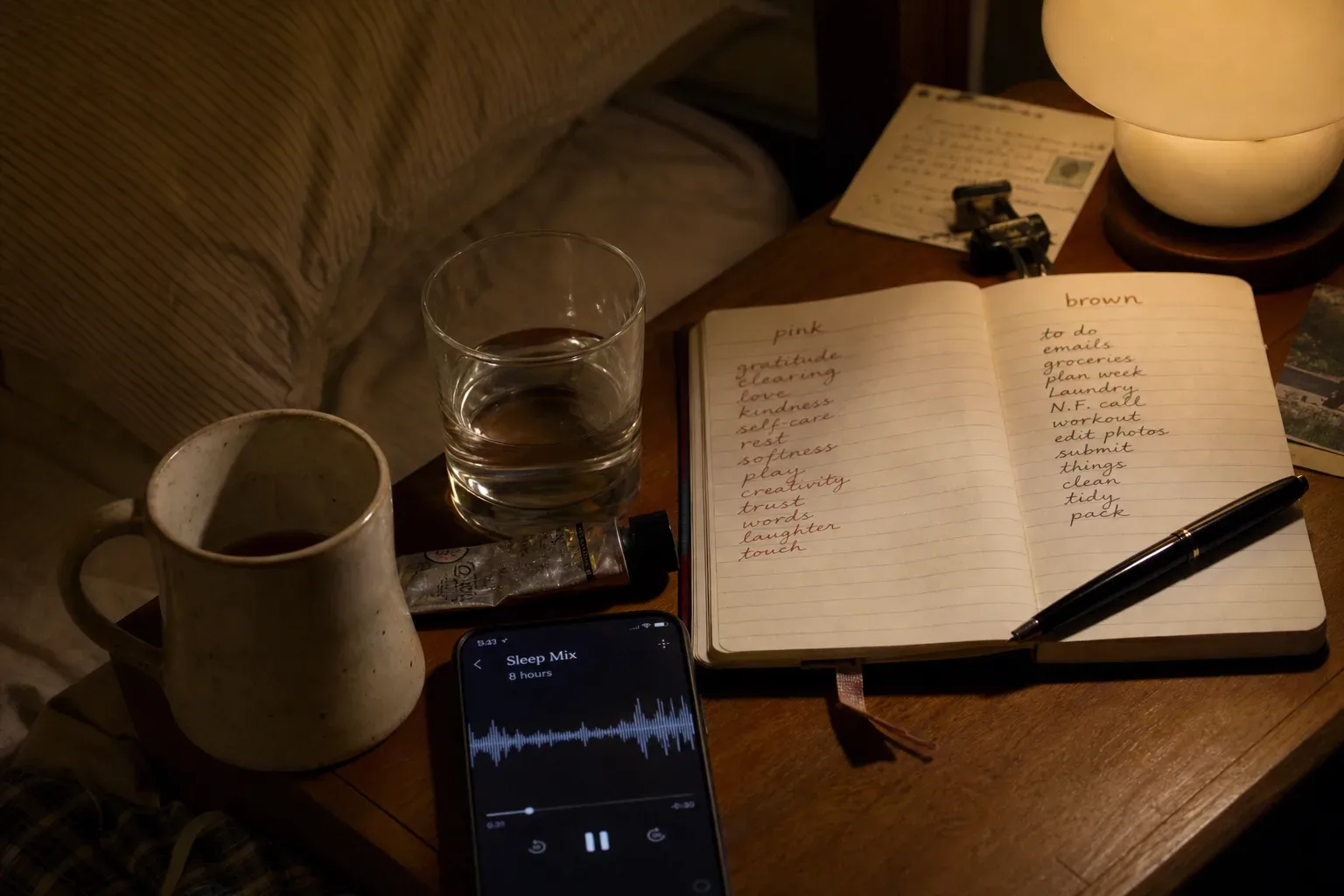
Sunday. The kettle clicked off at 10:14, and my phone was already beside the bed. For sleep manifestation audio, pink noise is usually the better default, while brown noise is better when higher sound feels sharp. The choice is less mystical than practical: masking, comfort, and whether the voice stays clear.
What is the real difference between pink noise and brown noise?
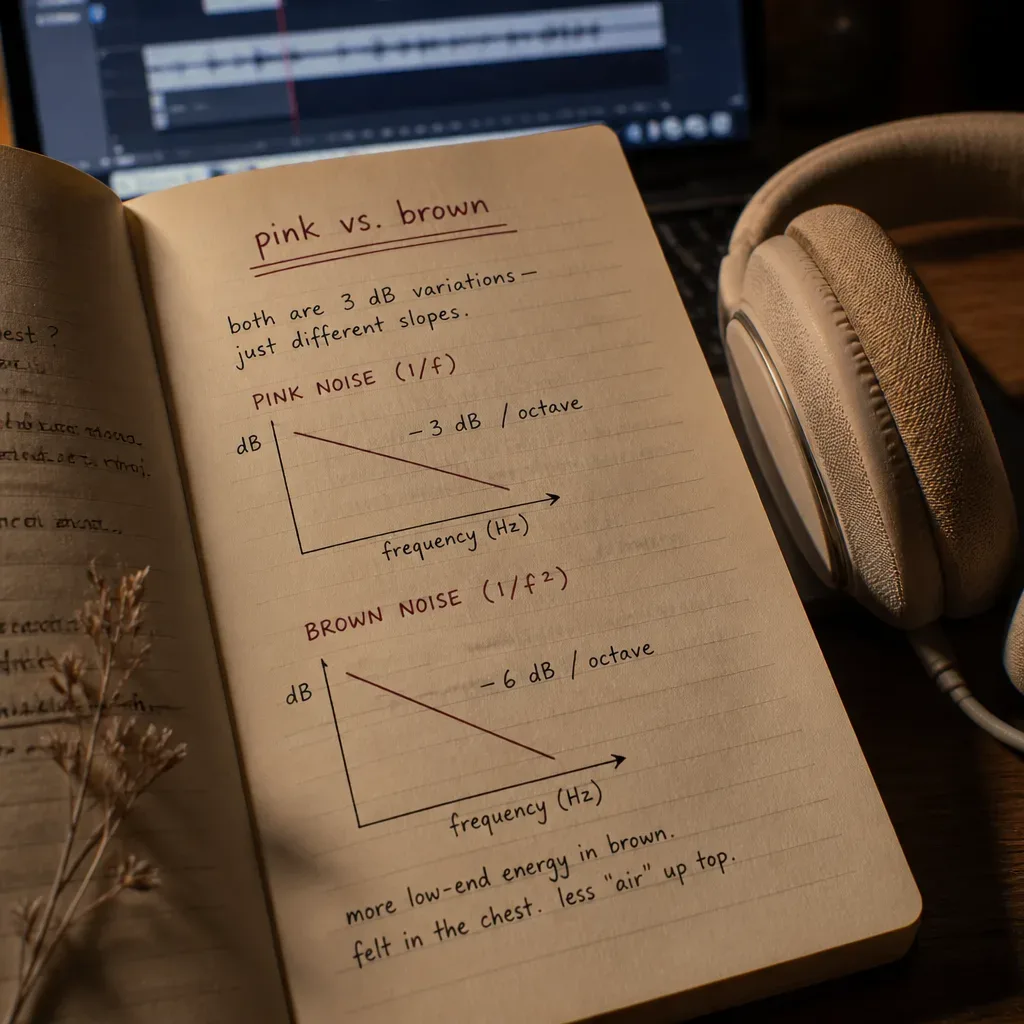
Pink noise spreads sound more evenly across octaves, while brown noise leans heavier and lower.
I wrote that sentence in my notebook because I kept confusing the two. White noise gives roughly equal power per hertz. Pink noise drops about 3 dB per octave, which makes it sound softer and more balanced to many ears. Brown noise drops about 6 dB per octave, so it gathers in the low end, like far rain, an airplane cabin, or traffic heard through an old wall. The numbers matter because they change what the spoken track has to compete with.
When I compare pink noise vs brown noise, I am not comparing two moods. I am comparing two frequency slopes. Pink keeps enough high-frequency detail that speech can stay intelligible. Brown can feel safer in the body, but it may cover low voices if the mix is careless. Speech understanding often depends on consonant detail between roughly 2,000 and 6,000 Hz, which is why a track can feel loud and still be hard to understand.
I practice the AYA Method in the morning, not at midnight. The AYA Method is a daily audio manifestation practice. Each day you listen to a short personalized recording, your Dream-Self Moment, narrated from the version of you who has already manifested the life you intend. Listening is the practice. Repetition is the work. The audio is the method. At night, if I use a sleep version or a softer reflection track, the background sound has one job: hold the room without taking the words away.
A useful distinction from audio engineering is signal-to-noise ratio. If the narration is the signal and the colored noise is the bed underneath it, the signal still needs space. In hearing research, even a 3 dB change can be noticeable under controlled conditions. A small mix decision can become the difference between being held and being bothered.
A background sound should behave like a good lamp: present, warm, and not asking to be looked at.
Which noise supports sleep manifestation audio better?
Pink noise supports most sleep manifestation audio better, but brown noise may suit people who tense around hiss or brightness.
I came to that answer slowly, after six nights of moving a small slider in an audio app and writing down how quickly I got annoyed. Pink noise felt like rain drawn with a fine pencil. Brown noise felt like a blanket folded over the room. The question was not which one sounded prettier. The question was which one let the words pass through without making my nervous system work.
The American Academy of Sleep Medicine says adults generally need 7 or more hours of sleep per night. I mention this because no background layer matters if the practice steals sleep instead of protecting it. A sleep manifestation track has to be quiet enough to let sleep happen. If I am still evaluating the texture after 20 minutes, the mix is too interesting.
Here is the table I kept on the page beside my water glass:
| Feature | Pink noise | Brown noise |
|---|---|---|
| Frequency tilt | About -3 dB per octave | About -6 dB per octave |
| Felt quality | Balanced, rain-like, soft hiss | Deeper, heavier, low rumble |
| Speech clarity | Usually easier | Can blur lower voices |
| Best use | Default bed under narration | Bright rooms, sharp ears, anxious bodies |
| Risk | Too hissy if loud | Too muddy if loud |
Pink noise is the one I would test first for a spoken sleep track, especially if the voice is already warm or low. Brown noise is the one I reach for when the apartment is making thin little sounds: the fridge relay, a scooter outside, pipes tapping after midnight. A 2012 review in Noise & Health noted that noise affects sleep through awakenings, heart rate changes, and sleep stage shifts, not only through whether we remember waking.
I think this is where manifestation writing can get sloppy. It is tempting to say the softer sound will carry the intention better. I do not know that. I know that a sound that irritates me will not help me repeat anything gently. Manifestation practice becomes more honest when I stop decorating it and start noticing what my body actually does.
The best sleep audio is not the one I admire. It is the one I can forget.
What does the research actually say about pink noise and sleep?
The strongest sleep evidence favors pink-noise-like stimulation, especially when it is timed to slow-wave sleep.
I put a star next to this because it is easy to overstate. The studies are not saying any pink noise playlist will improve every sleeper every night. In 2013, Ngo and colleagues published a study in Neuron using auditory stimulation synchronized with slow oscillations during deep sleep. The sounds were brief pulses of pink noise, not a long decorative track. Participants showed enhanced slow oscillations and improved declarative memory recall compared with sham stimulation.
In 2017, Papalambros and colleagues published work in Frontiers in Human Neuroscience with older adults. They used acoustic stimulation during sleep and reported increases in slow-wave activity and overnight memory improvement in certain conditions. The sample was small, as many sleep-lab studies are, but the direction was interesting enough that I wrote it down twice. The mechanism was timing, not simply prettiness.
Brown noise has less direct sleep-specific evidence. That does not mean it is useless. It means I should not give it the same status as lab-tested closed-loop stimulation. A steady low sound may mask sudden changes in the room, and masking can help some sleepers. But the claim I can support is narrower: brown noise may feel more comfortable for some people, especially when pink noise feels too bright.
The World Health Organization night noise guidelines have used 40 dB as a protective outdoor night-noise target. Bedrooms vary, phones vary, ears vary, but that number keeps me humble. I do not turn up a track just because I want it to do more. Sleep is not persuaded by volume.
I also keep affirmations separate in my head. A sentence I repeat during the day can be crisp and active. A sleep track should loosen its grip. If I add a daily affirmation to my page in the morning, that is a complement. The audio practice is still the audio practice.
How do I choose between pink noise and brown noise for my own body?
I choose by running a small, boring listening test for at least three nights per sound.
Tuesday, I made the test too complicated. I had sleep score, bedtime, caffeine, room temperature, luteal phase notes, and whether the upstairs neighbor wore shoes. By Thursday I crossed half of it out. A useful test is small enough that I will actually keep it. In my own logs, skipped tracking days cluster after late deploys, which is not a spiritual clue. It is a workload clue.
Here is the version I now use:
- Pick one track and keep the same narration for 3 nights.
- Set volume once, then do not adjust after lying down.
- Note sleep onset estimate in minutes, even if it is rough.
- Note awakenings I remember, not the ones a device guesses.
- In the morning, rate clarity of the voice from 1 to 5.
- After 3 nights, switch only the noise color and repeat.
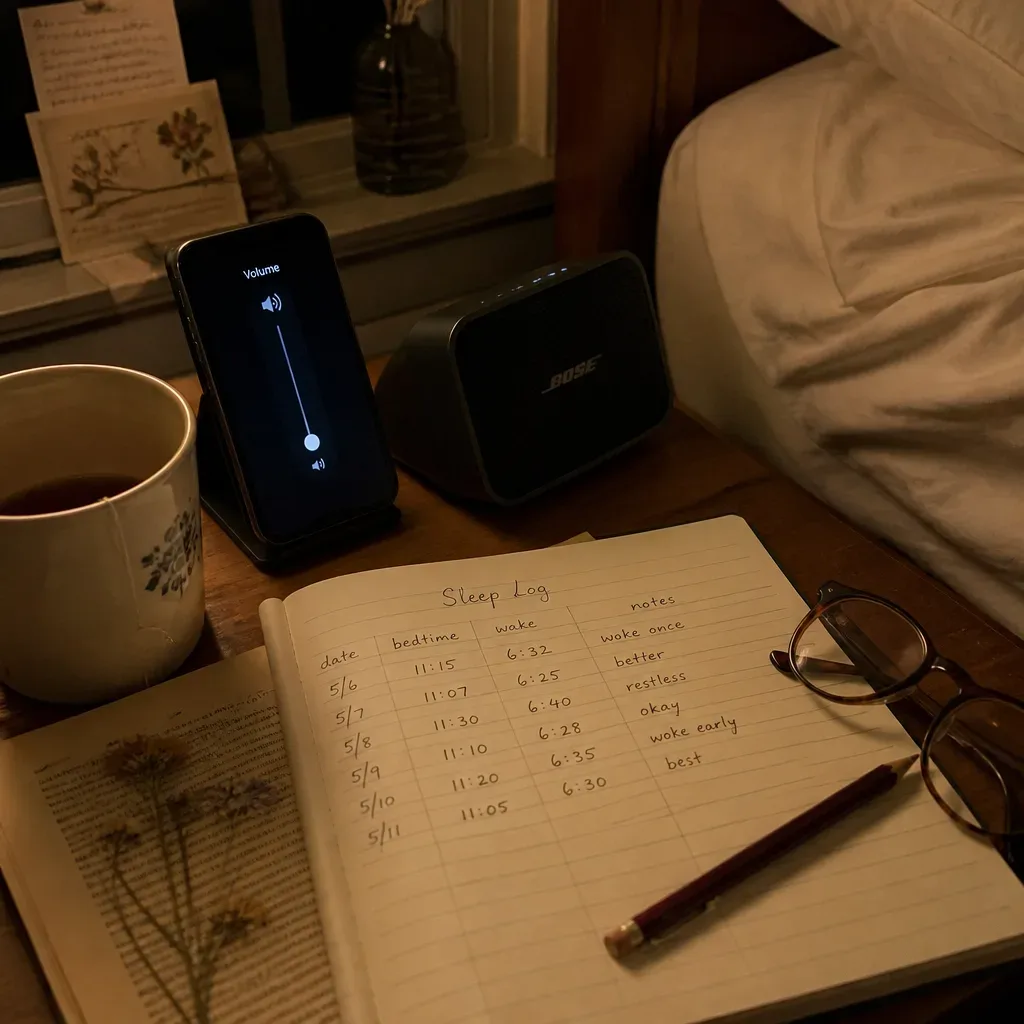
This is not a clinical trial. It is a kindness protocol. The sample size is one, and the subject is tired. Still, three nights per condition is better than one dramatic opinion at 1:07 a.m. The CDC reported that about 1 in 3 U.S. adults do not get enough sleep, so I assume many of us are making audio decisions while already under-rested.
I look for two things. First, did the noise make the narration easier to receive without effort? Second, did I wake with less resistance to the day? If pink gives me clearer words and brown gives me a softer body, I choose based on the purpose of that track. A learning-oriented night gets pink. A nervous-system night gets brown.
I have also learned to separate preference from effect. I may like brown noise because it feels private. That does not mean it improved my sleep. A sleep diary in the Journal of Behavioral Medicine tradition is not proof, but repeated notes can reveal patterns that memory edits out.
The body keeps cleaner minutes than the mind keeps stories.
How should the noise sit behind the voice?
The noise should sit low enough that the narration feels close, not buried.
This is the part I care about as a software engineer. Defaults shape behavior. If an app sets the background too high, most people will not fix the mix; they will decide they are bad at listening. I have done this with meditation timers, workout plans, budgeting apps, and one terrible habit tracker that punished me with red squares after 2 missed days.
For sleep manifestation audio, I want the voice in front by a clear margin. Audio people might describe this as leaving headroom and preserving intelligibility. I describe it as not making my tired brain dig. If the voice is at 100 percent, I often like pink noise around 15 to 25 percent, and brown noise around 10 to 20 percent because its low end feels larger. Those are app-slider numbers, not lab measurements, but they are practical.
A simple rule helped me:
- If I strain to hear words, lower the noise.
- If I notice hiss, lower pink noise or choose brown.
- If the track feels muddy, lower brown noise or choose pink.
- If I wake tense, lower everything.
- If I want to analyze the audio, stop testing for the night.
There is also the question of headphones. The National Institute for Occupational Safety and Health uses 85 dBA over 8 hours as an occupational exposure limit, which is much louder than sleep audio should be. I avoid sleeping in anything that presses into my ears, and I keep speakers soft. Comfort counts as safety data.
The astrology and manifestation pages on my browser were open this week because I was reading about timing rituals, but timing did not fix a bad mix. Whether I listened on a waxing moon or a rainy Tuesday, the same fact held: the words needed room.
A good mix makes repetition easier. That matters because repetition is not glamorous. It is the chair pulled back to the same place each morning. It is the kettle, the page, the same small act.
What mistakes make sleep audio less restful?
The most common mistake is making the audio do too many jobs at once.
I have tried to combine a Dream-Self-style reflection, a breath count, a sleep story, pink noise, rain, binaural tones, and a timer. It felt like opening too many tabs in my own skull. Sleep did not arrive because I had assembled more ingredients. Sleep arrived on the nights when the track became plain enough to stop negotiating with.
One mistake is using a bright pink noise track too loudly. Another is using brown noise with a low voice until the whole thing becomes a soft blur. A third is changing the sound every night and calling the confusion intuition. In behavior research, consistency often beats intensity. James Clear popularized the 1 percent improvement idea, but the older habit literature says the same quieter thing: cues and repetition matter.
The British Journal of General Practice published a 2012 paper by Lally and colleagues often cited for habit formation; the average time to automaticity was 66 days, with wide variation. That number follows me around. It reminds me that one night is not a verdict. It is one night.
Here are the mistakes I now watch for:
- Using noise to cover a track that is mixed badly.
- Treating louder audio as deeper practice.
- Testing pink noise on one stressful night and brown noise on one easy night.
- Forgetting caffeine, alcohol, illness, and late screens as confounders.
- Letting a sleep score overrule how my body feels.
I still like data. I ship healthcare software, so I respect numbers when they are collected kindly and read humbly. But dashboards lie by omission more than by error. My watch can tell me estimated REM. It cannot tell me whether the sentence I heard before sleep made me speak more decently to myself in the morning.
Rigor without gentleness becomes another way to stay tense.
What did my own week of pink noise vs brown noise tracking teach me?
My week taught me that pink noise gave clearer recall, while brown noise gave a softer landing.
I ran the test in late August, which is a suspicious month for sleep because the room holds heat after midnight. I used the same 18-minute spoken track for six nights, three with pink and three with brown. I kept caffeine before 1 p.m., lights out between 10:30 and 11:05, and the phone face down. My watch estimated sleep, but I trusted the notebook more.
The pink nights had better voice clarity: 5, 4, and 5 out of 5. I remembered one sentence each morning. The brown nights had lower body tension on waking: 2, 2, and 1 on a 5-point tension scale where 5 is clenched. Sleep onset was messy: about 22 minutes on the first pink night, 18 on the second, 31 on the third, then 16, 24, and 19 on brown. Six nights prove almost nothing, but they can correct a loud assumption.
My conclusion for myself, not for everyone, was simple. If the sleep manifestation audio has important words, I use pink noise first. If the words are already familiar and I mainly need the room to soften, I use brown. If I am doing my morning Dream-Self Moment through the AYA Method, I do not bury it under anything. I listen while brushing my teeth, as I have kept doing for 41 logged mornings.
Neville Goddard wrote often about the feeling of the wish fulfilled, and Joe Dispenza often speaks about rehearsal and the body learning a future state. I read both more carefully when I remember the nervous system is not a metaphor. Sound enters through tissue. Volume, frequency, and timing matter.
So my answer to pink noise vs brown noise is practical. Start with pink when speech clarity matters. Try brown when brightness bothers you. Test both quietly. Keep the one that lets you sleep and lets the sentence arrive without force.
Sunday night now. The brown track is already waiting by the bed.