mindset
Perfectionism Manifestation: Listen Before You Start
Perfectionism manifestation works best when you listen before doing. Use this 7-minute audio-first practice to lower pressure and start with steadier self-talk.

Tuesday, kettle clicking off. Perfectionism manifestation means using manifestation practice to loosen the all-or-nothing voice before it decides the day. I listen before I start because audio reaches me while my hands are still ordinary. A short Dream-Self Moment gives the brain a rehearsed cue: begin small, finish honestly, return tomorrow.
What is perfectionism manifestation, really?
Perfectionism manifestation is a practice of rehearsing a kinder identity before doing the thing that scares you.
I am writing this at the kitchen table with one sock on, because the laundry basket is beside my chair and I kept missing it. That feels like the correct beginning. Perfectionism always wants a clean table, a charged laptop, a right mood, a better pen. It asks for conditions first. Practice asks for contact first.
In psychology, perfectionism is usually described through dimensions such as personal standards, concern over mistakes, doubts about actions, and perceived expectations from others. Frost and colleagues published the Multidimensional Perfectionism Scale in 1990 with 35 items, and it is still cited because it separated high standards from the fear of being wrong. That distinction matters here. Wanting to do good work is not the wound. Needing the work to protect you from shame is the wound.
I use the word manifestation carefully. On this site, manifestation practice means naming the life I intend, repeating the identity that can hold it, and acting in ways that make that identity easier to believe. It is not a bargain with the sky. It is not a certificate that I will never feel fear again.
Perfectionism is not high standards. Perfectionism is a nervous attachment to never being seen mid-process.
The small promise of perfectionism manifestation is this: I can hear the version of me who has already learned to begin, before the older part of me starts negotiating. That is why I listen first. Not after the task. Not as a prize. Before.
Why do I listen before I start?
I listen before I start because the first cue often decides whether I enter the work or orbit it.
This morning the cue was my headphones on the counter. I had not opened the document yet. I had not checked messages. I listened to the AYA Method while the coffee cooled. The AYA Method is a daily audio manifestation practice: each day I listen to a short personalized recording, my Dream-Self Moment, narrated from the version of me who has already manifested the life I intend. Listening is the practice. Repetition is the work. The audio is the method.
The order matters because perfectionism is fast. It can turn a plain task into a courtroom in under 30 seconds. Cognitive neuroscience does not prove that audio changes a life by itself. It does show that self-relevant language is processed differently from neutral language. A 2006 meta-analysis by Northoff and colleagues linked self-referential processing to midline cortical regions, including medial prefrontal areas. In plain terms, words about me are not just words.
There is also habit science here. In a 2009 paper, Phillippa Lally and colleagues found that habit formation took an average of 66 days, with a wide range from 18 to 254 days depending on the behavior and person. That is a useful number because it keeps me patient. A cue repeated for three mornings is not a personality. A cue repeated for 66 ordinary mornings may become the way the day begins.
The audio gives me a pre-decision. I do not ask, am I ready? I ask, have I listened?
How do I do the seven-minute listen-before-start practice?
I do it by making the listening smaller than the resistance and the first action too plain to admire.
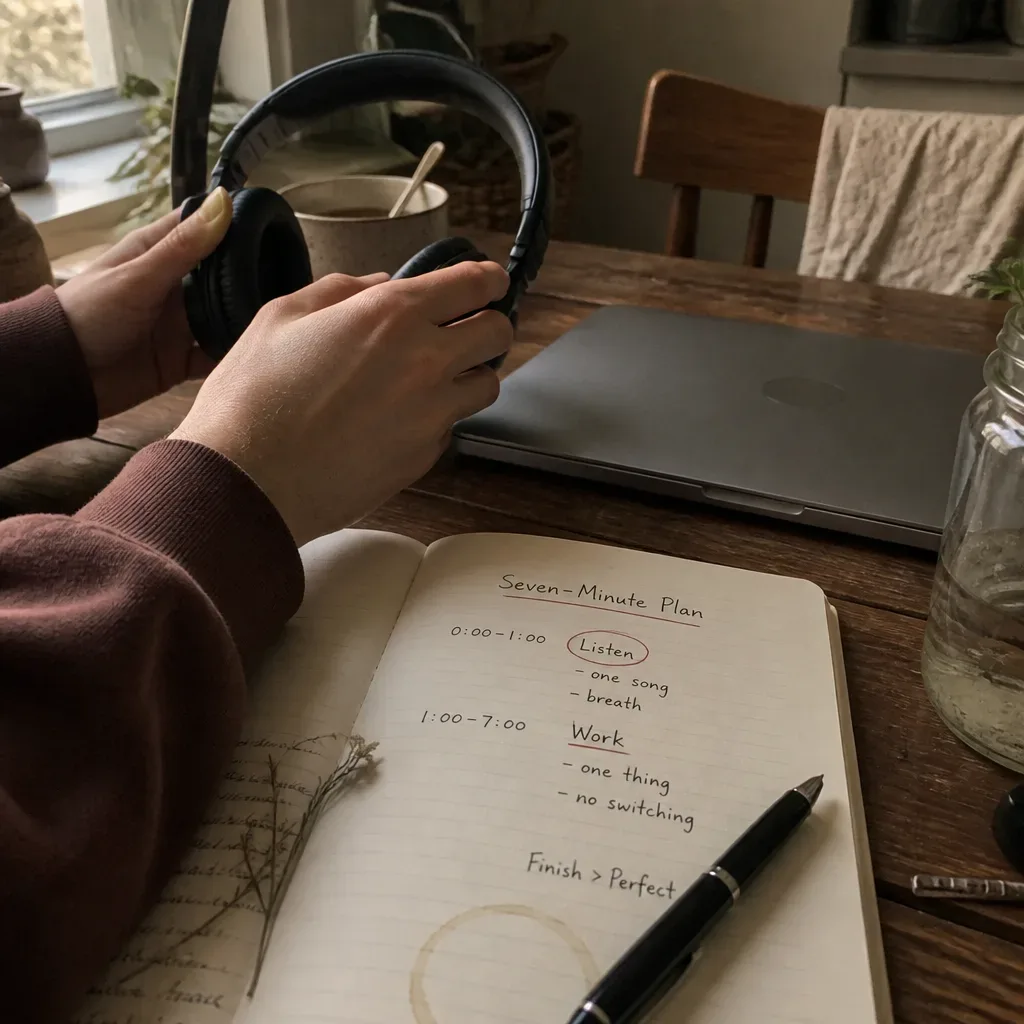
I have tried long routines. They became another room for perfectionism to decorate. Seven minutes is harder to ruin. I set a timer because my perfectionism likes to call itself depth. The timer tells the truth.
Here is the version I use on mornings when the page frightens me:
- Minute 0 to 1: Name the task in one sentence. I write: revise the grant paragraph, send the invoice, open the spreadsheet, walk for ten minutes.
- Minute 1 to 3: Listen. I play my Dream-Self Moment before I touch the task. If I am using a daily affirmation from the affirmations practice, I keep it as a small complement, not the center.
- Minute 3 to 4: Choose one visible start. I decide on a mark the room could see: title the document, write three messy bullets, put shoes by the door.
- Minute 4 to 7: Begin without improving the setup. I do the first action before I can make the ritual prettier.
Implementation intentions help explain why this works. Peter Gollwitzer’s 1999 work on if-then plans showed that linking a cue to a behavior can increase follow-through across many goal contexts. Later meta-analyses have reported medium-to-large effects, though the exact size depends on the task and study design. My if-then is plain: if I am about to begin something I avoid, then I listen first.
| Perfectionist version | Listen-before-start version |
|---|---|
| Wait until the full plan is clear | Hear the cue, choose one step |
| Improve the workspace first | Begin in the room as it is |
| Track whether it was excellent | Track whether I started |
| Use pressure as proof I care | Use repetition as proof I return |
The method is modest on purpose. A practice that needs perfect conditions will be captured by the very pattern it is trying to soften.
What should the audio say when perfectionism is loud?
The audio should speak from a believable future self who has learned to start before certainty arrives.
I do not want language that feels like a costume. If a recording tells me I am fearless, my body objects immediately. I know myself too well. I prefer sentences that feel 15 percent ahead of me, not 15 floors above me. In therapy research and behavior change research, that difference matters. A statement has to be close enough to be rehearsed.
A 2009 study by Joanne Wood, W. Q. Elaine Perunovic, and John Lee found that positive self-statements could make some people with low self-esteem feel worse, especially when the statement clashed with their current belief. This is why I am careful with affirmations. I do not ask a sentence to drag me somewhere. I ask it to place one foot on the floor.
For perfectionism manifestation, I like audio lines such as:
- I begin before the work knows what it is becoming.
- I can be seen learning.
- I send the honest draft and let revision do its job.
- I do not need the feeling of readiness to behave like someone who returns.
- I am allowed to make a first mark that is only a first mark.
The sentence that saves me most often is simple: readiness is not a gate I have to pass through.
Personalized audio helps because it removes one layer of effort. I am not composing the self-talk while I am already activated. The words arrive in the same order each time. Dr. Andrew Huberman often speaks about state and behavior in terms of nervous system readiness, and while his public teaching is broader than this practice, the basic point fits: a calmer cue before action changes the conditions under which action begins.
I keep a Manifestation Board sometimes, mostly one image and one line. It helps me remember the direction. But the board is not the pillar. The audio is the practice. Listening is what I do before my perfectionism can turn the board into a museum of better selves.
What if I feel resistance while I listen?
Resistance during listening is not a failure; it is often the exact material the practice is meeting.
I used to think calm meant the method was working. Then I noticed something more accurate. Some mornings I felt irritated while listening. Some mornings I rolled my eyes at the gentleness of it. On the bus last week, I paused the recording at 42 seconds because I did not want to hear the line about sending the draft. That was not proof that the practice was false. It was a map of the sore place.
Perfectionism often protects against social pain. Research by Hewitt and Flett, who have studied perfectionism for decades, links socially prescribed perfectionism to distress, depression, and interpersonal sensitivity. A large 2017 meta-analysis by Curran and Hill found that perfectionism increased among young people from 1989 to 2016, with socially prescribed perfectionism showing one of the steepest rises. The world has become very good at making ordinary effort feel publicly graded.
When resistance shows up, I do not argue with it. I write one sentence after listening: what is perfectionism trying to prevent? Usually the answer is not laziness. It is exposure. It is the fear that a visible attempt will settle the question of my worth.
A first draft is not evidence against you. It is evidence that you entered the room.
Here are the small rules I keep:
- If I feel tense, I lower the task, not the care.
- If I want to restart the audio to do it correctly, I do not restart it.
- If I miss a day, I return the next day without ceremony.
- If the sentence feels too grand, I edit it down until my body stops bracing.
What does the science support, and what does it not support?
The science supports repetition, self-relevant cues, and implementation support; it does not support magical claims about the brain obeying every imagined scene.
I am careful here because I study cognition, and I love practices that do not need inflated claims to matter. The brain can tell imagination from perception. If it could not, we would be in serious trouble every time we remembered a kitchen from childhood. But imagery, memory, and anticipated selfhood do recruit overlapping systems. That is the more honest sentence, and it is interesting enough.
Self-affirmation research is mixed but not empty. Claude Steele introduced self-affirmation theory in 1988, and later studies found that reflecting on personal values can reduce defensiveness under threat. A 2015 review by Cohen and Sherman described effects across health, education, and social threat contexts, while also noting that timing and context shape outcomes. I read that as permission to be precise, not cynical.
The astrology and manifestation readers sometimes tell me they like timing a practice with a moon phase. I understand the comfort of a dated ritual. As a neuroscientist, I do not need the moon to be the mechanism. If a date helps someone repeat a grounded behavior 12 times a month, repetition is already doing something measurable.
Joe Dispenza often speaks about rehearsing a future self, and many people find that language useful. My caution is with certainty. A practice can be meaningful without being proven in every claim made around it. Princeton Engineering Anomalies Research, often brought up in manifestation spaces, reported small effects in random event generator studies, but those findings remain debated and are not the foundation I would build on.
Calibrated belief is warmer than blind belief. It lets a practice help without asking evidence to pretend.
So I keep the claim small: listening before starting can cue a steadier self-state, reduce avoidance, and make the first action more likely. That is enough for a Tuesday.
How do I know this practice is working?
I know it is working when I start sooner, recover faster, and need less drama around imperfect work.
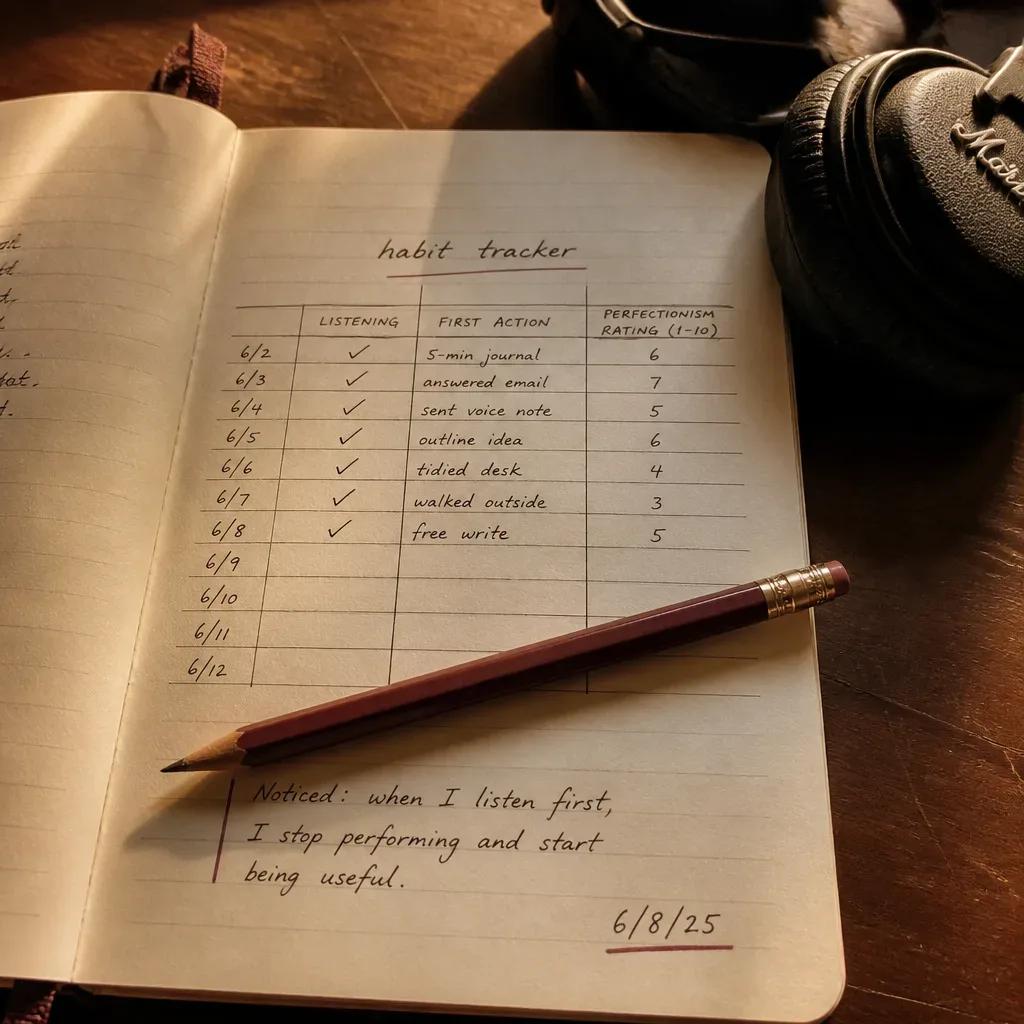
I do not measure whether I felt radiant. I measure what changed at the hinge of behavior. Did I open the file within 10 minutes? Did I send the imperfect reply? Did I stop rewriting the first sentence after the fifth pass? Did I come back after missing yesterday? These are small data points, but small data points are still data.
For two weeks, I use a tiny tracker. Fourteen days is not enough to prove a new identity, but it is enough to notice a pattern. In clinical and behavioral research, repeated measurement often matters more than one dramatic self-report. I keep the columns boring on purpose:
| Day | Listened before starting? | First action taken? | Perfectionism volume 1 to 5 |
|---|---|---|---|
| Monday | Yes | Opened draft | 4 |
| Tuesday | Yes | Wrote 3 bullets | 3 |
| Wednesday | No | Avoided until evening | 5 |
The score is not a moral grade. It is weather. If the perfectionism volume drops from 5 to 3 after listening, I note it. If it stays at 5 but I still begin, I note that too. Behavior sometimes changes before feeling does.
I also watch for language shifts. The old sentence is, I cannot start until I know how this ends. The newer sentence is, I can start and learn what the work is asking for. That is not a slogan. It is a different relationship to uncertainty.
If you want a wider frame for the practice, the Manifestation pillar is where I return when I need to remember that naming a desire is only the first part. The listening has to meet the day. The day is usually dishes, email, a late bus, a body that slept badly, and still one small beginning.
Wednesday now. The draft is not perfect, and it exists.