love manifestation
Manifesting Marriage Without Timeline Panic
Manifesting marriage without timeline panic can be a five-minute audio practice that steadies your body, choices, and attention each morning.

Saturday, 6:42 a.m. Manifesting marriage without timeline panic means practicing the felt identity of being loved and chosen without turning the calendar into a threat. A five-minute audio can help because it gives your nervous system one repeatable cue each day: I am available for commitment, and I do not have to chase it.
Why does timeline panic make manifesting marriage harder?
Timeline panic makes manifesting marriage harder because it trains the body to treat love as an emergency rather than a relationship.
I wrote that sentence beside my coffee this morning because I needed it before anyone else did. I have tested enough wellness apps to know the pattern: a countdown appears, the user feels behind, and the practice turns into another productivity cage. Marriage is especially vulnerable to this because it already carries numbers. Age 30. Age 35. Two years together. Six months to decide. Pew Research Center reported in 2023 that the median age at first marriage in the United States was about 30 for men and 28 for women, which means many people are now holding older cultural deadlines inside newer lives.
The body does not care whether the deadline came from a parent, a fertility article, a friend’s engagement photo, or a private note written at 24. If it reads the deadline as danger, it starts scanning. Scanning is not the same as choosing. Scanning asks, Is this the one, is this late, am I behind, what if I miss it. Choosing asks quieter questions. Do I feel safe enough to be honest. Do our lives have room for repair. Do I like who I become around this person.
Dr. John Gottman’s relationship research is often reduced too quickly online, but one number has stayed useful to me: stable couples tend to show roughly a 5 to 1 ratio of positive to negative interactions during conflict. That does not mean five compliments for every hard sentence. It means the small field of daily contact matters. Panic pulls attention toward the proposal, the date, the ring. Marriage is lived mostly in the unphotographed 5 to 1.
A deadline can be a planning tool. It becomes harmful when it starts making decisions for you. I have watched friends stay too long because the timeline was expensive to abandon, and I have watched others leave too early because uncertainty felt like failure. The calendar can hold logistics, but it cannot hold your worth.
Panic wants proof by Friday. Practice teaches the body to stop making Friday holy.
What does a five-minute audio practice actually do?
A five-minute audio practice gives attention a daily place to land before fear starts narrating the day.
This is why I kept the AYA Method in my own morning rotation after deleting many apps from my phone. The AYA Method is a daily audio manifestation practice. Each day you listen to a short personalized recording, your Dream-Self Moment, narrated from the version of you who has already manifested the life you intend. Listening is the practice. Repetition is the work. The audio is the method.
Five minutes looks almost too small on paper. That is part of its intelligence. BJ Fogg’s behavior model at Stanford has long argued that tiny behaviors are easier to repeat because they ask for less motivation. A 2010 study by Phillippa Lally and colleagues in the European Journal of Social Psychology found that habit formation varied widely, with an average of 66 days for a behavior to become more automatic. Five minutes for 66 mornings is more plausible than 40 minutes for three heroic days.
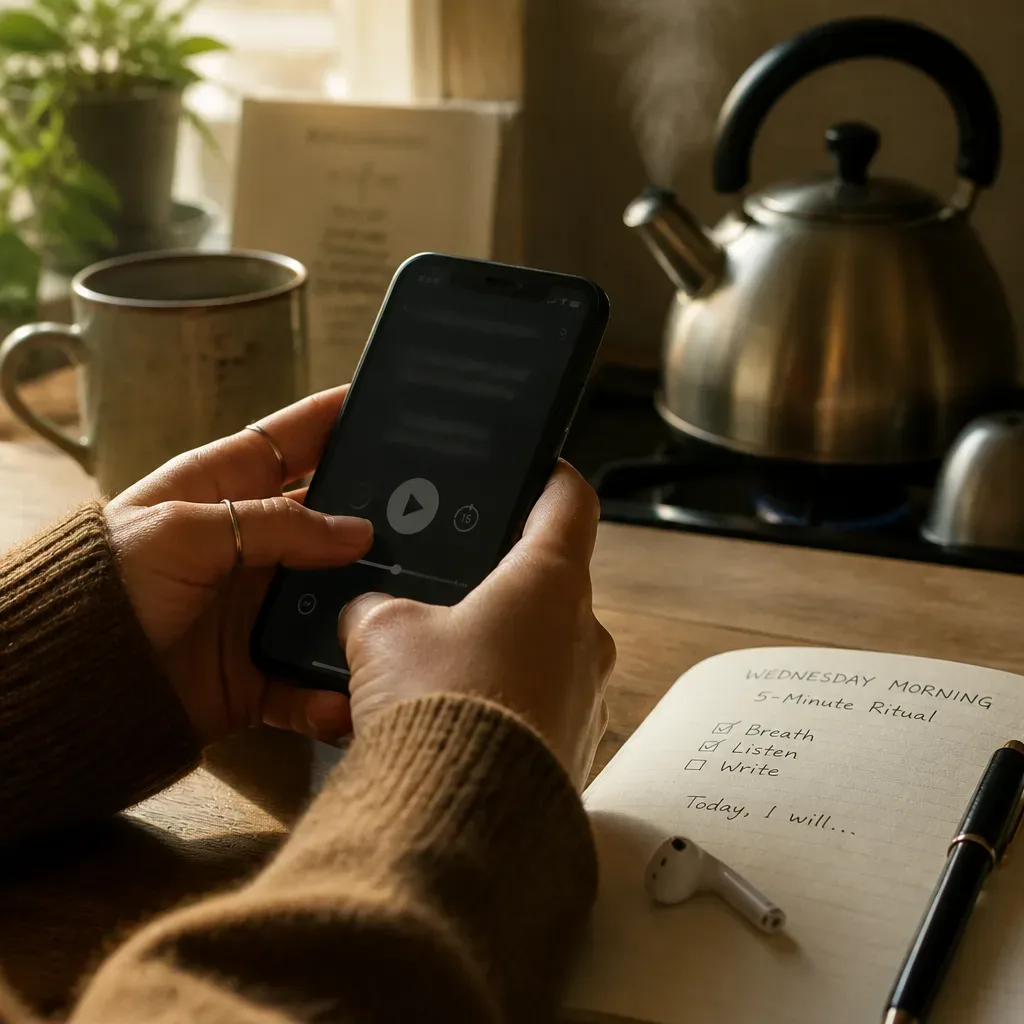
The audio matters because it reduces decision load. I do not have to invent the perfect affirmation while half awake. I do not have to visualize a wedding aisle if that image makes my chest tighten. I press play. I listen while the kettle clicks and the city starts lifting itself outside my window. My hands are usually around the blue mug. That ordinary setting has become part of the cue.
I think of it less as asking for marriage and more as rehearsing the inner weather of someone who can receive it. There is a difference. Asking can become bargaining. Rehearsing becomes posture, tone, and choice.
Here is the small comparison I keep in my notebook:
| Practice style | What it trains | Risk when anxious | Better use |
|---|---|---|---|
| Deadline scripting | Specific desire | Treats time as danger | Use rarely for clarity |
| Vision board | Visual attention | Can become comparison | Keep it simple and private |
| Daily affirmation | Language and belief | Can feel false if too big | Make it believable |
| Five-minute audio | Felt identity and repetition | Can be overchecked after listening | Listen, then live the day |
The audio is not magic theater. It is a behavioral container. On my better mornings, that is enough.
How do I set up the five minutes without making it precious?
I set it up by attaching the audio to an ordinary action that already happens every morning.
The mistake I used to make was ceremony. I would make tea, find a candle, open a notebook, adjust the chair, then lose the thread because the practice required a small stage. Now I use the kettle. Some mornings I listen before brushing my teeth. Some mornings I listen on the bus with one earbud in. The American Time Use Survey regularly shows that adults spend around 9 to 10 hours a day on personal care, household activity, work, and necessary movement. A practice that cannot live inside those ordinary minutes will probably not survive them.
My setup is plain:
- I put the phone face down after pressing play.
- I let the Dream-Self Moment run for about five minutes.
- I keep both feet on the floor.
- I notice one sentence that feels true enough for today.
- I take one matching action before noon.
The matching action matters. If the audio says I am loved without begging, the action might be not sending a third message. If it says I tell the truth early, the action might be asking what someone is looking for instead of decoding their punctuation. If it says I am building a marriage, not auditioning for one, the action might be cooking dinner for myself as if my life already deserves care.
There is good behavioral science behind attaching a new habit to an existing cue. Implementation intention research, associated with psychologist Peter Gollwitzer, has shown across dozens of studies that if-then plans increase follow-through. If the kettle starts, then I listen. If I sit on the morning bus, then I listen. The less dramatic the cue, the more I trust it.
I keep a daily affirmation on the page sometimes, and I keep a small Manifestation Board in the app, but I treat both as complements. The listening is the practice. The extras are useful only when they make the day quieter, not when they create another place to check for proof.
For the wider frame, I still send friends to the Manifestation pillar when they ask what manifestation means without the noise. I send them there because definitions matter. A practice gets safer when the words are clean.
What should the audio say if I want marriage but not obsession?
The audio should speak from the married self’s steadiness, not from the single self’s fear.
This is where wording becomes tender. If the recording keeps saying, He finally chose me, or I am no longer behind, the old wound remains the narrator. I prefer language that describes how I live as someone already partnered well. Specific, but not cinematic. Felt, but not inflated. Neville Goddard wrote often about assuming the feeling of the wish fulfilled, and whether one takes him literally or psychologically, the useful instruction is restraint. The feeling is not hysteria. It is naturalness.
A good marriage audio might include lines like these:
- I speak plainly because I am not trying to be selected by confusion.
- I let mutual interest reveal itself through repeated care.
- I am available for commitment, and I keep my dignity while I wait.
- I choose people by their behavior over time.
- I can want marriage deeply without making today a courtroom.
Those sentences work because they point to behavior. They do not require me to believe that a proposal is secretly scheduled for next month. They ask me to become less available to chaos. In 2022, the American Psychological Association reported that a large share of adults named money, health, and the future as significant stressors; relationship decisions often sit on top of all three. Any practice that adds more pressure to that stack is poorly designed.
I also keep the audio free of revenge. No proving someone wrong. No making an ex regret leaving. No spiritual scoreboard. Marriage built in the imagination as revenge still keeps the ex as an architect. I do not want that person holding the pencil.
If affirmations help, the Affirmations pillar has a calmer way into language than most lists online. I use one line only when it feels like a handrail. Too many sentences and I start performing belief instead of practicing it.
The right sentence does not intoxicate you. It returns you to yourself.
How do I date while practicing instead of waiting for a sign?
I date while practicing by treating the audio as preparation for honest contact, not a replacement for it.
This is the part I had to learn twice. A private practice can become too comfortable. Nobody interrupts you. Nobody has avoidant texting habits. Nobody says something kind on Tuesday and confusing on Thursday. Real dating brings data, and data is not always romantic. The practice should help me receive that data without turning every detail into prophecy.
There are useful numbers here too. Gottman’s longitudinal work often emphasizes that couples who repair well after conflict fare better than couples who never appear to disagree. The National Marriage Project has also reported for years that shared commitment and clear decisions matter more than constant novelty. I keep those ideas close because marriage is not proven by intensity at the beginning. It is proven by patterns after the beginning.
When I am dating, I use the five-minute audio and then ask one grounded question of the day:
- Did this person’s actions match their words at least once this week?
- Did I tell the truth, or did I edit myself to stay wanted?
- Did my body feel calm because it was safe, or calm because I was numb?
- Did I make room for mutuality, or did I do all the emotional labor?
- Did I confuse chemistry with evidence?
These are not glamorous questions. They save time. Years of app testing taught me that a product respects the user when it reduces open loops. I think dating has the same test. A person does not have to answer every fear immediately, but the connection should not multiply confusion as its main output.
I also leave room for timing that is practical, not mystical. Work schedules, children, visas, caregiving, grief, health, and geography matter. The Astrology and manifestation page is useful when timing symbols help someone reflect, but I do not hand my agency to a transit. I can respect a season without letting it decide for me.
What do I track so I do not start measuring signs?
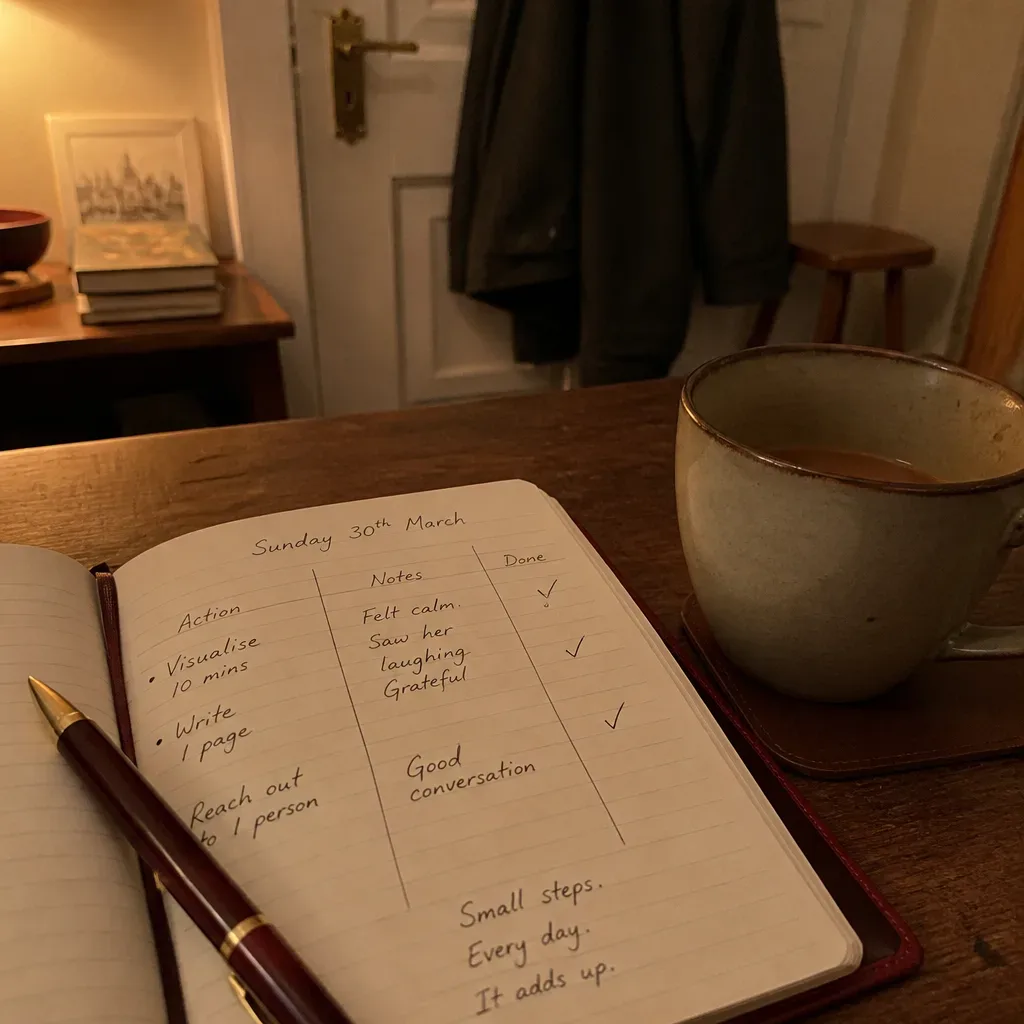
I track the practice, not the proof.
This is the cleanest rule I know. I mark whether I listened. That is all. I do not track who viewed a story, how many couples I saw on the walk, whether the song in the supermarket had the word forever, or whether a stranger’s wedding ring appeared at 11:11. The mind under pressure can turn anything into evidence. Princeton’s Global Consciousness Project is often cited in manifestation spaces, but even sympathetic readers should admit that its interpretations are debated. I would rather build my day on observable behavior.
My tracking page has three columns:
| Date | Listened? | One action after listening |
|---|---|---|
| Sept. 10 | Yes | Did not text from panic |
| Sept. 11 | Yes | Asked a direct question |
| Sept. 12 | Yes | Closed the app by 9 p.m. |
That is boring. Boring is a feature. A calm practice should not require detective work. When I tested apps for my Substack, the ones that failed usually made me manage the system more than the behavior. Too many streaks, badges, prompts, and social hooks. The survivor practices were quieter. They left fewer open loops at noon than at nine.
There is also evidence that self-monitoring can help behavior change, especially when the behavior is clear. A 2015 review in Psychological Bulletin found that monitoring progress increased goal attainment, particularly when records were written down or made public. I keep mine private because the goal here is not performance. The measurable behavior is listening. The unmeasurable fruit is steadiness.
A small warning, before I forget: do not use the tracker to punish yourself. If you miss a day, listen the next morning. Not twice. Not with apology. Once. The practice is a chair you return to, not a court you report to.
Repetition is not proof that you are behind. Repetition is how a new self becomes familiar.
How do I know the practice is making me calmer, not more attached?
I know it is working when my choices become cleaner and my body needs less reassurance after listening.
The first sign for me was not hope. It was less checking. I stopped reopening conversations to inspect them. I stopped asking friends to interpret a three-word reply. I stopped making every Saturday night a referendum on my future. That change was small enough that I almost missed it. In clinical mindfulness research, including work published in journals such as the Journal of Behavioral Medicine, brief repeated practices have been associated in small studies with reduced stress markers and improved emotional regulation. The scale varies, but the direction makes sense to me: repetition gives the nervous system a known path.
I use this checklist every Sunday night, usually at the kitchen table:
- I listened at least four days this week.
- I made one honest request.
- I did not chase someone who had already answered with absence.
- I let one good thing be good without demanding it become a timeline.
- I cared for my body in a way my married self would recognize.
If most of those are true, I trust the practice. If I become more frantic, I edit the audio. I make it slower. I remove any sentence that sounds like a guarantee. I return to the body. Dr. Andrew Huberman often points to the link between breath, physiology, and state regulation; I use that plainly here. Longer exhales. Feet on floor. Less prophecy.
The deeper sign is dignity. I do not mean pride. I mean the quiet refusal to abandon myself for an outcome I deeply want. Marriage is allowed to matter. Desire is allowed to be strong. But the practice should make me more available to love, not more available to panic.
I keep returning to the AYA Method because it does not ask me to manage ten moving parts. I listen. I repeat. I live the next hour. Some days that is spiritual enough for me, though I would probably not say it that way out loud.
For anyone building a broader practice around love, I would pair this with the basics on the Manifestation pillar and use the Affirmations pillar only when words help the body soften. The audio remains the method. The rest should stay light in the hands.
Saturday, 7:18 a.m., the kettle clicked off.