manifestation for life areas
Manifestation for Students: Dream-Self Audio Before Class
A quiet, practical guide to manifestation for students using Dream-Self audio before class, with an 8-minute routine, tracking notes, and study-day examples.
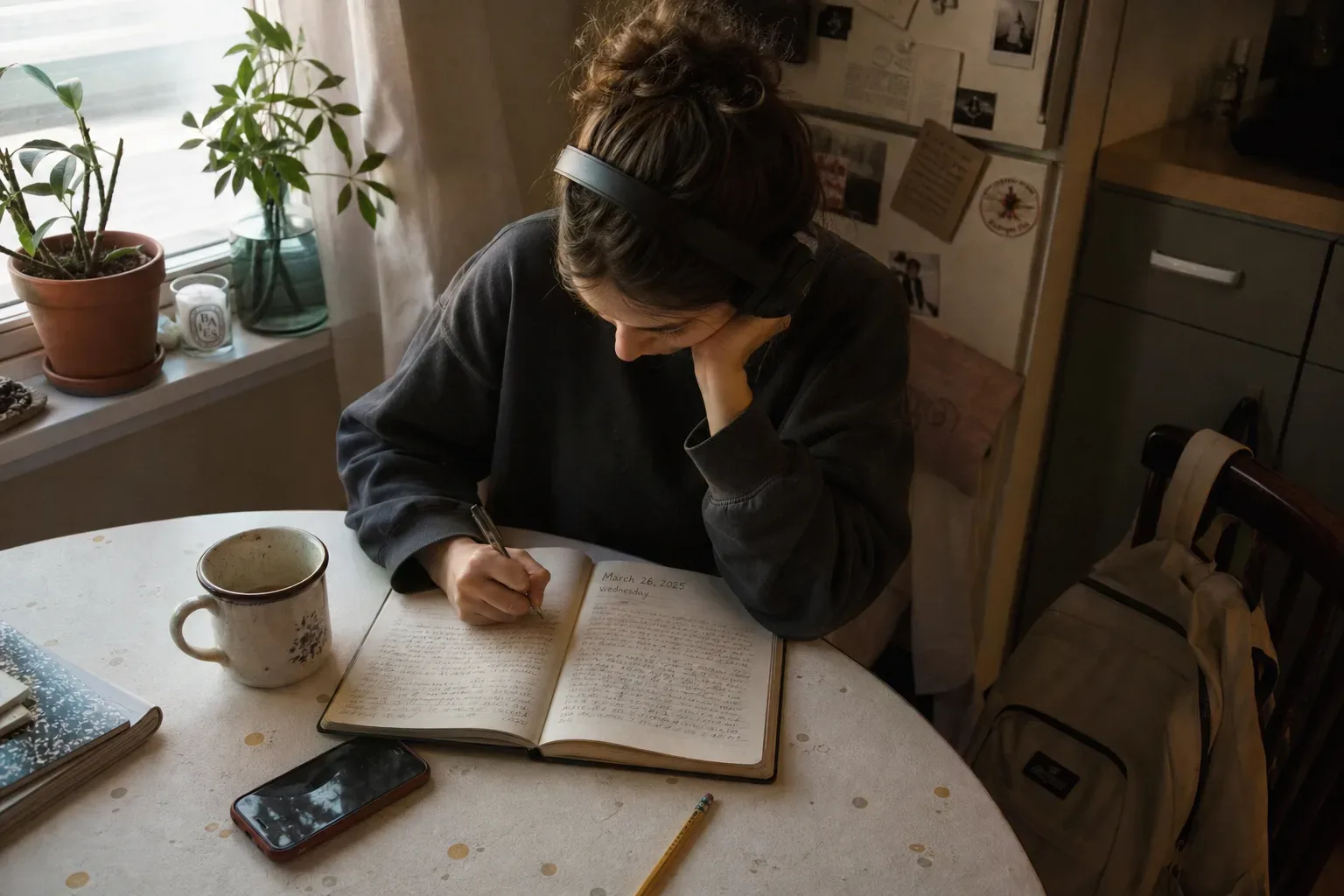
September 15. I listened at the kitchen table before my first call, the way I would have listened before lecture. Manifestation for students works best when it is small: hear the Dream-Self audio, name one class-day behavior, then carry that behavior into the room within 10 minutes.
Why would I listen before class instead of the night before?
Listening before class gives the mind a near cue, so the desired state has somewhere to land.
I learned this the practical way, not the graceful way. In college I made beautiful plans at 11:40 p.m. and forgot them by the time the 9 a.m. seminar started. The intention was sincere, but it was too far from the behavior. In habit research, context matters. Wendy Wood’s work on habit formation has shown that repeated actions attach themselves to stable cues, and a classroom door is a stronger cue than a vague promise made under a blanket.
This is why I like the phrase manifestation for students only when it stays close to the timetable. A student does not need another belief system before class. A student needs a repeatable cue, a calmer body, and one action that can be seen. The practice is not a substitute for reading chapter 4. It is a way to enter chapter 4 with less inner noise.
The American College Health Association’s 2023 undergraduate data reported that many students experienced moderate or serious psychological distress in the prior month, with figures often landing above 70% when moderate and serious categories are combined. I do not read that as a headline to panic over. I read it as a reminder that students are carrying more than backpacks into rooms.
A near cue helps because the nervous system is literal. If I listen 6 minutes before class, I am not asking my mind to remember a future identity in the abstract. I am asking it to practice a posture, a breath, and a first sentence now. A small ritual before the threshold can do what a large promise cannot.
The best student practice is not dramatic. It is repeatable at 8:53 a.m. with coffee on your sleeve.
What is Dream-Self audio in the AYA Method?
Dream-Self audio is a short personalized recording narrated from the version of you who has already become the student you are practicing toward.
In the AYA Method, the definition is exact: it is a daily audio manifestation practice. Each day you listen to a short personalized recording, your Dream-Self Moment, narrated from the version of you who has already manifested the life you intend. Listening is the practice. Repetition is the work. The audio is the method.
I am careful with that last sentence because I have watched myself turn good practices into dashboards with costumes. The audio is not one pillar among several. The daily affirmation I sometimes write in the margin, and the Manifestation Board I glance at on Sundays, are complements. They help if they help. They are not the center.
For a student, the Dream-Self Moment might sound like a future self who attends calculus without dread, or a nursing student who asks for clarification during lab, or a first-year literature student who has learned to speak while the thought is still imperfect. Neville Goddard wrote often about assuming the feeling of the wish fulfilled. I translate that into something less ornate before class: rehearse the felt reality, then do one matching thing.
There is also a cognitive reason to keep it audio. Dr. Andrew Huberman has often discussed how attention follows state, and state is shaped by breath, focus, and sensory input. A 2-to-8-minute audio gives the student fewer decisions than a blank page. Fewer decisions matter when the lecture starts in 7 minutes.
How do I do the 8-minute routine before class?
I do the routine by pairing one listen with one visible class behavior and one tiny note afterward.
Here is the version I wrote on an index card this morning. I dated it because dated things feel less like theory and more like evidence.
- Minute 0 to 1: arrive and stop scrolling. I put the phone face up only because the audio is there. Pew Research Center reported in 2024 that 95% of U.S. teens have access to a smartphone, and college students are rarely less connected. The first move is not spiritual. It is closing the feed.
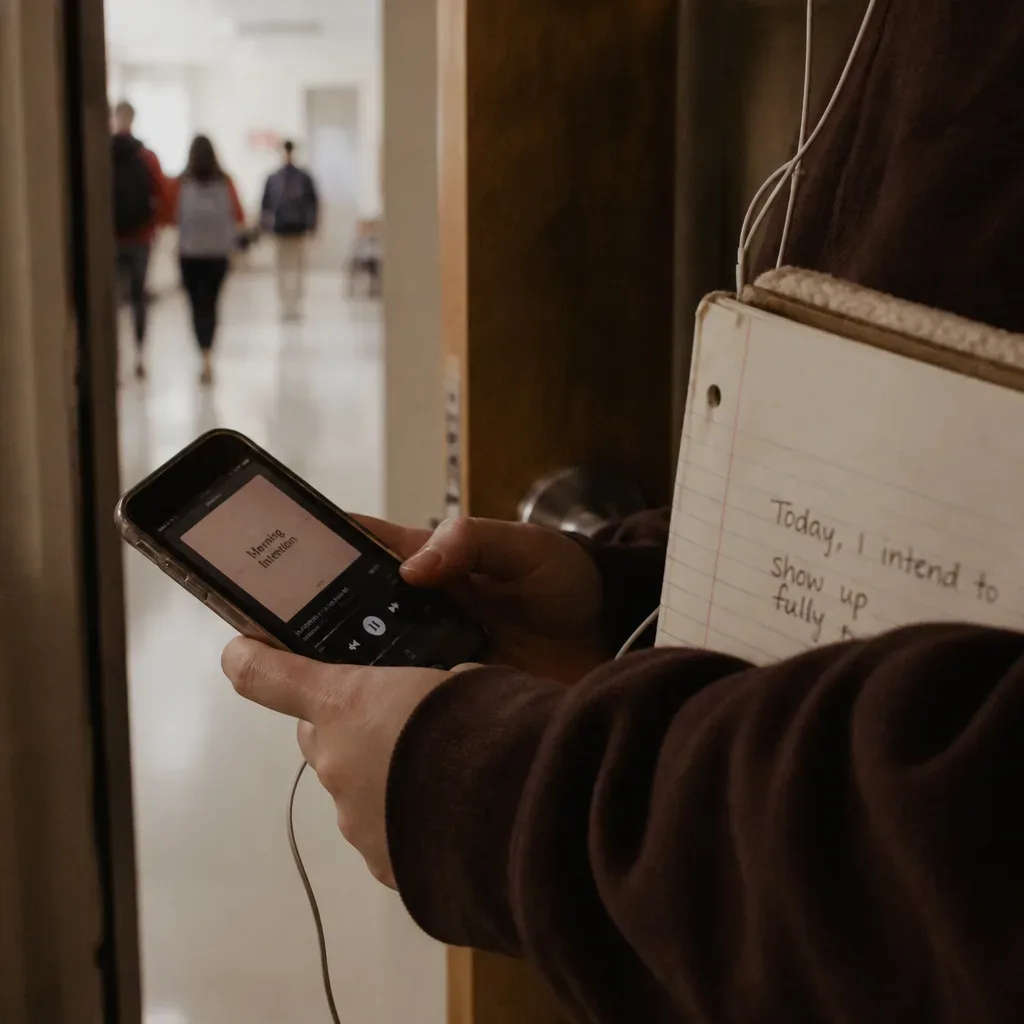
- Minute 1 to 5: listen to the Dream-Self Moment. I use headphones if I am in a hallway. On the bus, I keep my eyes open. Safety first. The point is not to disappear from the world. The point is to enter it more deliberately.
- Minute 5 to 6: name one class behavior. I choose something measurable: sit in the second row, write the date at the top of the page, ask one question, begin the worksheet before checking messages.
- Minute 6 to 7: take three slow breaths. Research on slow breathing is still developing, but small studies often find that paced breathing around 5 to 6 breaths per minute can improve heart-rate variability, a marker linked with regulation.
- Minute 7 to 8: cross the threshold. I walk in before I can renegotiate with myself.
The routine is short because students already have enough long things. Lectures run 50 or 75 minutes. Labs run 3 hours. Reading lists expand when no one is looking. A pre-class practice has to respect the life it is trying to support.
I also keep a rule that the chosen behavior must be visible. A feeling can be sincere and still slippery. A behavior leaves a trace. If I say I am becoming a steadier student, then opening my notebook before the professor starts is a better receipt than thinking intensely about steadiness.
What should I listen for in the recording?
I listen for the sentence that makes my next action obvious.
Some mornings, the sentence is not poetic. It is something like, I start before I feel ready. That sentence has carried me through more rooms than any polished affirmation. The Dream-Self voice is useful when it narrows attention. It should not make the day bigger. It should make the next move clearer.
I like to map common student worries to a listening cue because my engineer brain calms down when there is a table. Implementation intention research by Peter Gollwitzer has found that if-then plans can meaningfully improve goal follow-through across many domains. The audio sets the identity. The if-then plan gives it feet.
| Student worry | Listen for | One class behavior |
|---|---|---|
| I am behind | A steady student returns today | Write the date and begin the first task |
| I am afraid to speak | My voice can be brief and still count | Ask one prepared question |
| I do not belong here | I learn by staying in the room | Sit where I can hear clearly |
| I panic during tests | I move one line at a time | Read the first question twice |
The table is plain, but plain things save time. In my own tracking, I learned that an intention with one behavior attached survived busy weeks better than an intention with three behaviors. My sample size is one human being with a laptop and inconsistent sleep, so I do not pretend it is a study. Still, after 28 logged mornings, the single-action days were the days I actually remembered.
A student does not become different by making the plan more impressive. A student becomes different by making the plan easier to repeat when tired.
How do affirmations, boards, and astrology fit without taking over?
They fit as reminders, not as the method.
I write about this because I am prone to adding layers when I am nervous. A daily affirmation on the corner of a planner can be tender and useful. The Affirmations pillar is a good place to think about language that is believable enough to repeat. But before class, I do not want 12 sentences. I want one sentence I can carry through the door.
The same is true for a Manifestation Board. A board can remind a student why the work matters: the clinic they want to serve in, the studio they want to rent, the research poster they want to stand beside. But a board is not the practice in the AYA Method. The listening is. The board stays on the wall. The audio comes with me to the hallway.
I have also had weeks when I checked Astrology and manifestation because a moon phase made me want language for timing. I keep that gentle. If a transit gives me a reflective question, fine. If it makes me fatalistic before a chemistry quiz, I close the tab. No system gets to excuse me from doing the next kind thing.
For broader grounding, I return often to the Manifestation pillar, especially when I need the practice to stay connected to action. Attention without action becomes rumination. Action without attention becomes force. The student version needs both, in small amounts.
What should I track so I do not fool myself?
I track only the few signals that help me return tomorrow.
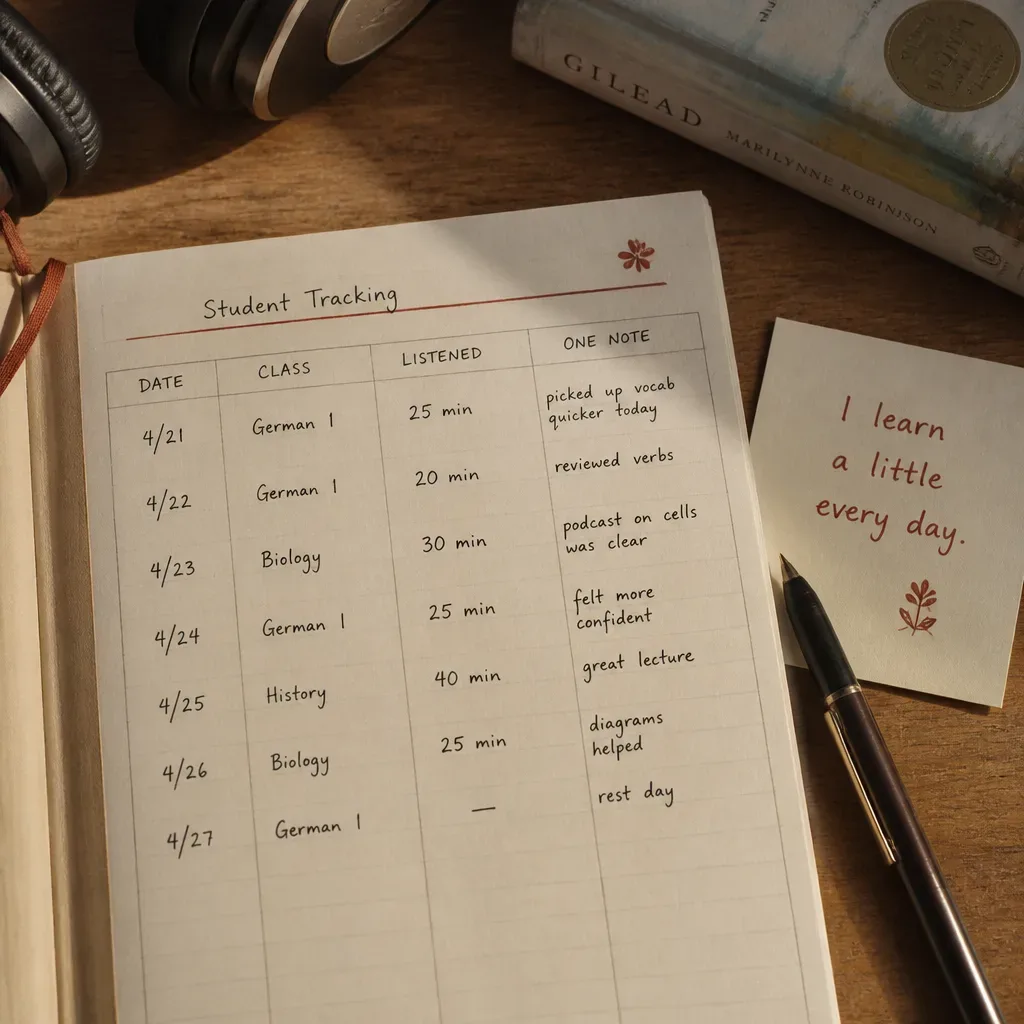
This is where my work brain enters the diary. I ship software in healthcare, and healthcare software taught me that a metric can look clean while hiding the human. So I keep the student log humane. Four columns are enough: date, class, listened, one note. If I add more, the log becomes homework, and homework already exists.
Here is the small list I would use for 5 class days:
- Date and class: September 15, Biology 102.
- Listened: yes, no, or partial.
- State before class: one word, such as tense, sleepy, flat, ready.
- Visible action: asked one question, opened notes, stayed after 2 minutes.
- After class note: one sentence, not a verdict.
A 2009 study in the European Journal of Social Psychology by Phillippa Lally and colleagues found that habit automaticity took a median of 66 days, with wide variation from 18 to 254 days depending on the behavior and person. I find that comforting. If a practice feels uneven after one week, that is not failure. That is data arriving early.
I would not track grades at first. Grades lag. They are affected by sleep, teaching quality, family stress, money, work shifts, and whether the exam asked the one thing you did not review. Track the controllable behavior first. Did I listen. Did I enter. Did I do the one visible thing.
A kind metric points you back to the practice. A cruel metric points you back to shame.
After 5 days, I would look for one pattern, not 14. Maybe the listen works better before discussion sections than lectures. Maybe the bus is too loud. Maybe the first class of the day needs a shorter recording because the kettle took too long. Useful data often sounds ordinary when it finally tells the truth.
What if I feel anxious, skeptical, or too tired?
I make the practice smaller before I make it more intense.
An anxious student does not need a scolding disguised as discipline. The National Institute of Mental Health notes that anxiety disorders are common, and campus counseling centers have reported high demand for years, including in the Center for Collegiate Mental Health annual reports. If listening to future-self language increases panic, pause. Put both feet on the floor. Name 5 things you can see. Ask for support when anxiety is more than a passing wave.
Skepticism is allowed too. I write for people who find just believe unpersuasive. I am one of them. The practice does not require me to pretend certainty. It asks me to test a repeatable input against my own behavior. Did the audio help me enter the room. Did it help me start sooner. Did it help me speak to myself decently when I got an answer wrong.
Too tired is its own category. Sleep research is blunt here: the American Academy of Sleep Medicine recommends that adults get 7 or more hours per night, and many students do not. If I slept 4 hours, the Dream-Self Moment does not become a magic cloak. It becomes a 3-minute kindness before I do the minimum honest work and go to bed earlier if I can.
On hard days, I use a reduced version:
- Listen to 60 seconds of the audio.
- Choose one tiny behavior.
- Do not insult myself in the notes.
That third step matters more than it looks. Measurable kindness is still kindness. A student who can return without self-punishment has learned something the transcript may never show.
How do I keep this practice for a full week of classes?
I keep it by lowering the friction and protecting the same cue for 5 school days.
On Sunday night, I would download or queue the audio, put headphones in the bag, and write the week’s classes on one page. That is not glamorous. It is infrastructure. James Clear popularized the 2-minute rule for habits, but the older behavioral idea is simple too: make the desired behavior easier to start than to avoid. For students, preparation often means removing one tiny morning argument.
I would also choose one anchor. Before the first lecture. After the bus stop. Outside the lab door. Anchors work because the brain loves sequence. In my own logs, skipped practice days clustered after late deploys, not after low motivation. The problem was not my character. The problem was a broken evening that broke the morning.
Here is the week I would try:
| Day | Cue | Audio | One behavior |
|---|---|---|---|
| Monday | Outside first classroom | Full listen | Open notes before class starts |
| Tuesday | Bus stop | Full listen | Sit where I can hear |
| Wednesday | Library chair | Short listen | Ask one question |
| Thursday | Hallway | Full listen | Start worksheet first |
| Friday | Kitchen table | Short listen | Write one after-class note |
If you miss a day, do not restart the identity from zero. The Manifestation pillar reminds me that practice is not proved by never slipping. It is proved by returning. I also return to the AYA Method page when I need the center again: the audio is the method, repetition is the work.
The week is not a contract with perfection. It is a way to gather five small pieces of evidence. Students live among deadlines, buses, group chats, part-time shifts, family calls, and rooms where they are still learning how to be seen. A practice that survives that life has to be quiet enough to fit inside it.
Tuesday night. My headphones are charging beside the blue mug.