audio manifestation
Listening Manifestation Practice for No-Journal Days
A listening manifestation practice for days you will not journal: a quiet audio-first method, with steps, timing, and gentle tracking.
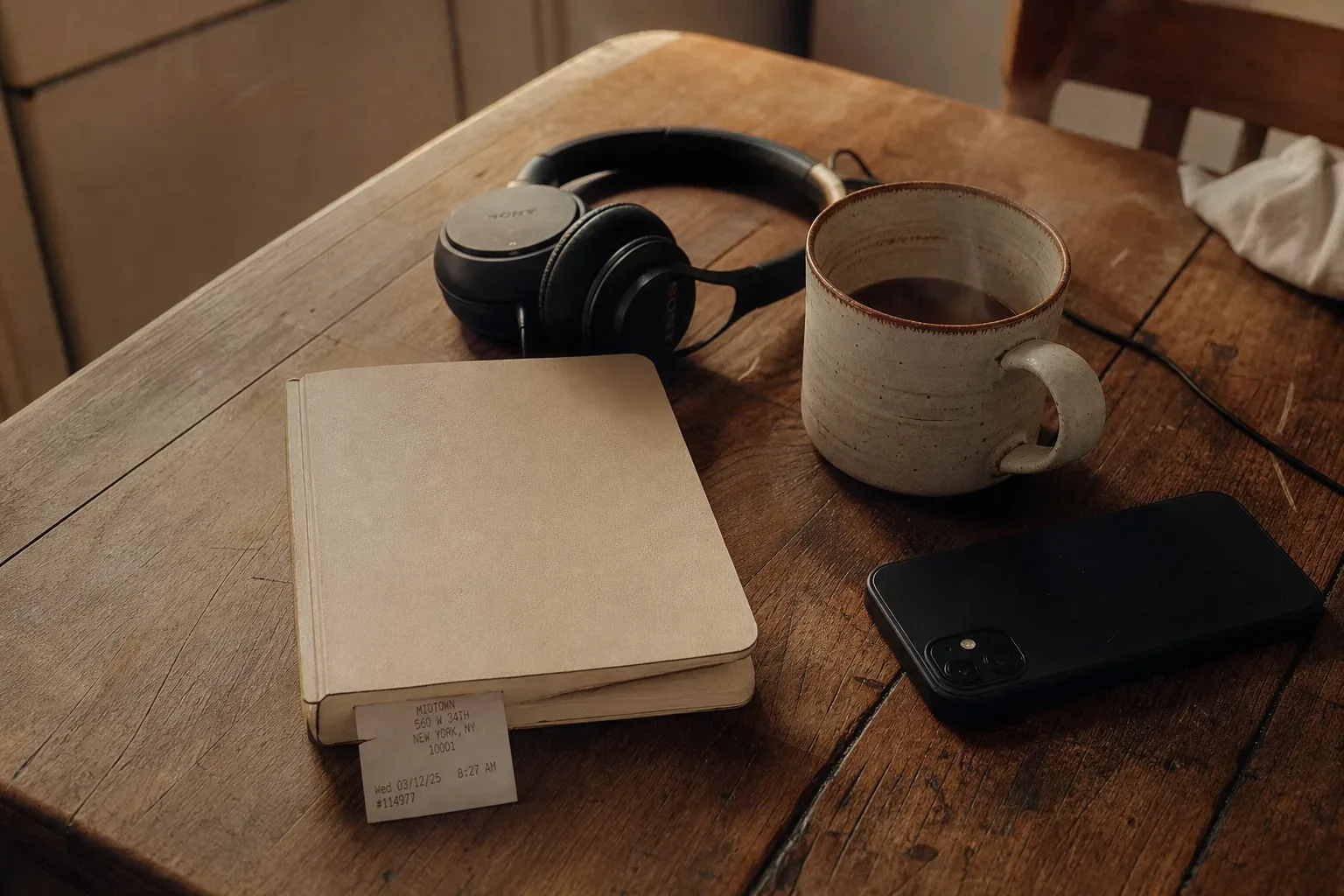
Saturday. The notebook was still on the kitchen table, closed, with a receipt tucked into it as a bookmark. A listening manifestation practice is the simplest way I keep my intention on days I will not journal: I listen to the audio, choose one sentence, and let repetition do the work.
What is a listening manifestation practice when the page stays blank?
A listening manifestation practice is an audio-first daily practice where I hear the life I am asking for described back to me, without needing to write anything down.
I am naming it carefully because I have confused myself before. Journaling is useful. It has helped me find the sentence under the sentence. James Pennebaker’s expressive writing research, which began in the 1980s, linked structured writing with improvements in stress-related outcomes in some groups. But some mornings, my hand refuses the pen. Not dramatically. Just quietly. The kettle clicks off, Slack is already waiting, and the blank page feels like one more person asking me for language.
On those days, I use audio. In the AYA Method, the AYA Method is a daily audio manifestation practice. Each day you listen to a short personalized recording, your Dream-Self Moment, narrated from the version of you who has already manifested the life you intend. Listening is the practice. Repetition is the work. The audio is the method.
That definition has become useful to me because it removes the guilt math. I do not owe the page three paragraphs before the practice counts. I do not have to perform insight at 7:12 a.m. The listening counts because attention counts. Repetition counts because the nervous system learns through contact, not speeches.
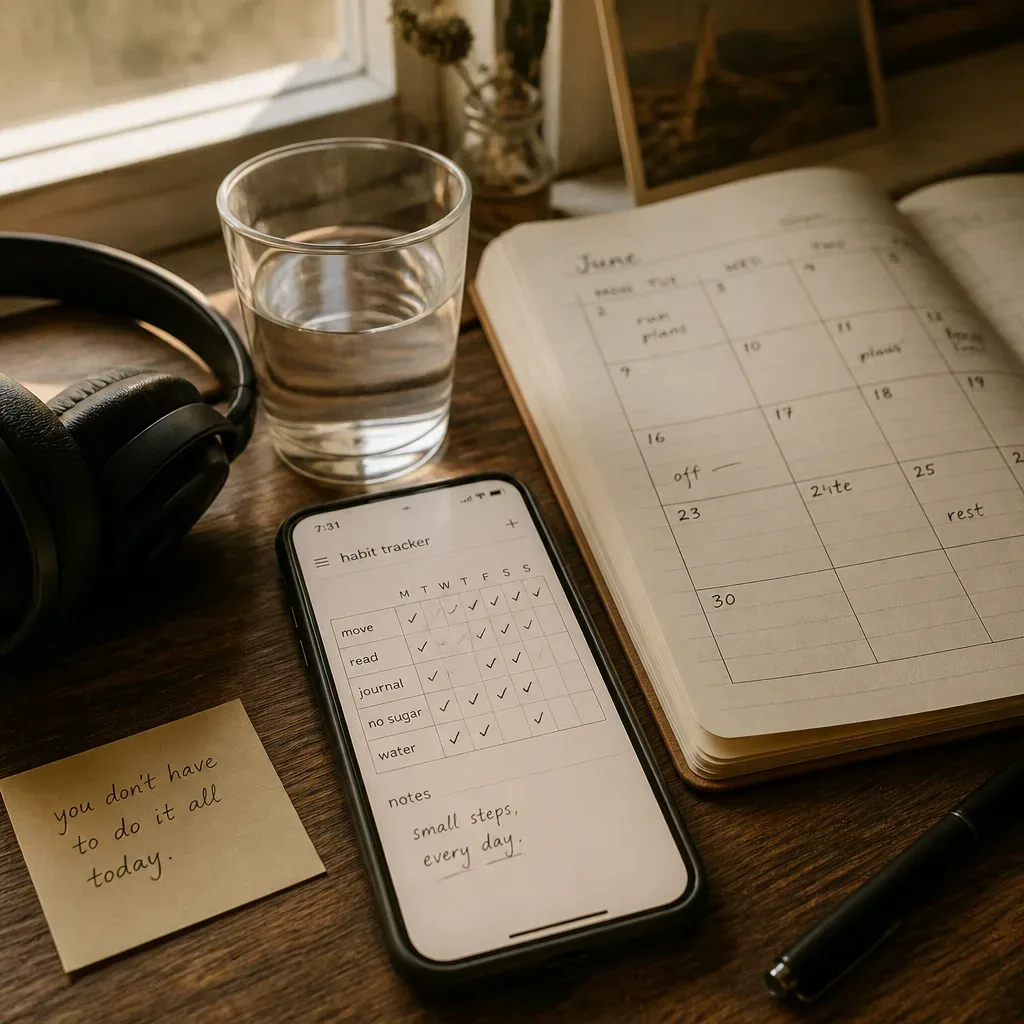
I keep a small tracker because I am Pris and because software made me this way. The row has 3 columns: listened, mood, sleep. That is enough. If I add too many fields, I start managing the practice instead of practicing it. A dashboard can become another locked door if I forget the human being it is measuring.
A practice does not become real because it is difficult. It becomes real because I return to it.
For a wider grounding in the language of asking, intention, and repetition, I keep returning to the Manifestation pillar. I like having one plain place to remember what the word means before I complicate it with my own metrics.
Why might listening work better than journaling on tired days?
Listening can work better than journaling on tired days because it lowers the effort required to begin while keeping the repetition intact.
There is a kind of tired that makes writing feel like lifting furniture. I noticed it during a two-week release window this spring. My sleep average dropped from 7 hours 21 minutes to 6 hours 12 minutes, according to the app on my phone. My journal entries fell off first. The audio stayed. Not every day, but more often than the page did.
Behavior science would not find that surprising. BJ Fogg’s Tiny Habits model, published widely after years of Stanford behavior design work, emphasizes making the desired behavior small enough to do even when motivation is low. The listening practice fits that idea. I can press play when I cannot produce a paragraph. I can sit in the chair and receive the words before I have my own.
There is also the matter of cognitive load. Working memory is limited. George Miller’s famous 1956 paper suggested the number 7, plus or minus 2, though later researchers have argued the practical capacity is often closer to 4 chunks. On a tired morning, writing asks me to hold intention, grammar, emotional honesty, and self-permission at once. Listening asks for less. It gives the sentence to me first.
Here is the comparison I wrote in my notebook before I stopped writing that day:
| Practice | Best for | Hard part | Minimum viable version |
|---|---|---|---|
| Journaling | sorting thoughts | starting from a blank page | 3 honest lines |
| Listening | repetition and tone | staying present | one full audio play |
| Affirmation | naming one belief | keeping it believable | one sentence after listening |
| Vision board | visual memory | over-editing the image | one image kept visible |
The table helped because it did not make the practices compete. I still read about language and belief on the Affirmations pillar, especially when I want one sentence after the audio. But on tired days, I do not promote the sentence above the listening. I let the audio carry the morning.
A small practice is not a lesser practice. Sometimes it is the only honest one available.

How do I set up the practice in under seven minutes?
I set up the practice by attaching the audio to one existing cue, deciding not to journal, listening once, and logging only the smallest useful proof.
I used to make rituals too large. I would put the candle on the counter, open the notebook, choose a pen, check the moon, find the playlist, and then somehow run out of time. The setup was prettier than my follow-through. Now I use a 7-minute container. Not because 7 is mystical to me, but because it fits between the kettle and the first calendar alert.
The 2010 study by Phillippa Lally and colleagues in the European Journal of Social Psychology found that habit automaticity took a median of 66 days, with a wide range from 18 to 254 days. I think about that range often. It reminds me that the goal is not to feel automatic by Friday. The goal is to make the practice repeatable enough that Friday has a chance.
Here is my no-journal setup:
- Choose the cue. I use the kettle on weekdays and the bath on Sundays.
- Name the condition. I say, quietly, this is a listening day.
- Press play before checking messages. If I check messages first, my attention leaves the room.
- Let the audio finish once. I do not pause to analyze.
- Pick one line. I carry one sentence into the next ordinary task.
- Log one mark. A yes in the tracker is enough.
The order matters because my phone is not neutral. Pew Research Center reported in 2024 that a large majority of U.S. adults own smartphones, and my own behavior confirms the obvious: once I enter the phone, the phone starts assigning me tasks. Listening before messages protects the practice from becoming another notification.
My current cue is embarrassingly plain. I press play after I rinse the blue mug and before I brush my teeth. I listened to my Dream-Self Moment before brushing my teeth for 24 of the last 31 mornings. That number is not perfect. It is much better than the 9 journal entries I wrote in the same month.
The cue is the doorway. The audio is the room.
What should I listen for if I am not writing reflections?
I listen for one believable sentence, one bodily softening, and one next action small enough to do before the day hardens.
When I am not journaling, I need a replacement for reflection that does not become secret journaling in my head. So I listen with 3 simple questions. What sentence did I believe by one percent more today? Where did my body unclench? What is the next decent action? These are not grand questions. They fit in the palm.
Dr. Andrew Huberman has often discussed the role of attention and state in learning, especially how repetition paired with salience can support neural change. I am careful with neuroscience claims because one person with headphones is not a lab. Still, I notice that when a line in the audio has emotional weight, I remember it later. Salience marks the sentence. Repetition keeps it from floating away.
Some mornings, the sentence is practical. You answer the email without apologizing twice. Some mornings, it is softer. You trust the quiet yes. I do not force myself to like every line equally. In a 4-minute recording, one honest line is enough for me to carry.
I use this small checklist after listening, usually while pouring coffee:
- Did I finish the audio once?
- Did one sentence feel believable, even slightly?
- Did my breath change anywhere?
- Is there one action under 2 minutes that matches what I heard?
- Can I leave the notebook closed without making that mean failure?
The 2-minute action comes from the same family of habit thinking as David Allen’s Getting Things Done rule: if something takes less than 2 minutes, do it now. I do not use it for every task, but it helps here. If my Dream-Self Moment reminds me that I am not hiding from money, I open the bill. If it reminds me that I answer cleanly, I send the message.
I also keep one eye on timing and one eye on tenderness. Data can tell me that I listened 24 days. It cannot tell me whether I bullied myself through all 24. That part I have to tell the truth about.
How do I keep it from becoming passive or vague?
I keep it from becoming passive by pairing the audio with one named behavior and one honest measure.
This is where my engineer brain becomes useful, as long as I do not let it take over the house. Listening is receptive, but it is not passive. Music practice is also listening. Language learning is full of listening. In both cases, repetition builds familiarity before fluency appears. The same principle helps me here: I hear the identity before I can always act from it.
Neville Goddard wrote often about assuming the feeling of the wish fulfilled. I read him with both interest and caution. The useful part, for me, is not pretending. It is rehearsal. If the audio says I speak plainly in meetings, I do not wait for a new personality to arrive. I choose one meeting and remove one unnecessary apology.
I use a tiny tracking rule because measurement changes behavior. A 2008 review in the Journal of the American Medical Association found that self-monitoring was one of the more consistent predictors in weight management interventions. Different context, yes. Still, the principle is familiar: what I kindly observe becomes easier to repeat.
My measure is not elaborate. It looks like this:
| Field | Options | Why I track it |
|---|---|---|
| Listened | yes / no | consistency without drama |
| Mood after | 1 to 5 | not a verdict, just weather |
| One behavior | 1 short phrase | proof in ordinary life |
The behavior field matters most. If I only track mood, I start chasing a feeling. If I track one behavior, I remember that manifestation practice has to touch the day. The behavior can be tiny: sent invoice, drank water, asked directly, closed laptop at 8:30.
I have learned to distrust big conclusions from small samples. A sample size of 1 is intimate, not universal. My tracker cannot prove that audio caused a better day. It can show me that on weeks when I listened at least 5 mornings, I tended to speak to myself less harshly. That is not a clinical claim. It is a useful household truth.
A metric is kind when it helps me return without humiliating me.
Where do affirmations, boards, or astrology fit on no-journal days?
They fit as complements only after the listening, if they make the practice clearer rather than heavier.
I keep saying this to myself because I like adding things. I like systems. I like tidy names and little boxes. But the audio is the practice. The daily affirmation is sometimes a match struck after the candle is already lit. The Manifestation Board is sometimes a visual reminder I pass on the way to the sink. Neither has to become a second assignment.
When I do use an affirmation, I keep it close to the sentence I heard in the audio. If the Dream-Self Moment says, I make decisions without abandoning myself, my affirmation might be, I can choose and stay with myself. I do not use language I secretly reject. Research on self-affirmation, including work by Claude Steele and later health-behavior studies, suggests affirmations can help when they connect to values. Forced positivity is not the same thing.
The board is even simpler. One image. One glance. I do not redesign it on a no-journal day. I have lost too many mornings to arranging evidence of a life instead of living one minute of it. A visual cue should return me to the practice, not become a craft project with better lighting.
Astrology is similar for me. I read transits sometimes, the way I check weather before choosing shoes. The Astrology and manifestation guide is useful when I want timing language, but I do not let timing replace listening. If the moon is doing something interesting and I still have only 4 minutes, I press play.
A no-journal day is allowed to stay simple:
- Audio first.
- One sentence carried.
- Optional affirmation if it feels true.
- Optional board glance if it steadies attention.
- No extra debt tomorrow.
That last line is the one I need most. I do not make up missed pages. I do not write double because Tuesday was tired. The practice is not a punishment system with incense near it.
For the broader architecture of asking and attention, I keep this manifestation guide bookmarked. For sentence-level practice, I return to this affirmations guide. Then I close the tabs and listen.
What do I do tomorrow if I skipped today?
I return tomorrow without repayment, because consistency is built by reducing shame, not by charging interest on missed days.
This is the part I keep learning in public and in private. I miss days. Usually after late deploys. Sometimes after an argument with my mother. Sometimes for no reason I can defend. The old version of me would open the tracker, see the blank cell, and decide the whole month was ruined. The newer version writes nothing dramatic. She presses play the next morning.
Habit researchers sometimes call this the what-the-hell effect, a phrase associated with dieting research by Janet Polivy and colleagues. One lapse becomes a reason to abandon the larger intention. I see the same pattern in my practice logs. If I mark a missed day as failure, I am more likely to miss the next one. If I mark it as data, I usually return within 24 hours.
So I have a reset protocol. It is plain enough to survive real life:
- Do not explain the missed day unless the explanation helps.
- Use the same cue as before.
- Listen once, even if attention is messy.
- Log yes, not redeemed.
- Take one behavior that matches the audio.
The word redeemed is banned from my tracker. It makes the practice sound like a debt ledger. I am not trying to become a better machine. I am trying to become a person who can return without making a courtroom inside her chest.
There is good evidence that self-compassion supports behavior change. Kristin Neff’s work on self-compassion, developed in the early 2000s, has been linked in multiple studies to resilience and lower self-criticism. I do not need to overstate it. I can simply say this: I keep more promises when the promise is not guarded by contempt.
If you want the shortest possible version for tomorrow morning, it is this. Put the notebook away. Press play. Let one sentence find you. Do one small thing that agrees with it. If you want more background, read the AYA Method and then try the audio before you try to optimize it.
The page can wait. The listening can begin while the kettle comes on.
Sunday now. The notebook is still closed, and I am not calling that a loss.