mindset
Imposter Syndrome Manifestation With Future-Self Audio
Use imposter syndrome manifestation with future-self audio to steady self-doubt, rehearse belonging, and act from the person you're becoming.

A coffee cup cools beside your laptop. The email is written, but not sent. Imposter syndrome manifestation means rehearsing the self who can send it while fear is still present. Future-self audio helps by making belonging familiar through daily listening, then pairing that listening with one small confirming action.
What is imposter syndrome manifestation, really?
Imposter syndrome manifestation is the practice of using future-self repetition to make belonging feel less foreign before you act.
The phrase can sound strange at first. Imposter syndrome is often treated as a private defect, as if the answer is to become tougher inside. It isn’t that simple. Pauline Clance and Suzanne Imes first described the imposter phenomenon in 1978, especially among high-achieving women who could not internalize success even when evidence was visible. Since then, the pattern has been found across genders, professions, and cultures.
A 2020 review in the Journal of General Internal Medicine reported prevalence estimates ranging from 9% to 82%, depending on the population and measure used. That wide range matters. It means you’re not looking at a rare weakness. You’re looking at a common human response to visibility, evaluation, and status change.
Manifestation, at its cleanest, is not wishing. It is attention plus rehearsal plus action. On Aya, manifestation is treated as a daily practice, not a dramatic announcement. You rehearse the self who can hold the result, then you behave in one small way that agrees with that rehearsal.
Future-self audio gives the practice a body. You don’t only write the new identity. You hear it. You listen to a voice narrating from the self who has already done the hard thing and remained intact. The nervous system learns through repetition, and repetition is quieter than force.
Imposter syndrome loses some of its grip when belonging stops being a theory and starts becoming a sound you recognize.
Why does future-self audio help when self-doubt is loud?
Future-self audio helps because the brain responds to repeated identity cues, especially when they’re specific, sensory, and tied to action.
Hal Hershfield’s research on future-self continuity, published in work from 2011 onward, shows that people who feel more connected to their future selves tend to make choices that protect that future self, such as saving more money or acting with longer time horizons. The point for imposter syndrome is simple. If your future self feels like a stranger, your present choices often stay small.
Audio adds closeness. Reading a sentence can be useful. Hearing a future version of you describe the room, the breath, the next step, and the steadiness after being seen can land differently. In neuroscience-adjacent practice, Dr. Andrew Huberman has often pointed to repetition and state as key parts of learning. You don’t need a dramatic state. You need a repeatable one.
Self-affirmation research also gives a clue. A major review by Cohen and Sherman in the Annual Review of Psychology in 2014 found that affirming important values can reduce defensiveness under threat. That doesn’t mean repeating bright lines until you believe them. It means returning to a larger self when one part of you feels judged.
This is where the AYA Method belongs, quietly. The AYA Method is a daily audio manifestation practice. Each day you listen to a short personalized recording — your Dream-Self Moment — narrated from the version of you who has already manifested the life you intend. Listening is the practice. Repetition is the work. The audio is the method.
The daily affirmation and Manifestation Board in the app can support what you hear. They are complements. The center is the listening. One recording. One return. One small action after.
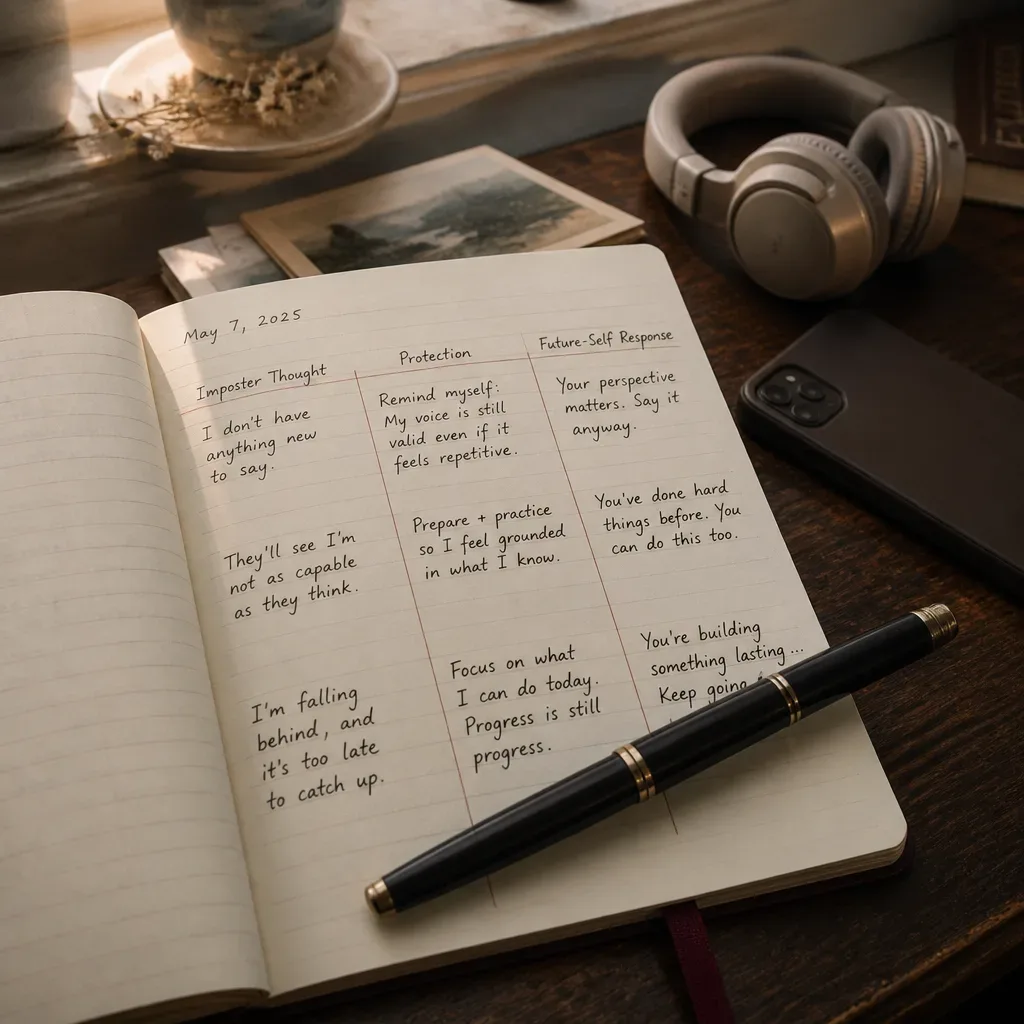
How do you name the imposter thought without feeding it?
You name the imposter thought by writing it plainly, then treating it as a signal rather than a verdict.
Most imposter thoughts arrive as bad weather with a legal tone. They say you tricked them. They say the praise was luck. They say the room will find out. The first step is not to argue. The first step is to write the sentence exactly. In cognitive behavioral approaches, thought labeling is used because distance changes the relationship to the thought. You can observe a sentence more easily than you can fight a fog.
Try this for 2 minutes. Set a timer. Finish the line: My imposter thought says that I am ____. Keep going until the sentence feels embarrassingly honest. Maybe it’s not qualified enough. Maybe it’s too late. Maybe it’s everyone else knows the code and I don’t. The sentence is data.
Then add one quieter line under it: This is a fear response, not a fact. That sentence will not fix everything. It will create a small space. Research on affect labeling, including work by Matthew Lieberman and colleagues in 2007, suggests that naming emotion can reduce amygdala activity in lab settings. Small language can change threat intensity.
Use the table below before you write your audio script:
| Imposter sentence | What it protects | Future-self response |
|---|---|---|
| I don’t belong here | Safety from rejection | I can be new and still be real |
| They made a mistake choosing me | Safety from responsibility | I can learn inside the role |
| I got lucky | Safety from being seen | Luck didn’t do the work for me |
| I can’t fail publicly | Safety from shame | A mistake is not an exile |
The goal is not to delete the old sentence. The goal is to stop letting it write your calendar.
How do you write future-self audio for imposter syndrome?
You write future-self audio by choosing one real scene and narrating it from the self who has already lived through it with steadiness.
Start small. Not a whole new life. One scene. A Monday meeting. A grant application. A sales call. A first lecture. A studio visit. A client presentation. The more specific the scene, the easier it is for the mind to rehearse. Mental practice research is old and sturdy here: in a 1995 study by Pascual-Leone and colleagues, mental rehearsal of piano sequences changed motor-cortex patterns in ways that resembled physical practice, though physical practice still mattered.
Use 150 to 250 words for your script. At a calm speaking pace, that becomes roughly 60 to 100 seconds. Aya’s Dream-Self Moment is short by design because a daily practice has to survive real mornings. If it needs a perfect room and 40 minutes, it will vanish the first week your life gets ordinary.
Write in present tense. Not someday I’ll be confident. Write: I open the call. My shoulders are lower. I answer the first question slowly. I don’t rush to prove I belong. I let the work speak, then I add one clear sentence. I receive the nod without shrinking.
A simple structure helps:
- Name the scene. Put yourself in a specific room, screen, chair, street, or doorway.
- Name the body. Add breath, hands, jaw, spine, feet, voice, or pace.
- Name the action. Include one behavior your future self actually does.
- Name the repair. Include what happens if you stumble.
- Name the after. Let the scene end with ordinary steadiness.
If you like written supports too, the affirmations library can help you find one sentence to hold after listening. Keep it secondary. The audio teaches the inner scene. The affirmation can be a small note in your pocket.
A believable future self does not shout over fear. It speaks from the other side of one completed action.
When should you listen so the practice actually changes your day?
You should listen once a day, close enough to the trigger that your next action can confirm what you heard.
Timing matters because imposter syndrome is often situational. You may feel fine on a walk and false inside a meeting. You may feel steady with friends and small when pricing your work. A 2022 workplace report from KPMG found that many executive women still reported imposter feelings despite high responsibility. Status does not automatically remove the pattern.
Pick one listening window for 7 days. Before opening the laptop. Before entering the building. Before sending a proposal. Before recording yourself. Before asking for payment. The window should be small enough that you can repeat it on a boring Tuesday. A 3 to 5 minute practice is realistic for more people than a long ritual.
Behavioral science supports this plainness. Peter Gollwitzer’s work on implementation intentions, beginning in the late 1990s, found that if-then plans improve follow-through across many goals. So make the audio part of a cue: If I sit down to write the application, then I listen first. If I park before the interview, then I listen before I check messages.
Here are useful cues:
- Before the situation that makes you shrink
- After brushing your teeth, if mornings are calm enough
- Before opening a blank document
- Before a call where you usually over-explain
- After receiving praise, if praise makes you want to disappear
There is one warning. Don’t use listening as a delay tactic. If you replay the audio 5 times to avoid sending the email, the practice has become a hiding place. Listen once. Act once. Keep the ritual small enough to tell the truth.
What action should follow the audio?
The action after the audio should be small, visible, and directly related to the identity you just rehearsed.
Manifestation without action becomes decoration. Action without identity rehearsal can feel like white-knuckling. The useful middle is a small confirming act. After the audio says you are someone who can speak, ask one question. After it says you are someone who can be seen, post the draft. After it says you are someone who can receive praise, answer with thank you and stop there.
BJ Fogg’s behavior model, widely used in habit design, centers on making behavior small enough to happen when motivation is unstable. This matters for imposter syndrome because motivation often collapses near exposure. You don’t need a grand act. You need a behavior that proves the old sentence is no longer in charge.
Use this 4-part pattern after listening:
- Send one thing. Email, invoice, pitch, draft, application, message.
- Say one thing. A clear opinion, a boundary, a question, a rate.
- Stay one minute. Remain visible after praise, silence, or correction.
- Record one proof. Write down what happened, not what fear predicted.
The proof log matters. Memory has a bias toward threat. If the meeting went 80% fine and one sentence felt awkward, the imposter mind will frame the awkward sentence as the truth. A written proof log gives you counter-evidence. Keep it plain: I asked the question. Nobody mocked me. The client said yes. I corrected myself and stayed.
If symbols and timing help you stay with a practice, you might also read astrology and manifestation as a softer companion. But don’t let timing replace the next action. The day you’re in is always usable.
Confidence is not the price of entry. Sometimes it’s what arrives after you’ve acted while your hands were still cold.
How do you know the practice is working?
You know the practice is working when the gap between self-doubt and action gets shorter.
Do not measure this by constant confidence. That is a cruel metric. Measure it by latency. How long between the fear and the send button? How long between praise and your need to deflect it? How long between a mistake and your return to the work? If the gap moves from 3 days to 30 minutes, something real has changed.
Track 3 numbers for 14 days:
| Metric | What to write | Good sign |
|---|---|---|
| Listen count | Did I listen today? | 10 or more listens in 14 days |
| Action count | What did I do after? | One small act per listen |
| Recovery time | How fast did I return after doubt? | Shorter gaps by week 2 |
Fourteen days is long enough to see patterns and short enough not to turn the practice into a self-improvement project. In small habit studies, consistency in the first 2 weeks often predicts whether a routine survives. The exact number varies, but early repetition matters.
You can also watch for subtler signs. You over-explain less. You let your work be judged without treating judgment as exile. You receive a compliment without handing it back. You stop researching for 4 more hours when the real next step is to send.
For a broader base, keep returning to the AYA Method and the wider practice of manifestation as repetition plus action. If you use affirmations, let affirmations be the short line that remains after the audio. The method is still the listening.
The future self becomes useful when it changes what you do in the next 10 minutes.
You can come back before you believe it.