aya method deep dive
Don't Know What to Manifest? Build Dream-Self Audio
If you don't know what to manifest, build a Dream-Self audio from sensory details, values, and one honest next scene you can listen to daily.
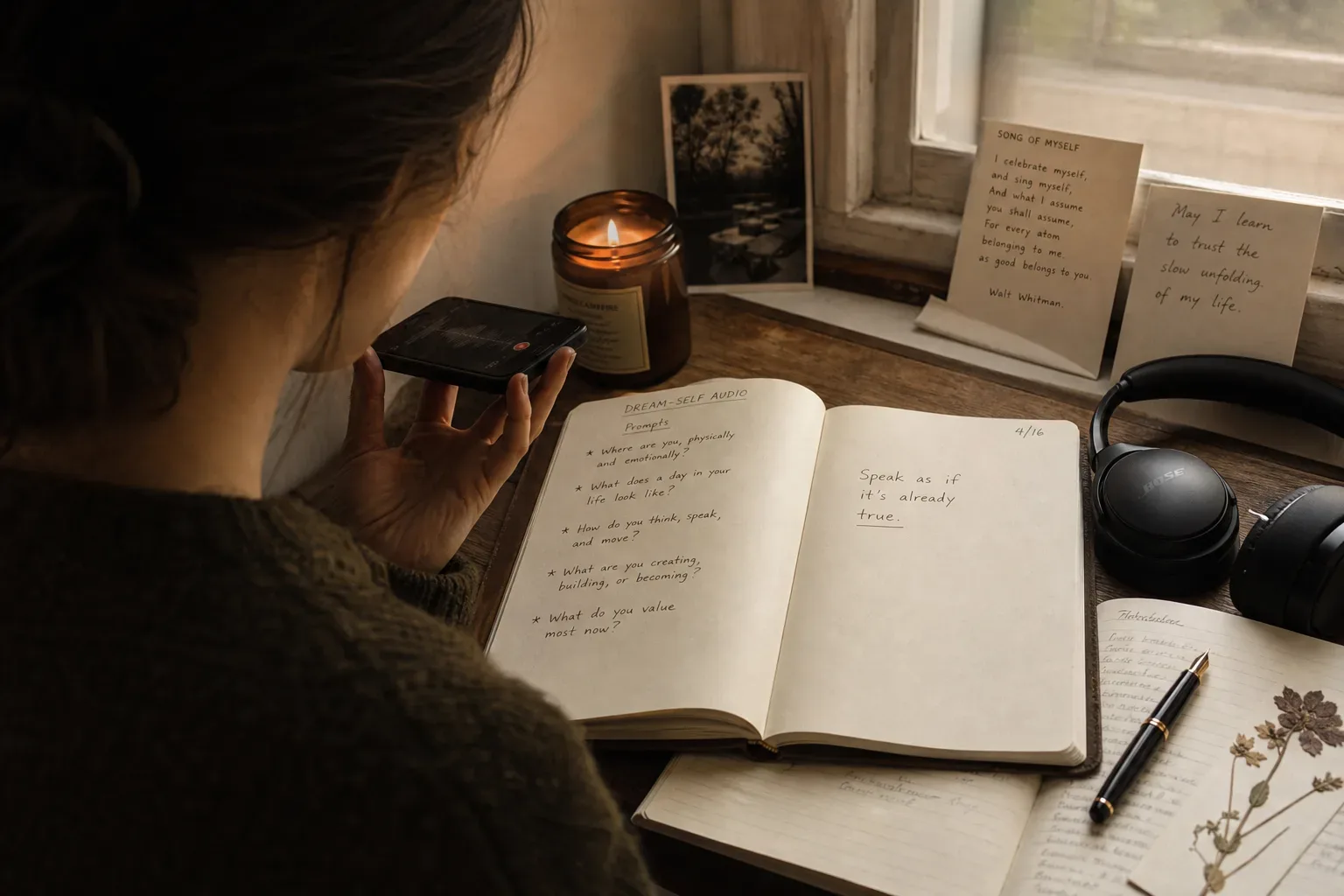
The phone is face down. The room is quiet. If you don’t know what to manifest, start by building a short Dream-Self audio around one lived scene: how your future self wakes, moves, chooses, and feels. Clarity often arrives after the voice has somewhere simple to stand.
What do you do when you don’t know what to manifest?
You choose one felt change before you choose one visible outcome.
When the desire is blank, the blankness is information. It may mean you’re tired. It may mean you’ve been borrowing other people’s goals. It may mean the wish is real but not yet safe to name. The first move is not to force a grand answer. It is to make the question smaller.
Goal-setting research has been saying something adjacent for decades. Locke and Latham’s 2002 review in American Psychologist summarized about 35 years of findings: specific, challenging goals tend to improve performance more than vague goals. But before specificity, you need contact. A desire you can’t feel will not stay in your day.
Start here:
- Pick one life area: work, love, body, home, money, creativity, or rest.
- Write one sentence beginning with, I want life to feel more…
- Finish it with a body word, not a status word.
- Ask what one ordinary moment would prove that feeling is true.
- Turn that moment into a 2 to 5 minute audio.
A clear desire is not always louder. Sometimes it is simply less defended.
If you write, I want to be successful, your mind may go cold. If you write, I want to open my laptop and know what matters first, the body can answer. The second sentence has a room inside it. It has a morning. It has a self you can listen to.
This is why the Manifestation pillar begins best when it is lived, not performed. Manifestation is easier to practice when the image is close enough to believe and honest enough to repeat.
Why does a Dream-Self audio help when the wish is blurry?
Dream-Self audio helps because it gives an unclear desire a voice, a place, and a repeatable cue.
Here is the exact frame. the AYA Method is a daily audio manifestation practice. Each day you listen to a short personalized recording — your Dream-Self Moment — narrated from the version of you who has already manifested the life you intend. Listening is the practice. Repetition is the work. The audio is the method.
Audio matters because attention is not only visual. A 2016 study by Kang and colleagues in Social Cognitive and Affective Neuroscience found that self-affirmation was associated with activity in brain regions linked to self-related processing and valuation, including the ventromedial prefrontal cortex. The finding does not prove that a sentence creates an outcome. It does suggest that personal, future-oriented language can engage parts of the mind involved in meaning and choice.
A Dream-Self audio also lowers the design burden. You don’t have to make a perfect board, pick the right photo, or write ten polished statements. You only need to hear a future self speak in a way that feels true enough to return to tomorrow.
The voice can hold nuance better than a slogan. It can say, I wake slowly now. I answer the message without shrinking. I know what to do first. I don’t need to explain my whole life before breakfast.
Clarity is easier to receive when it sounds like you, not like a poster on a wall.
If you’re used to working with written statements, the Affirmations pillar can support this. But in this practice, daily affirmation is a complement. It is not the center. The center is the repeated Dream-Self Moment.
What should you ask before you write the audio?
You should ask questions that lead to evidence, not fantasy.
The best prompts are small enough for the nervous system to answer. In clinical and behavioral research, specificity often helps intention become action. Gollwitzer and Sheeran’s 2006 meta-analysis on implementation intentions reviewed 94 studies and found that if-then planning had a medium-to-large effect on goal achievement. The lesson for manifestation is simple: a future becomes easier to rehearse when it has conditions.
Use these questions before writing:
- What is the first sign that life is no longer organized around fear?
- What room am I in when I notice the shift?
- What am I wearing, holding, opening, sending, or closing?
- What decision feels easier now?
- Who can hear the difference in my voice?
- What am I no longer checking?
- What does my calendar stop proving?
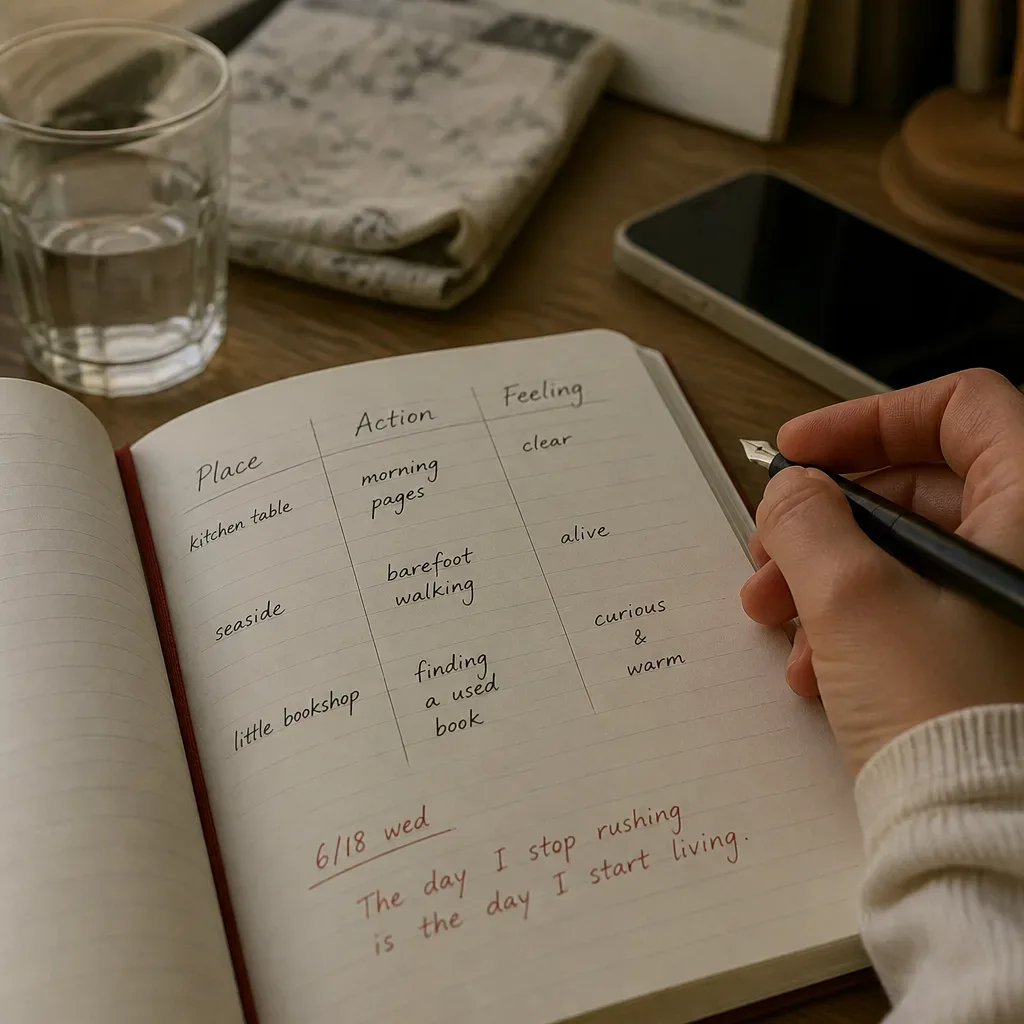
You are not trying to write a screenplay. You are gathering proof. Three details are enough: a place, an action, and a feeling. If you have more than three, choose the ones your body believes.
A useful test is the 10-second test. Read the scene out loud. If your chest tightens, soften it. If your face relaxes, keep going. Somatic language is not a scientific instrument, but body response can be a practical filter. In small studies on expressive writing, including work associated with James Pennebaker, naming personal material in concrete language has been linked with measurable changes in stress-related outcomes.
| Blurry want | Clearer Dream-Self scene |
|---|---|
| I want money | I open my banking app and breathe normally |
| I want love | I send the honest text without rehearsing it 12 times |
| I want purpose | I begin the first task before checking everyone else’s life |
| I want confidence | I hear myself speak at the meeting and don’t rush |
The wish becomes clearer when it becomes observable.
How do you write the first Dream-Self script?
You write it as one present-tense scene narrated by the self who already lives the shift.
Keep it short. A 2 to 5 minute recording usually needs about 300 to 700 spoken words, depending on pace. For a first version, aim closer to 300. The goal is not literary beauty. The goal is repeatability. Lally and colleagues, in a 2010 European Journal of Social Psychology study, found that habit automaticity took a median of 66 days to form, with wide variation. The exact number is not the rule. The pattern is: small enough to repeat wins.
Use this structure:
- Arrival: Name where you are. One sentence.
- Body: Name how you feel physically. One sentence.
- Proof: Describe one thing that is now different.
- Choice: Describe the action you take from this new self.
- Return line: End with a sentence you can hear every day.
Here is a simple draft shape:
I wake in my room and the light is soft. My body is not bracing for the day. I know what matters first, and I don’t bargain with myself before beginning. The message I used to avoid is already answered. My calendar has space around the work that matters. I move slowly, and I still move. This is mine now.
Notice what is missing. No pressure. No perfect identity. No list of ten outcomes. The Dream-Self voice does not need to sound like a coach. It needs to sound like the part of you that is done abandoning yourself.
Neville Goddard often taught the idea of assuming the feeling of the wish fulfilled. You don’t have to accept every metaphysical claim to use the practical part: rehearse the fulfilled state in a scene that feels intimate. Joe Dispenza also emphasizes mental rehearsal, though his claims are debated. Keep what is usable. Return to what is honest.
If you want timing as a reflective layer, Astrology and manifestation can help you choose when to write or revise. It should not replace listening. Timing can be a doorway. The audio is still the room.
How do you record and listen without making it precious?
You record it plainly, listen daily, and resist editing until the audio has had time to meet you.
Use your phone microphone. Sit somewhere you won’t perform. Read more slowly than you think you need to. Dr. Andrew Huberman has often spoken about how repetition and attention shape learning, drawing from neuroplasticity research. The practical takeaway here is not complicated: the mind tends to learn what it repeatedly attends to.
Do not wait for the perfect voice. The first recording may sound awkward. That is allowed. Your voice is not auditioning. It is becoming familiar.
Try this 7-day listening rhythm:
- Day 1: Record once. Listen once. Change nothing.
- Day 2: Listen in the same place if possible.
- Day 3: Notice one sentence that lands.
- Day 4: Notice one sentence that feels false.
- Day 5: Keep listening anyway.
- Day 6: Write one note after listening.
- Day 7: Revise only if the desire is clearer.
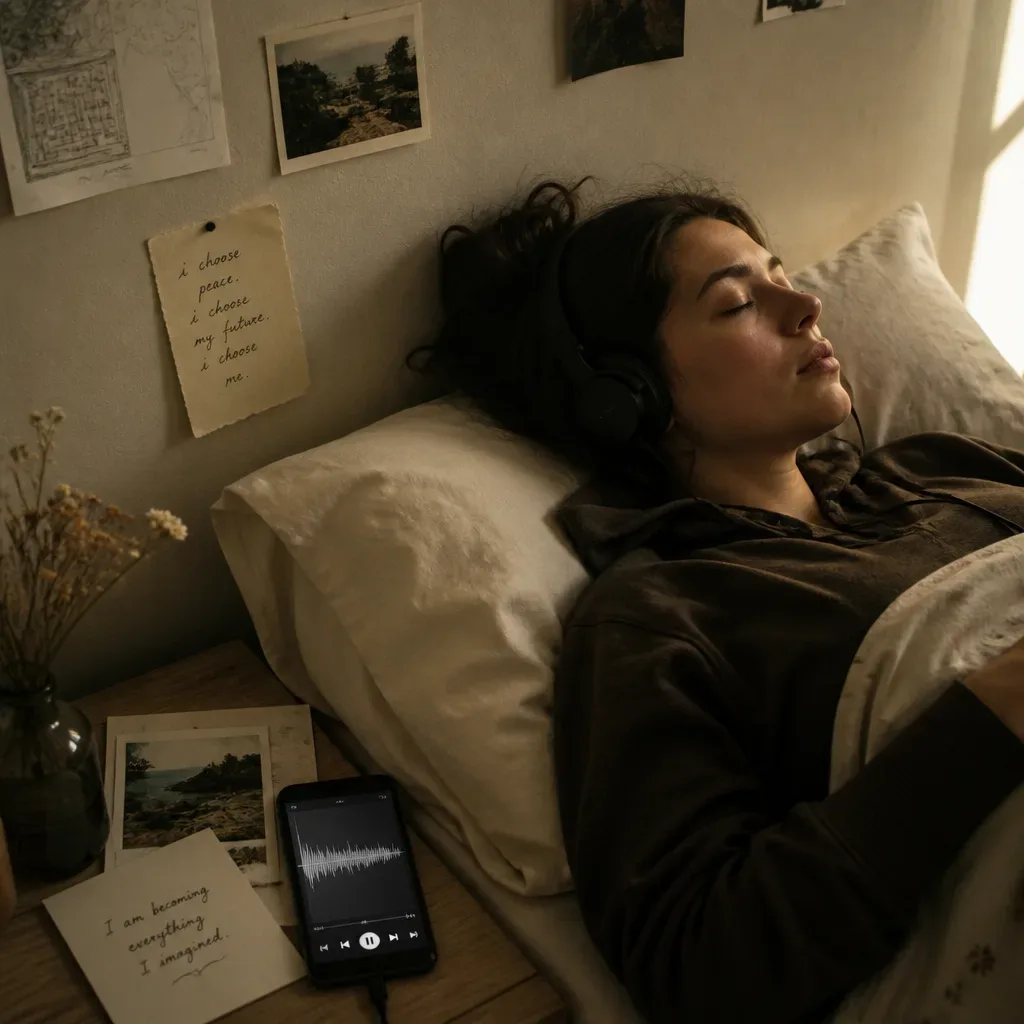
Seven days is not magic. It is just long enough to see whether the words soften or harden. In behavior studies, even brief daily practices can change adherence when they are cued by an existing routine. The cue can be brushing your teeth, opening curtains, or putting in headphones before sleep.
The gentlest rule is this: do not keep rewriting because you’re afraid to be seen by your own desire.
If one line feels wrong, mark it. If the whole audio feels too far away, bring it closer. I own a studio can become I sit at my desk and make the first honest page. Your future self should stretch you, not shame you.
How do you use complements without losing the audio?
You use complements as quiet reminders, while the Dream-Self audio remains the daily practice.
The app may include a daily affirmation or a Manifestation Board, and both can help. But they are not equal pillars inside this method. Audio leads. The board gives the eye something to see. The affirmation gives the day one sentence to carry. The Dream-Self Moment gives the self a lived scene to remember.
This distinction matters because too many tools can make a tender desire feel like homework. Pew Research Center reported in 2024 that large shares of adults already feel digital life asks for constant attention, especially through phones and notifications. A practice meant to return you to yourself should not become another tab you keep failing to close.
Use this order:
- Listen to the Dream-Self audio.
- Read the daily affirmation once.
- Add or remove one image from the Manifestation Board only if the audio made something clearer.
A board is most useful when it answers the audio, not when it competes with it. If your audio says, I wake rested and choose my first task, the board might hold a quiet desk, clean sheets, or a calendar with white space. If it holds ten luxury symbols that make your body leave the room, it is not serving clarity.
The same is true for affirmations. One sentence can support the scene. I trust the next honest step. That is enough. More is not always more. Sometimes more is avoidance wearing perfume.
For a broader foundation, return to the AYA Method guide when you need the practice named again. For the wider frame, keep the Manifestation pillar nearby. The method works best when it stays simple enough to do tomorrow.
How do you know the desire is becoming clearer?
You know clarity is arriving when your next action gets smaller, calmer, and more specific.
Clarity often shows up as subtraction. You stop adding new outcomes every day. You stop asking the audio to fix everything. You begin to hear one line and know what it asks of you. That is not a small thing. It is the practice becoming personal.
Track only a few signs for 14 days:
- Which sentence do I remember without trying?
- What did I do differently within 24 hours of listening?
- What desire feels less borrowed now?
- What image, word, or goal can I release?
- What next version of the audio is asking to be written?
Fourteen days gives you two full weeks of signal. It is not a scientific trial, but it is enough to notice repetition, resistance, and relief. In mental contrasting research, including work by Gabriele Oettingen, pairing a wished-for future with present obstacles can improve goal pursuit in some contexts. For your audio, this means you can let clarity include friction. The future self is not pretending the obstacle never existed. The future self has learned how to move with it.
If after 14 days the desire is still unclear, manifest clarity directly. Write an audio where your Dream Self says: I know what is mine to choose next. I don’t need the whole map. I can feel the next true step. Then listen for another week.
There is no failure in beginning with fog. Fog is weather. It is not identity.
For more support with sentence-level practice, use the Affirmations pillar as a companion, not a substitute. If timing helps you stay gentle with the process, revisit Astrology and manifestation as a reflective layer. Keep the order clean. Listen first. Then look. Then write.
Start small, and let the voice come home.