subliminals
Do Subliminals Work? Try Dream-Self Audio Instead
Do subliminals work for manifestation? I tested the promise, checked the research, and kept returning to audible Dream-Self audio instead.
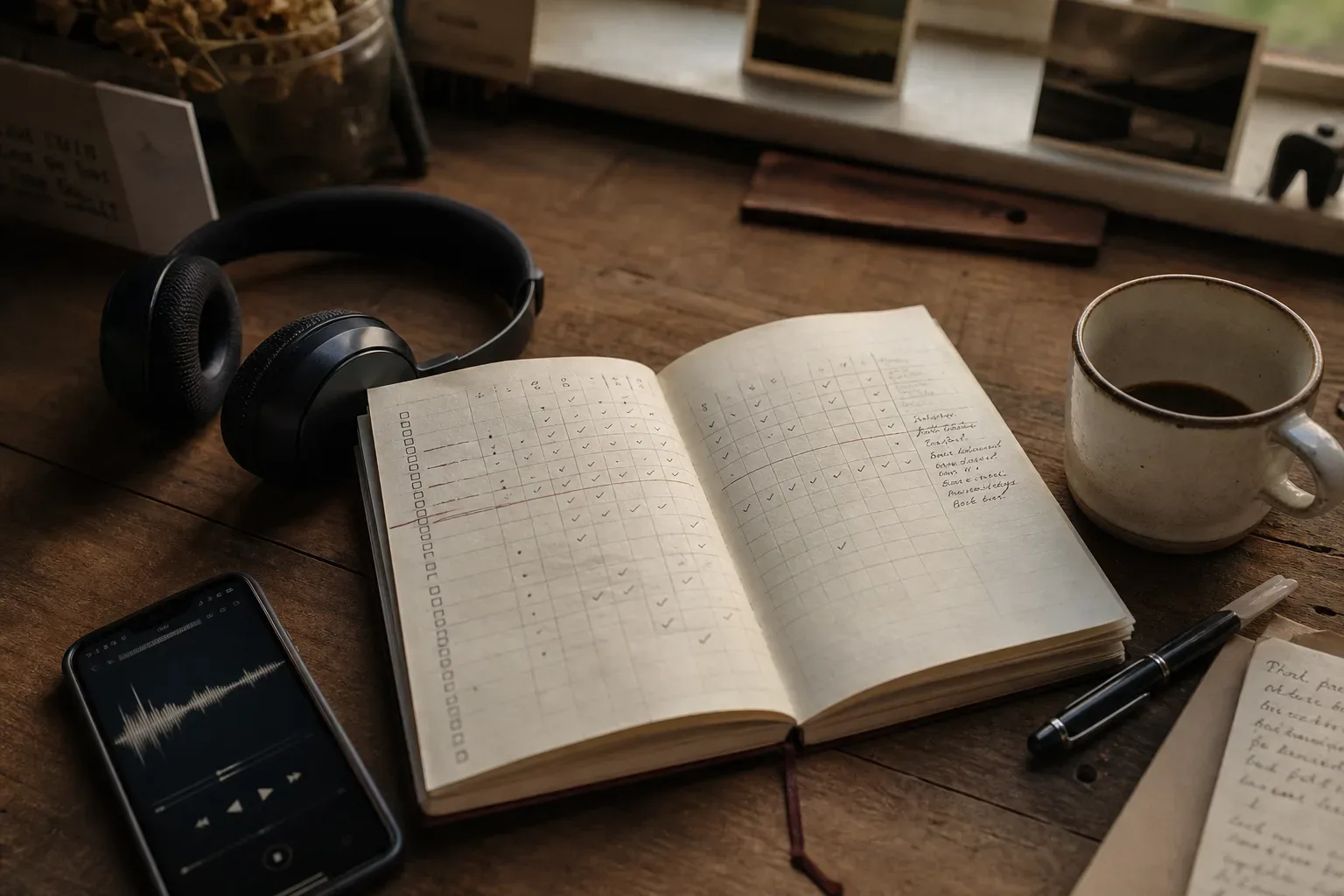
September 3rd. The kettle clicked off while I wrote the question down: do subliminals work? My honest answer is: sometimes they may nudge perception, but the evidence for major change is thin. I trust audible Dream-Self audio more because I can hear it, consent to it, repeat it, and track what changes.
I have tried the hidden-message version. I have also tried the very plain version, where a sentence meets me in the room and I know exactly what it is asking me to practice. The second one has stayed in my mornings. The first one mostly became another tab I forgot was open.
Do subliminals work, or do they mostly work because I expect them to?
Subliminals can create small effects in lab conditions, but I have not found strong evidence that they reliably create the life changes people often buy them for.
The clearest warning I keep taped to this topic is the 1991 study by Anthony Greenwald, Eric Spangenberg, Anthony Pratkanis, and Jay Eskenazi. Participants used commercial subliminal self-help tapes for memory or self-esteem. Some tapes were mislabeled. People often reported benefits that matched the label they believed, not the tape content. That is not proof that nothing happened. It is proof that expectation can wear a very convincing coat.
I write this with my coffee beside my keyboard because I know I am not immune. In healthcare software, I have watched dashboards change how people feel about their day before the underlying data changes. A number can soothe. A label can steer. A hidden audio track can feel like a private contract, even when I cannot verify the terms.
Researchers such as Philip Merikle and colleagues have reviewed subliminal perception and found that unconscious cues can influence narrow, immediate responses, especially when the stimulus is simple and the measurement is close in time. That is different from asking a buried sentence to rebuild a belief system. A flash of a word is not the same as a daily practice.
A hidden message cannot do the work of an honest sentence.
When I read the broader Manifestation pillar, I notice the same distinction I keep finding in my own logs: naming an intention is not magic by itself. It becomes useful when it changes attention, emotion, memory, and behavior often enough to leave a trace.
Why did hidden audio start to feel suspicious in my own tracking?
Hidden audio became suspicious to me because I could not tell whether I was practicing or merely outsourcing attention.
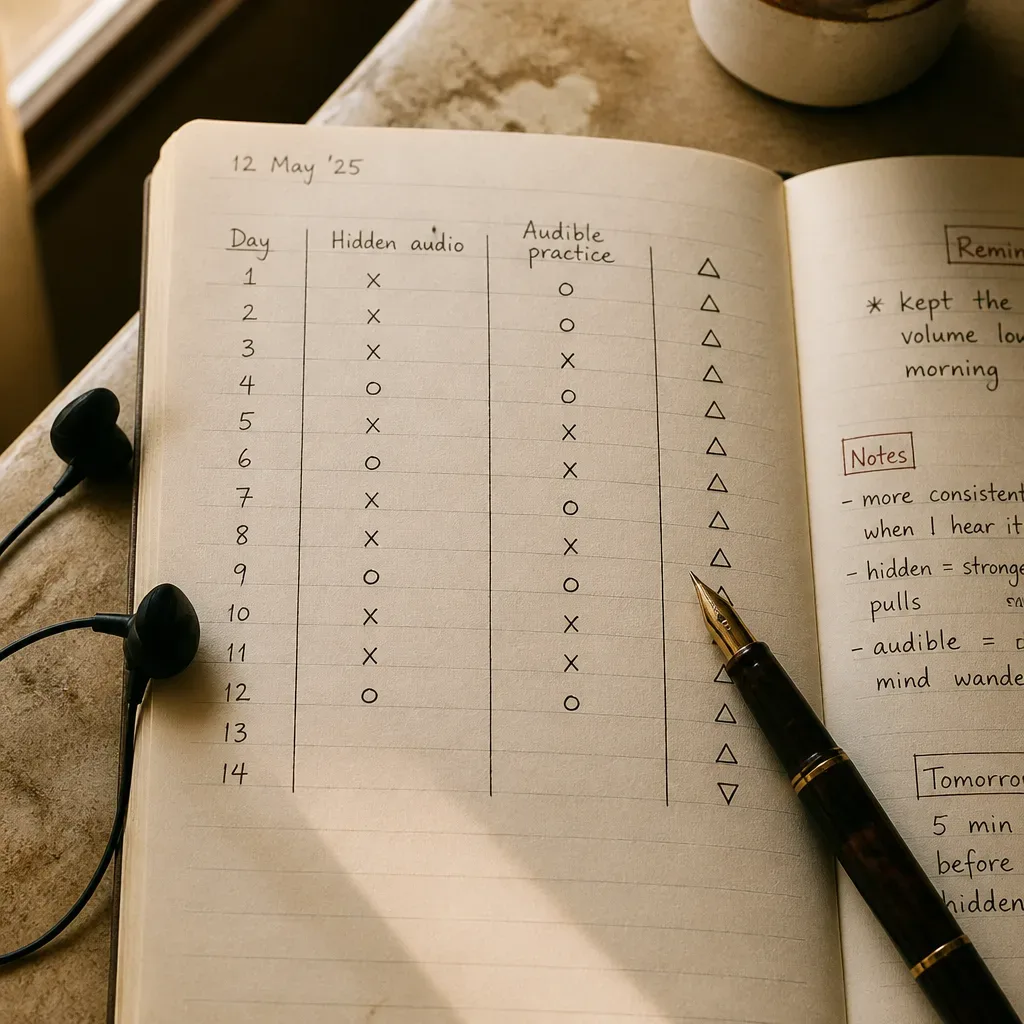
I kept a small spreadsheet for 28 days last winter. It was not a clinical trial. It was one tired engineer, a blue mug, and a column called listened. I logged sleep, mood from 1 to 5, whether I played a subliminal track, whether I listened to my audible Dream-Self Moment, and whether I took one concrete action related to the thing I was asking for.
By day 14, the problem was obvious. The subliminal track could run while I answered messages, cleaned the sink, or scrolled. It gave me a checked box without requiring presence. My audible recording did the opposite. It interrupted me gently. I had to hear the words. I had to notice whether I believed them yet.
The data was small, but the pattern was not subtle. On days I played only subliminals, I marked a related action 3 times out of 11. On days I listened to audible Dream-Self audio, I marked a related action 10 times out of 13. I would not publish that as proof. I do keep it as a personal caution.
Small samples do not tell the whole truth, but they often tell me where to look next.
This is where the AYA Method became easier for me to trust as a practice. The AYA Method is a daily audio manifestation practice. Each day you listen to a short personalized recording, your Dream-Self Moment, narrated from the version of you who has already manifested the life you intend. Listening is the practice. Repetition is the work. The audio is the method.
I needed that sentence: the audio is the method. Not the background track. Not the secret frequency. Not the hope that something hidden was fixing me while I avoided myself.
What does the research say about audible words, attention, and change?
Audible words have an advantage because attention, repetition, and memory can work together instead of separately.
I am careful here. I do not think hearing a sentence once changes a person. If it did, every calendar reminder would save me. But conscious repetition has more behavioral scaffolding around it than subliminal exposure does. Peter Gollwitzer’s work on implementation intentions, often summarized as “if-then” planning, has shown across many studies that specific cues tied to specific actions can improve follow-through. The sentence matters because it can become a cue.
The Journal of Behavioral Medicine has also published research on self-affirmation and health behavior, including work connected to Geoffrey Cohen and David Sherman’s broader self-affirmation theory. The effects are not universal, and they are often modest. Still, the mechanism is visible: a person reflects on a valued identity, feels less threatened, and becomes more able to take in a difficult truth or act differently.
That is one reason I keep audible language close to the Affirmations pillar, even though I do not treat affirmations as the whole practice. A daily affirmation can help me mark the direction. The audio practice asks me to inhabit it long enough to hear the friction.
Here is the comparison I wrote in my notebook before I forgot:
| Practice | What I can verify | Main risk | What I track |
|---|---|---|---|
| Subliminal audio | That I pressed play | Mistaking exposure for practice | Minutes played |
| Audible affirmations | The exact sentence | Repeating words without feeling | Belief rating, 1 to 5 |
| Dream-Self audio | Words, tone, identity, repetition | Expecting too much too fast | Listening, mood, next action |
Dr. Andrew Huberman often talks about attention and nervous system state in practical terms: the state I am in affects what I can learn and repeat. I hear that in a very ordinary way. If I am half-asleep and resentful, the best sentence in the world lands badly. If I am awake enough to listen, two minutes can be enough.
Practice is not made more powerful by being harder to notice.
How is Dream-Self audio different from a subliminal track?
Dream-Self audio is different because it is audible, personal, and accountable to the listener in real time.
A subliminal track asks me to trust what I cannot hear. Dream-Self audio asks me to listen to what I am willing to become responsible for. That is a large ethical difference. Consent matters even when I am talking to myself. I want to know the sentence going into my mind at 7:12 a.m., before my first standup and before I have become useful to anyone else.
In my morning routine, I listen before brushing my teeth. That is the order I do them in. The recording is short enough that I do not bargain with it. Most days, it takes under 5 minutes. Lally and colleagues’ 2009 study in the European Journal of Social Psychology found that habit automaticity took 66 days on average, with a range from 18 to 254 days. That range comforts me. It tells me I am not broken when day 12 still feels manual.
The difference shows up in language. A subliminal might be a claim I never hear. My Dream-Self Moment says something specific enough to disagree with. Some mornings I hear, “I answer with steadiness,” and my whole body says, not yet. That is useful information. It tells me where the work is.
I also keep the practice distinct from the small complements around it. I sometimes write one daily affirmation under the date. I sometimes pin a sentence to a Manifestation Board. But the audio is the practice I return to. The board does not listen for me. The sentence does not repeat itself for me. I do.
When I need a wider frame, I go back to the AYA Method and read it plainly: listening is the practice. Repetition is the work. The audio is the method.
If I still want to test subliminals, how would I do it without fooling myself?
I would test subliminals with a simple log, a fixed time period, and at least one behavior measure that is not just a feeling.
I do not say that to drain the mystery out of everything. I say it because I have fooled myself with prettier systems than this. The Princeton Engineering Anomalies Research program, often called PEAR, reported small statistical deviations in random event generator studies over many years, and critics have argued about methods and interpretation since. I mention it carefully because it taught me a useful posture: unusual findings deserve curiosity and humility, not instant certainty.
For a personal test, I would keep it small and dated. Fourteen days is enough to notice whether I am becoming more present or only more superstitious. Thirty days is better if sleep and work stress are variable. Pew Research Center has repeatedly found that large shares of adults use phones for health information and tracking; the tool is ordinary now. The humility has to be ordinary too.
My test would look like this:
- Choose one intention for the test period, not five.
- Pick one subliminal track and do not change it midweek.
- Listen at the same time each day, or mark the time honestly.
- Track mood before and after on a 1 to 5 scale.
- Track one related behavior, such as sending the email, applying, practicing, resting, or asking.
- Write one sentence about what I noticed, not what I hope it means.
I would also write down these guardrails:
- I will not treat a bad day as proof that I failed.
- I will not buy three new tracks when one clear test would do.
- I will not call background noise a practice unless I was actually present.
- I will compare subliminals with audible Dream-Self audio, not with doing nothing.
The cleanest metric is not whether I felt enchanted. It is whether I became more honest and more consistent.
Why do I prefer audible Dream-Self audio now?
I prefer audible Dream-Self audio because it gives my attention a shape I can return to and measure kindly.
This week, the kettle clicked at 6:48. I listened in the kitchen with one hand on the counter. I did not feel dramatic. I felt available. That has become the difference for me. Subliminals often made me feel as if something was happening somewhere behind the curtain. Dream-Self audio makes the practice happen here, in the room, where I can notice whether my shoulders drop.
Joe Dispenza writes and teaches about rehearsing a future self, and Neville Goddard wrote often about assuming the feeling of the wish fulfilled. I read both with a practical filter. I am less interested in grand claims than in the repeatable part: the mind practices identity through attention. Cognitive rehearsal is used in sports psychology, exposure work, and performance training because repeated mental patterns can shape readiness. The details matter, but the principle is not strange.
My own criteria are plain now:
- I need to hear the words.
- I need the recording to be short enough for an ordinary morning.
- I need to know what behavior the practice is pointing me toward.
- I need to track consistency before I judge outcome.
- I need the practice to make me kinder, not more frantic.
That last one is the boolean in my notes: spoke_to_self_decently. Some weeks the average is embarrassing. Some weeks it rises. When it rises after 9 or 10 days of steady listening, I pay attention, but I still do not pretend I have isolated every variable. Late deploys, hormones, weather, money, and sleep all sit in the data with me.
I have also noticed that astrology and manifestation can be used in the same honest or avoidant ways. A moon date can help me pause. It can also become a way to postpone. The same is true of audio. The tool does not save me from my relationship to the tool.
Clarity is kinder than secrecy when the practice is happening inside my own mind.
What should I choose if I am starting tonight?
I would choose a short audible Dream-Self recording first, then use any subliminal track only as an optional experiment.
If it is tonight, I would not build a large system. I would charge my phone, put headphones by the bed, and choose one sentence I can bear to hear in the morning. I would make it specific enough to touch the day. Not “everything is perfect.” More like, “I answer the email before noon,” or “I speak to my body as if it belongs to someone I love.” A sentence that cannot meet Tuesday is too vague for me.
The broader subliminals notes can be useful if you are comparing claims, but I would start with the practice that leaves the clearest record. Audible Dream-Self audio gives me the record. I know whether I listened. I know what I heard. I know whether I resisted it. I know whether I took one next action.
A 2020 review by Andrillon and Kouider on sleep and learning suggests that the sleeping brain can process some information, but complex learning during sleep is limited and state-dependent. That is another reason I do not lean on overnight subliminal promises. Rest matters. I do not want my sleep turned into another productivity shift.
Here is the small version I would keep for seven mornings:
- Listen to one audible Dream-Self Moment before opening messages.
- Rate belief in the recording from 1 to 5.
- Take one related action before lunch.
- Write one line under the date.
- Repeat without revising the whole practice every day.
If I still wanted subliminals, I would add them later, after I had a baseline. Baselines are not cold. They are how I stop blaming myself for weather I did not measure.
The Manifestation pillar says the larger word, and the Affirmations pillar holds the sentence work. For me, the morning audio sits between them: felt enough to matter, clear enough to track.
Thursday now. I can hear the rain against the vent.